
Trader Joe’s Dried California Persimmons
Posted: May 7, 2013 Filed under: Trader Joe's Brand, Vegan, Vegetarian | Tags: Dried Fruit, persimmon 6 Comments
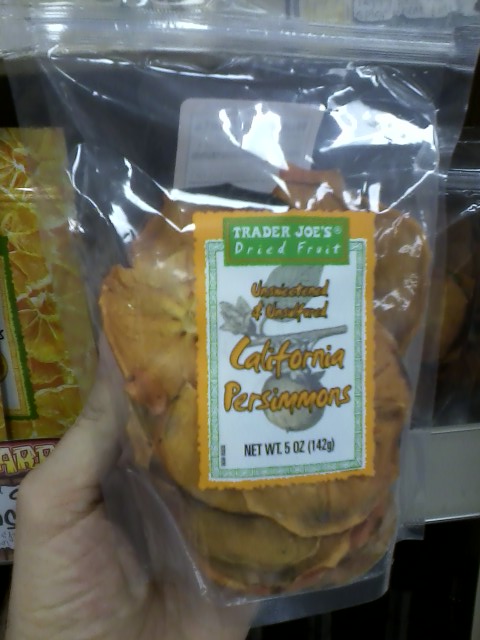
Sitting there in plane view, like it has nothing to hide. But who are you really, persimmon?
Ah yes, the persimmon. One of those strange liminal fruits of the world that, like the lychee or jack fruit, is known by some, occasionally encountered, but largely a mystery, a stranger lurking on the edges on the far edge of the apples and bananas. Where do you come from, Trader Joe’s Dried Persimmons? What do you want with us?
You are liable to encounter a persimmon anywhere in the world, they are cultivated in narrow geographical regions from Asia, through the Middle East, into south America, and even – oddly enough – in Indiana. The most common type of persimmon, in it’s natural state, looks like a pallet-swapped tomato – orange and brown instead of red and green. They are sweet, with an almost pumpkin like taste an a texture somewhere between an apple and a firm tomato.
All of this matter because Trader Joe’s Dried Persimmons are simply that – dried persimmons, proud members of the one ingredient club (Ingredient: persimmons). On top of this, the persimmons are both unsulfured (adding sulfur dioxide extends the shelf life of dried fruit, but causes allergic reactions in some individuals) and unsweetened. We’ve seen Trader Joe’s love of the unsulfured, dried fruit before , following their urge to provide dried fruit that are as healthy and as close to nature as possible.
All of which means they;re good – chewy, pliable, quarter inch thick slices of a simple tasty fruit. It also means they’re hard to recommend to anyone who hasn’t ever tried persimmon before. If you have in fact bitten into the flesh of the tender persimmon, they you know if you’ll like these or not out the gate. It’s more of the same, the tastes intact, the meats merely drier.
If, on the other hand, you’ve never had a persimmon, my job becomes tougher. I suppose I could just shrug my shoulders and write this off as a boolenean “You either get it or you don’t” situation, but instead I’ll take the hard road and attempt to describe, Mary Super Scientist-style, the nature of a percept of which you have no experience. Now please, allow me to get my poet on:
Autumn. The persimmon, hanging heavy and orange on a lone dark branch, is an autumn fruit. Dense with itself it hangs, plucking free into your hand with a pleasant heft. The skin is firm and taut, tight-packed with the fruit’s juicy flesh, juicy but not overflowing, not sopping, merely permeated with the sweet, wet juices. A sweetness that is all it’s own, a taste which is unlike any other fruit. Not the high, bright, intense sweetness of cherries or apples, but a low, earthy sweetness, a mild, slow sweetness like a toned-down brown sugar, not a clean, clear touch on the tongue, but a lingering, mealy embrace – a pliable laying upon the tongue like the flesh of the banana. Your teeth pierce the skin, and at the first, at the very front of the bite, it is not sweet at all, but rich like a squash, like a ripe, late season pumpkin, and only then, only after you know it as that, comes the the mild slow sweetness and the moist, chewy flesh.
There you are. That’s the best I’ve got. If that sounds like the taste for you, by all means go ahead and pick up some persimmon, either dried or otherwise. If you’ve tired persimmon before and now regard me as an idiot, please post your more accurate description in the comments below.
The Breakdown:
Would I recommend it: Yes, if you like persimmons.
Would I Buy it Again: It’s nice, but my need for persimmons is not that high.
Final Synopsis: If you think regular persimmons are too moist for your purposes, this is the product for you.
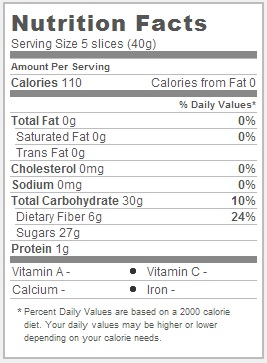
Trader Joe’s Dried Persimmon – Nutritional Information
Trader Joe’s Cultured Coconut Milk – (Blueberry & Vanilla Flavors)
Posted: May 2, 2013 Filed under: Blueberry, Coconut, Kosher, Trader Joe's Brand, Vanilla, Vegan, Vegetarian, Yogurt | Tags: Cultured Coconut Milk, Yogurt Substitute 2 Comments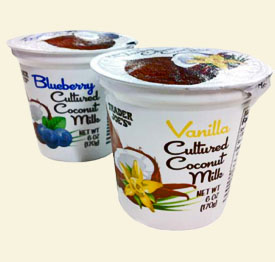
Cultured coconut milk, not yogurt. How could you even begin to confuse the two?
As you may be aware, I have a thing for coconut milk. Maybe not a well thought through thing, but definitely a thing. Basically, if something is made of coconut milk, I go “Wuh? Gimme, somma dat!”
Thus picking up Trader Joe’s Cultured Coconut Milk in blueberry and vanilla flavors was an automatic grab for me. Coconut milk yogurt, awesome, gimme sommma dat. It wasn’t until later that day, as I was unpacking my bags, when the words on the label really sank in. Cultured coconut milk. Not coconut-blueberry flavored yogurt, in fact not even yogurt at all – but a blueberry yogurt substitute made from coconut milk. A vegan, kosher alternative to your dairy product breakfast. Now this was intriguing. Obviously the world is full of human beings, many of them wonderful human beings, who elect not to eat dairy products for a variety of reasons. Nevertheless, the hankering for dairy products persists – an itch that one perpetually hopes to have satisfactorily scratched by innovative new products such as this one. Not an issue I personally have, but one that intrigues me none the less.
The first question, of course, is does this stuff taste like coconut?
No it does not, not at all. No more than your pot of Dannon tastes like milk. The coconut milk base here is effective obscured and overridden by the “yogurting” process, a process that is scientifically not actually referred to as “yogurting”, but which in this case seems to involve a great deal of flavorless seaweed extracts (our old friends agar and carrageenan among them), and some industrious bacteria.
A second question arrives hot on the heels of the first – how much like regular yogurt is this cultured coconut milk? Not more than a close miss, actually. Coconut milk “yogurt” falls squarely into the imperfect facsimile camp, alongside such not-quite-there simulacra as Tofurkey, Silk, and Fakon. Simply put, you won’t mistake this cultured plant fluid for Yoplait.
That said, Trader Joe’s does score points in two important arena. One, it doesn’t violently merge two words into a terrible vegetarian pun (“cocogurt”, perhaps), and two, cultured coconut milk tastes pretty good in its own right. Taken as a dairy yogurt supplement coconut milk yogurt doesn’t quite hit the mark, but taken as a new sort of breakfast item it’s not bad at all.
Trader Joe’s Cultured Coconut Milk differs from dairy yogurt in two chief ways – it’s much looser, fluidic almost to the point that threatens to spill from your spoon. However, it’s also strangely creamier than other yogurts, with an underlying velvety smoothness that coats your tongue in pleasant way.
The strength of this yogurt substitute depends almost totally on your enjoyment of this novel texture. Taste-wise the coconut milk culture tastes fine – the blueberry tastes like yogurt blueberry and the vanilla tastes like yogurt vanilla. Not much news there. Being able to enjoy the coconut milk culture is simply a matter of being okay with a loose, velvety yogurt over a firmer, less smooth one.
I’d be a convert, honestly, if it wasn’t for one thing. Quickly scroll down and check out the protein content – a single gram. Not much protein in those coconuts, evidently.
The main reason I turn to yogurt for my sustenance in the mornings instead of, say, a bagel or muffin, is because of the aura of healthiness surrounding the concept of yogurt. There might be just as much sugar in a little pot of Yoplait (27 grams) as there is in a whole donuts but yogurt has protein, dammit! That has to count for something. Trader Joe’s Coconut Milk Culture has 20 grams of sugar in it per serving, a considerable payload in it’s own right. Take the protein out of the equation and all you’re left doing is slurping up a sweet, loose paste of dubious nutritional value.
Breakdown
Would I Recommend it: Tailor made form my vegan-Hasidic friend, less compelling for everyone else.
Would I Buy It Again: As an experiment for a smoothie base, maybe, but probably not.
Final Synopsis: An intriguing yogurt alternative, but no protein and plenty of sugar ultimately make it less than desirable.
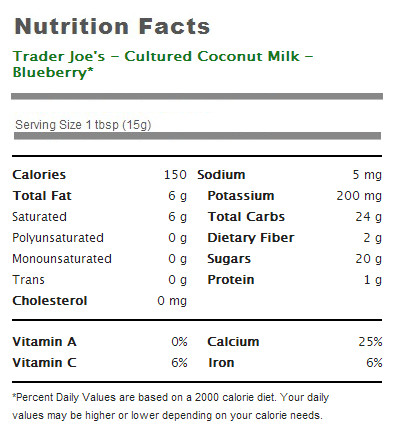
Trader Joe’s Coconut Milk Culture (Blueberry) – Nutritional Information
 Eating At Joes
Recent Comments