
Trader Joe’s Onion Dip Mix
Posted: September 17, 2013 Filed under: Dip, Onion, Trader Joe's Brand | Tags: dip mix, onion dip 6 Comments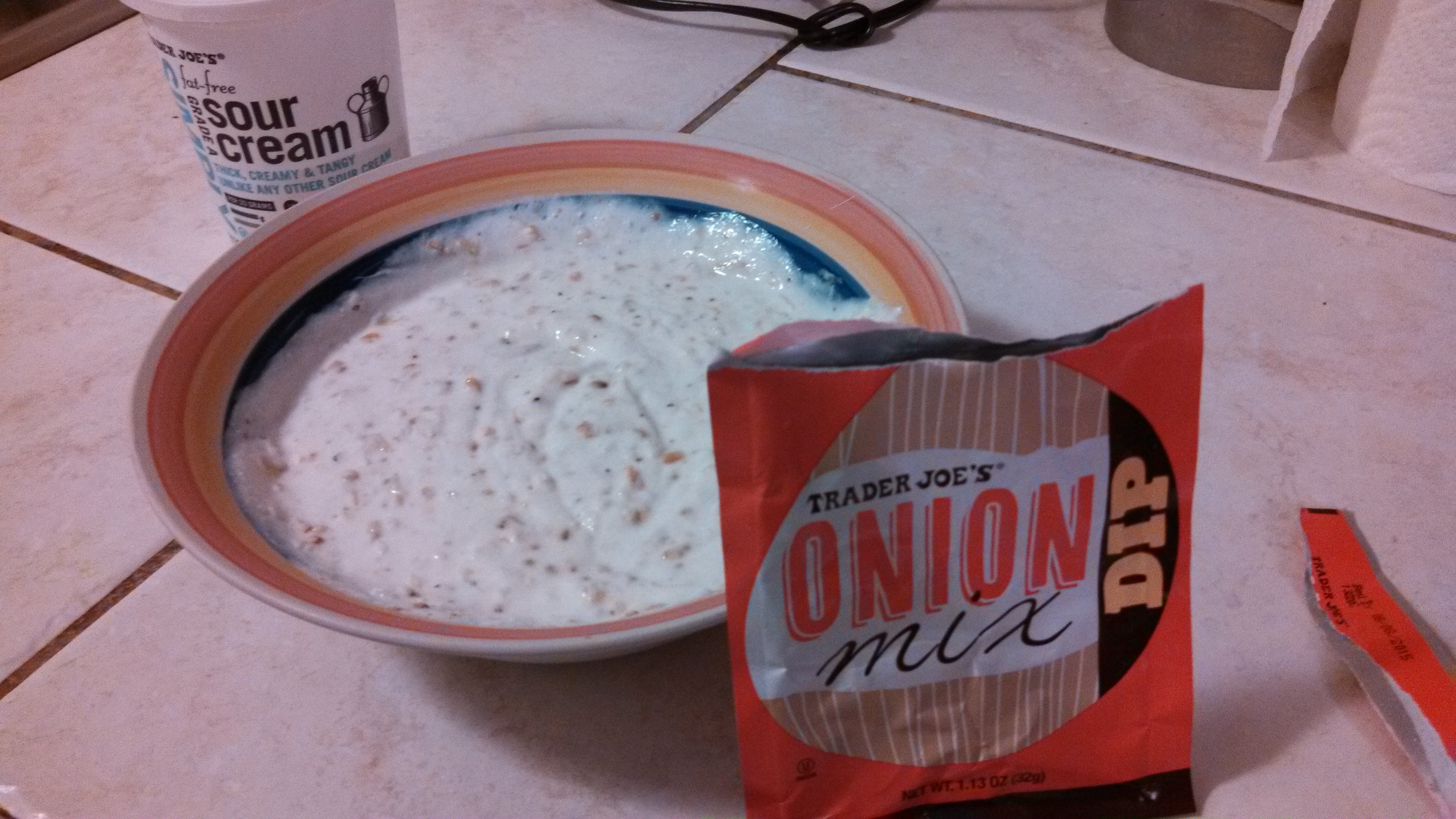
Onion dip!
Onion dip, one of mankind’s most favorite dips. With the exciting arrival of Trader Joe’s Onion Dip Mix, they have now fulfilled the requirement that all supermarkets sell some type of powdered onion dip mix. I picked this up because it was new, and that’s always cool, and because onion dip is one of the most ordinary things you’re ever going to encounter in your life. Powdered onion dip mixes seldom, if ever, vary – presumably it’s all made in the same enormous mixing plant in New Jersey somewhere and then packaged with different labels. Trader Joe’s treads so far from the beaten path, is so devoted to bringing us strange and mysterious things, that it seemed weirdly incongruous that they’d be offering something as mundane and prosaic as onion dip. Surely they’ve got something sneaky planned with their onion dip, some uniquely Trader Joe’s twist hidden in this little orange packet.
Sadly, this is not the case. Trader Joe’s Onion Dip is practically indistinguishable from any other powered onion dip you might have ever had. It’s not a bad onion dip, it’s just a very ordinary onion dip. The sort of onion dip that makes you go, “Yup, here’s some onion dip.” So, in summary – if you are looking for a cheap ($0.99) onion dip mix on par with Knorr or Lipton, here you go.
The deeper, and to me more interesting, question is why do we eat onion dip at all. It’s tasty and I’m glad we do, but who was the first enterprising soul who thought “Know what this sour cream needs? A really strong onion flavor.” That’s really weird, wouldn’t you say? These are not two ingredients that naturally occur near each other in the wild Of course, I’m not Northern European either. Various recipes involving sour cream and onions were floating around the Old Country long before we adapted it into a party appetizer in the states. That transformation took place in the mid-
As it happens, the first onion dip didn’t come about until 1954, and owes its thanks entirely to the wondrous Modern Age. The era of convenience that exploded in America after WWII showed itself nowhere more clearly than through changes in the kitchen. Take the sudden rise of powdered soup, for instance. The idea of dehydrating soup for ease of use is a surprisingly old one. Lewis and Clark packed a great quantity of a commercially produced “pocket soup” with them on their expedition. The very first mentions of such a product can be traced back to as far as England, in the year 1681. These first powdered soups however, were more akin to bouillon cubes, hard lumps to be dissolved over time. These were eventually refined into powdered mixes that could easily be added to water by the busy housewives of the 1940’s and 50’s. It was one of these women, now as forgotten to time as the honorable Governor Ding, who first grabbed a packet of Lipton’s Onion Soup Mix and added it to a bowl of sour cream. The result was a hit, and quickly co-opted by the Lipton company who as early as 1958 started printing it on every packet of onion soup mix they sold.
That, pretty much, is everything you need to know about the history of onion dip. What will the future hold for onion dip? We must wait and see. In the meantime, the next time you need to cater a party on the cheap, or prep a snack for the football game, you can give this dip a whirl
The Breakdown
Would I Recommend It: Eh. It’s as good as any other brand.
Would I Buy It Again: Sure, if I’m having people over or something.
Final Synopsis: A competent onion dip mix with no surprises.
Trader Joe’s Sriracha Sauce
Posted: September 5, 2013 Filed under: Condiments, Sauces, Trader Joe's Brand | Tags: sriracha, sriracha sauce 3 Comments
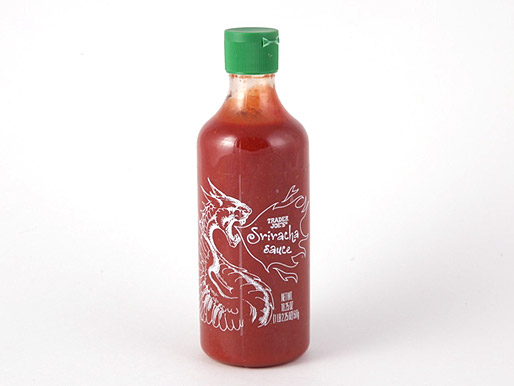
An upstart Dragon arises in the West to challenge the Eastern Cock.
Well I certainly wasn’t expecting this. Trader Joe’s has always blazed its own, idiosyncratic course when it comes to it’s food offerings. Rarely do they stoop to blatantly biting on someone else’s style, as they do here with Trader Joe’s Sriracha Sauce. Even more surprising, while it may share the name, this very tasty hot sauce is a different beast entirely.
You know sriracha, you love sriracha, you probably have some in your fridge right now. That is, unless you’re an avowed chili wuss like myself. As a rule, I steer clear of the hot stuff, and that means that, until today, I’ve gently skirted my way around Trader Joe’s Sriracha Sauce whenever I crossed paths with it in the store. Finally, like a kitten being introduced to a new squeaky toy, my curiosity has overcome my fear and I’ve made the plunge. The results have been unexpected.
My basis for avoiding sriracha hot sauce for 99.9% of my life has been based on a few, memorable encounters with the sriracha hot sauce, Huy Fong Food’s Tuong Ot Sriracha, aka the rooster sauce, aka the huge, bright red bottle of thick fiery paste.
I may have missed out on a wide variety of BBQ sauces in my youth, but there was no missing this screaming red blast of hot lava, rising like a flaming obelisk over the tables of South East Asian restaurants from NY to LA. Tuong Ot Sriracha! That thick red paste of concentrated burning hot jalapenos. That thick ooze the consistency of axle grease. That famous recipe made with no water-added. (A point of pride at Huy Fong Food. Check it out yourself: no water, just a splash of vinegar five ingredients down the list). Such a mush of pure heat that is impossible to apply in moderation to your food – leading to concentrated pockets of burning pain or to a plate plastered in a thick layer.
Sure, I tried some Sriracha, curious young man that I was. I tried it and it burnt me – hard. I had no more reason to return to the Devil’s teat. No reason, that is, until now.
Not all sriracha sauce, it turns out, is like Tuong Ot Sriracha. In fact, most isn’t. Unlike the Huy Fong Foods version (a Vietnamese-Chinese product) sriracha is originally a Thai invention, hailing from the town of Si Racha, naturally. Authentic Thai sriracha sauce is a much runnier, tangier sauce, more akin to what we’d consider a “normal” hot sauce to be in the west. It’s this Thai style sriracha that TJ’s is basing it’s version off of.
Trader Joe’s Sriracha Sauce is looser than the rooster sauce, and bring actually flavor to the sauce as well. Much tangier, a little tiny bit sweet and a touch bitter – it’s a complex, rich taste that enlivens soups, noodles, entrees, pizza, basically anything and everything, all without the threat of igniting all the mouth’s surfaces.
Is it still hot? Unequivocally, yes. But it’s noticeably a notch down from Tuong Ot Sriracha. Think Cholula compared to Tabasco. I image this might upset some of the hard-line hot sauce die hards out there, those who seek pain before pleasure in the sauces, but please try it before you judge it. You might just find the flavor more than makes up for the slightly cooler heat.
For the rest of us, or even those who fear the flame like myself, this might just make you look at sriracha sauce in a whole new light.
The Breakdown:
Would I Recommend It: Yes – this sauce is a sriracha revelation.
Would I Buy It Again: …..………maybe. But that’s saying a lot for me!
Final Synopsis: A srircha sauce that straddles the line between the super hot Huy Fong Foods version, and the authentic Thai version.
Trader Joe’s Many Clove Garlic Cooking and Simmer Sauce
Posted: August 27, 2013 Filed under: Condiments, Garlic, Sauces, Spices, Trader Joe's Brand | Tags: 40 clove garlic sauce 23 Comments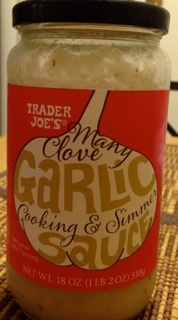
So much garlic they can barely fit the label on the jar.
On the bottle of Trader Joe’s Many Clove Garlic Cooking and Simmer Sauce, Joe himself lays it down, explaining that the jar contains garlic, “minced garlic, roasted garlic, garlic puree and granulated garlic”. That’s a lot of garlic, suckers. This is the sauce that Joe made to compensate for growing up in a garlic deprived household. There’s more garlic in here than there is in a clove of garlic. 110% of your USDA recommended annual allotment of garlic is in this sauce. This sauce is Trader Joe’s way of ensuring that no one ever kiss each ever again. Outside of the Stinking Rose, and Van Helsing’s kitchen, this is the most garlic you’re going to find in one place.
Open this jar up, dip a fork in, and put it right on your tongue. Feel that? That high burn that comes to the fore after a second? The way it zings your tongue? That’s the allicin at work – the same potent compound found in onions and chives. Famed for it’s antibacterial / anti-viral properties, what you’re feeling is Trader Joe’s Garlic Sauce actually cleaning your tongue. What I’m saying is, that’s a lot of garlic.
What we’re really tasting is a sauce known elsewhere as 40 Clove Garlic Sauce. A sauce made with exactly that – 40 cloves of garlic. According to Trader Joe’s own packaging, they didn’t keep count of how many cloves were jammed into this jar, which either means this sauce has more than 40 cloves, in which case someone needs to rein in the madmen in Trader Joe’s R&D, or it has less than 40 cloves, which case the thought of real 40 clove garlic sauce scares me.
But of course, this sauce isn’t meant as a dipping sauce or condiment, it’s a cooking and simmer sauce, and in such a role the garlicky nature of the sauce is much ameliorated. Mixed with pasta, or cooked up with chicken, this sauce retains its strong garlic flavor but mercifully loses the sting. If you like garlic this is a great sauce to work into any Italian inspired cooking. If you don’t, you still might want to give it a shot, because this is a garlic sauce done right. The garlic taste is heavy, but the creamy sauce isn’t – containing only a slender 4 grams of fat and 70 calories per ½ cup serving. The sodium on the other hand, is intense. 930 mg are packed into each serving, roughly 2/3rd of your daily recommend amount. Despite this sodium load, the sauce doesn’t taste notably salty. Mostly it all vanishes in the garlic blitzkrieg.
I like this sauce, but I’m also a man who went through a phase where I chewed up a raw clove of garlic every morning based a vague notion that it was supposed to enhance your endurance. This sauce may well be just too garlicky for some folks there, but for the rest of the population I have to give it a hearty, and healthy, recommendation.
The Breakdown:
Would I Recommend It: Yes, unless you’re sensitive to garlic, or a Transylvania count.
Would I Buy It Again: A healthy, creamy Italian cooking sauce? Absolutley.
Final Synopsis: Very low fat, very high sodium, very, very garlicky sauce.

Trader Joe’s Many Clove Garlic Cooking and Simmer Sauce – Nutrition Facts
Trader Joe’s Creamy Almond Butter & Trader Joe’s Crunchy Almond Butter
Posted: August 15, 2013 Filed under: Condiments, Peanut Butter, Spreads, Trader Joe's Brand | Tags: almond butter 5 Comments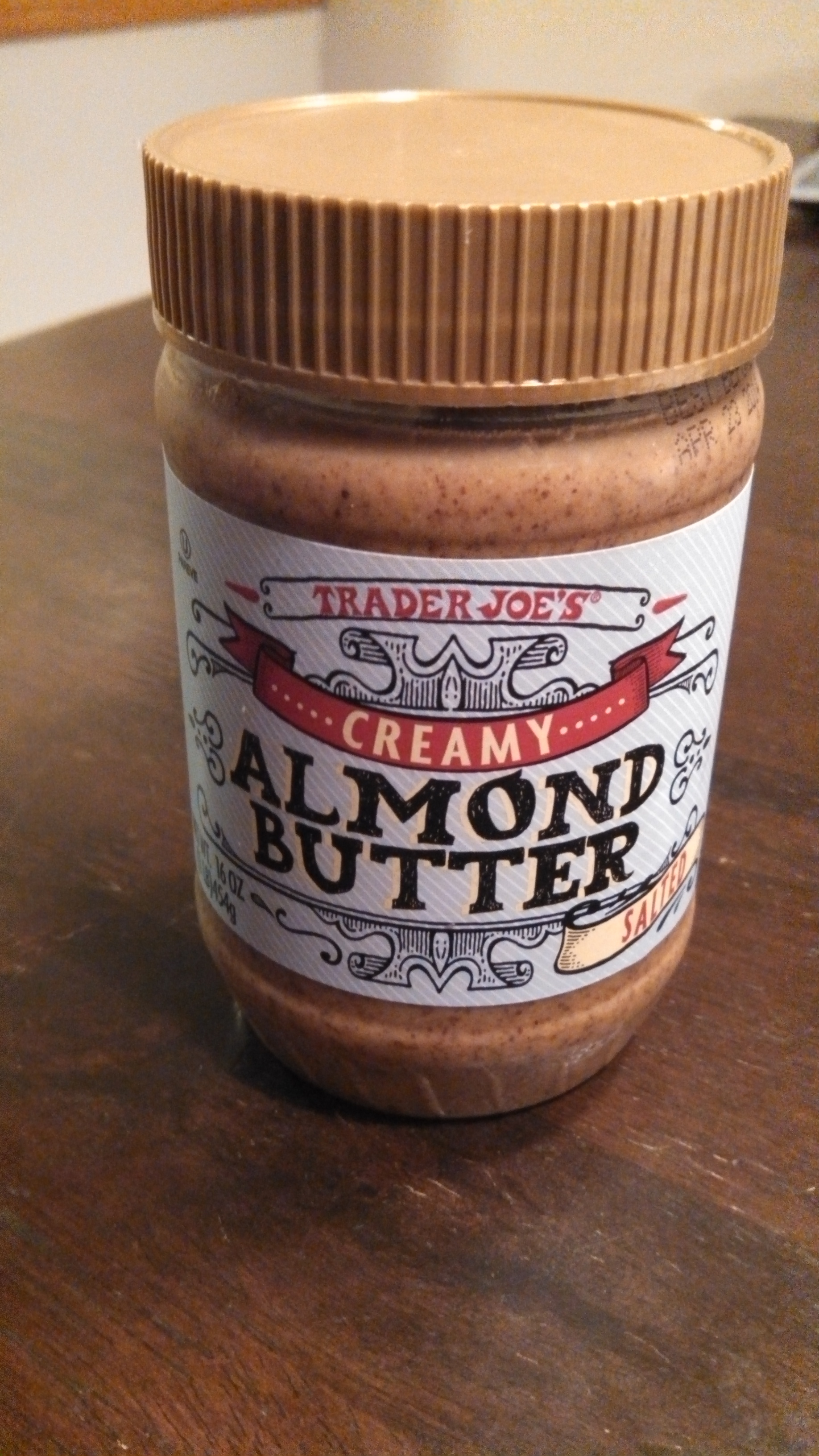
Almond butter, the Hydrox of the peanut butter world.
When I first set eyes on Trader Joe’s Almond Butter, my heart did a little leap. After all, the last time Trader Joe’s unveiled a new butter, it was an epochal, life-changing event. History had prepared me for another smash hit. Unfortunately, history was setting me up for a fall. This new almond butter is a very average spread with little to recommend it.
Both new almond butters are the “stir” variety, with a thick layer of oil on top that needs to be mixed in before using. This is, as always, the tell tale sign of the “natural” nut butter. Trader Joes’ creamy and crunchy almond butters follow in this proud, healthy tradition. Salt has been added, but only 60 mg which is rock bottom by commercial standards, and sugar is at a minimum, with only 2 grams per serving. Of course, that means it lacks that tongue pleasing tingle that you get with additive laden, less healthy butters, but a little mouth-plastering blandness has ever been the price for healthful eating.
All of that’s fine by me. In both taste and nutrition it’s about the same as the natural, stir peanut butters that Trader Joe’s offers, but that is exactly my problem – there’s no meaningful difference netween these almond butters and their peanut counterparts. Even in taste, we’re only talking about a very subtle change to the underlying nuttiness of the spread, one that you might be able to identify in a side-by-side taste test but which, when incorporated into a sandwich etc, is practically interchangeable with a natural peanut butter.
If there’s something I’m missing here, please clue me in to it. Frankly, I don’t see the appeal or rationale for almond butter. There are, I’m aware, people with peanut allergies. Is that the whole market almond butter was made for? At the risk of sounding intolerant, I think we can all agree that these “people” should simply acclimate to life in the margins of society. Suck it up, peanut allergienes!
I really, really do not understand almond butter. Yes, we can make our nut butters out of things other than peanuts, and we can make car tires out of wood and books that are 25 feet tall. We can do a lot of things – but a lot of things don’t make sense to do. It’s not like we’re talking about hazelnut butter here, which brings a totally new and delicious taste to the table. Now, I’m always a proponent of a broad selection and innovation in the food market – but only to the extent that it makes sense, and almond butter doesn’t make sense to me. It’s like laboring tirelessly to create Hydrox cookies, then trying to sell them for more than Oreos.
Aside from aiding the peanut sensitive, there really doesn’t seem to be a good reason for almond butter to exist. Jokes aside, I am glad that it exists for that reason at least. My heart really does go out to people who suffer from peanut allergies. I can only imagine the nightmare of living in a world where the peanut, one of the most widely used foodstuffs, has the power to incapacitate and/or kill you. Peanuts are tiny. They could be anywhere. Not to mention that they’re often incorporated with absolute stealth into a bewilderingly huge assortment of food product, and the only tip off is a tiny line of small type hidden under the bar code. That’s like living in a war zone where all the enemies are invisible, but give you a quick “Heads up!” before opening fire.
Ulitmately, I feel about Trader Joe’s Almond Butter about the same way I feel about their sunflower seed butter – good on them for giving us more options, but there’s nothing compelling about the product, unless it be the brief, sad thrill of the blandest form of rebellion conceivable. “Forget what those mainstream losers are doing – I’m putting almond butter on my sandwich.”
No sir, it doesn’t make sense to me at all. You can leave me with Better’n Peanut Butter for my PB alternative.
The Breakdown:
Would I Recommend It: No, unless you have peanut allergies.
Would I Buy It Again: Never.
Final Synopsis: 90% identical to peanut butter, only more expensive.

Trader Joe’s Creamy Almond Butter – Nutrition Facts
Trader Joe’s Carolina Gold Barbeque Sauce
Posted: August 13, 2013 Filed under: Condiments, Sauces, Trader Joe's Brand | Tags: barbecue sauce, south carolina barbecue 3 Comments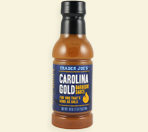
TJ’s has elected to use the non-standard “barbeque” on this bottle. Getting pretty fancy there, Joe.
Hot dang! Now this is some good BBQ sauce. Though I’m sorry to admit it, barbecue has never been my specialty, however, even I can recognize that Trader Joe’s Carolina Gold Barbeque Sauce is top shelf.
If it were possible to reach back through time and space to tweak one aspect of my childhood, I would probably make it so I came from a proud tradition of barbecuing. There is something incredibly appealing to me about the great American BBQ – a potent blend of technical know-how, manliness and cherished family tradition that culminates in a perfect summer day. As it is, I grew up unaware of the heights barbecue can achieve, and of the four great traditions within it. I speak, of course, of the four chief BBQ regions in the US: Memphis, Kansas City, Texas and, of course, the Carolinas.
Books can and have been written on the character of these distinct styles and their various merits. I have no desire to choose sides on that hotly contested subject, (about as much desire to weigh in on that as I do to choose sides in European Football League) so for the purposes of this post we’ll limit ourselves to the qualities of the sauce itself.
TJ’s leaves it at Carolina on the bottle, but those in the know could place this sauce with far more accuracy. The golden color and strong mustard base place it firmly in central South Carolina, in Midlands region. The hankering pig eaters in those towns were the first to really place mustard based BBQ sauces on the map, and have been knocking them out the park ever since. That’s right – mustard. Carolina Gold still incorporates the tomato puree you find in more name brand sauces, but in a much smaller quantity than the rich yellow mustard and vinegar which are the hall-marks of Carolina sauces.
Thanks to this mustard and vinegar base, this sauce tastes like the half-way point between more traditional BBQ sauces and Honey Mustard. The first thing you’ll taste when you take a bite of that pork rib is the zing and tang of a sharp mustard followed by the even sharper vinegar. That’s just first blush, however. The complex medley of tastes you expect from a good barbecue sauce follow right on the tail of that, softening the edge. Unlike some Carolina sauces, Trader Joe’s Carolina Gold is thick, not watery. This might offend some purists, but makes it great for slathering on pork and beef. In fact, the mustard edge of the sauce allows it to pair with far more foods than another barbecue sauce normally could – try using it on your sandwich or veggies.
There is, however, a dark side. This sauce doesn’t taste very sweet outright, like a Kansas City sauce might, but still packs in plenty of sugar. One serving (two tablespoons) contains a whopping 14 grams of sugar. For comparison, Bull’s Eye’s name brand Carolina sauce only weighs in at 11 grams of sugar for the same serving size. For what it’s worth, this sugar isn’t high fructose corn syrup, like it is in so many other name brand barbecue sauces, but made from cane sugar. How much that means to you is a matter of personal taste, for my part I find that processed sugar tends to be processed sugar.
Even with the high sugar content, this sauce still comes out in the black in my books – hands down the best store bought barbeque sauce I’ve ever had.
The Breakdown:
Would I Recommend It: There are probably better small batch BBQ sauces out there, but if you haven’t found them yet go for this one.
Would I Buy It Again: I plan on restocking for next BBQ season.
Final Synopsis: A delicious, mustard-based barbecue sauce that goes well with everything.
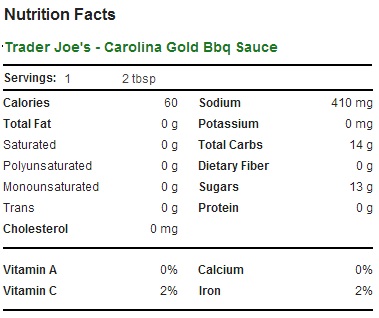
Trader Joe’s Carolina Gold Barbecue Sauce – Nutrition Facts
Trader Joe’s Eggplant Garlic Spread
Posted: July 18, 2013 Filed under: Eggplant, Garlic, Spreads, Trader Joe's Brand | Tags: bulgarian, ljutenica 7 Comments
A Bulgarian spread? I’ll allow it, but I think I know some Serbs and Macedonians who will take issue with that.
Continuing my foray into the popular world of Serbian/Bulgarian/Macedonian food stuffs comes Trader Joe’s Eggplant and Garlic Spread. Unlike its very close cousin and shelf neighbor, TJ’s Red Pepper Spread with Eggplant and Garlic, this condiment is hands-down delicious – like a thick, savory pasta sauce made with eggplant rather than tomato.
I got into this already with the craptacular ajvar, and I don’t want to kill it all over agian here, but TJ’s is really wrecking their own house with these name games. These two products, Trader Joe’s Eggplant and Garlic Spread (with peppers) and Trader Joe’s Red Pepper Spread with Eggplant and Garlic, could not be positioned to confuse the casual shopper more. One delicious, one awful, both Bulgarian, of similar packaging and nearly identical names. It’s like having an evil twin and a good twin and naming one George T. Riley and the other George D. Riley. What’s that? Did you say T. Riley? You did? Well too late, because now I’m dead and/or my chicken tastes awful.
Let’s rectify the situation right here – this product, like it’s compatriot, is proudly Bulgarian, and is known in that country as ljutenica. The name might roll off the tongue, but it’s hard to say what exactly a proper ljutenica is supposed to taste like. As with many folk foods (kimchi, etc) it’s taste, consistency and composition varies widely between households. Some are much spicier than cousin ajvar, some sweeter, and so on. This ljutenica is actually milder and more savory. Whatever it was that Trader Joe’s did to its red pepper spread to make it so they avoided it here – nothing harsh or mealy comes through from the garlic or eggplant. Instead, both blend together with the fefferoni pepper to make an intriguing new taste – a full-bodied, broad, tongue-pleasing taste. It is somewhat salty, but not overly so, and very slightly piquant. It worked excellently for me as a condiment for chicken dishes, vegetables and meatballs.
How this ljutenica stacks up against the real Bulgarian stuff I couldn’t venture to say – and if any Eastern Europeans out there want to weigh in please do so – but I personally couldn’t be happier with what I’ve got. If ajvar threatened to turn me against Bulgarian condiments, this spread has rectified all wounds.
The Breakdown
Would I Recommend It: Yes – try it with your chicken or pasta, or slathered on bread and topped with goat cheese.
Would I Buy It Again: I already killed my first jar, so it’s pretty likely I will.
Final Synopsis: A ljutenica that will do you well from Sofia to the Black Sea.
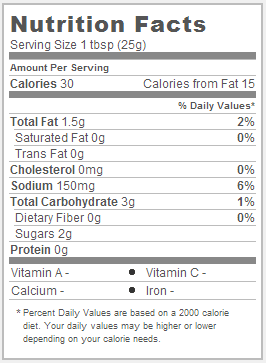
Trader Joe’s Eggplant Garlic Spread – Nutrition Facts
Trader Joe’s Red Pepper Spread with Eggplant and Garlic
Posted: July 9, 2013 Filed under: Eggplant, Red Pepper, Spreads, Trader Joe's Brand, Vegetables | Tags: ajvar, serbian 7 Comments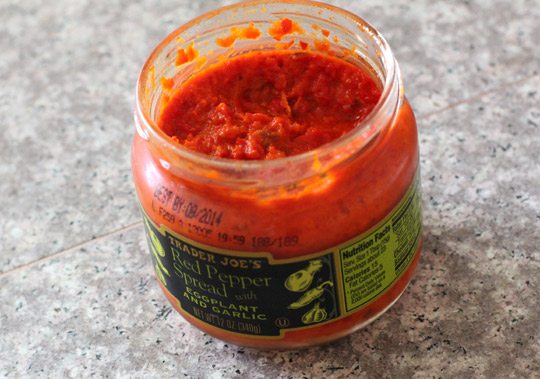
A little Serbian Salad for ya.
It seems like there must be something wrong with Trader Joe’s Red Pepper Spread with Eggplant and Garlic. For one, that is a ponderous descriptor for something which has an actual name. Two, and more importantly, it’s bitter – so unpleasantly bitter!
“Add to pasta sauces, spread on chicken,” the jar enthusiastically suggests, “Top a burger with it!” Why, jar? I like all those things. Why would I want to smear a bitter condiment from the former Soviet bloc all over them?
That is being, perhaps, a bit unfair to the good people of Bulgaria, from whence this spread hails, and who I’m sure are only trying to do the best they can. The problem may lay in me, after all. Red Pepper Spread – or ajvar as it’s known as in its Serbian homeland – is not something I’m very familiar with. I’m more than willing to grant that the the subtleties of the spread are being lost on me.
Let’s take a quick look at the history of this unusual spread before we get into what exactly it’s trying to do to your taste buds.
Ajvar, also known under the more easily remembered but more frightening sounding name “Serbian Salad”, is basically a type of relish – made primarily from roasted red bell pepper and garlic, containing various quantities of eggplant, red pepper etc. Historically, the dish is known as a winter food throughout the Balkans, canned in early Autumn and subsisted on until spring brings fresh veggies.
I’m not quite sure why Trader Joe’s embraces some of the cultural names for its dishes, like dukkah, but not others, like this poor spread, unless perhaps they feared the outrage of countless babushkas, their dudgeon raised high by a sub-standard product peddled under the name ajvar.
All else set aside, I must praise Trader Joe’s for fetching interesting foods from interesting places. Always a culinary adventure at TJ’s! Of course, every adventure must have its times of misfortune, and that is where our red pepper spread comes in. In its homeland, this spread can be many things – piquant, red hot, even sweet – what it is not supposed to be, and what most foods try and avoid being, is unpleasantly bitter.
As the spread hits the tongue it is nearly sweet, thanks to the sugar added by TJ’s to offset the harshness of the taste. Even with the sugar, however, the bitterness comes through, clean and strong, right from the beginning. During the chew the bitterness rises in power, finally lording over your tongue for the length of the aftertaste. I can’t really figure out what it is they put in the spread that makes it so bitter – the list of ingredients is pure and simple, veggies, some oil and vinegar, no preservatives or artificial colors. It’s possible the fault lay in the preparation process itself. Ajvar is rumored to be best when roasted – not simply cooked on an industrial scale. Perhaps what the spread is missing is the tender loving of a roasting flame?
What isn’t bitter in the spread is certainly worth praising. The robust, earthy tastes of the eggplant and red pepper very nicely compliment simple meat and vegetable dishes, but the bitterness is simply too strong for me to actually enjoy any given mouthful of the stuff. It’s a nice idea for a spread, I only hope Trader Joe’s can reformulate this and bring it back under a prouder banner.
The Breakdown:
Would Recommend It: I’m afraid not, not even for novelties sake.
Would I Buy It Again: This spread has no place in my cabinet.
Final Synopsis: A hearty, tasty spread ruined by a strong bitter flavor.
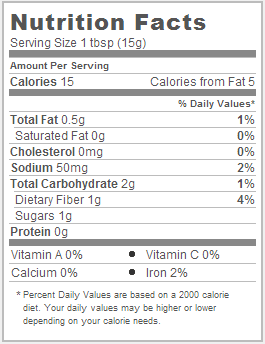
Trader Joe’s Red Pepper Spread with Eggplant and Garlic – Nutrition Facts
Trader Joe’s Cowboy Caviar Salsa
Posted: June 25, 2013 Filed under: Gluten Free, Salsa, Trader Joe's Brand, Vegan, Vegetarian | Tags: caviar, cowboy caviar, Salsa 2 CommentsTrader Joe’s Cowboy Caviar Salsa is, hands down, the grossest product name in the store. I’m no marketing expert, but if you want to sell someone your strange, globular salsa you might be thanked not to name it after fish eggs pulled from the ugliest fish in the Caspian. That aside, this corn-filled, black bean-based salsa is a bold, tasty alternative to your standard yellow-cap Pace and worth a look for anyone.
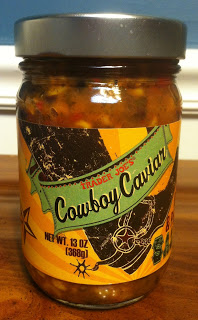
Do not confuse with Rocky Mountain oysters.
I should say that the blame for the name is not strictly TJ’s fault in this case. Cowboy caviar was first crafted into existence in the 1950’s by Helen Corbitt, famed chef, fresh food advocate, innovator of bold new cuisine and, ultimately, head chef at the flagship Neiman Marcus in Dallas, Texas – famed at the time (and known still) for its fine eating. The South, as every good southerner knows, has a hankering for black-eyed peas – a hankering that includes, but is not limited to, mandatory black-eyed pea consumption on New Years Day. Thus the decree that Neiman Marcus was to roll out an “all-Texas” menu, prominently featuring the beans was no surprise. No, the surprise was that Helen Corbitt, herself a Yankee girl from New York, detested black-eyed peas, and couldn’t bring herself to serve them in a traditional way. Instead, she pickled them in onions and served them as a chill dip – and lo history was made.
Trader Joe’s differs from its primogeniture by introducing the aforementioned corn, plus onions, red bell pepper and , perhaps hereticaly, swapping black beans for black-eyed peas. The chunky veggies are mortared by a mix of chipotle peppers, adobe sauce and lime juice – and the result is a dang good, medium salsa that give you plenty to chew on chip by chip. In addition to the touch of fire, you’ll pick up a citrus tang and even a hint of sweetness, which makes this an interesting salsa all around.
I myself am a die hard salsa fan, willing to take it any way I can get it, and to me this is one astounding find. Even with the sudden coming into vogue of non-traditional salsas (mango & papaya salsa, for example) there’s still a paucity of tomato-free varieties. Why not get the tomatoes the hell out of there? It’s the 3rd millennium A.D. isn’t it? “Nothing is sacred” is all but the mantra of our epoch – I don’t see why we should stop at tomatoes as salsa.
If you’ve ever been to a Trader Joe’s you know that they have a host of intriguing chips to go along with this salsas and dips. Why not try a bag of Super Seeded Tortilla chips when you pick up your southwester, rough-ridden, saddle-packed jar of cowboy caviar.
The Breakdown
Would I Recommend It: Surely I do.
Would I Buy it Again: It’s a good change of pace salsa, if not an everyday kind of salsa.
Final Synopsis: Pickled corn and beans? As a salsa? Yessir, and damn good one.

Trader Joe’s Cowboy Caviar Salsa – Nutrition Facts
Trader Giotto’s (Joe’s) Balsamic Glaze
Posted: May 23, 2013 Filed under: Condiments, Trader Joe's Brand, Vinegar | Tags: balsamic vinegar, glaze 11 Comments
The lying little bottle.
Let’s keep it up with the balsamic vinegar, yeah? Today we’re going to look at Trader Joe’s Balsamic Glaze.
Now a glaze is an interesting thig to buy – one of those intriguing grocery product outliers, like bouillon cubes or cloves – that you only by once every 3 years or so and which seems to be manufactured exclusively by tiny, unknown companies with names like “Winslow’s” or “Classic Star”.
Let me say, up front, that this is a pretty good product. Glaze is a weird accessory to food – only lending itself to a few dishes – and I’ll admit that this glaze has vexed me in my efforts to incorporate it into my meals. It’s certainly not something you’re going to use every day, but it does have a multi-year shelf life so that’s not a big problem. Trader Joe’s Balsamic Glaze is a mixture of a thick, natural grape syrup (called grape must) and balsamic vinegar, and it tastes exactly like what you’d expect a vinegar infused grape syrup would taste like. It has a sweet, strong tang that pairs nicely with pork medallions or roast beef, or as a side sauce with Italian-herbed potatoes. There’s no sugar added to the glaze, but don’t underestimate the sweetness – the grape must, being the concentrated remains of crushed grapes, is 10-15% glucose by weight. That said, the balsamic vinegar is strong enough that it makes up the primary taste. This one will zing your tongue before it soothes it. I’m not going to ladle the praise on too liberally here though. A sweet, vinegary syrup is a bold new taste but not necessarily one everybody is going to flip over. I dip into this bottle twice a month or so and have always left satisfied but never blown away.
What intrigues me more than the taste is the weird marketing shenanigans Trader Joe’s has gotten up to with this product. This is sold on the Trader Giotto’s label, it also proudly touts the fact that it’s not just “Made in Italy” but even a “product of Modena” made with “traditional methods”.
Let’s take a look at what they’re insinuating.
Balsamic vinegar, true balsamic vinegar – Aceto Balsamico Tradizionale di Modena – is essentially refined grape must, aged for a decade in special casks within the town of Modena, Italy. This is a designation protected by international law to prevent cheap knockoffs. True balsamic vinegar sells for around $100 an ounce, and is justly craved by the well-to-do trendy gourmet set.
On the other hand, Aceto Balsamico di Modena (no “tradizionale”) is an inexpensive, commercially produced imitation of true balsamic vinegar, which is to say it’s the only type you or I have every had. This balsamic vinegar is really just a mixture of ordinary vinegar with food coloring, some caramel and bit of thickening agent. A dollar a gallon, in other words.
If Trader Joe’s were the hardcore mofo’s they want us to think they are we would be discussing the former right now. In reality, of course, this glaze is made with the latter. What I don’t understand is why they’re bothering with the antics here. We’re not idiots, TJ, we’re not going to think you’ve somehow figured out a way to package super-expensive, authentic balsamic vinegar into a plastic squeeze bottle at $2.99 a pop. Why bother with the misleading language? Made with “traditional methods”? Really? You mean the method of mixing food coloring and ordinary wine vinegar, just like they did in the middle ages?
It’s a sad fact that we live in a time where the shape of our daily life has predominantly been decided by marketers trying to make a buck. Every man-made thing we come into contact with, from our cradles to our coffins, have passed through the hands of a marketer at some point. I’m aware of this, it’s the way of the world, but I sometimes like to fool myself into thinking that maybe there’s a corporation out there that could change things, that maybe there’s a CEO who values genuine human interaction over a forklift full of money. Trader Joe’s does a better job than most at coming across as sincere, so moments like this are important reminders that in this day and age, faking sincerity is just one more way to get that dollar out of your pocket.
The Breakdown:
Would I Recommend It: If you have use for a sweet, vinegar glaze this is a good bet.
Would I Buy It Again: One is enough, thanks.
Final Synopsis: A sweet, tangy glaze that promises more than it can deliver.
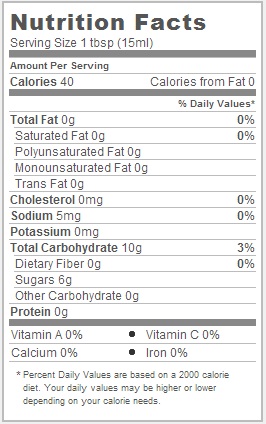
Trader Joe’s Balsamic Glaze – Nutritional Facts
Trader Joe’s Sunflower Seed Butter
Posted: April 4, 2013 Filed under: Condiments, Nuts, Trader Joe's Brand, Vegetarian | Tags: sunflower seed 11 Comments
About a hundred million sunflower seeds, right there.
We’ve dipped a toe into the wild, wondrous world of non-standard spreads and emollients before, with universally positive results. Let us now turn our discerning gaze to that strange lurker on the peanut butter rack – Trader Joe’s Sunflower Seed Butter.
Here we have a weird and unusual spread. Almond pastes and hazelnut creams have become, if not common, at least wider known in recent years – earning a reputation for packing a delicious punch that belies their simple parts. Sunflower seed butter, on the other hand, is an item I’ve only encountered on the far left hand side of Trader Joe’s shelves, huddled off shyly to itself, away from the lime light of the more popular spreads.
I have long been intrigued by this little guy. Was he, like myself, the poor awkward kid in the school yard hiding a heart of gold, or was he a deserving misfit, a mismade troll rightfully shunned into lurking under the bridge in Trader Joe’s sunny world? Is it, in other words, any good?
The answer is not easy to come up with. Trader Joe’s Sunflower Seed Butter isn’t particularly good or bad. It has a very unusual taste that a certain niche audience might enjoy, and which isn’t offensive, but has nothing in particular to recommend it.
It’s hard, at first, to get past the packaging. The label has a cheap, tossed-off look that screams “We don’t care about this product”, a notion that is backed up by the surprisingly flimsy plastic jar it comes in. Twist off the top, and you’ll discover that sunflower seed butter looks almost exactly like your run of the mill creamy PB. Look closer, do you see how, as you tilt the container from side to side, a sheen of separated oil glimmers on the top? You’ll notice as well that the sunflower seed butter flows quite easily, more like an organic, hand-made peanut butter than a Jiff. In fact, the sunflower seed butter is so loose you could almost pour it out, if you wanted to. This is not all bad, as it makes it easy to spread, though it comes at the cost of being somewhat sloppy to ladle with a knife.
The taste is simple and unmistakable – sunflower seeds. This will be your first blush and the long, lingering tail. The immediately taste is almost identical to popping a shelled handful of those tiny, oily seeds into your mouth. After that, as you roll it around on your tongue, the taste become much more mild and somewhat sweeter (thanks, no doubt, to the evaporated cane sugar used as a natural sweetener). While chewing you’d almost swear you were eating ordinary peanut butter – if it wasn’t for a faint hint of that sunflower seed taste lingering just on the peripheral of your tongue. This is all more or less exactly what I expected from a sandwich spread made of sunflower seeds, what surprised me was that once you swallow, the strong, undeniable taste of sunflower seeds will resume. This is practically identical to the aftertaste left in your mouth when you munch on a handful of dry sunflower seeds, and it is not a quick aftertaste either but long and lingering.
Overall it’s not a bad taste or a very good taste – it’s simply a very strong sunflower seed taste. If you have an aversion to peanuts, and therefore peanut butter, you could very well get used to this instead. That said, there isn’t very much to recommend this over any other peanut-variation butter. Like all nut/seed butters it is mostly fat, and it has very nearly the same amount of sugar and carbs as other alternatives. In the end it comes down to how you feel about sunflower seeds. If you love snacking on them, keep them in your kitchen cupboards and car cup holders, this is your dream product.
A final note, sunflower seed butter is very dense compared to most store bought butters. Like organic peanut butter, a very small amount of sunflower seed butter goes a long way – each dab is dense with the crushed essence of a hundred sunflower seed kernels. One small bite and you’re tongue will feel slathered with the paste, resulting in much dog-like chop licking. As a result, one jar of this stuff is going to last you a lot longer than a similar jar of peanut butter, for better or worse.
The Breakdown:
Would I Recommend It: Only if you have a peanut allergy and don’t like almond butter.
Would I Buy It Again: Maybe when this jar runs out, 2 or 3 years down the line.
Final Synopsis: Yes, apparently you can make this, and yes it does taste exactly like you think.
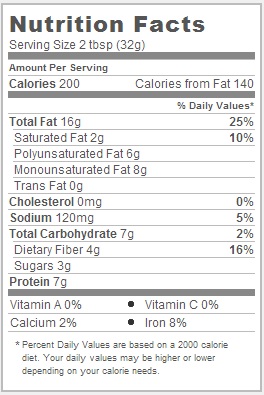
Trader Joe’s Sunflower Seed Butter – Nutrional Information
 Eating At Joes

Recent Comments