
Trader Joe’s Thai Lime Shrimp Skewers
Posted: April 11, 2013 Filed under: Frozen Food, Lime, Shrimp, Trader Joe's Brand | Tags: kaffir lime, lime leaves Leave a comment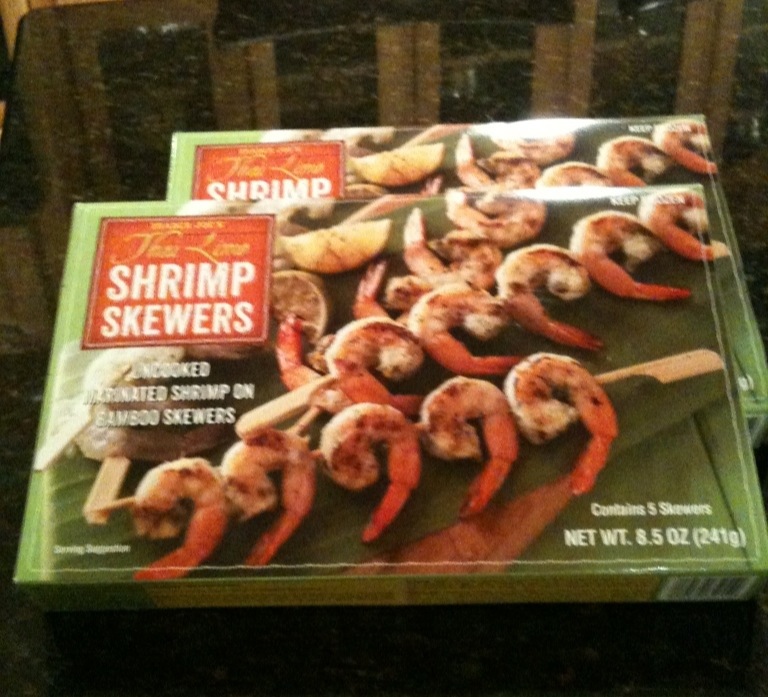
Disappointingly, the banana tree leaves are not included.
Like another syntactically ambiguous citrus product, Trader Joe’s Thai Lime Shrimp Skewers confounds the English tongues ability to parse. Come on TJ, is this a Thai preparation of shrimp with lime, or Thai limes on shrimp?
Spurned to action by this irksome lack of clear-sightedness, I threw myself into a burst of quick detective work. The answer, it turns out, lurks in the ingredients.
I present to you, ladies and gentlemen, proudly listed on the second line, the kaffir lime.
Yes, the kaffir lime – the very sort commonly used in Thai cuisine! A Thai lime, if you will. Long did I suspect this particular ingredient was one of those overly elaborated upon nouns used for marketing purposes – as in “optic white” or “full serving”.
The truth is quite to the contrary. Kaffir limes are not just a distinct species, smaller, uglier and native to southeast Asia, but are also largely inedible. In fact, kaffir limes are used in cooking not for their citric juices, like the garden variety lime, but for the fragrance of their leaves. A grilled shrimp spritzed with citrus is delicious, but this isn’t that. This is a shrimp prepared in a very Thai way, with the aroma of lime but not its zest.
Trader Joe’s Thai Lime Shrimp Skewers come uncooked but ready to pop on the oven or grill for your non-bar mitzvah party event. The box holds five skewers of five shrimp, each simply herbed with flakes of the kaffir lime leaf and assorted other spices. The taste is subtle, but distinct – laying on top of the shrimp taste as a counterpoint rather than working with it like a butter or cream.
The end result is a simple, and simply prepared, dish that captures the taste of Thai cuisine. The taste is difficult to summarize, after all kaffir lime leaf is not that common here in the West, but if you’ve ever had a Thai curry or Tom Yum Gai you’ve tasted it.
Trader Joe’s Thai Lime Shrimp Skewers would make a great addition to the buffet table, as a fun option for a family meal or, if you pluck the shrimp from their skewers, a fantastic addition to your curry or light noodle dish.
Two words of warning. First, don’t think “citrus” when you buy this – be ready for an exotic taste of Thailand.
Second, each skewer is as long as the box they come come in. If you’re prepping them on the range, make sure you have a big, and preferably square, skillet. I used my largest frying pan, but found I could only fit two skewers across it’s diameter at the same time. A square skillet eliminates such geometric hassles, as would cooking them up on the grill.
The Breakdown
Would I Recommend It: Yes, to party planners or Asian cuisine dabblers.
Would I Buy It Again: Next time I tire of ordinary shrimp.
Final Synopsis: An easy, healthy way to get a taste of Thailand.
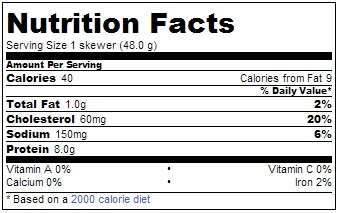
Trader Joe’s Thai Lime Shrimp Skewers – Nutritional Information
Trader Joe’s Hake en Papillote
Posted: March 12, 2013 Filed under: Fish & Seafood, Frozen Food, Hake, Trader Joe's Brand | Tags: en Papillote, frozen food, Hake, paper 8 Comments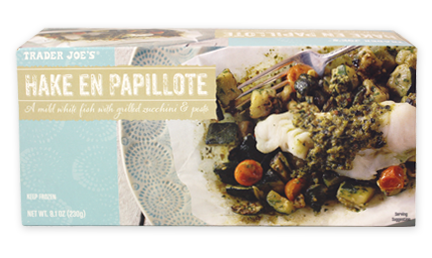
Ah…yes…Hake en Papillote…Of course I know what that means.
If Trader Joe’s made love to Ikea, Hake en Papillote would be their golden child.
Trader Joe’s typically intriguing take on food shows up with all the hallmarks of the Swedish furniture magnate4 here – an absurdly foreign name, calming minimalist design, and clever European-style packaging. That’s nice, much more refreshing than the usual frozen fish in vacuum-packed polyvinyl approach, but design is not food. My question is, does it taste as good as it looks?
Yes it is. And more so. I’ll delve into the details shortly, but first I want to answer the question on everyone’s mind: What the hell does “Hake en Papillote” mean?
Hake (rhymes with “rake”) is a smallish, seagoing white fish – most commonly eaten in Western Europe. Spaniards in particular hanker after the hake, snapping up nearly 50% of all hake eaten on the continent. Like tilapia, hake is a text book example of a “trash” fish suddenly becoming a marketplace commodity. Previously sold on the docks as “scrod”, denoting its undesirability and small size, hake has now stepped in as a tasty, white and flaky alternative to more expensive cod or halibut. The problem with all white fish is that they tend to dry out more or less immediately when stuck in a hot oven. This problem can be worked around in a number of ways, but Trader Joe’s struck on an innovative solution with its roots in French, as well as Japanese culture.
Cooking “en papillote” literally means “in parchment” in French. Upon opening your box of hake you’ll see this is exactly what Trader Joe’s has delivered on – a tidy box of folded white paper entombing your meal. There are various reasons for cooking in this rather unconventional way, but ultimately the reason is that foods sealed in paper will steam in their own evaporated juices, creating an even more flavorful environment than with traditional steaming (where the water vapor rushes out and away).
Cooking en papillote is generally limited to fish and vegetables, so obviously a good choice here, but is historically fraught with difficulties – How is the meal best wrapped? How is it kept closed as it steams? How can it be opened without scalding tender fingers? As a result, most en papillote cooking, even at fancy restaurants striving for haute cuisine, use aluminum foil for the task.
Trader Joe’s would have none of that. As stated on the box, and self-evident upon opening the package, they have devised a brilliant, two-piece, origami box that neatly wraps up the food, holds it safe, and allows for easy opening – either in the kitchen or directly on the plate for that “ooh-la-la” feeling.
So it’s a fancy take on something old, that’s fine – but is it worth all the paper-folding? Simply put, Trader Joe’s should start packaging all of their frozen fish like this, because I can’t get enough. Hake en Papillote is, without a doubt, the tastiest frozen meal I’ve ever had from Trader Joe’s or, in fact, ever.
Now, I’m not necessarily a fish person – I’m entirely satisfied to go months on end without tasting the flesh of the cold-blooded ichthyoid – but Hake in Papillote might just change my mind. Conceive of a light, flaky fish in a tasty, savory nutty pesto with a spring vegetable melange that pleases the whole tongue and you’ve got it. Often, I find that white fish tends to taste particularly “fishy”, though whether that’s because of something inherent in the fish or my own poor cooking I don’t know. In either case, the preparation here takes care of that for me and the hake has a clean, fresh taste without a hint of fishiness. The cherry tomatoes and zucchini are augmented elegantly by the delicious, but not overwhelming, pesto, and the steam-cooking process ensures that all these flavors come out vividly.
And let’s not for get the nutritional information – Hake en Papillote offers a complete entree that’s actually healthy. 14 grams of fat, 8 grams of carbs and only 220 calories make it the perfect, tasty meal for all but the most ascetic dieters.
It is a brilliant work of food engineering – from packaging, to presentation, to taste, to price. I try and maintain a philosophical outlook on the comings-and-goings of Trader Joe’s many products – to become too attached to any one product at TJ’s is to set yourself up for heartbreak – but this is one product whose eventual absence will leave me utterly crestfallen.
The Breakdown:
Would I Recommend It: Yes, firmly and definitely.
Would I Buy it Again: I’ll be picking this up on a weekly basis.
Final Synopsis: The best frozen fish you’ve ever had, and a reason to believe in a hopeful future.
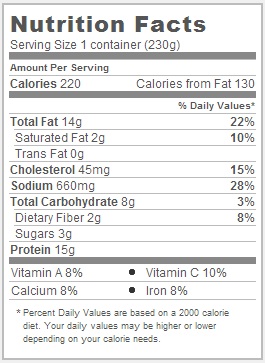
Trader Joe’s Hake en Papillote – Nutritional Information
 Eating At Joes
Recent Comments