
Trader Joe’s Broccoli Slaw and Kale Salad with White Chicken Meat
Posted: July 5, 2013 Filed under: Chicken, Kale, Salad, Trader Joe's Brand 7 Comments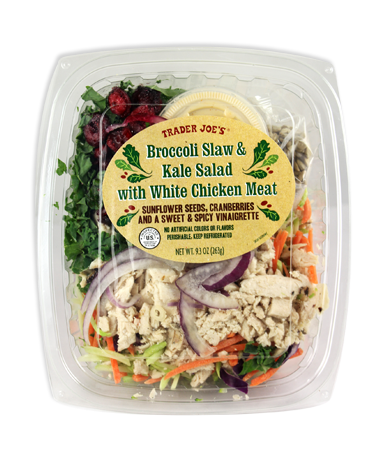
Man, red onion is an absolute salad winner – why are you leaving it off your label?
Ah, another delicious salad from Trader Joe’s – but like most TJ’s salads, their Broccoli Slaw and Kale Salad with White Chicken Meat has a unique set of quirks and shortfalls. Somewhere out there is the perfect Trader Joe’s salad, and while I’ve come close before it still eludes me. Nevertheless I press on, searching for that pot of leafy greens at the end of the rainbow.
Things get a bit weird from the word go as we face the fact that this is a kale-based salad – an uncommon choice in a world of iceberg and baby spinach. I have been underwhelmed by kale before, but at least now it’s being utilized for it’s intended purpose. Kale is a tough, flavorful leaf – a mess of roughage just waiting to scrub your insides clean, and as such demands a flavorful and carefully balanced composition to justify such a bold base. TJ’s finds exactly this with the addition of such hearty ingredients as cranberries, sunflower seeds, a coarse grating of broccoli slaw white chicken meat and, though it goes unheralded on the label, finely sliced red onion. Thin shavings of red onion are one of my favorite additions to any salad and they do beautifully here, adding a bit of zing to the broad, nutty flavors of the kale and sunflowerseeds.
What works a little less well for me is the broccoli slaw. Not that I have anything against broccoli slaw – in fact I buy Trader Joe’s Broccoli Slaw by the bagful for use in my own salads. That, however, is exactly the problem. The broccoli slaw on this salad is indisputable the same kind they’re peddling to me from the produce aisle three feet to my left. While that doesn’t necessarily drive me into a rage or anything, it does make me feel a bit cheap.
I suppose it was a little naive of me to think that Trader Joe’s might have a separate storehouse of special ingredients they use to make their salads and that weren’t just dipping into the common trough of their consumer goods and slapping something together. Nevertheless, it’s nice to see someone get dressed up if they’re courting your tastes. If you look at your little pail of food and realize it’s just just a diverted conveyor belt away from whatever goes into the bulk, economy bags the magic fades a little.
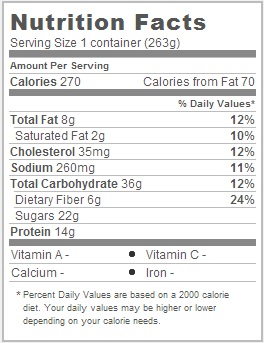
Aside from that rather abstract gripe, there’s only one other thing that bothers me about this otherwise very fine salad – the salad dressing. The packaging bills it as a “Sweet and Spicy Vinaigrette” which begins to approach the truth of the matter but then explodes in a burst of absurdity. Sweet and spicy? Yes, and very tasty to boot. Vinaigrette? Not on any planet I’m familiar with. The thick dressing that rolls sluggishly about its little plastic tub has more in common with 1000 Island than any vinaigrette I’ve seen in my life. In fact, a quick survey of the ingredients, or a quick taste, reveals that the dressing is primarily made from mayonnaise. Is this bad? Not necessarily, certainly not if you don’t mind a delicious but hugely fatty dressing on your kale. For my part, I substituted in Trader Joe’s Balsamic Vinaigrette and was much happier for it.
The Breakdown:
Would I Recommend It: Yes – even if you’ve never liked kale before you might like this.
Would I Buy It Again: Despite a couple short-comings, absolutely.
Final Synopsis: A robust, healthy salad with an unhealthy dressing.
Trader Joe’s Crunchy Black and White Rice Rolls
Posted: June 20, 2013 Filed under: Rice, Snacks, Trader Joe's Brand, Vegan, Vegetarian | Tags: Black rice, rice rolls, sushi rice Leave a comment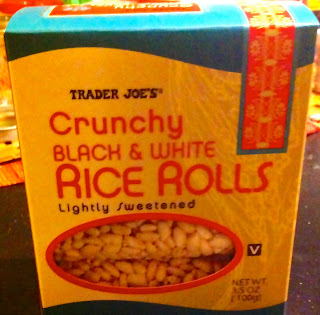
The put the little window on there like, “Check out the crazy colored rice!” But there is no crazy colored rice. What is your end game here TJ’s?
Trader Joe’s Crunchy Black and White Rice Rolls are just rice folks, slightly sweetened, crunchy rice in a little roll. They’re good tasting, pretty healthy and convenient. That’s about all there is to say on these, folks. I mean, c’mon, really – it’s just rice. I suppose I should be thrilled by coming across such a cheap, tasty, and healthy snack, but I’m not a mom. I’m a guy with a slightly faulty “Act Like A Normal Person” switch in his head. The light is steady from time to time, but mostly it sort of blinks on and off. I suppose I’m just a little disappointed by such a utilitarian, ordinary snack after the aggressively weird brown butter, lemon and parsley popcorn the other day. We must wonder, however, what is black rice, and why cylinders instead of disks?
The main reason I picked these rolls up was because of the intriguing mention of “black rice” in the title. Now, there are several kinds of black rice cultivated around the world, form the “forbidden rice” once reserved only for the Chinese Emperor’s table to Thai black jasmine rice. The exotic lure of the promise of such a deviation in color pulled me in, much as the promise of black eggs, or black milk would have done. Unfortunately, I found myself left to disappointment. Not only is it impossible to taste any difference between the “Black Pearl Rice” and “Sushi Rice” used, but impossible to even see any difference. Black rice usually cooks up to a deep purple color, but whatever cooing method Trader Joe’s employed has denatured any chromatic differences between the two. Perhaps I should champion these black and white rice rolls as a paragon of color-blind, racial harmony, but instead it feels bland and sterile. Even TJ’s, usually so florid with their food descriptions, can’t seem to muster much enthusiasm for their generic rices in the product copy. Humph.
This, I sense, may be my own idiosyncratic quibble. As I already said, these really taste quite good – rice cake or not. Even better, they appear to be air puffed, like a bunch of lightly sweetened corn pops smushed lightly together, giving the whole roll a light and airy feeling. This certainly an advancement over ordinary rice cakes whose density can sometimes make a snacking session feel like an arduous slog.
So, sweet, light and crunchy – what’s not to like, really? It may, of course, be possible to take issue with the shape. Why cylinders, TJ? Is the traditional disk shape too square for you? Not hip enough for the educated, middle-income crowd? Functionally, this is not actually much of an issue, except in one important way – it’s difficult to layer or spread any condiments on the rice rolls. As a man who always has some room for a nice puffed rice cake smeared with a thickness of peanut butter, this qualifies as a design flaw.
A final word, unlike some other items I’ve reviewed, the rice rolls compare very well to their mainstream alternatives. Despite the differences in shape and texture, Trader Joe’s Black and White Rice Rolls are nearly identical in sugar, carbs and calories to Quaker’s ubiquitous sweetened rice cakes.
The Breakdown
Would I Recommend These: Yes, especially to moms.
Would I Buy Them Again: As I have no kids and enjoy spreading peanut butter, probably not.
Final Synopsis: A good, but chromatically perplexing, rice snack.
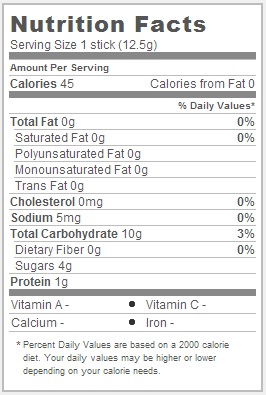
Trader Joe’s Crunchy Black and White Rice Rolls – Nutrition Facts
Trader Joe’s Super Spinach Salad
Posted: June 13, 2013 Filed under: Gluten Free, Quinoa, Salad, Spinach, Trader Joe's Brand, Vegetables, Vegetarian | Tags: miso, pumpkin seeds, Salad Leave a comment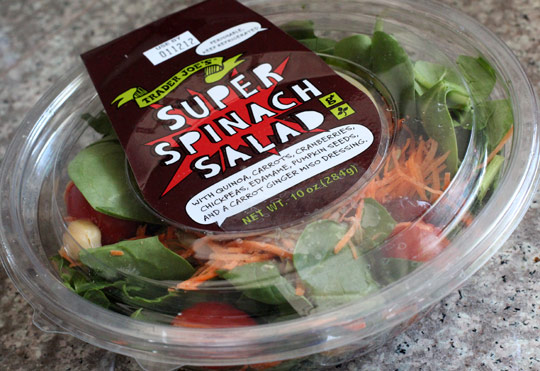
Why do the little grape tomatoes get left out? Poor little grape tomatoes, always overlooked…
An interesting salad, this Trader Joe’s Super Spinach Salad, an intriguing salad, but not necessarily a very good salad.
Spinach is an incredible base for any salad – tender, and flavorful, and supple, and yielding to the ardent bite, and nutritious, and, and, and – well, I could go on. I have a deep and abiding love for leafy, raw spinach that manifests itself in a refrigerator stuffed full of salad greens and dirty looks I throw at petulant children. My adoration of spinach, I’ll admit, is partially irrational. You see, I lost my salad virginity to spinach.
I was a young man, a college freshman. I hadn’t been looking for love, I didn’t even think I was interested in salads. I had grown up around plates of iceberg lettuce and, apart from the occasional juicy crouton or Baco Bit, they did nothing for me. But then I saw it, there in the dorm cafeteria’s buffet , demure but intriguing. I remember stuffing my mouth full of the delicious young sprigs, the juicy blast of nutritious flavor. I can taste it still. That day changed my life, leading me into the wonderful world of salads, and though I’ve often played around with exotic radicchios and roquettes I’ve always returned home to those tender, loving fronds.
So you’d think a TJ’s spinach salad would be an almost perversely easy slam dunk, right? Not so. Trader Joe’s Super Spinach Salad offers up the sort of charmingly eclectic list of ingredients see in some of their other excellent salads, quinoa, carrots, cranberries, chickpeas, edamame, tiny little tomatoes, and pumpkin seeds, but they simply do not work as well as a unit. It’s hard to say where the salad goes wrong. The main problem seems to be the carrot ginger miso dressing, which is, one, a strange combination of ingredients that don’t work very well with the salad mix, and two, unusually thick, almost like a very gritty mayonnaise that resists spreading evenly across the salad. Worse, the dressing leaves a strong aftertaste of onion in your mouth that lingers on long after the salad is finished.
The veggies do make for a crunchy, crispy unit that’s not bad for munching on, and I would suspect that if you ditched the dressing and substituted it for a personal favorite the salad would benefit greatly by it.
Even worse than being unpalatable, the dressing commits the all-too-common sin of wrecking the otherwise very healthy nutritional profile of the salad. Check out these post dressing stats: 19g of fat (a third of your daily intake), and a whopping 53g of carbs which, even controlling for the 10g that come from fiber, is more than a Big Mac packs.
I’ve got nothing against the occasional decadent salad (perhaps choked with gorgonzola and candied pecans), but it has to be pretty fantastic tasting to make the calories worth it. This salad fails to deliver anything like the level of enjoyment I’d demand for blowing my diet for the day.
The Breakdown
Would I Recommend It: With a caution – lose the salad dressing and substitute a healthy alternative.
Would I Buy It Again: Not I, there are far more interesting salads to explore.
Final Synopsis: A very promising salad ruined by a very poor salad dressing.
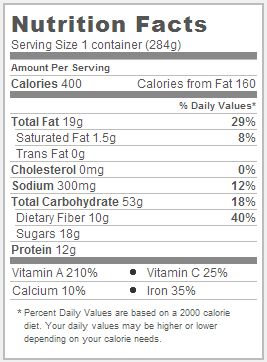
Trader Joe’s Super Spinach Salad – Nutrition Facts
Trader Joe’s Grilled Eggplant and Zucchini Melange
Posted: June 6, 2013 Filed under: Eggplant, Trader Joe's Brand, Zucchini | Tags: melange 3 Comments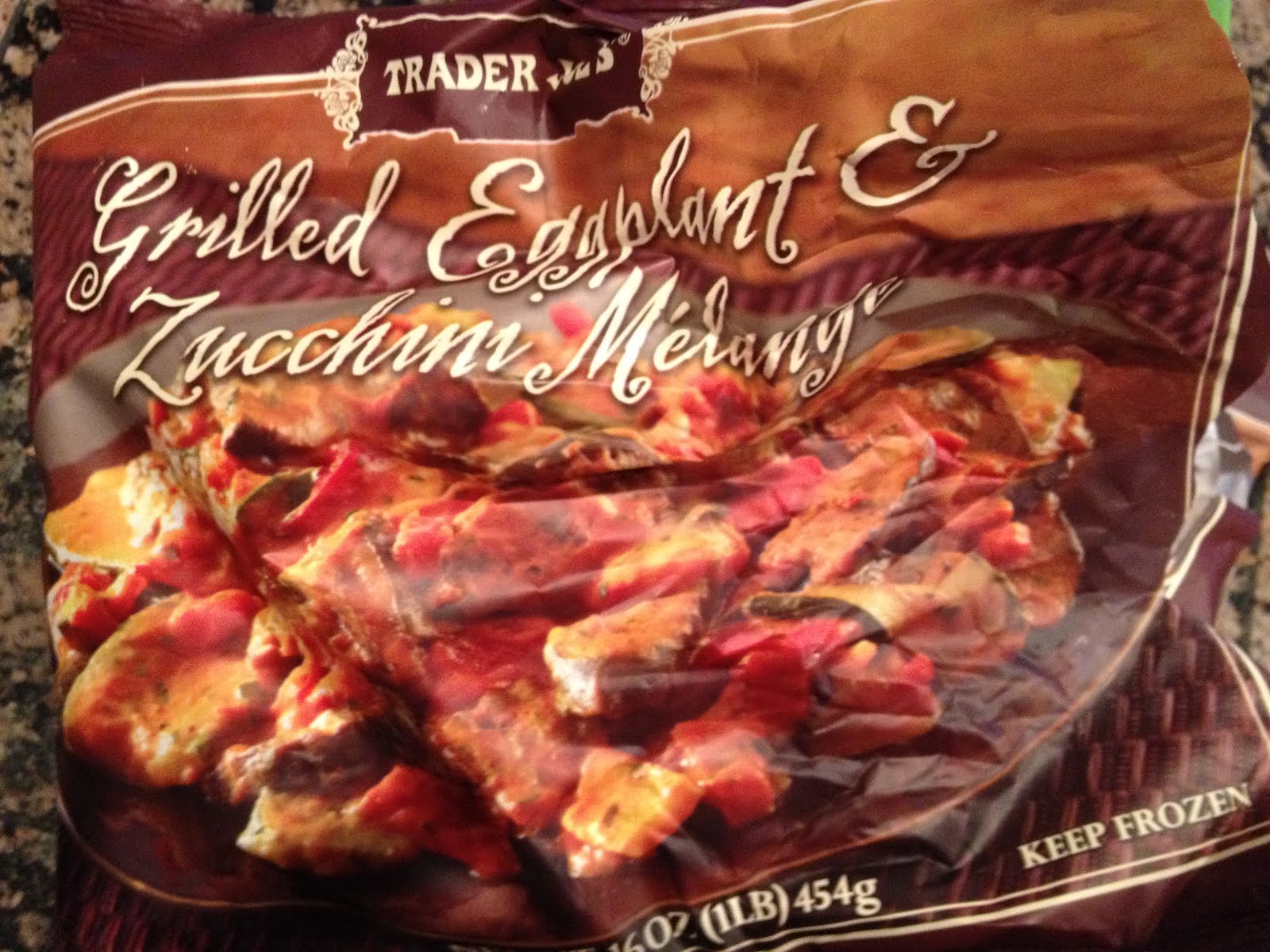
Goony cousins, zucchini and eggplant, make good.
Maybe it’s just me, but I’m not a big fan of melanges in general. They’re a cut above medleys, to be sure, but I’ll take a combo, mishmash or salmagundi over them any time. Nevertheless, Trader Joe’s Grilled Eggplant and Zucchini Melange is a credit to the name – a tasty, tangy, cheesy mixture of two of the vegetable world’s least celebrated members.
You could not blame the average consumer for passing up this awkwardly named side dish. Eggplant and zucchini aren’t the world’s most popular veggies individually, let alone together, and a passerby could be forgiven for assuming this mixture of the two is aimed to please the health-food nut more than the mother of three. Such is not the case however. Following a brief jaunt in the microwave, the dish is surprisingly pleasing – hiding it’s big veggies in a thick tomato based sauce. Though not noted in the product title, a judicious helping of cheese, both mozzarella and parmesan, appear in the dish which gooifies the sauce without dominating the vegetables (unlike Trader Joe’s Chile Rellano).
Eggplant and zucchini, despite their frumpy reputations, actually serve very well in this dish. Both veggies have a mild taste that complement each other and the sauce they come in, while providing enough heft to make for a satisfying mouthful. That said, nothing is done to ameliorate the texture of the large, floppy eggplant slices, which remain, as ever, a bit mealy and soggy.
Overall, the result is a tasty and healthy side, that fills you up without laying on the fat. The downside, for me, were the relatively small portions. The bag, though quite ample, shares the same large bag problem of the cioppino. Though it promises you four servings, I found that it what you get after cooking is more realistically described as two.
The Breakdown
Would I Recommend It: Yes, to all but the eggplant haters.
Would I Buy It Again: Absolutely, it’s a great side for many an entree.
Final Synopsis: A veggie side that takes the middle ground between steamed broccoli and fried potatoes.
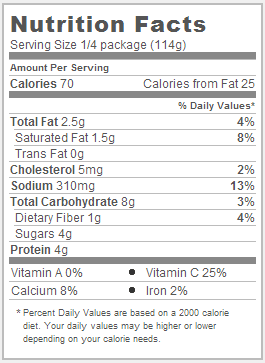
Trader Joe’s Grilled Zucchini and Eggplant Melange – Nutrition Facts
Trader Joe’s Cauliflower Romanesco Basilic
Posted: May 28, 2013 Filed under: Basil, Cauliflower, Romanesco, Trader Joe's Brand, Vegetables | Tags: cauliflower, garlic butter, romanesco Leave a comment
Every time I eat romanesco I feel compelled to tell people about fractals in nature. I apologize in advance.
Trader Joe’s Cauliflower Romanesco Basilic is, pretentious name aside, a nifty little dish.
So often it’s so hard to eat like a reasonably decent human being on a frozen vegetable budget. Oh sure, if you’ve got some skill in the kitchen you’ll manage to make do, but for the rest dinner time is a harrowing event not to be looked forward to. It’s parade of sorrow: sacks of frozen, mechanically-chopped spinach wilting into a messy wet pile in the skillet, or yet another bag of green beans that repel all attempts to make palatable or, worse, tiny plastic TV dinner trays with impossibly hopeful names that do nothing to mask the depression that infuses every misplaced kernel of corn or sloppy lump of beef product.
What I’m saying is it’s tough out there for the unskilled bachelor (or bachelorette) folks, and it’s rare to find something to eat in the flash frozen food aisle that makes you feel like you’ve still got your dignity about you. Trader Joe’s awesome Hake en Papillote dish is one, and their Cauliflower Romansco Basilic is another. It not only provides a truly delicious side dish to any meal in minutes, bit it does so with so much class and style that you actually feel like a better human being while eating it.
First off, it’s healthy. 70 calories per serving, (serving size 1 cup), and oly 6 grams of carbs, two of which are fiber. The world garlic butter does show up right there in the title, so you’ve got to expect some fat, but at only 4.5 grams per serving it’s not an unreasonable amount.
Now healthy is no big thing if it doesn’t taste good, and man does this stuff taste good. So good that you’ll relish munching each morsel of cauliflower and want to slurp up the juices after. How does it manage this trick on otherwise undesirable cauliflower? Through the miracle of garlic butter folks. Right out of the microwave your portion of steaming veggies are swimming in a sea of melted garlic-infused butter – enough to pack each piece with a savory, smooth, tongue-pleasing taste without going too heavy on either the butter or the garlic. It walks that knife edge of light but delicious and reaches the other side unscathed. And tender, my god – can we talk about tender? I’m going to wholeheartedly endorse preparing your cauliflower melange in the microwave because six minutes turns these ice-crusted veggies into yielding, supple morsels that provide absolutely nothing in the way of resistance. It’s like eating a cloud, so pleasant it is.
Trader Joe’s ingeniously preps their broccoli and cauliflower for success by freezing the garlic butter sauce around each sprig or stalk. It’s a stroke of absolute brilliance that eliminates the fuss of having to deal with a enclosed secondary sauce packet. The sauce melts around each individual piece as you heat it, meaning that you can portion out your veggies in any quantity over any length of time and always get just the right amount of garlic butter sauce with them. Goddamn brilliant!
All of this is, of course, ignoring the coolest part of the Cauliflower Romanesco Basilc, which is of course the romanesco – that craziest looking of vegetables adored by fractal-lovers and gourmands alike. If you’ve never had it before, don’t get too freaked out by it’s glorious, Fibonacci sequence exemplifying spirals, just relax and try some – it’s taste is halfway between cauliflower and broccoli. I absolutely applaud it’s inclusion here, or in fact, anywhere that it replaces it’s boring cousin broccoli if for no other reason than novelty.
The Breakdown
Would I Recommend It: You’ve got to try this one at least once.
Would I Buy It Again: Without hesitation.
Final Synopsis: A downright scrumptious vegetable side perfect for any occasion.
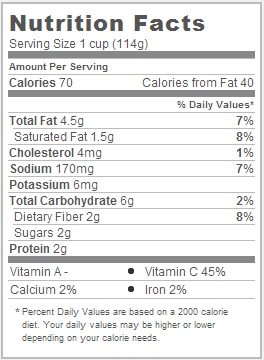
Trader Joe’s Cauliflower Romanesco Basilic – Nutrition Facts
Trader Jose’s Vegetable Stuffed Poblano Peppers
Posted: April 30, 2013 Filed under: Frozen Food, Poblano, Trader Joe's Brand, Vegetarian | Tags: chile rellano 2 Comments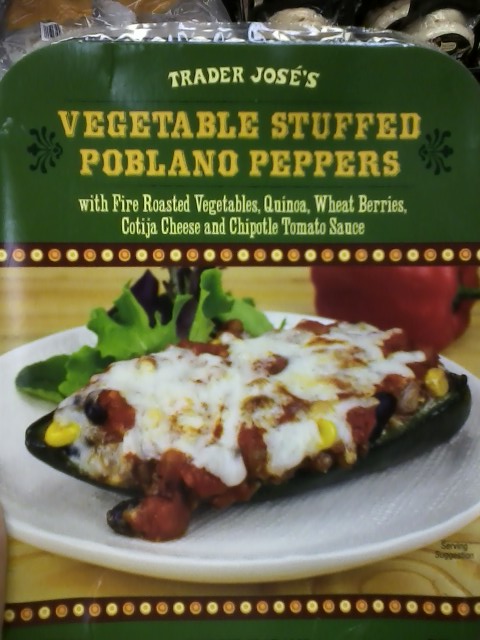
Stuffing those veggies inot more veggies. Doing it.
Occasionally I sit at the table gnashing my teeth and staring balefully at a plate of vegetables. My complaint, I think, is a common one – there simply are not enough vegetables in my vegetables. I, and no doubt you, will be relieved to discover that Trader Joe’s has taken a direct approach to resolving this problem by splitting some poblano peppers open and stuffing them to over flowing with corn, beans, wheat berries, quinoa (and a bit of cheese) in Trader Jose’s Vegetable Stuffed Poblano Peppers.
Essentially we are dealing with a chile rellano made with more veggies instead of meat. Why this rellano like product, not even labeled as such, is handled under the Trader Jose’s label while this one is not shall remain a mystery for all time – knowable only to the augerers in Trader Joe’s occultism department.
This veg-and-cheese medley makes for a tasty filling and manages to avoid the heavy lingering vegetable aftertaste common to other veggie-only dishes. This is notable given that the veggies in question are massive, whole kernels of corn and insolent, lounging beans – an almost aggressively vegetarian dish showing off its full vegetable pedigree on its face. That said, the strongest taste is that of the meaty, thick-skinned poblano peppers that require a knife to saw through. The poblanos have lost much of the fire they pack while raw but not all of it, making this a mild dish with a faint edge of tongue-tingling heat.
I microwaved my Vegetable Stuffed Poblano Peppers in leiu of the 25 minute oven prep, and found that the peppers came out somewhat tough and resistant – far from the tender bell pepper skin of Trader Joe’s Stuffed Peppers with Seasoned Turkey and Rice. Worse, the poblanos were laced through with a bitter tinge, a common feature of poblano’s that have been overcooked. Was this my fault? Perhaps, but I adhered to TJ’s box-side directions so I’m going to pass the buck on to them.
A final intriguing touch is the addition of wheat berries and quinoa in the stuffed peppers – two quasi-grains not commonly associated with Mexican cuisine. I wrote about these trendy, health alternatives to other grains here. In the stuffed peppers their presence is largely undetectable, masked by the other stronger tastes, but lending a pleasant quality to the texture of the sauce.
I mentioned Trader Joe’s Turkey and Rice Stuffed Peppers already, and I can’t help but comparing this dish with that one overall. Do Trader Joe’s Vegetable Stuffed Poblano Peppers stand a chance of replacing this favorite of mine? By no means, the tender, savory, seasoned turkey stuffed peppers beat this newcomer across the board. A decent stuffed-pepper stand-in for the vegetarian crowd perhaps, if they found this one too cheesy, but no match for taste and texture of the stuffed red peppers.
The Breakdown
Would I Recommend It: To vegetarians in need of a hearty stuffed pepper only.
Would I buy it again: Almost certainly not.
Final Synopsis: A vegetarian-friendly chile rellano that’s basically mediocre.
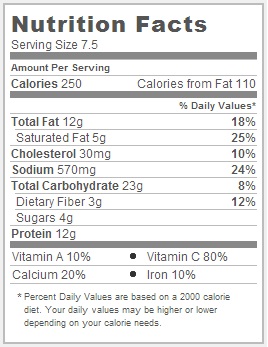
Trader Jose’s Vegetable Stuffed Poblano Peppers Nutritional Information
Trader Joe’s Vegetable and Grain Country Salad
Posted: April 25, 2013 Filed under: Cabbage, Salad | Tags: bulgur 2 Comments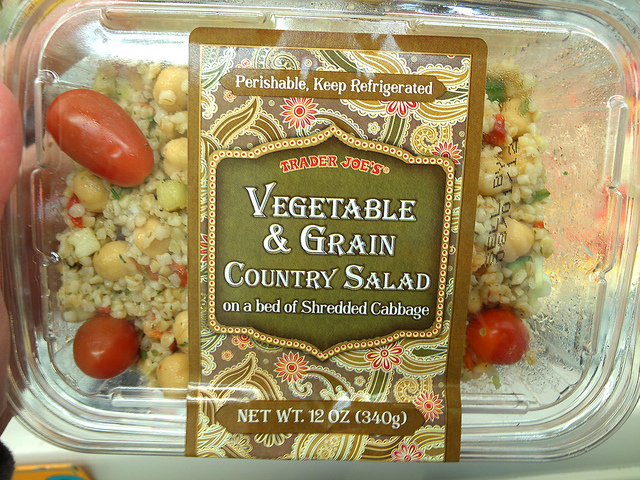
Why can’t the shredded cabbage be considered part of the salad? It’s a vegetable too.
I never would have guessed raw cabbage and cooked bulgur could be so tasty, and yet here I have my proof in Trader Joe’s Vegetable and Grain Country Salad.
Let us first commend this hearty and delicious salad as a study in the art of simple, elegant salad making. The salad is skillfully tossed together from 4 simple components – a bed of shredded cabbage, a scattering of garbanzo beans and a few select cherry tomatoes embedded in a dense field of moist bulgur. Raw shredded cabbage is ordinarily hard to make palatable, but in this instance it works as crispy counterpoint to the yielding, flavorful grain. Add a few choice spices, and you’re left with a rich, sumptuous salad that smells enticingly of the middle east and fills you up without weighing you down. It does, however, lead us to our first question. Bulgur – what is bulgur?
Bulgur. This is not a word the average American runs into on network TV or his daily paper. It sounds fashionable, in that return-to-the-past sort of way, maybe the sort of thing peasants in medieval Italy were stabbing Cypriots with pikes over. “Unload your mule of my bulgur, varlet” was probably a common cry somewhere at sometime.
In actual point of fact, bulgur is a Mediterranean crop – a high fiber grain, related to wheat but looking and feeling like couscous and with a lightly nutty flavor. If you’ve ever had tabbouleh, you’ve had bulgur, (a phrase which is as fun to say as it was to write). Bulgur is somewhat in vogue nowadays due to the fact that it cooks up like white rice, but with more protein and fiber, and a lower glycemic index.
This leads us to our second question. Where does Trader Joe’s get off calling this a salad?
Being made mostly of grain, it’s pushing the definition of salad further than normally tolerated. It would be just as accurate to call this a pasta dish with a side of shredded cabbage. Not to mention the absence of a salad dressing. Has there ever been an actual salad-type salad that you can eat without a dressing? Top scientists say no. Except maybe in the case of pasta salads, of which this is almost certainly one, which I suppose negates the entire point of this paragraph. Never mind, let’s move on.
Although possibly a bit unorthodox, there’s s nothing to regret about Trader Joe’s Vegetable and Grain Country Salad – simple parts that come together in a tasty, well-designed medley of refreshingly unusual tastes and textures and exotic smells.
The Breakdown
Would I Recommend It: Yes, to anyone who is at all curious about salads or bulgur.
Would I But It Again: A little carb heavy as a salad, but tasty as a side dish, so yes.
Final Synopsis: A resounding yes to the question, “Does bulgur taste good as a salad?”
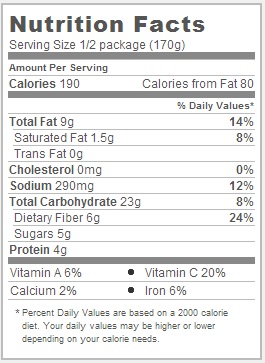
Trader Joe’s Vegetable and Grain Country Salad – Nutritional Information
Trader Joe’s Chile Rellano
Posted: April 23, 2013 Filed under: Cheese, Frozen Food, Pepper, Poblano, Trader Joe's Brand, Vegetarian | Tags: cheddar, monterey jack, poblano pepper 1 Comment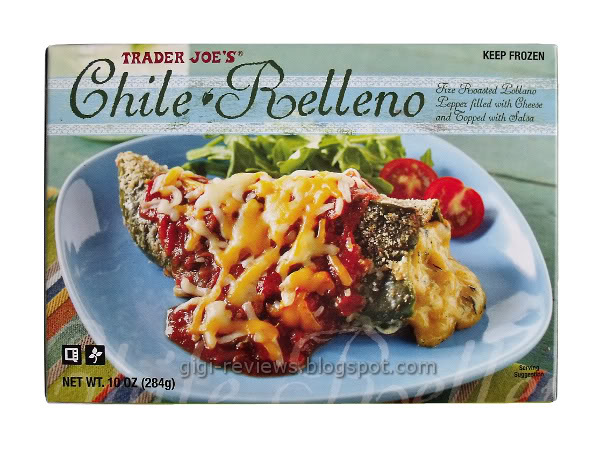
The tube of cheese in question.
Once again, I am shocked that Trader Joe’s Chile Rellano is not on the Trader Jose label. What’s the point of positing the existence of a Hispanic doppelganger if you’re not going to ham-handedly slap him on all your Spanish-inspired cuisine?
For that matter, why have a Trader Jose, a Trader Giotto, a Trader Josef and so on, but not a Korean Trader Jae, an Egyptian Trader Jahi, or a Thai Trader Jayavarman? Why the narrow window of ethno-specificity Trader Joe’s? Edward Said called, he wants to know where you got your Orientalism.
In any case, I better start off this review by disclosing that I’m not really all that into chile rellanos. My list of favorite Mexican food looks like this:
Table 1-1: Mexican Food Preference Chart
- Smothered/”Wet” Burritos
- Fish Tacos (soft)
- Nachos (supreme or ultimate)
- Sweet corn cake mash
- Huraches
As you can see, chile rellanos don’t even crack the top 5, so TJ’s was already embarking on an uphill battle when they created this product then let me go home with it. Strike 1 and 2, Trader Joe’s. Dubious but willing, I tucked in.
The Trader Joe’s Chile Rellano is a roasted poblano pepper, nice and mild, stuffed with monterey jack, slathered in spicy tomato salsa, dusted with bread crumbs and topped with cheddar. When that much melted cheese comes into play, it’s hard to make an unpalatable dish – and as you might imagine these rellanos go down easy.
While most rellanos contain meat of some sort, take note that this one is a vegetarian dish, meaning it is little more than a meat-free, tube of cheese.
This is not necessarily a bad thing, especially if you’re a vegetarian looking for sustenance amid the barrens of the modern grocery store. If you’re looking for that meat free Mexican food fix, here you are. The salsa is admirably spicy, delivering a short sharp burn with each bite, and the roasted pepper is toothsome, if somewhat tough to cut. The vegetarian rellano also boosts a surprisingly high protein profile, 22 grams to the serving, which might give you some sense of how much cheese we’re talking about here.
For my part, I found the meat-less rellano less than filling. As a component to a larger Mexican dish it would certainly be more effective – as plate compatriot to an enchilada, perhaps, or a taco. However, if I’m going to ingest that much straight up cheese I have other ways I’d prefer to go about it. (See table 1-1).
The Breakdown
Would I Recommend It: To Mexican craving vegetarians, no one else.
Would I buy it again: I don’t see it happening.
Final Synopsis: This cheesy pepper is alright, but nothing special.
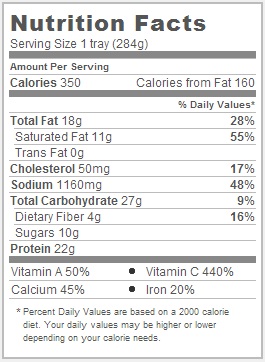
Trader Joe’s Chile Rellano – Nutritional Information
Trader Joe’s Stuffed Peppers with Seasoned Turkey and Rice
Posted: April 9, 2013 Filed under: Red Pepper, Rice, Trader Joe's Brand, Turkey | Tags: Stuffed Peppers 7 Comments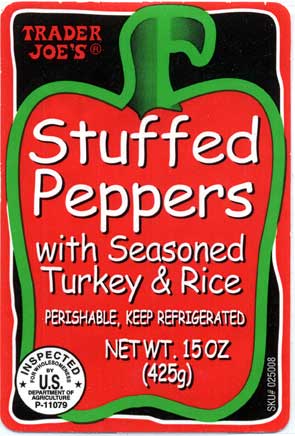
Trader Joe’s Stuffed Peppers
I’ve always been cautious when it comes to foods stuffed in other foods, so it was with wariness that I approached Trader Joe’s stuffed peppers with seasoned turkey and rice. Stuffing, after all, is fraught with peril. We’ve all heard the dire warnings regarding turkey stuffing and seen the gruesome spectacle of sausage stuffing. It is a mixed bag. Sometimes the rewards outweigh the dangers, and sometimes you find yourself eating a pile of gunk.
I turned to Trader Joe’s stuffed red peppers during a quest to find a cheap, easy prep, low carb, non-frozen dinner entree. A tall order, and one that Trader Joe’s has trouble delivering on. It was after a great deal of searching that I finally struck upon these. Trader Joe’s Stuffed Red Peppers may not be exactly a dieters dream, but at 11 grams of fat and 14 grams of carbs per serving they’re not too far off the mark.
I’ve come back to these stuffed peppers time and time again because it fills a gap not many Trader Joe’s products do – a dead-cheap dinner option that takes 15 minutes and no prep. In other words, with two full servings for about $2.50 each and no knowledge of cooking necessary, this is the perfect I’m-An-Unskilled-Bachelor dinner go to. I go the oven-cooked route, but it’s just as easily microwaved. In either case, you end up with something that’s not just tasty, but could nearly pass as home cooked.
The piping hot rice and season turkey spills in a moist slump over the red pepper’s wilted walls – flavorful, meaty and savory without being starchy or over-salted. The balance between turkey and rice is generously nudged toward the turkey side, which at makes this more entree than side dish. This rich filling is, in turn, balanced by the soft and very mild taste of the roasted red pepper casing.
That said, these stuffed peppers aren’t perfect. For one, the casing always collapses to some degree when cooked, making messy piles. Relatedly, the filling tends to resist becoming crisp and brown no matter how long you bake it.
Trader Joe’s Stuffed Red Pepper isn’t incredible, exotic or revolutionary, but like TJ’s Minestrone it’s something with a value all it’s now, a classic mainstay. This is the sort of meal that a mom might serve up to her family once a week – a modern-day casserole that gives the TV Dinner Set an option outside the freezer section.
The Breakdown:
Would I Recommend It: Yes, whether you’re a mom, a bachelor or just too tired to defrost the chicken.
Would I Buy It Again: I already have.
Final Synopsis: A simple, but tasty classic.
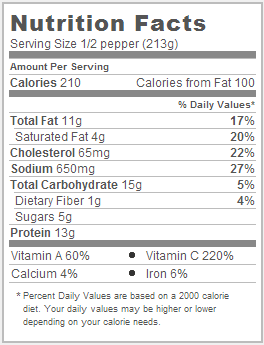
Trader Joe’s Stuffed Peppers with Seasoned Turkey and Rice
Trader Joe’s Dried Kimchi
Posted: March 7, 2013 Filed under: Cabbage, Trader Joe's Brand | Tags: dehydrated, dried, kimchi 12 Comments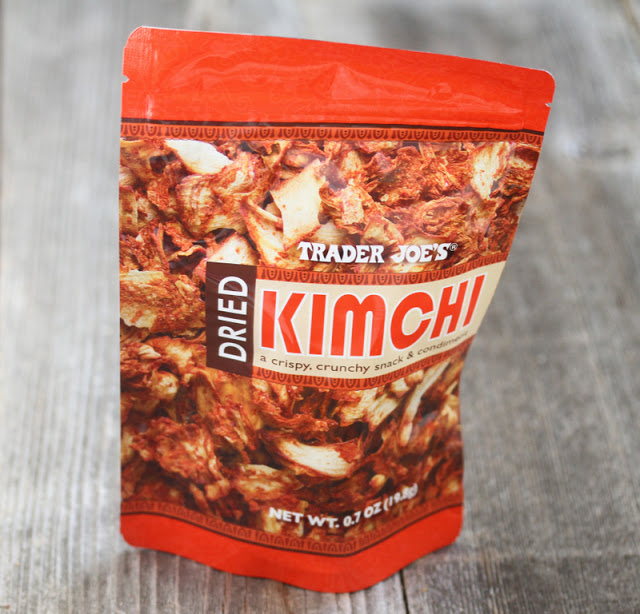
Cabbage is more than 90% water – is this a good idea?
First, for those of you who aren’t Korean, or don’t frequent the adventurous aisles of your supermarket, I will spare a few words for the remarkable food that is kimchi.
It seems that at some point in ancient history the good folks of the Korean peninsula thought they should start pickling fermented vegetables in spicy, spicy spices. Kimchi can be made from many vegetables, but most commonly from cabbage.
You’ve been served this limp, red-slathered dish in a tiny bowl if you’ve ever been lucky enough to patronize a Korean BBQ (or any Korean restaurant for that matter).
If you’ve ever been to Korea you’ve encountered it much more often than that. Kimchi is, in fact, the national food of the Koreans. The food is so important in that nation that it’s more a deeply ingrained cultural element than a food. Your typical Korean serves three or more types of kimchi every meal, including breakfast. Kimchi is to the Koreans what apple pie would be to Americans if Aunt Bea was the tyrannical overlord of our nation. Many Koreans, and this is utterly true, own two refrigerators – a regular refrigerator and a kimchi refrigerator. A separate refrigerator, you understand, that they need to own so they have a place to keep all their kimchi.
To your average American, kimchi is something of an acquired taste. We don’t pickle as much as we used to, and cabbage was never on the menu even back when pigs feet were going in the brine. Add to that fermentation in red hot spices and it starts to become clear why kimchi isn’t more widespread in the states.
So if that’s Kimchi’s illustrious, if idiosyncratic, past what is Trader Joe’s thinking by drying it? I really can’t get over how crazy this idea is. Unless there was a protracted, filibustering exhibition of super-human showmanship, I have great difficulty imaging the board meeting where this idea was successfully pitched. Essentially, someone must have stood up and said, “We want to start dehydrating cabbage,” and every just looked at each other and nodded. How does that happen?! This is 2013 – are all our pretenses to enlightenment a hollow lie?
Let me reiterate – I like kimchi. I’m a guy who literally says, “Alright, kimchi!”, when it’s served to him. I’ve willingly purchased whole jars of kimchi and brought them home with me. This is not a weird food to me, this is something I like. But I do not like this. Dried kimchi is, essentially, a bitter dose of spices on a shrunken leaf wad. It falls into the category of foods so weird I can’t even like them for their weirdness.
As we’re all aware, cabbage is 93% water content, and the bits that aren’t water are more tolerated than celebrated. Not many people are walking around hefting heads of cabbage and biting off a big mouthful just for the flavor. Really, dehydrating cabbage is just a fancy way of throwing it away. The fact that the already intense kimchi spices get concentrated in equal intensity on these dry bits of leaf is not a selling point.
The bag advertises the dehydrated kimchi as a “snack and condiment”, but a snack it is not. Dried kimchi is something you take a small pinch of, chew on slowly, and regret your recent life decisions. It’s more bitter than anything, although it’s also tremendously spicy.
As a condiment, the dehydrated kimchi fares better. The bag makes several suggestions for working the product into your daily life, some of them ludicrous, but includes “soup” and “salad” among them.
Dried kimchi flakes on salad is not something I would encourage. If you set out to design a salad entirely around the dried kimchi flakes, I dare say you could manage it. If you simply sprinkle them on a standard garden salad like I did, your results will be less than stellar. The gnarly cabbage-ness of the flakes blends away into your other leafy greens, but the touch of bitter spiciness still stands out, clashing with the other, more dominant flavors in the salad.
Soup, I’m glad to say, fares much better. I sprinkled my kimchi on Trader Joe’s Spicy Seaweed Ramen and actually found the dish much improved. The ramen, though tasty, is fairly simple in flavor. Seaweed doesn’t contribute much to it in terms of taste, and the spicy broth is simple and straight forward without depth.
Adding dehyrdated kimchi improved the whole situation. When the kimchi contacted the broth it began to reconstitute and unfurl, essentially undoing the damage done to it by Trader Joe’s mad kitchen scientists. With a little moisture and life returned to it the kimchi fares much better – infusing the soup with it’s complex, tangy, spicy flavor. This was the only way the dried kimchi seemed edible to me – if TJ’s is serious about keeping this stuff on the shelf they should try and play up this angle.
As good as the kimchi was as a soup additive, it made me wonder “Why not just add regular kimchi to the soup?” If I’m in the market to buy some kimchi, and it comes down to dehydrated or regular, I’m going to go with regular every time. Not only can it be incorporated into more meals than the dried kimchi, but it’s cheaper per pound, and even stores better – a jar of kimchi will last in your fridge for as long as you need while the dried kimchi starts to degrade in quality as soon as the airtight bag is opened.
Overall, this is a weird exercise in food absurdity – almost an art project. If, like me, you actually like kimchi, do yourself a favor and just buy the regular, non-dehydrated stuff.
The Breakdown:
Would I Recommend It: Only to die-hard kimchi fans looking for another way to get that kimchi-fix.
Would I Buy It Again: Oh no. No, no, no.
Final Synopsis: Dehydrating cabbage is a bad idea.
 Eating At Joes
Recent Comments