
Trader Joe’s Onion Dip Mix
Posted: September 17, 2013 Filed under: Dip, Onion, Trader Joe's Brand | Tags: dip mix, onion dip 6 Comments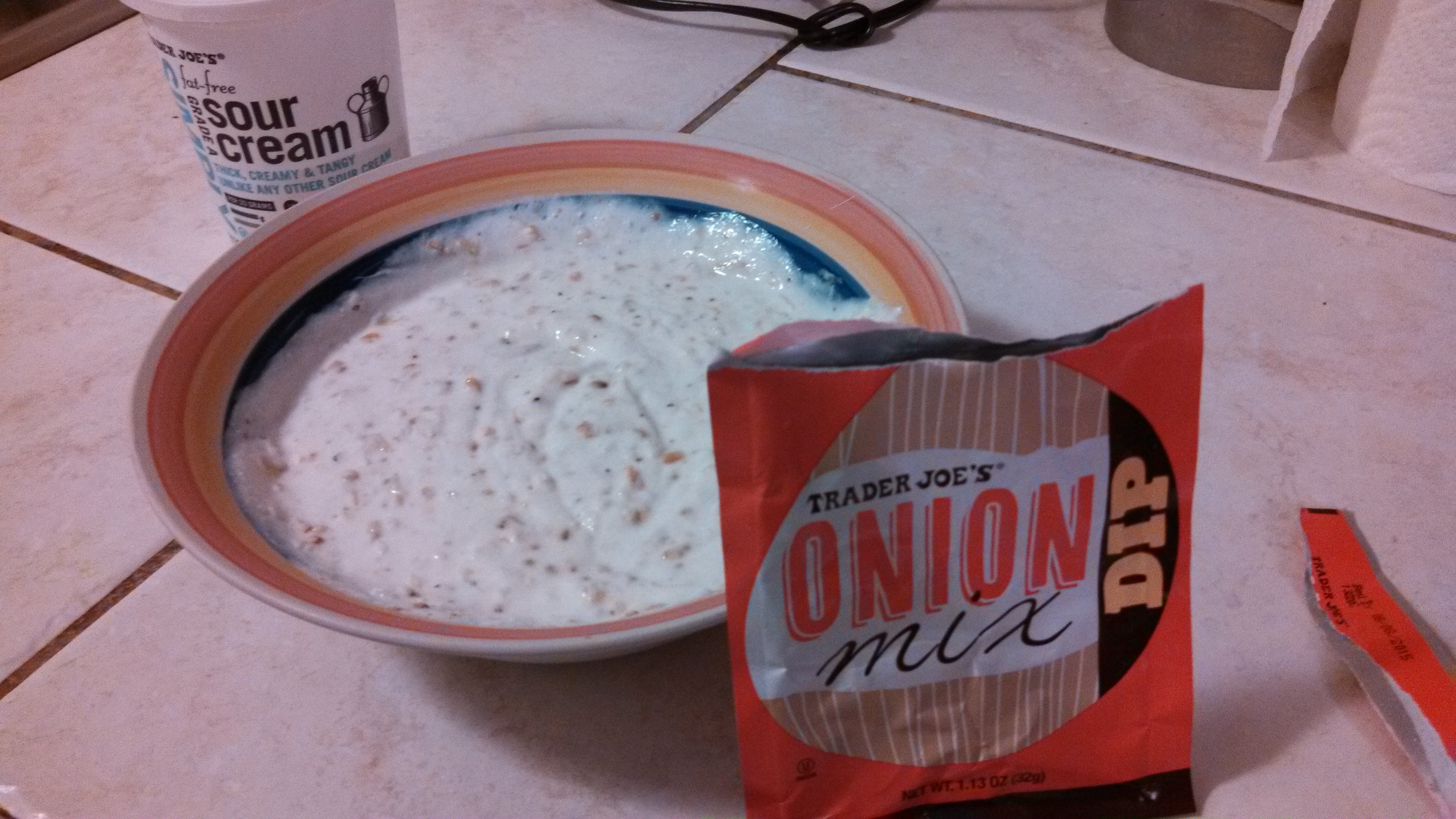
Onion dip!
Onion dip, one of mankind’s most favorite dips. With the exciting arrival of Trader Joe’s Onion Dip Mix, they have now fulfilled the requirement that all supermarkets sell some type of powdered onion dip mix. I picked this up because it was new, and that’s always cool, and because onion dip is one of the most ordinary things you’re ever going to encounter in your life. Powdered onion dip mixes seldom, if ever, vary – presumably it’s all made in the same enormous mixing plant in New Jersey somewhere and then packaged with different labels. Trader Joe’s treads so far from the beaten path, is so devoted to bringing us strange and mysterious things, that it seemed weirdly incongruous that they’d be offering something as mundane and prosaic as onion dip. Surely they’ve got something sneaky planned with their onion dip, some uniquely Trader Joe’s twist hidden in this little orange packet.
Sadly, this is not the case. Trader Joe’s Onion Dip is practically indistinguishable from any other powered onion dip you might have ever had. It’s not a bad onion dip, it’s just a very ordinary onion dip. The sort of onion dip that makes you go, “Yup, here’s some onion dip.” So, in summary – if you are looking for a cheap ($0.99) onion dip mix on par with Knorr or Lipton, here you go.
The deeper, and to me more interesting, question is why do we eat onion dip at all. It’s tasty and I’m glad we do, but who was the first enterprising soul who thought “Know what this sour cream needs? A really strong onion flavor.” That’s really weird, wouldn’t you say? These are not two ingredients that naturally occur near each other in the wild Of course, I’m not Northern European either. Various recipes involving sour cream and onions were floating around the Old Country long before we adapted it into a party appetizer in the states. That transformation took place in the mid-
As it happens, the first onion dip didn’t come about until 1954, and owes its thanks entirely to the wondrous Modern Age. The era of convenience that exploded in America after WWII showed itself nowhere more clearly than through changes in the kitchen. Take the sudden rise of powdered soup, for instance. The idea of dehydrating soup for ease of use is a surprisingly old one. Lewis and Clark packed a great quantity of a commercially produced “pocket soup” with them on their expedition. The very first mentions of such a product can be traced back to as far as England, in the year 1681. These first powdered soups however, were more akin to bouillon cubes, hard lumps to be dissolved over time. These were eventually refined into powdered mixes that could easily be added to water by the busy housewives of the 1940’s and 50’s. It was one of these women, now as forgotten to time as the honorable Governor Ding, who first grabbed a packet of Lipton’s Onion Soup Mix and added it to a bowl of sour cream. The result was a hit, and quickly co-opted by the Lipton company who as early as 1958 started printing it on every packet of onion soup mix they sold.
That, pretty much, is everything you need to know about the history of onion dip. What will the future hold for onion dip? We must wait and see. In the meantime, the next time you need to cater a party on the cheap, or prep a snack for the football game, you can give this dip a whirl
The Breakdown
Would I Recommend It: Eh. It’s as good as any other brand.
Would I Buy It Again: Sure, if I’m having people over or something.
Final Synopsis: A competent onion dip mix with no surprises.
Trader Joe’s Pizza Veggie Burgers
Posted: September 12, 2013 Filed under: Burgers, Pizza, Trader Joe's Brand, Vegetarian | Tags: pizza burger, veggie burger 11 Comments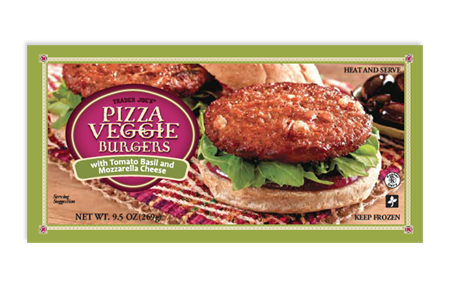
Not quite a burger and not really a pizza, but something new and interesting.
Pizza in a burger, folks. Think about that. Has it really taken us this long to combine two of America’s favorite foods into one delicious food? Isn’t that strange? What’s even stranger is that it took Trader Joe’s Pizza Veggie Burger to do it. I myself am an unrepentant carnivore and steer clear of the veggie burgers unless a particularly whimsical spirit seizes me, nevertheless I am a huge fan of these. Go pizza burgers! Show us the way to a better future!
All the veggie burgers I’ve had in my life to this point have been a disappointment. When you get the hankering for a nice, sloppy burger it’s never satisfying to sit down to a heavily processed mass of tofu studded with whole peas and corn kernels. I always have been disappointed, and I expect I always will be in the future (Trader Joe’s excluded) for the simple reason that veggie burgers are playing a losing game. Vegetables simply cannot replace meat. They are beautiful and wonderful in the own right, but even the absolute best slice of marinated seitan is going to come second to a middling steak. Yet for some reason vegetarian food providers return to the well of ersatz meat products – foisting not just veggie burgers, but tofurky and chik’n and vegetarian bacon and countless other so-called “meat analogs”. It’s this sort of weird fixation on replicating meat that turns so many of the vegetarian-curious away from the shores of meatlessness. Try as you might, a soy protein patty isn’t going to be mistaken for a ground beef patty.
On the other hand, vegetables can do all sorts of excellent things that meat can’t. Where vegetarian cuisine embraces it’s flexible, malleable and adaptable nature it champions greatly. There are a million ways to cook delicious vegetarian meals that don’t resort to imitating meat products – take the world of Indian cuisine for instance. There’s no reason that a veggie burger has to try and force itself to taste like a ground beef burger – by branching out into a world of other interesting tastes, in this case pizza, Trader Joe’s flips the game on its head by setting its own standard of success. It’s not trying to be a regular burger – it’s trying to be a pizza burger, and on those grounds it succeeds.
Trader Joe’s Pizza Veggie Burger is made from a big chunk of reconstituted soy protein, yes, but it’s also chock full of tomato, basil and melted mozzarella cheese. Yes, it is as good as it sounds.
Two things really work to sell you on these before you get to the taste. First is the color, while most veggie burgers are a variation on beige, the pizza burgers are a dark, almost incarnadine red, thanks to the tomato infusion. Second is the smell, which is very reminiscent of cheese pizza.
I zapped my burgers in the microwave, and they came out piping hot and smelling great after a couple minutes. I added the usual burger toppings and a bun, and the first bite turned me into a fan. These pizza burgers don’t taste like your usual burger, but they don’t taste like a veggie burger either. They occupy their own unique space – moist, chewy, and really bursting with the flavors of a margarita pizza. I was particularly impressed by the texture, which held up well, felt natural and didn’t crumble or fall apart during either cooking or eating – a typical weak point of vegetable patties.
Unlike their rather unfortunate attempt to make a new type of sushi, Trader Joe’s can chalk their pizza burgers up as a solid success. They are a delicious alternative to beef and vegetable burgers alike, and a real contender for my future barbecuing purposes.
The Breakdown
Would I Recommend Them: Yes, to vegetarians and meat-eaters alike.
Would I Buy Them Again: Yes. In fact, I might choose them over beef patties.
Final Synopsis: An tasty melding of pizza and burger that does vegetarians proud.
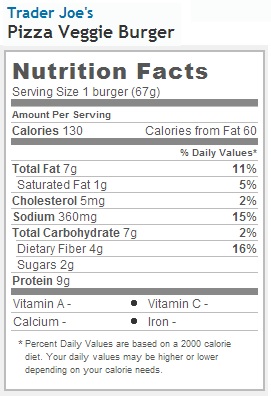
Trader Joe’s Pizza Veggie Burgers – Nutrition Facts
Trader Joe’s Quinoa Teriyaki Mushroom Rolls
Posted: September 10, 2013 Filed under: Mushrooms, Quinoa, Trader Joe's Brand, Vegan, Vegetarian | Tags: quinoa, rolls, sushi, teriyaki 3 Comments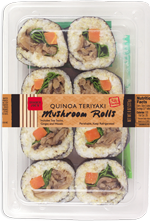
Yes, there is quinoa in sushi now. No one shall escape quinoa!
Holy crap – I mean, guys, words fail me. We’ve seen some pretty bold and unpredictable moves from Trader Joe’s before, but I’ve never seen anyone, anywhere, seen anything like Trade Joe’s Quinoa Teriyaki Mushroom Rolls. Swapping the rice out of sushi for quinoa? That is some mad scientist level tinkering there, mad science that has resulted in an abomination not fit to dwell on God’s green earth.
Look, I like Trader Joe’s, you like Trader Joe’s, but let’s be honest here – no supermarket has ever made reasonable sushi. Supermarkets on the coast of Japan don’t even do sushi well. If you want sushi, you go to a sushi restaurant. If you want cold patties of clammy rice and old fish, you go to supermarket. I can only imagine that it’s only due to the abysmal standards of supermarket sushi that Trader Joe’s thought they could get away with such an outlandish concoction. Replace the seafood with marinated mushrooms? Why not? Infuse the rice with quinoa? Who’s to stop you?
It’s not that I can’t see their thought process here – a healthy, vegetarian option for sushi lovers is a noble goal – but the execution here is unconscionable. The marinated mushrooms themselves are alright – a bit slimy, but tasty and nicely saturated with teriyaki flavor. If the product was mushrooms alone, I’d have little to complain about. The real culprit in making these rolls inedible is the unpleasant quinoa/rice wrapping – served soggy, tremendously dense and mealy. Those are characteristics shared by most supermarket sushi rolls, granted, but these were without a doubt the worst I’ve had of that dubious ilk. Was it adding quinoa that pushed it to the bottom, or would these have been just as bad with rice alone? It’s hard to say.
What would you expect the primary ingredient to be in a quinoa roll? Quinoa, perhaps? You would be mistaken, I’m afraid. I like quinoa, I’ve discussed it before, but it’s inclusion here is tragic. If the roll was entirely made of quinoa, that’d be one thing – I expect I’d even like a roll made entirely of quinoa. But that’s not what we have here. What you’re really getting is rice, sprinkled with a bit of quinoa.
Consult, if you would, the picture above. Notice the little yellow dots? That’s the quinoa. Everything else? That’s rice. It hardly seems honest, really, to bill these as quinoa rolls. If TJ’s really wanted a healthier sushi roll, they should have gone with a brown rice. You can’t just mix up an 80-20 rice to quinoa mix and call them quinoa rolls – that’s farcical, Joe. Knock it off.
If you’re a vegetarian and you love sushi, I feel for you I really do. For the time being, however, I’d suggest sticking to your cucumber and daikon rolls. I hope that Trader Joe’s will do something else with the teriyaki mushroom bits. Until then, I must award these quinoa rolls with the ignoble “Worst Thing I Have Ever Eaten from Trader Joe’s” award. Congratulations.
The Breakdown
Would I Recommend Them: No. Really, really no.
Would I Buy Them Again: Not until opposite day, the day when you buy the things you hate and throw away the things you love.
Final Synopsis: Why would Trader Joe’s do this to sushi?
Nutritional Info, per 3-pc serving
Calories: 120
Total Fat: 3g
Saturated Fat: 0g
Cholesterol: 0mg (duh, since it’s vegan)
Sodium: 430mg (before the soy sauce of course)
Potassium: 0mg
Total Carbs: 21g
Dietary Fiber: 1g
Sugars: 4g
Protein: 2g
Vitamin A: 25%
Vitamin C: 4%
Calcium: 2%
Iron: 4%
Trader Joe’s Sriracha Sauce
Posted: September 5, 2013 Filed under: Condiments, Sauces, Trader Joe's Brand | Tags: sriracha, sriracha sauce 3 Comments
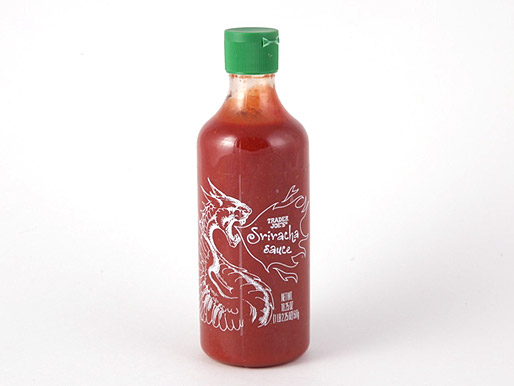
An upstart Dragon arises in the West to challenge the Eastern Cock.
Well I certainly wasn’t expecting this. Trader Joe’s has always blazed its own, idiosyncratic course when it comes to it’s food offerings. Rarely do they stoop to blatantly biting on someone else’s style, as they do here with Trader Joe’s Sriracha Sauce. Even more surprising, while it may share the name, this very tasty hot sauce is a different beast entirely.
You know sriracha, you love sriracha, you probably have some in your fridge right now. That is, unless you’re an avowed chili wuss like myself. As a rule, I steer clear of the hot stuff, and that means that, until today, I’ve gently skirted my way around Trader Joe’s Sriracha Sauce whenever I crossed paths with it in the store. Finally, like a kitten being introduced to a new squeaky toy, my curiosity has overcome my fear and I’ve made the plunge. The results have been unexpected.
My basis for avoiding sriracha hot sauce for 99.9% of my life has been based on a few, memorable encounters with the sriracha hot sauce, Huy Fong Food’s Tuong Ot Sriracha, aka the rooster sauce, aka the huge, bright red bottle of thick fiery paste.
I may have missed out on a wide variety of BBQ sauces in my youth, but there was no missing this screaming red blast of hot lava, rising like a flaming obelisk over the tables of South East Asian restaurants from NY to LA. Tuong Ot Sriracha! That thick red paste of concentrated burning hot jalapenos. That thick ooze the consistency of axle grease. That famous recipe made with no water-added. (A point of pride at Huy Fong Food. Check it out yourself: no water, just a splash of vinegar five ingredients down the list). Such a mush of pure heat that is impossible to apply in moderation to your food – leading to concentrated pockets of burning pain or to a plate plastered in a thick layer.
Sure, I tried some Sriracha, curious young man that I was. I tried it and it burnt me – hard. I had no more reason to return to the Devil’s teat. No reason, that is, until now.
Not all sriracha sauce, it turns out, is like Tuong Ot Sriracha. In fact, most isn’t. Unlike the Huy Fong Foods version (a Vietnamese-Chinese product) sriracha is originally a Thai invention, hailing from the town of Si Racha, naturally. Authentic Thai sriracha sauce is a much runnier, tangier sauce, more akin to what we’d consider a “normal” hot sauce to be in the west. It’s this Thai style sriracha that TJ’s is basing it’s version off of.
Trader Joe’s Sriracha Sauce is looser than the rooster sauce, and bring actually flavor to the sauce as well. Much tangier, a little tiny bit sweet and a touch bitter – it’s a complex, rich taste that enlivens soups, noodles, entrees, pizza, basically anything and everything, all without the threat of igniting all the mouth’s surfaces.
Is it still hot? Unequivocally, yes. But it’s noticeably a notch down from Tuong Ot Sriracha. Think Cholula compared to Tabasco. I image this might upset some of the hard-line hot sauce die hards out there, those who seek pain before pleasure in the sauces, but please try it before you judge it. You might just find the flavor more than makes up for the slightly cooler heat.
For the rest of us, or even those who fear the flame like myself, this might just make you look at sriracha sauce in a whole new light.
The Breakdown:
Would I Recommend It: Yes – this sauce is a sriracha revelation.
Would I Buy It Again: …..………maybe. But that’s saying a lot for me!
Final Synopsis: A srircha sauce that straddles the line between the super hot Huy Fong Foods version, and the authentic Thai version.
Trader Jose’s (Trader Joe’s) MexiCali Salad
Posted: September 3, 2013 Filed under: Salad, Trader Joe's Brand | Tags: mexicali salad 5 Comments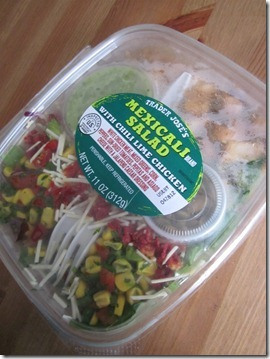
One of these days, I hope someone uses “CaliMexi”, just to shake things up.
Of everything I love at Trader Joe’s, I must love their salads best of all. Why? Trader Jose’s MexiCali Salad with Chili Lime Chicken is all the explanation I need offer. Dig this bad mother – it’s got it all, minced greens, corn, diced pepper, sun-dried tomatoes, pepitas (aka pumpkin seeds), asiago cheese and of course the chili lime seasoned white chicken all tied up in a creamy jalapeno Caesar dressing. Daaaaaaamn.
Is that good? Yes, man, it’s great! Is it necessary for Trader Joe’s to have a “MexiCali” Salad when they already have the Southwest Salad? Sir, if you’re asking that question, you obviously haven’t tried these two back to back like some bloggers. The MexiCali salad blows the southwest salad away, and not just because the MexiCali salad has chicken and the Southwest salad has mere vegetables, but because the MexiCali salad is an almost ecstatic blend of savory, flavorful ingredients that really gives you something to chew on. Of course, I’m not trying to suggest an either or situation here. We need both salads! It’s my personal opinion that we need as many types of salad as 100% of the fully utilized workforce is capable of developing, though I’m willing to admit that I run toward the extreme on this issue.
What’s really nice about Trader Joe’s MexiCali Salad, what won me over, is how unique it tastes. Going into it I was expecting something exactly like the Southwest Salad, but with some chicken thrown on top. This is absolutely not the case. Not only are the ingredients unique to this salad, but with the asiago cheese, sun-dried tomatoes, pepitas and chili lime chicken the salad is practically chewy. This may sound off putting, but it’s actually tremendously delicious. Each bite puts up delicious resistance, flooding your mouth with the savory, complex tastes of rich, tangy vegetables, zesty chicken and the creaminess of the mildly spicy jalapeno infused dressing. In fact, the salad’s contents speak so well for themselves that you’ll want to go light on the dressing so you can better appreciate the actual flavors at play.
Nutritionally, you’ll have to pay a light toll for the rich flavors. Even with dressing on the salad comes to a scant 350 calories, unfortunately nearly half of those are from fat. The hearty helping of cheese (attributing to the above mentioned chewiness) is the culprit here – even without the dressing this salad still covers 20% of your daily value of fat. Of course, you’ll be getting 26 grams of protein as well, and only 27 grams of carbs (6 of those from fiber).
On a final note, whoever was in charge of composing the salad green mix went all out. Constituents include some well-known faces (romaine lettuce, green and red cabbage), but also some much less common leafy friends, such as mizuna, frisee, tatsoi, tango, lollorosso and galactic. I haven’t even heard of half of those, let alone eaten them. It may be hard to tell if you’re eating galactic or tango when they’re all mixed up in a salad, but you should feel cool knowing they’re there.
The Breakdown:
Would I Recommend It: Yes, this salad is a taste sensation.
Would I Buy It Again: Readily.
Final Synopsis: MexiCali must mean “rich and savory, protein-packed salad done right” in some language.
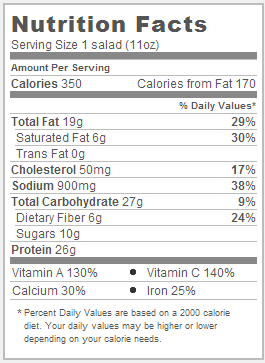
Trader Joe’s MexiCali Salad with Chili Lime Chicken – Nutrition Facts
Trader Ming’s (Trader Joe’s) Kung Pao Chicken
Posted: August 29, 2013 Filed under: Chicken, Frozen Food, Meat, Trader Joe's Brand | Tags: chinese, kung pao, trader ming 10 Comments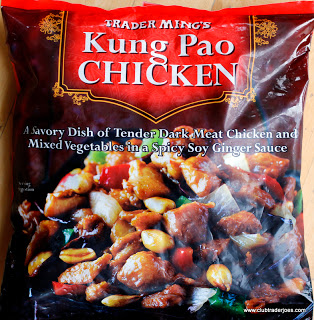
Tastes even better than it looks.
This, folks, is a classy frozen meal. When it comes to frozen dinners there are many terrible ones and a few tasty ones – then there are the classy ones. A classy dish is one that turns from frozen, straight-from-the-supermarket food into something that makes you feel like a real person – a dish you’d be happy to serve your family, not just shovel into your mouth alone. Our old friend Hake en Papillote was such a classy dish, and TJ’s Kung Pao Chicken is another. It tastes so good, and cooks up so easily, that and looks so nice on your plate (peanuts and spicy red peppers included!) that you can’t help but feel like a skilled chef.
Before I get into exactly why this Kung Pao is so tasty, a few words on its history are in order. Like many traditional dishes, Kung Pao chicken has a fascinating story that needs to be heard. Kung Pao chicken popped into existence in the 1800’s in the spicy Szechuan region of China. It quickly exploded in popularity, becoming a darling of restaurants all across the nation, until it abruptly ceased to exist one day in 1966, and wouldn’t return to tables for two decades. This sudden disappearance was, of course, the fault of Ding Baozhen, an aristocrat who died in the Qing Dynasty nearly a hundred years earlier.
“Kung Pao” literally means “Palace Guardian”, which just happens to be the title that noble Ding, then governor of Shichuan province, bore. Due to reasons lost to time, Govenor Ding was bestowed the honor of having this delicious, spicy chicken dish named after him. Kung Pao glorified Ding on menus across the kingdom until the sudden, alarming rise of Communism in the mid 60’s China and the ensuing Cultural Revolution. The Cultural Revolution was a period of intense fanaticism in China, and chief among its various purposes was to unmoor modern China from it’s imperial roots. Practically, this meant rewriting all of Chinese history, right down to the incidentally named local fare. As a result, from the 1960’s to the 1980’s, Kung Pao, though still served, was no longer known as Kung Pao. Officially, it was now known as “Hongbao Jiding” or “Fast-fried chicken cubes”.
At the exact same time, Kung Pao was experiencing great turbulence in the immigrant kitchens of Chinese Americans. There the savory dish was suffering an identity crisis of similar magnitude as in China. While the name persisted unchanged, its ingredients started to undergo a radical revision. Authentic Chinese Kung Pao hinges on one key ingredient, the Sichuan peppercorn – an ingredient common throughout Szchehuan cooking. These peppercorns were responsible for the unique, tingling zing Kung Pao was supposed to have on the tongue and lips. The peppercorns flowed freely into American ports until 1968, when Uncle Sam slammed the door. The problem? A botanical ailment known as “citrus canker” was devastating American crops and Sichuan peppercorns numbered among the disease’s potential vectors. With the fate of the Florida orange at stake, Sichuan peppercorns had to go. For 32 years, all the way until the year 2000, the peppercorns were banned from these shores, forcing Kung Pao to mutate into a different form – the peppercorn-free, vegetable-laden dish we know today.
Communism has fallen and the Sichuan peppercorn is again freely available, but the path of western-style Kung Pao is firmly implanted in the American mind. This isn’t a bad thing – bringing a delicious new form of food into the world can never be a bad thing – and Trader Joe’s has mastered the medium perfectly. I’ve been known to bandy the word “mastery” around fairly lightly, but in this case it absolutely applies. I’ve sat down to a plate after plate of Kung Pao chicken in numerous Chinese restaurants and I can firmly say that, like minestrone before it, the Trader Joe’s version is better than all of them.
I’ll be damned if I know how they packed that much goodness into a frozen bag, but they managed it. Snap open the 1 lb+ bag (cost, a damn reasonable $4.99), and you’ll find some frozen, breaded chicken, a bag of frozen veggies (bell peppers, onions, and water chestnuts and of course super hot peppers), two sacks of tangy sauce, and a baggy of halved peanuts. There are microwaveable instructions on the bag but disregard these – they’re only there to tempt the weak-willed. Your choice should be skillet cooking, which could not be easy, quicker or more rewarding. I’m generally a klutz in the kitchen, but even I can brown chicken in a tablespoon of oil, add the vegetables until they soften, mix in sauce and garnish with peanuts. Nothing more than that, and you end up with a somewhat sweet, salty, savory dish of tender chicken, crunchy veggies and yielding peanuts, all held together by a brilliantly balanced sauce and a thread of fire.
The only complaint I can level against the Kung Pao is that it comes with too much sauce. Two packets is more than you need – but this is as easily solved as putting one packet aside before cooking. If only all of life was this easy.
The Breakdown
Would I Recommend It: I absolutely would.
Would I Buy It Again: I already have.
Final Synopsis: A turbulent history has culminated in this better-than-restaurant Kung Pao chicken.
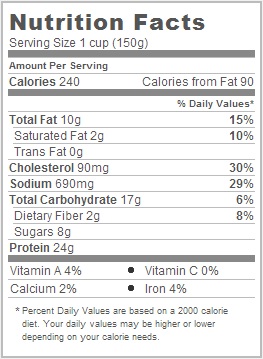
Trader Joes Kung Pao Chicken – Nutrition Facts
Trader Joe’s Many Clove Garlic Cooking and Simmer Sauce
Posted: August 27, 2013 Filed under: Condiments, Garlic, Sauces, Spices, Trader Joe's Brand | Tags: 40 clove garlic sauce 23 Comments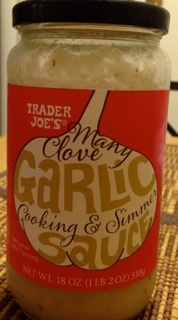
So much garlic they can barely fit the label on the jar.
On the bottle of Trader Joe’s Many Clove Garlic Cooking and Simmer Sauce, Joe himself lays it down, explaining that the jar contains garlic, “minced garlic, roasted garlic, garlic puree and granulated garlic”. That’s a lot of garlic, suckers. This is the sauce that Joe made to compensate for growing up in a garlic deprived household. There’s more garlic in here than there is in a clove of garlic. 110% of your USDA recommended annual allotment of garlic is in this sauce. This sauce is Trader Joe’s way of ensuring that no one ever kiss each ever again. Outside of the Stinking Rose, and Van Helsing’s kitchen, this is the most garlic you’re going to find in one place.
Open this jar up, dip a fork in, and put it right on your tongue. Feel that? That high burn that comes to the fore after a second? The way it zings your tongue? That’s the allicin at work – the same potent compound found in onions and chives. Famed for it’s antibacterial / anti-viral properties, what you’re feeling is Trader Joe’s Garlic Sauce actually cleaning your tongue. What I’m saying is, that’s a lot of garlic.
What we’re really tasting is a sauce known elsewhere as 40 Clove Garlic Sauce. A sauce made with exactly that – 40 cloves of garlic. According to Trader Joe’s own packaging, they didn’t keep count of how many cloves were jammed into this jar, which either means this sauce has more than 40 cloves, in which case someone needs to rein in the madmen in Trader Joe’s R&D, or it has less than 40 cloves, which case the thought of real 40 clove garlic sauce scares me.
But of course, this sauce isn’t meant as a dipping sauce or condiment, it’s a cooking and simmer sauce, and in such a role the garlicky nature of the sauce is much ameliorated. Mixed with pasta, or cooked up with chicken, this sauce retains its strong garlic flavor but mercifully loses the sting. If you like garlic this is a great sauce to work into any Italian inspired cooking. If you don’t, you still might want to give it a shot, because this is a garlic sauce done right. The garlic taste is heavy, but the creamy sauce isn’t – containing only a slender 4 grams of fat and 70 calories per ½ cup serving. The sodium on the other hand, is intense. 930 mg are packed into each serving, roughly 2/3rd of your daily recommend amount. Despite this sodium load, the sauce doesn’t taste notably salty. Mostly it all vanishes in the garlic blitzkrieg.
I like this sauce, but I’m also a man who went through a phase where I chewed up a raw clove of garlic every morning based a vague notion that it was supposed to enhance your endurance. This sauce may well be just too garlicky for some folks there, but for the rest of the population I have to give it a hearty, and healthy, recommendation.
The Breakdown:
Would I Recommend It: Yes, unless you’re sensitive to garlic, or a Transylvania count.
Would I Buy It Again: A healthy, creamy Italian cooking sauce? Absolutley.
Final Synopsis: Very low fat, very high sodium, very, very garlicky sauce.

Trader Joe’s Many Clove Garlic Cooking and Simmer Sauce – Nutrition Facts
Trader Joe’s Chile Spiced Mango
Posted: August 22, 2013 Filed under: Fruit, MANGO!, Trader Joe's Brand | Tags: chile, chile-spiced, Dried Fruit 1 Comment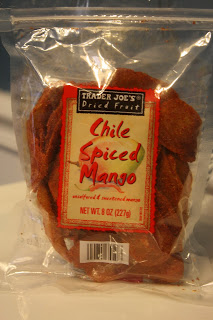
I mean, they look fiery, don’t they?
Did I eat the entire bag of Trader Joe’s Chile Spiced Mango slices in one day? Yes. Did it taste very good? Not really, no.
My ongoing struggle with the world’s most addictive fruit has been well documented. If there is mango in my house, dried or otherwise, there is an increasingly likelihood, day by day, that I will enter a mango frenzy, stuff it all into my mouth and once, then burst into the streets looking for more. Even now I feel the mango-craving beast within stirring in my breast, it’s insatiable hunger for mango only whetted by this offering. I hold it safely in check – for now. If the chile spiced mango had been a tastier treat, it’s unlikely that would be the case.
A brief lapse in my mango defenses resulted in me buying this sachet of dried fruit the other day. The chili spiciness is what got me. Faithful readers might remember this post about chile spiced dehydrated pineapple from early on. The ecstasy of that sweet napalm still tingles on the edge of my tongue, and the thought of that but in mango form was a lure I could not resist. Sadly, the reality was a faint shadow of the dream.
By no means was this my first encounter with chili powder on fruit, let alone mango. As a denizen of that astonishing salmagundi we know as Los Angeles, I’ve purchased my share my share of fresh, sliced fruit from curbside cart pushers. Always it’s handed to you with a healthy dusting of rusty red cayenne pepper. Not necessarily
my favorite way to enjoy fresh fruit, but certainly a tasty option. My hope was that Trader Joe’s, with their network of chefs and deep coffers, would have perfected this local delicacy. What I got was something no self-respecting street vendor would give you.
Trader Joe’s Chile Spiced Mango is bland. With every bite you’re expecting a blast of intense hotness, tempered by the profound amplitude of succulent mango. This is what you never get. This is the worst dehydrated mango I’ve had from TJ’s. The mango taste is subdued and flat, not so much hidden by the chile powder as absent all together. Meanwhile, the chili powder itself is practically impotent. I get that when you’re selling to a national market you need to tone down the heat, but I’ve had mild salsa with more kick than this chili pepper. There’s a brief hint of fire, like a match threatening to light, that immediate vanishes into a dusty, indistinct taste.
It’s two ingredients, Trader Joe’s! If you’re going to spice something with chili powder, actually spice it. If you’re going to use mango, then let us taste the mango. Yes, I’ll eat the entire bag (it is mango after all), but I’m not going to like it.
The Breakdown:
Would I Recommend It: Not unless you like bland mango.
Would I Buy It Again: Not until it’s the last mango available to me on Earth. Then yes.
Final Synopsis: “A bland, timid entry, suitable for patients recovering from surgery.” -Homer Simpson
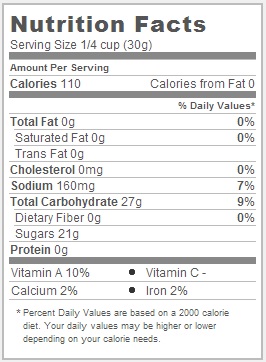
Trader Joe’s Chili Spiced Mango – Nutrition Facts
Trader Joe’s Honey Roasted Macadamia Nuts
Posted: August 20, 2013 Filed under: Macadamia nuts, Nuts, Trader Joe's Brand | Tags: honey roasted, macadamia Leave a comment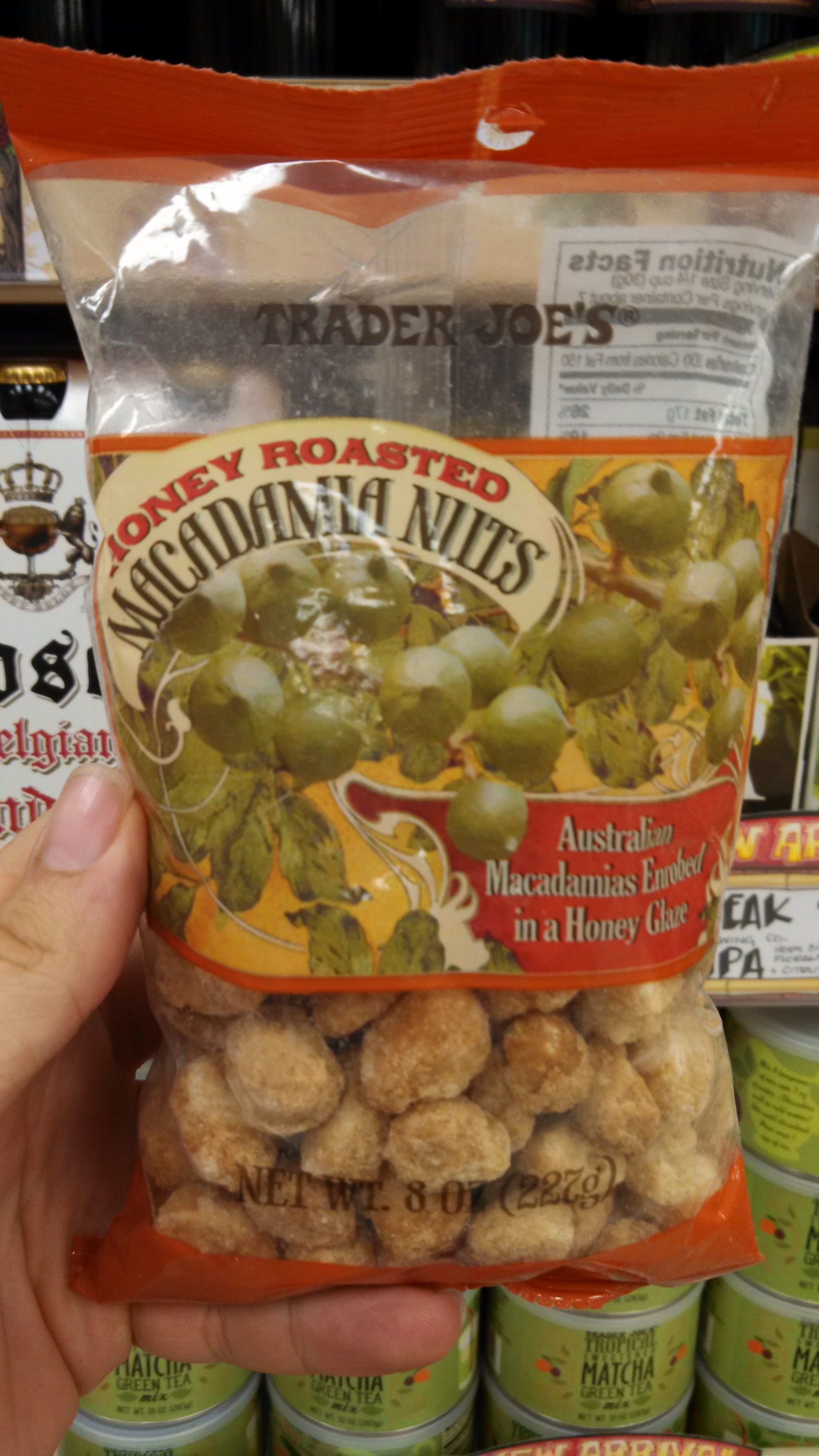
Evidently macadamia nuts grow in little green pods. Who knew?
Oh very nice, Trader Joe’s! I’m not sure which genius came up with the idea of honey roasting nuts all those many years ago, but someone needs to give him some sort of award. Roasting nuts with honey? It’s an idea that would’ve been laughed out of the building if it hadn’t been so damn brilliant! In any case, it’s put to excellent use here on Trader Joe’s Honey Roasted Macadamia Nuts.
While swapping out the peanuts in peanut butter might have left something to be desired, when it comes to snacking nuts any variety is a welcome change of pace.
The first thing you’ll notice with these little nuggets, even before the different taste of the nut itself, is how well the honey-roasting was done. These things really taste like honey. The moment you drop one on your tongue, you’ll be met by a brief candied sweetness followed by the distinct, lingering note of real honey. It’s eye opening, especially when compared to name brand honey-roasted nuts (Mr. Peanut, I’m looking at you) where “honey-roasted” just means, vaguely sweet.
I found this real honey taste quite delightful but, to be frank, I can imagine it may not please everyone. It’s a bolder and more nuanced taste than plain, sugary sweetness, and it demands you pay attention to what your tongue is doing. A thinking man’s honey roasted peanut, if you will.
The macadamia nut itself is, I would hope, not unknown to you. If you’ve never had a white chocolate and macadamia nut cookie, you need to get your butt out that door right now and try one. Let’s just say, if I want to kiss the guy who invented honey roasting, the guy who invented this cookie is in danger of a marriage proposal.
The macadamia nut is mild tasting nut with a light, clean taste that doesn’t linger on the tongue, like the brittle almond or bitter walnut. A macadamia nut makes itself a welcome guest in your mouth, but does not overstay.
The roasted macadamia nut not only has a completely different taste than the peanut, but a different crunch as well. This crunch bears a few words. Your typical macadamia nut is maybe 50% larger than a standard issue peanut, and very round – almost spherical. This, to me, makes for an almost indecently enjoyable munching experience. A macadamia nut really gives you something to grip in your incisors and cleanly bisect, something to put up a brief, satisfying resistance before giving way beneath set of molars. Tremendously satisfying.
Of course, on the other hand, it’s quite oily. In fact, the macadamia nut is one of the fattiest nuts around, and one of the lowest in protein to boot. 17 grams of fat for only 2 grams of protein. By comparison, TJ’s Honey Roasted Peanuts have 13 grams of fat and 5 grams of protein per serving.
On a pure taste basis, I’d prefer these over honey roasted peanuts most any time, but there’s no reason the world can’t accommodate both varieties. These could be a perfect addition to a trail mix, or even mixed in with honey roasted peanuts in the nut bowl to create a more nuanced party snack.
The Breakdown
Would I Recommend Them: Yes, to all and sundry.
Would I Buy Them Again: These could go over well at my next cocktail party.
Final Synopsis: If the higher fat doesn’t put you off, this is a great roasted nut.
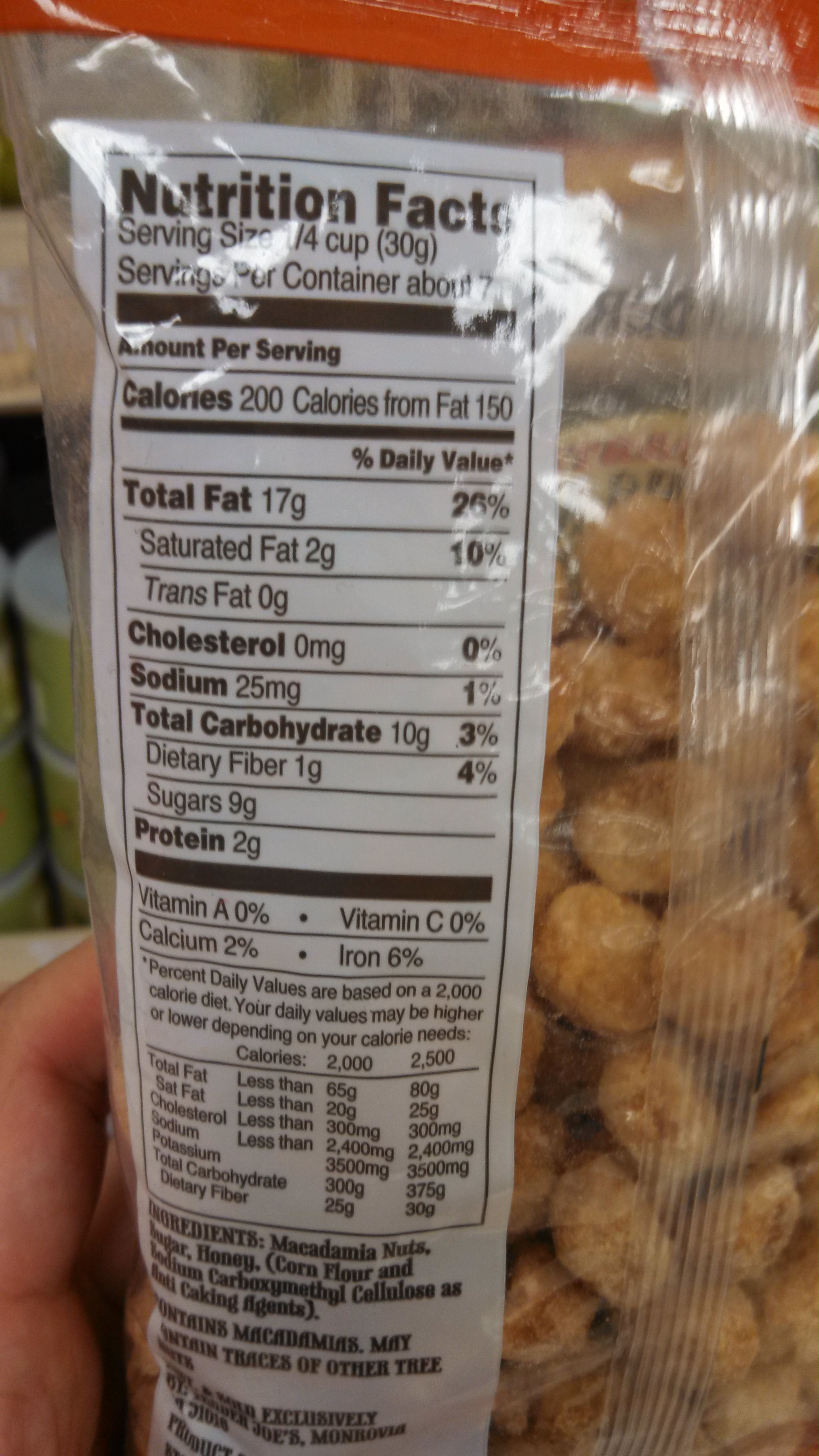
Trader Joe’s Honey Roasted Macadamia Nuts – Nutrition Facts
Trader Joe’s Creamy Almond Butter & Trader Joe’s Crunchy Almond Butter
Posted: August 15, 2013 Filed under: Condiments, Peanut Butter, Spreads, Trader Joe's Brand | Tags: almond butter 5 Comments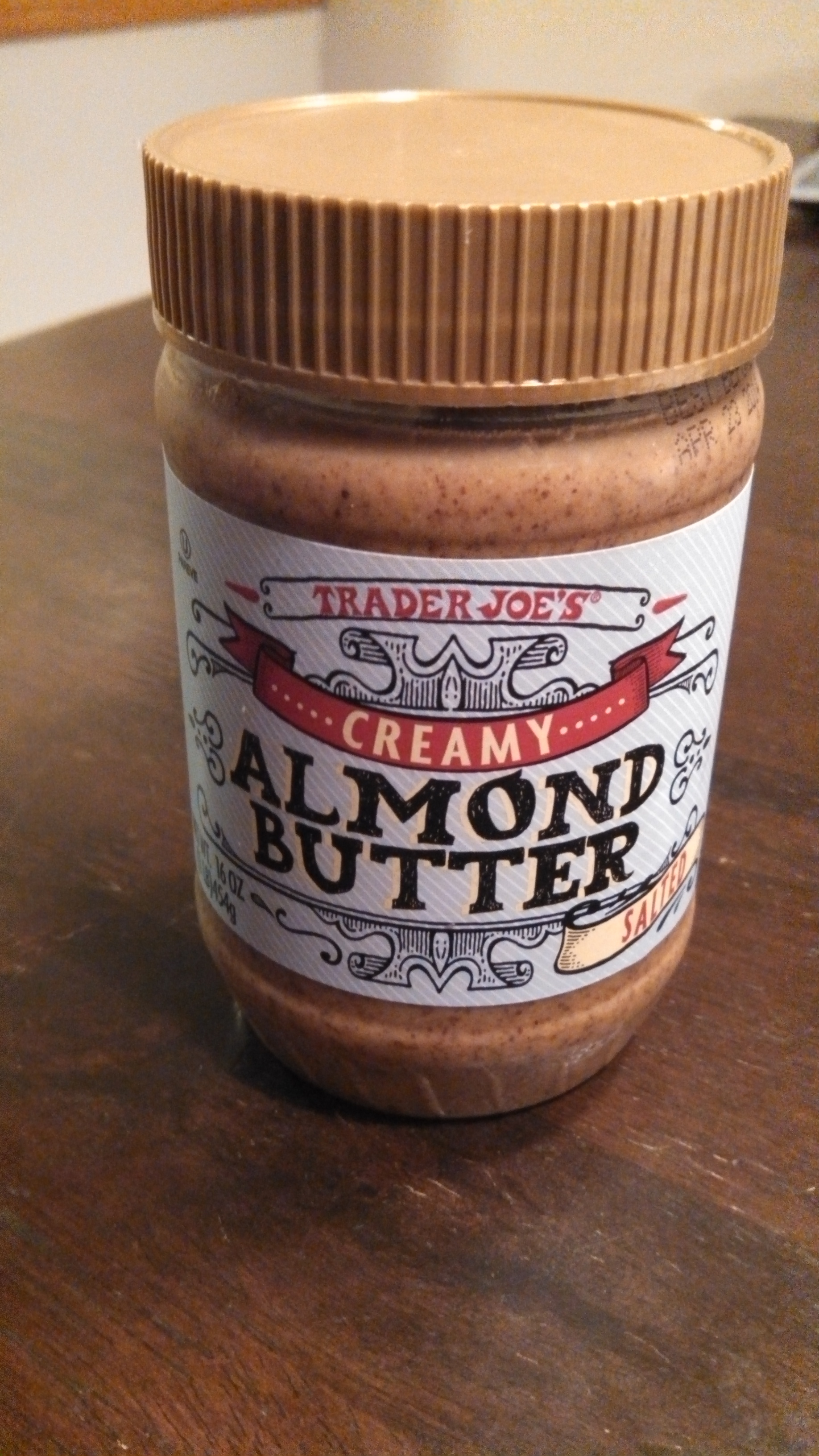
Almond butter, the Hydrox of the peanut butter world.
When I first set eyes on Trader Joe’s Almond Butter, my heart did a little leap. After all, the last time Trader Joe’s unveiled a new butter, it was an epochal, life-changing event. History had prepared me for another smash hit. Unfortunately, history was setting me up for a fall. This new almond butter is a very average spread with little to recommend it.
Both new almond butters are the “stir” variety, with a thick layer of oil on top that needs to be mixed in before using. This is, as always, the tell tale sign of the “natural” nut butter. Trader Joes’ creamy and crunchy almond butters follow in this proud, healthy tradition. Salt has been added, but only 60 mg which is rock bottom by commercial standards, and sugar is at a minimum, with only 2 grams per serving. Of course, that means it lacks that tongue pleasing tingle that you get with additive laden, less healthy butters, but a little mouth-plastering blandness has ever been the price for healthful eating.
All of that’s fine by me. In both taste and nutrition it’s about the same as the natural, stir peanut butters that Trader Joe’s offers, but that is exactly my problem – there’s no meaningful difference netween these almond butters and their peanut counterparts. Even in taste, we’re only talking about a very subtle change to the underlying nuttiness of the spread, one that you might be able to identify in a side-by-side taste test but which, when incorporated into a sandwich etc, is practically interchangeable with a natural peanut butter.
If there’s something I’m missing here, please clue me in to it. Frankly, I don’t see the appeal or rationale for almond butter. There are, I’m aware, people with peanut allergies. Is that the whole market almond butter was made for? At the risk of sounding intolerant, I think we can all agree that these “people” should simply acclimate to life in the margins of society. Suck it up, peanut allergienes!
I really, really do not understand almond butter. Yes, we can make our nut butters out of things other than peanuts, and we can make car tires out of wood and books that are 25 feet tall. We can do a lot of things – but a lot of things don’t make sense to do. It’s not like we’re talking about hazelnut butter here, which brings a totally new and delicious taste to the table. Now, I’m always a proponent of a broad selection and innovation in the food market – but only to the extent that it makes sense, and almond butter doesn’t make sense to me. It’s like laboring tirelessly to create Hydrox cookies, then trying to sell them for more than Oreos.
Aside from aiding the peanut sensitive, there really doesn’t seem to be a good reason for almond butter to exist. Jokes aside, I am glad that it exists for that reason at least. My heart really does go out to people who suffer from peanut allergies. I can only imagine the nightmare of living in a world where the peanut, one of the most widely used foodstuffs, has the power to incapacitate and/or kill you. Peanuts are tiny. They could be anywhere. Not to mention that they’re often incorporated with absolute stealth into a bewilderingly huge assortment of food product, and the only tip off is a tiny line of small type hidden under the bar code. That’s like living in a war zone where all the enemies are invisible, but give you a quick “Heads up!” before opening fire.
Ulitmately, I feel about Trader Joe’s Almond Butter about the same way I feel about their sunflower seed butter – good on them for giving us more options, but there’s nothing compelling about the product, unless it be the brief, sad thrill of the blandest form of rebellion conceivable. “Forget what those mainstream losers are doing – I’m putting almond butter on my sandwich.”
No sir, it doesn’t make sense to me at all. You can leave me with Better’n Peanut Butter for my PB alternative.
The Breakdown:
Would I Recommend It: No, unless you have peanut allergies.
Would I Buy It Again: Never.
Final Synopsis: 90% identical to peanut butter, only more expensive.

Trader Joe’s Creamy Almond Butter – Nutrition Facts
 Eating At Joes
Recent Comments