
Trader Joe’s Quinoa Duo and Vegetable Melange
Posted: February 6, 2014 Filed under: Frozen Food, Quinoa, Trader Joe's Brand, Vegetables, Zucchini | Tags: red quinoa, Sweet Potato, Trader Joe's, white quinoa, zucchini 7 Comments
QUINOA!
Trader Joe’s Qunoa Duo with Vegetable Melange is the sort of healthy fare I turn to when the New Year rolls around and the scale starts broadcasting dire warning vis-a-vis my sexiness. I’ve touched upon the intricacies of quinoa before, but this is the first time I’ve really sat down for an all quinoa dish.
The big deal with quinoa, and the cornerstone of its popularity, is the fact that quinoa contains a balance of all nine essential amino acids, in other words it’s a “complete protein”. This is common among meats, but rare in the plant world which makes it a boon to vegetarians. While that’s not me, I was particularly excited by the notion that I would be eating both red and white quinoa at once. Two quinoas? They must be, like, wildly different right? Otherwise, why mix them together? Sadly, I was a let down to discover that red and white quinoa are practically identical. The only real difference is that red quinoa is a little more toothsome than white quinoa, and doesn’t clump as much.
Trader Joe’s Quinoa Duo combines the quinoas with cubed zucchini and sweet potato, tinged with a bit of tomato sauce. The result is about as strange as it sounds. I’ll be upfront with you, I didn’t much love this one. It’s not that I dislike quinoa – I like it just fine, sometimes I even love it, and it’s not that I dislike vegetable melanges either, I’ve had one or two from TJ’s that I’ve quite enjoyed. The problem for me came in the mixture of everything together.
Quinoa has a decidedly nutty flavor.This works well with the sweet potato, and reasonably well with the zucchini, but for some reason Trader Joe’s decided to put a french twist on the dish. This takes the form of a tomato flavoring that is mixed in with the dish – not so strong as to really stand on its own, just strong enough to sort of throw the other flavors off. It certainly makes for a complex taste, but to me it came across as more of a mess of flavors than a medley.
Really, though, how much you like this dish will come down to how much you like hot quinoa . Although the words “vegetable melange” are right there in the title, don’t come to this dish expecting much more than quinoa. The pseudograin-to-veggie tradeoff is something like 80 – 20, meaning for every big mouthful of quinoa you’ll get a couple bits of zucchini or sweet potato. That also means that, despite Trader Joe’s urgings to the contrary, this doesn’t make a very good main dish. Undoubtedly there’s room to find a good entree pairing here that will elevate the rather confused taste of the quinoa duo to a higher level, although I couldn’t tell you what that would be.
If you’re really interested in working this quinoa duo into your diet, I reckon the best approach is to disregard Trader Joe’s serving suggestions entirely. Cool down the quinoa after you cook it up, and turn it into a salad base. You can find one good recipie for just that on this blog. Mixed with the right combination of veggies and seasoning this quinoa duo can become something great – by itself, not so much.
The Breakdown
Would I Recommend It: Yes, to undernourished vegetarians and adventurous salad makers. No to most others.
Would I Buy It Again: No, I wasn’t really into it.
Final Synopsis: Lots of good qunoia with a strange tomato taste.
Trader Joe’s Poutine
Posted: February 4, 2014 Filed under: Cheese, Fries, Frozen Food, Trader Joe's Brand | Tags: canadian nachos, gravy, poutine, Trader Joe's Leave a comment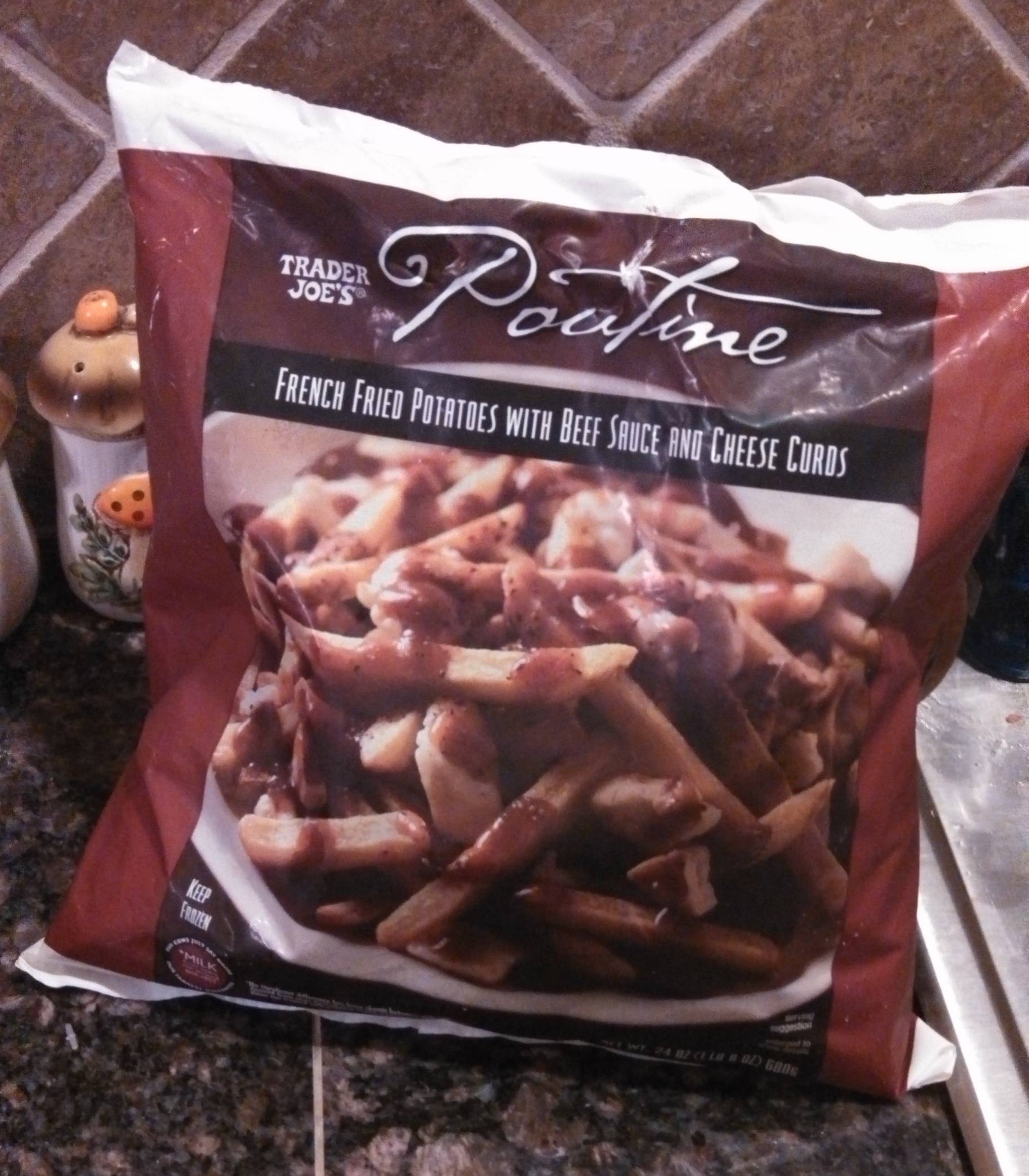
A font that fancy even makes poutine look classy.
Put on your checkered, ear-flap caps readers, because today we’re going full Canadian with Trader Joe’s Poutine.
Poutine – what is poutine? What is this strange word, this strange brown bag smiling broadly at us from the depth of the freezer section? What do french fries, cheese curds and gravy have to do with each other? To put it simply, poutine is French Canadian nachos – only instead of tortilla chips you have fries, and instead of melted cheese you have gravy, and instead of jalapenos you have melted cheese. Yes, I know that’s confusing, but there’s no avoiding that. Only a Canadian can truly understand poutine – just as only Aussies can truly understand Vegemite, only Scots can truly understand Irn-Bru and only Americans can truly understand root beer. Nevertheless, I’ll do my best to explain.
Basically, what you get with Trader Joe’s Poutine is a big bag of frozen french fries, a packet of beef gravy and a packet of cheese curds. The idea is, you cook the fries in your oven, while warming the gravy and curds on the stove top. Once everything’s ready, you top the fries with the curds, drizzle the gravy over the whole lot, then eat it with a fork/your fingers. It’s a sloppy heap of messy, salty savory junk food perfect for anytime you feel like abandoning your goals and dreams in favor of immediate mouth-stuffing gratification – again, not unlike nachos.
I’d never had poutine before, which presented me with a unique challenge. How could I fairly review Trader Joe’s Poutine, and thus avoid incurring Cannuck ire, without anything to compare it against? Where was my control group? A Google search revealed the depth of my problem. Although poutine is wildly popular in the barren polar regions of North America, it doesn’t have much of a presence anywhere so far south in America as Los Angeles, CA.
I was able to find a number of upscale restaurants offering their own nouveau fusion versions of poutine designed to downplay the more uniquely Canadian side of poutine (read: giant salty cheese curds) in favor of a more marketable, bastardized dish, but little in the way of real, authentic poutine. For a moment I thought I’d found a lucky break in the form of the Gravy Train Poutinerie – a poutine slinging mobile food truck promising real, home-style poutine – but an examination of their Twitter account revealed that they moved operations to the greener pastures of Salt Lake City, UT in October 2013. Things were getting depressing.

If nachos are the nachos of Mexico, and poutine is the nachos of Canada, what are the nachos of the US? Still nachos?I’m not sure, but leave your best guess in the comments.
Finally, I found success at Little Fork, Hollywood – a cool little box of a restaurant dedicated to serving Canadian food up right. Over a couple cheap Molsens I enjoyed my first real poutine – smoked meat gravy, gooey cheese curds and all. Folks, it was a delicious heap of a hot mess.
So it was with considerable anticipation that I cooked up Trader Joe’s Poutine on my stove. After following the direction and digging in – I’m sorry to report that I didn’t like it very much at all.
The gravy is fine, and the cheese curds, though saltier than I like, are as thick and squeaky as you could ask for. The problem, unfortunately and unavoidably, is in the fries. It’s next to impossible to cook fries in an oven and have them be anywhere as near as good as fries out of a deep fryer. Countless brands have tried to do it, but none, not ever Trader Joe’s, has succeeded. Without the deep fryer, fries aren’t fries – they’re just dull potato planks.
There are some other minor difficulties with Trader Joe’s Poutine – I found it hard to heat up the cheese curds without them melting together into a big blob, even by heating them in a water bath, but these are only petty concerns. The heart of a good poutine is in the good fries – take those away and your might as well just have your cheese and gravy on a baked potato. Honestly, you’d be much better off buying some good fries from a takeout joint and adding the curds and gravy to them than you would be buying this frozen bag of flat potato slices. Thank you, Trader Joe’s, for bringing us the delicacy of rural Quebec, but these fries simply won’t do.
The Breakdown
Would I Recommend It: Not with these fries I wouldn’t.
Would I Buy It Again: No – I’ll just wait for the Poutinere to wheel it’s way back here.
Final Synopsis: The great Quebecoise cuisine brought low by inadequate fries.
Trader Joe’s Petite Seafood Croquettes
Posted: October 8, 2013 Filed under: Fish & Seafood, Frozen Food, Shellfish, Trader Joe's Brand | Tags: croquettes, imitation crab, seafood, surimi Leave a comment
Made with imitation crab – TJ’s makes a clean breast of it right in the title.
Trader Joe’s Petite Seafood Croquettes are pretty dang good. Maybe not New England crab shack good, but still good in their own right. Of course, these seafood patties are not to be confused with Trader Joe’s Maryland Style Crab Cakes, Seafood Crab Cakes or, really, anything that might actually contain anything like real crab. These mini seafood croquettes are, of course, made with imitation crab, also known as krab, mock crab, or seafood extender, but most commonly called by it’s official name surimi.
No doubt you have encountered the let down that is surimi imitation crab many times in your life when you thought that maybe you were actually eating real shellfish. Those happy moments come to you via far eastern Asia, a land known for it’s love of heavily processed deep sea food products. Surimi first popped into existenece in Japan, 1963, in the chilly Hokkaido food laboratory of one Nishitani Yosuke, the man who first industrialized the process of taking nearly any sort of cheap, white fish and machine processing it until it becomes a semi-gelatinous, bland lump. Surimi is produced for it’s texture first and foremost, then flaovred as needed to resemble the crab/lobster/scallops/whatever is more economically, if not culinarily, desierable.
So cost effective was Mr. Yosuke’s discovery that it was immediately taken to heart by food manufacturers the world over. Today 2-3% of the global fish catch is directly processed into surimi. That’s roughly 3 million pounds of fish going under the mechanical pulverizers annually or, to put it another way, about 4 tons of surimi being extruded every day.
Most surimi is made from pollock, or our old friends hake. The surimi that we’ll be trying today comes from the threadfin bream, a very boring normal looking fish that you’d forget about as soon as you saw it. Explaining to you what threadfin bream tastes like would be beside the point of this article. Trader Joe’s seafood croquettes has about as much in common with the fish they’re made from as dinosaurs have with the fuel in your gas tank.
So with all that out of the way, what can you expect from one of these croquettes? A rather pleasant experience actually. Despite the mishmash of quasi-seafood ingredients going into these seafood cakes, they taste pretty close to the real deal. Certainly close enough that you won’t mind paying only $4.99 for the box of them. The mock crab is mixed with egg whites, sour cream, cheese, breadcrumbs and a variety of dehydrated veggies. The result is a very passable entree. A quick trip to the oven will get these guys lightly browned, crispy on the outside, and tender in the center – perfect for crunching lightly between the teeth. They smell just right as well, rich and savory with an aroma very near real crab.
This are basically high quality fakes – they won’t impress anyone looking for the real thing, but if you’re in the market for similacra it’s going to be hard to find better than this. My only real complaint is that they are a little off putting visually. As you can see in the above photo, they look less like the hand-formed patties shown on the box and more like they were squeezed out of a tube into row out of row of pre-sized receptacle. It’s the one touch that breaks the illusion that you are eating real seafood.
The Breakdown
Would I Recommend Them: Yes, to anyone who can’t afford real crab cakes.
Would I Buy Them Again: Yes, since that includes me.
Final Synopsis: A high-quality crab cake fake.
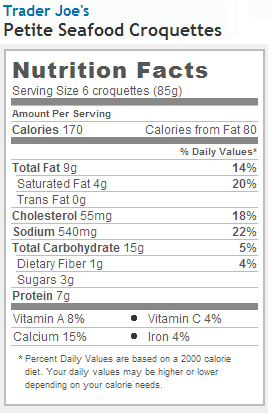
Trader Joe’s Petite Seafood Croquettes – Nutrition Facts
Trader Ming’s (Trader Joe’s) Kung Pao Chicken
Posted: August 29, 2013 Filed under: Chicken, Frozen Food, Meat, Trader Joe's Brand | Tags: chinese, kung pao, trader ming 10 Comments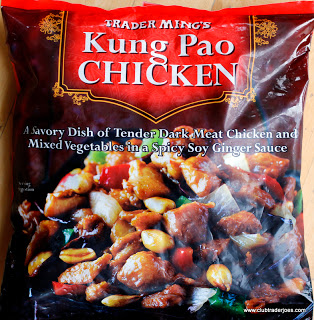
Tastes even better than it looks.
This, folks, is a classy frozen meal. When it comes to frozen dinners there are many terrible ones and a few tasty ones – then there are the classy ones. A classy dish is one that turns from frozen, straight-from-the-supermarket food into something that makes you feel like a real person – a dish you’d be happy to serve your family, not just shovel into your mouth alone. Our old friend Hake en Papillote was such a classy dish, and TJ’s Kung Pao Chicken is another. It tastes so good, and cooks up so easily, that and looks so nice on your plate (peanuts and spicy red peppers included!) that you can’t help but feel like a skilled chef.
Before I get into exactly why this Kung Pao is so tasty, a few words on its history are in order. Like many traditional dishes, Kung Pao chicken has a fascinating story that needs to be heard. Kung Pao chicken popped into existence in the 1800’s in the spicy Szechuan region of China. It quickly exploded in popularity, becoming a darling of restaurants all across the nation, until it abruptly ceased to exist one day in 1966, and wouldn’t return to tables for two decades. This sudden disappearance was, of course, the fault of Ding Baozhen, an aristocrat who died in the Qing Dynasty nearly a hundred years earlier.
“Kung Pao” literally means “Palace Guardian”, which just happens to be the title that noble Ding, then governor of Shichuan province, bore. Due to reasons lost to time, Govenor Ding was bestowed the honor of having this delicious, spicy chicken dish named after him. Kung Pao glorified Ding on menus across the kingdom until the sudden, alarming rise of Communism in the mid 60’s China and the ensuing Cultural Revolution. The Cultural Revolution was a period of intense fanaticism in China, and chief among its various purposes was to unmoor modern China from it’s imperial roots. Practically, this meant rewriting all of Chinese history, right down to the incidentally named local fare. As a result, from the 1960’s to the 1980’s, Kung Pao, though still served, was no longer known as Kung Pao. Officially, it was now known as “Hongbao Jiding” or “Fast-fried chicken cubes”.
At the exact same time, Kung Pao was experiencing great turbulence in the immigrant kitchens of Chinese Americans. There the savory dish was suffering an identity crisis of similar magnitude as in China. While the name persisted unchanged, its ingredients started to undergo a radical revision. Authentic Chinese Kung Pao hinges on one key ingredient, the Sichuan peppercorn – an ingredient common throughout Szchehuan cooking. These peppercorns were responsible for the unique, tingling zing Kung Pao was supposed to have on the tongue and lips. The peppercorns flowed freely into American ports until 1968, when Uncle Sam slammed the door. The problem? A botanical ailment known as “citrus canker” was devastating American crops and Sichuan peppercorns numbered among the disease’s potential vectors. With the fate of the Florida orange at stake, Sichuan peppercorns had to go. For 32 years, all the way until the year 2000, the peppercorns were banned from these shores, forcing Kung Pao to mutate into a different form – the peppercorn-free, vegetable-laden dish we know today.
Communism has fallen and the Sichuan peppercorn is again freely available, but the path of western-style Kung Pao is firmly implanted in the American mind. This isn’t a bad thing – bringing a delicious new form of food into the world can never be a bad thing – and Trader Joe’s has mastered the medium perfectly. I’ve been known to bandy the word “mastery” around fairly lightly, but in this case it absolutely applies. I’ve sat down to a plate after plate of Kung Pao chicken in numerous Chinese restaurants and I can firmly say that, like minestrone before it, the Trader Joe’s version is better than all of them.
I’ll be damned if I know how they packed that much goodness into a frozen bag, but they managed it. Snap open the 1 lb+ bag (cost, a damn reasonable $4.99), and you’ll find some frozen, breaded chicken, a bag of frozen veggies (bell peppers, onions, and water chestnuts and of course super hot peppers), two sacks of tangy sauce, and a baggy of halved peanuts. There are microwaveable instructions on the bag but disregard these – they’re only there to tempt the weak-willed. Your choice should be skillet cooking, which could not be easy, quicker or more rewarding. I’m generally a klutz in the kitchen, but even I can brown chicken in a tablespoon of oil, add the vegetables until they soften, mix in sauce and garnish with peanuts. Nothing more than that, and you end up with a somewhat sweet, salty, savory dish of tender chicken, crunchy veggies and yielding peanuts, all held together by a brilliantly balanced sauce and a thread of fire.
The only complaint I can level against the Kung Pao is that it comes with too much sauce. Two packets is more than you need – but this is as easily solved as putting one packet aside before cooking. If only all of life was this easy.
The Breakdown
Would I Recommend It: I absolutely would.
Would I Buy It Again: I already have.
Final Synopsis: A turbulent history has culminated in this better-than-restaurant Kung Pao chicken.
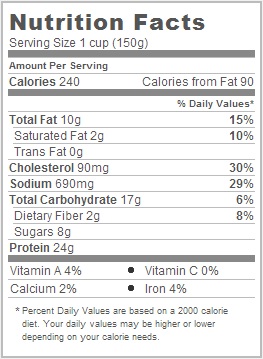
Trader Joes Kung Pao Chicken – Nutrition Facts
Trader Joe’s 4 Dried Whole Persimmons
Posted: July 2, 2013 Filed under: Frozen Food, Fruit, Trader Joe's Brand | Tags: gotgam, hoshikaki, korean delicacy 2 Comments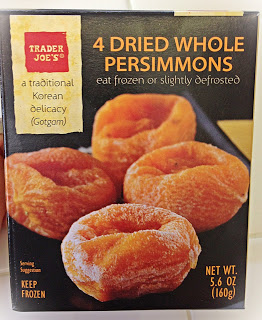
They are being very clear about how many you get. You get four.
What a totally cool item – good job Trader Joe’s! Four frozen (frozen!) tiny, whole persimmons served straight to you from Korea. Even with your history of craziness, that was an unexpected move, TJ. Nothing could have called out to me more – a tiny, dark box, sitting next to the ice cream as if it were no big deal, a total mystery even as it plainly stated that it was, in fact, 4 dried whole persimmons. It’s the sort of boldly simple statement that’s impossible to let slide – like a man who walks up to you on the street and says he can eat his own fist. What does that mean? Why are you even here? Unable to resist the pull, I took the mystery box home to investigate.
With such a straightforward title as Trader Joe’s 4 Dried Whole Persimmons you would think no one should be surprised by what they’re going to get. And yet I was more surprised by this product than I’ve ever been by anything at Trader Joe’s. I’ve covered persimmons before – I delved into the ins, the outs, and the evocative poetry of the fruit when I covered them here. Before opening the box, that’s exactly what I was expecting – four mushed up, wrinkled and brown hachiya persimmons, served cold. What I got were tiny works of art. Check these out:
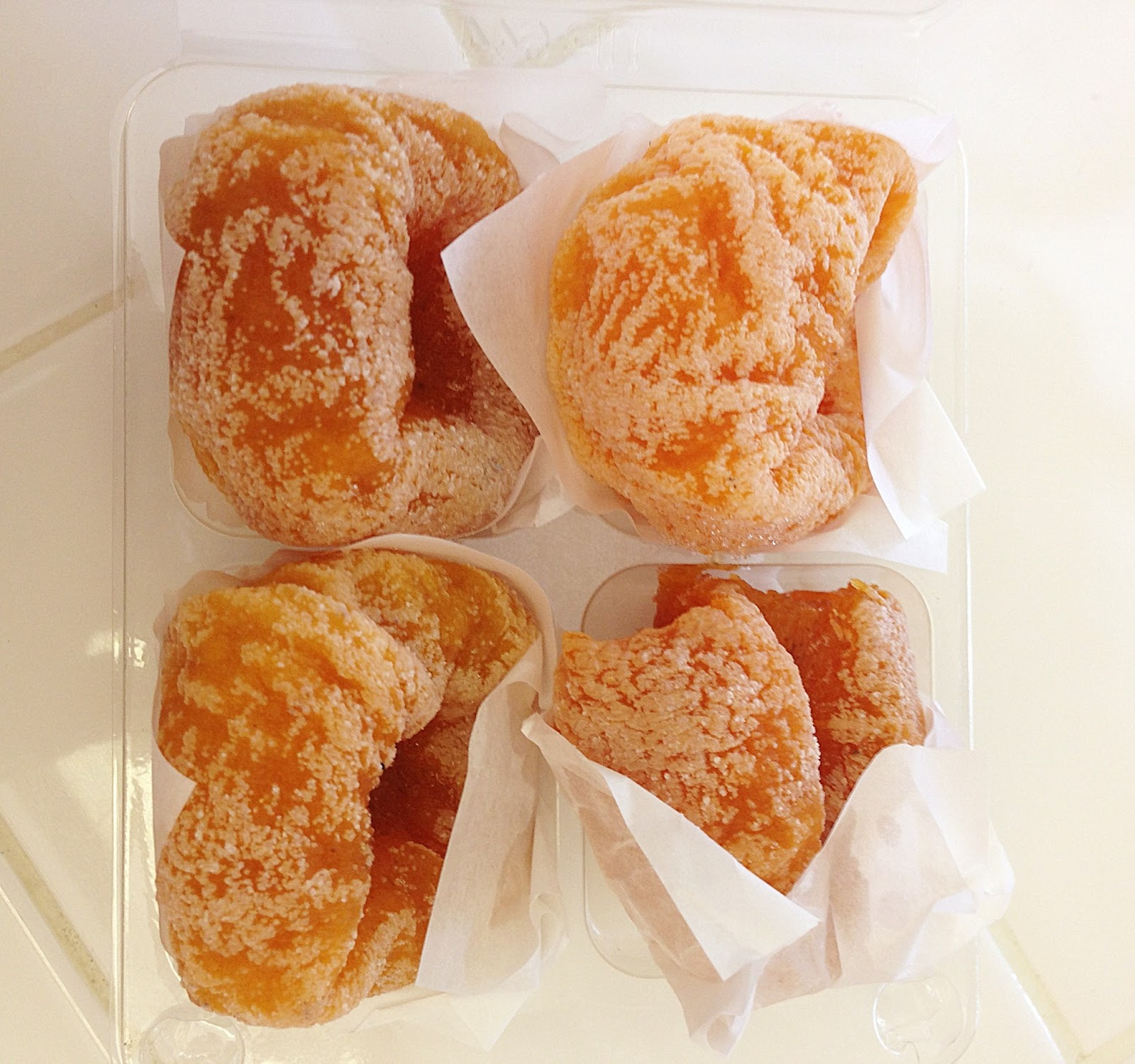
Examine that delicate whiteness tracing the edges of the fruit – since these were just taken from the freezer you might expect that to be frost. It’s not though, it’s actually the fruit’s own crystallized sugar, extruded through the skin during the long drying process and carefully preserved.
The delicacy of the dried, whole persimmon is known as gotgam in Korea and by other names in China, Japan and Vietnam. What everyone can agree on is that they’re a delicious, sweet treat. Trader Joe’s, in their continual bid for excellence, has sourced these persimmons directly from the green rolling hills of Gyeongbuk, South Korea where they are harvested each fall and then immediately dried and frozen. The drying part is common world wide – it’s the freezing part that’s uniquely Korean. Functionally meant as a way to preserve the sugary, moist fruit for the long term, it also makes for a unique way to cool down in the summer heat with a totally natural treat.
Although I’m a big fan of this strange item on the grounds of it’s unusual nature alone, there’s less I can say about the taste. Despite being frozen, these dried persimmons taste just like any other dried persimmon. Their beautiful exteriors don’t do anything to change that wonderful sweet and mealy persimmon taste of sweet potato, pumpkin and brown sugar. This isn’t a bad thing, I like the taste of persimmon, but it doesn’t really make a case for the exotic freezing, high price ($3.99 for four persimmons), or TJ’s breathless product copy.
The value of this item comes from the mystique surrounding it. If you can produce your fancy box of frozen persimmons to a few choice friends (or kids), read off the box copy (“made from the perfectly ripe hachiya persimmons of Gyeongbuk”), and pass around the gorgeous treats you’ll make a memory. Beyond that, there isn’t much difference between these and any other dried persimmon you may choose.
Breakdown:
Would I Recommend Them: Yes, if you’re a persimmon fan looking for a single memorable experience or a Korean ex-pat.
Would I Buy Them Again: The appeal of these is primarily in their novelty, so no.
Final Synopsis: Like regular dried persimmons, but colder.
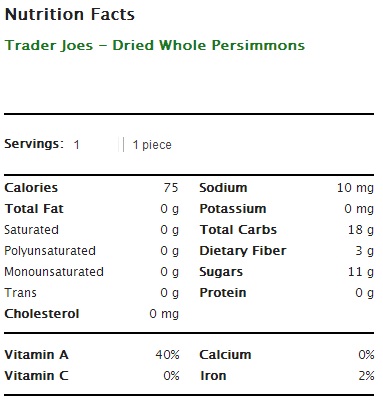
Trader Joe’s 4 Dried Whole Persimmons – Nutrion Facts
Trader Joe’s Chicken Cilantro Mini Wontons
Posted: May 14, 2013 Filed under: Chicken, Frozen Food, Trader Joe's Brand | Tags: cilantro, wonton 1 Comment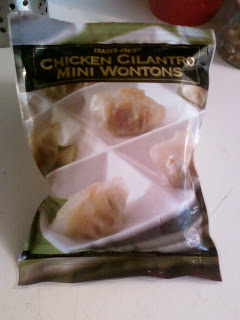
The mini wontons I get, but who has a dish with individual mini compartments for each mini wonton? You’re living in a dream world Trader Joes!
Mini wontons. What a world of astounding technical innovation this is – our computers are becoming increasingly smaller, the pixels in our devices are shrinking to infinitesimal points, and now Trader Joe’s has successfully miniaturized the wonton.
How did they manage the technological breakthrough that is Trader Joe’s Chicken Cilantro Wonton? Microchips? A pact with helpful elves? There’s no telling, but here they are nonetheless. This leaves only one question worth answering: Is it okay to just cavalierly mix cilantro into your Chinese wontons, no matter how small they are?
Actually, there’s nothing new about mini-wontons cooked with cilantro. A recipe very similar to the one Trader Joe’s is peddling can be found throughout Shanghai. As you might expect, different regions and cities throughout China have their own unique spins on the concept of wonton. Although more famous for their massive, tortellini-shaped wontons, China’s largest city also has a long tradition of peppering their soups with handfuls of these tiny, cilantro-seasoned wantons – properly called xiao huntun.
A wonton is, ultimately, a very simple recipe (some meat, some greens, a little seasoning) and lends itself to all sorts of interpretations, so there’s nothing that shocking about cilantro in a wonton. Taste-wise, there isn’t much to write about. Despite the prominent billing of cilantro in the mini-wontons, they don’t actually taste that strongly of cilantro. The potent herb is hidden under the chicken and other seasonings, only showing up later, as a mild aftertaste wafting off the tongue.
This isn’t altogether surprising, seeing that cilantro is listed in nearly the last place on the nutritional label, outdone by bean thread, salt, and green onions. This is not necessarily a bad thing, it’s easy to abuse cilantro and its presence in this dish is subtle and effective, a gentle touch that sets the wontons apart from the potstickers and gyoza of the world – just don’t come crying to it for your cilantro fix.
Cooking the wontons could not be easier. Two minutes in a microwave makes up a big batch, and pan-frying or soup based cooking directions are included as well. Add to this the generous number of wontons included in each bag (about 50) and you’ve got an easy to prepare, tasty Chinese meal for 1-3. If only they’d replace “cilantro” with “shanghai-style”, I’d have nothing to complain about.
The Breakdown
Would I Recommend Them: Easy to prepare and good tasting – definitely.
Would I Buy Them Again: With some Asian stir-fry, this could become a standard Chinese dinner for me.
Final Synopsis: A good wonton, misleadingly named.
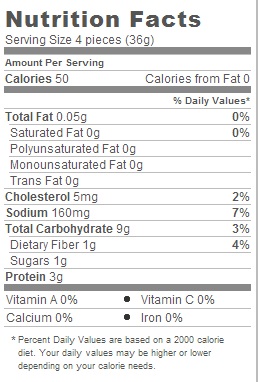
Trader Joe’s Chicken Cilantro Mini Wontons – Nutritional Facts
Trader Jose’s Vegetable Stuffed Poblano Peppers
Posted: April 30, 2013 Filed under: Frozen Food, Poblano, Trader Joe's Brand, Vegetarian | Tags: chile rellano 2 Comments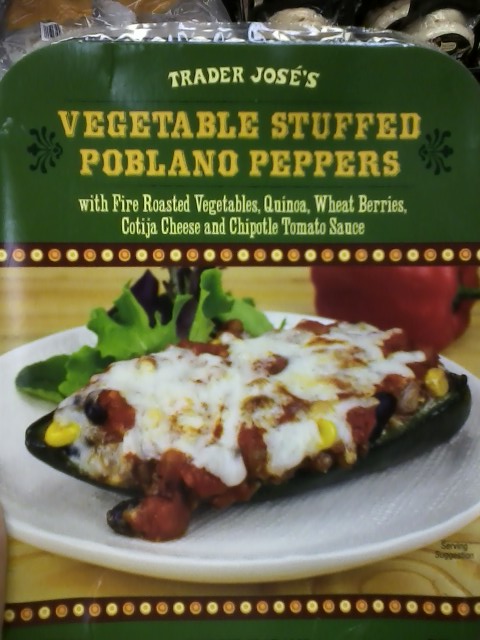
Stuffing those veggies inot more veggies. Doing it.
Occasionally I sit at the table gnashing my teeth and staring balefully at a plate of vegetables. My complaint, I think, is a common one – there simply are not enough vegetables in my vegetables. I, and no doubt you, will be relieved to discover that Trader Joe’s has taken a direct approach to resolving this problem by splitting some poblano peppers open and stuffing them to over flowing with corn, beans, wheat berries, quinoa (and a bit of cheese) in Trader Jose’s Vegetable Stuffed Poblano Peppers.
Essentially we are dealing with a chile rellano made with more veggies instead of meat. Why this rellano like product, not even labeled as such, is handled under the Trader Jose’s label while this one is not shall remain a mystery for all time – knowable only to the augerers in Trader Joe’s occultism department.
This veg-and-cheese medley makes for a tasty filling and manages to avoid the heavy lingering vegetable aftertaste common to other veggie-only dishes. This is notable given that the veggies in question are massive, whole kernels of corn and insolent, lounging beans – an almost aggressively vegetarian dish showing off its full vegetable pedigree on its face. That said, the strongest taste is that of the meaty, thick-skinned poblano peppers that require a knife to saw through. The poblanos have lost much of the fire they pack while raw but not all of it, making this a mild dish with a faint edge of tongue-tingling heat.
I microwaved my Vegetable Stuffed Poblano Peppers in leiu of the 25 minute oven prep, and found that the peppers came out somewhat tough and resistant – far from the tender bell pepper skin of Trader Joe’s Stuffed Peppers with Seasoned Turkey and Rice. Worse, the poblanos were laced through with a bitter tinge, a common feature of poblano’s that have been overcooked. Was this my fault? Perhaps, but I adhered to TJ’s box-side directions so I’m going to pass the buck on to them.
A final intriguing touch is the addition of wheat berries and quinoa in the stuffed peppers – two quasi-grains not commonly associated with Mexican cuisine. I wrote about these trendy, health alternatives to other grains here. In the stuffed peppers their presence is largely undetectable, masked by the other stronger tastes, but lending a pleasant quality to the texture of the sauce.
I mentioned Trader Joe’s Turkey and Rice Stuffed Peppers already, and I can’t help but comparing this dish with that one overall. Do Trader Joe’s Vegetable Stuffed Poblano Peppers stand a chance of replacing this favorite of mine? By no means, the tender, savory, seasoned turkey stuffed peppers beat this newcomer across the board. A decent stuffed-pepper stand-in for the vegetarian crowd perhaps, if they found this one too cheesy, but no match for taste and texture of the stuffed red peppers.
The Breakdown
Would I Recommend It: To vegetarians in need of a hearty stuffed pepper only.
Would I buy it again: Almost certainly not.
Final Synopsis: A vegetarian-friendly chile rellano that’s basically mediocre.
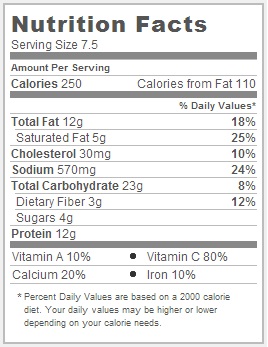
Trader Jose’s Vegetable Stuffed Poblano Peppers Nutritional Information
Trader Joe’s Chile Rellano
Posted: April 23, 2013 Filed under: Cheese, Frozen Food, Pepper, Poblano, Trader Joe's Brand, Vegetarian | Tags: cheddar, monterey jack, poblano pepper 1 Comment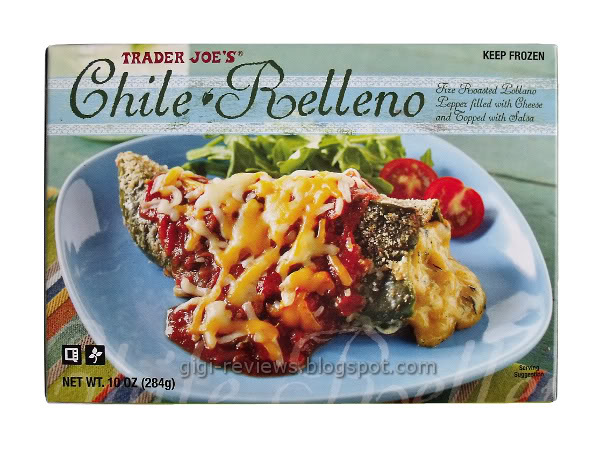
The tube of cheese in question.
Once again, I am shocked that Trader Joe’s Chile Rellano is not on the Trader Jose label. What’s the point of positing the existence of a Hispanic doppelganger if you’re not going to ham-handedly slap him on all your Spanish-inspired cuisine?
For that matter, why have a Trader Jose, a Trader Giotto, a Trader Josef and so on, but not a Korean Trader Jae, an Egyptian Trader Jahi, or a Thai Trader Jayavarman? Why the narrow window of ethno-specificity Trader Joe’s? Edward Said called, he wants to know where you got your Orientalism.
In any case, I better start off this review by disclosing that I’m not really all that into chile rellanos. My list of favorite Mexican food looks like this:
Table 1-1: Mexican Food Preference Chart
- Smothered/”Wet” Burritos
- Fish Tacos (soft)
- Nachos (supreme or ultimate)
- Sweet corn cake mash
- Huraches
As you can see, chile rellanos don’t even crack the top 5, so TJ’s was already embarking on an uphill battle when they created this product then let me go home with it. Strike 1 and 2, Trader Joe’s. Dubious but willing, I tucked in.
The Trader Joe’s Chile Rellano is a roasted poblano pepper, nice and mild, stuffed with monterey jack, slathered in spicy tomato salsa, dusted with bread crumbs and topped with cheddar. When that much melted cheese comes into play, it’s hard to make an unpalatable dish – and as you might imagine these rellanos go down easy.
While most rellanos contain meat of some sort, take note that this one is a vegetarian dish, meaning it is little more than a meat-free, tube of cheese.
This is not necessarily a bad thing, especially if you’re a vegetarian looking for sustenance amid the barrens of the modern grocery store. If you’re looking for that meat free Mexican food fix, here you are. The salsa is admirably spicy, delivering a short sharp burn with each bite, and the roasted pepper is toothsome, if somewhat tough to cut. The vegetarian rellano also boosts a surprisingly high protein profile, 22 grams to the serving, which might give you some sense of how much cheese we’re talking about here.
For my part, I found the meat-less rellano less than filling. As a component to a larger Mexican dish it would certainly be more effective – as plate compatriot to an enchilada, perhaps, or a taco. However, if I’m going to ingest that much straight up cheese I have other ways I’d prefer to go about it. (See table 1-1).
The Breakdown
Would I Recommend It: To Mexican craving vegetarians, no one else.
Would I buy it again: I don’t see it happening.
Final Synopsis: This cheesy pepper is alright, but nothing special.
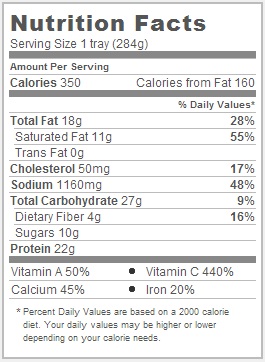
Trader Joe’s Chile Rellano – Nutritional Information
Trader Joe’s Raspberry and Vanilla Cream Bars
Posted: April 18, 2013 Filed under: Desserts, Frozen Food, Fruit, Gluten Free, Raspberry, Trader Joe's Brand, Vanilla 5 Comments
Behold the clever angle the bars are displayed at. Surely the stick is down there somewhere, right? Just out of view maybe?
I don’t normally review items that are obviously delicious. For example, I’m not writing a review of Trader Joe’s Chocolate Covered Sea Salt Butterscotch Caramels.
Trader Joe’s Raspberry and Vanilla Cream Bars would seem to fall into this category. I mean, frozen fruit juice bars? It’s not like no one’s every thought of doing this before. Do you really need to be told if you’ll like this or not – especially if you’re at Trader Joe’s where, if you’re in the mood for a frozen fruit bar, you have a choice of about three options?
Let’s just consider the ingredient list – raspberries, sugar, vanilla, cream. Does this sound like something you’d like to eat in a frozen bar form? Of course it does! It really seems like a waste of perfectly good turns of phrase, not to mention everyone’s time, to dig much deeper.
So that’d be it, article over, if it wasn’t for the fact that someone in the Trader Joe’s corporate chain of command is either a twisted madman, or a genius in thrall of a dream beyond our comprehension. In either case the visions that torment him have been made manifest in this bar for, you see, this bar has no stick.
NO STICK. It’s just a little plastic envelop with a lump of frozen fruit and cream in it.
In all honesty, Trader Joe’s expects you to take out one of the small bags, tear open the plastic wrapper, and devour their Raspberry and Vanilla Cream bar right there as is. There is simply no way to take it out of the wrapper without sticky-ing your fingers. I suppose you could drop it onto a plate, at which point you will stare at the sad, stick-less lump and wonder why TJ’s would do such a thing.
The history of civilization is the story of man striving to develop the perfect frozen treat delivery system – whether sandwiched between cookies, pushed up a cardboard tube, enrobed in chocolate and wrapped in foil, served in tiny tubs, sugar cones, waffle cones or chocolate-dipped waffle cones progress has marched on! And throughout it all the stick has remained most simple, most pure and cost effective method – the father and platonic ideal of all frozen treats delivery systems. All this progress out the window!Trader Joe’s is trying to single-handedly undo all the progress frozen novelties have achieve in the past centuries and drag it kicking and screaming back to the dark ages.
This is madness Trader Joe’s! Put sticks in your fruit & cream bars! We are not animals! We will not mess our faces like beasts at the trough. If you wanted to serve ice cream in a little pouch, than call it ice cream in a little pouch. Don’t call it a bar and stick it in with the rest of the iced novelties as if that were somehow sane.
Also, the bars are a little bit small. Each bar comes in at 40 grams, or 1.4 ounces, which makes them about as big as your cell phone’s battery back, or about two bars of guest soap set side to side. That’s may not be much to chew on, but the cream is so sweet and the fruit so rich that it eats slow It is an intense and delicious taste sensation that brims over with real raspberry taste and sweet vanilla cream that would lend itself to slowly nibbling – if only it had a stick.
The Breakdown
Would I Recommend It: Yes, if you don’t mind tiny bars that are doomed to be messy.
Would I Buy It Again: No, it’s just not fun to eat.
Final Synopsis: A delicious bar, fatally flawed by the lack of a stick.
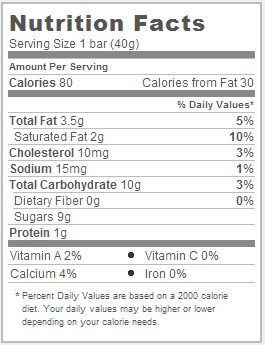
Trader Joe’s Raspberry and Vanilla Cream Bars – Nutritional Facts
Trader Joe’s Cioppino Seafood Stew
Posted: April 16, 2013 Filed under: Fish & Seafood, Frozen Food, Shellfish, Soup, Trader Joe's Brand 9 Comments
The giant, over-sized cioppino bag.
Seafood can be done well, and seafood can strand you in the bathroom for 24 hours – so when someone, even Trader Joe’s, offers to make me a stew from assorted castoff bits of seafood I take pause. Nevertheless, it is my duty to report on such things to you, dear reader, and so I found myself face to face with a bubbling bowl of Trader Joe’s Cioppino Seafood Stew.
Cioppino, despite it’s robustly Italian-sounding name, is actually an American creation – springing into existence on the docks of San Francisco in the 1800’s. It owes it’s name to a derivation of the Italian word meaning “to chop”, a naming convention that is less than totally unique.
In this case, the chopping was done to whatever the fisherman had left over once the good bits of their day’s catch had been accounted for. This fish, bivalve and crustacean medley was then chucked into a pot and simmered in a tomato and wine base until delicious. This colorful history played through my head as I stared at the floppy, opaque bag Trader Joe’s was peddling – images of unsavory, marine castoffs swimming through my head. As I ripped open the bag and poured its contents into my stew pot, I discovered my fears were for naught. Once again, the TJ’s chefs have saved what may have been a questionable concept in lesser hands by the strength of their delicious recipes. Rich, red and flavorful, Trader Joe’s Cioppino Seafood Stew is as hearty as it is delicious.
It’s the base that makes it work – a heavily seasoned tomato stock cut with red wine that verges on the edge of being too salty without going over. It’s a good stew base through and through, a gut-warmer that invites slow, deep sips.
The seafood itself is a nice mixture of deboned cod, and shelled shrimp, scallops, mussels and clams. Strictly speaking, this is a departure from traditional ciopinno, which is made from local fish plus shrimp, crab and squid, still bone-in and in shell, as suits the tuff wharf walkers of San Fran. Even better, despite the plentiful helping of seafood in the stew, it doesn’t suffer from a debilitating fishy taste.
I didn’t find much to dislike with this stew. One quibble is that the bag contains 80% of your daily sodium intake between two small servings. Speaking of which, the bag is ridiculously oversized for the contents it holds. Despite the appearances, you’ll be able to cook up the entire dish in a pint-sized sauce pan with room to spare. Trader Joe’s calls this two servings. Not where I come from, TJ.
The Breakdown
Would I Recommend It: Get your cioppino on, those of you not suffering from high blood pressure!
Would I Buy It Again: It’s the perfect excuse for me to buy a bread bowl.
Final Synopsis: A tasty, salty seafood stew that does it all right.

Trader Joe’s Cioppino Seafood Stew – Nutritional Facts
 Eating At Joes
Recent Comments