
Trader Joe’s Balela
Posted: October 10, 2013 Filed under: Chickpeas, Condiments, Dip, Trader Joe's Brand | Tags: balela, Hummus 6 Comments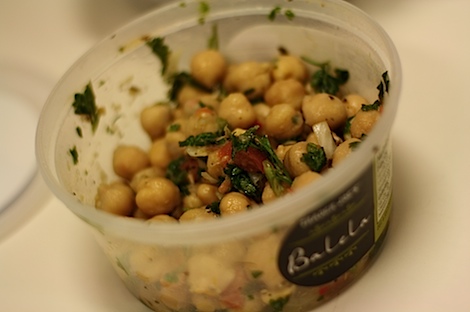
Not hummus
Trader Joe’s Balela is a mildly spiced, tangy chickpea bean dip with it’s origins in the Middle East and it’s absolutely killer. I know what you’re all thinking – “A middle eastern chickpea bean dip? He means hummus right? Why doesn’t he just say hummus? Is he stupid?”
Please, reserve your harsh judgement, hasty internet commentator, for unlike hummus the chickpeas in balela are whole, not ground. That little fact, of course, makes a world of difference.
Balela is in fact a loose mixture of garbanzo and black beans tossed with tomatoes, lemon juice, onion, garlic, parsley and a hint of mint, all served in a tiny, hummus size tub. This makes it a dip, bean salad or side dish, depending on your need.
I set into my little dish of balela with a collection of tortilla and pita chips, and simply could not stop eating it. It has that same tongue pleasing tingle and pleasant mealiness of hummus, while avoiding the overwhelming richness that hummus brings. While the tastes aren’t exactly analogous, they’re close enough that you can think of balela as “hummus light” – a much less dense take on the classic dish. The absence of tahini and presence of mint and parsley very much help further this difference between the two.
The only real mark against this dish is the small size. Little eight ounce tubs are plenty for hummus, but only holds a handful of whole beans. I ate this thing up in about six bites which, though good, was a bit fast for $3.00. It’s not terrible for an individual, but you’d have to buy about 10 of these tubs to cater to even a small get together.
Normally at this point I like to launch into the history and cultural relevance of the food I’m reviewing, but there is a shocking dearth of information about balela online. Numerous blogs all mention the dish, but only in reference to having seen it at Trader Joe’s, and the lone wikipedia article on balela is for 1950’s Portuguese soccer coach Manuel Balela. This suggests that TJ’s is delving further and deeper into esoteric foreign cuisines than I had previously dreamed, or that they’re just making up their own dishes now. I’m not sure which of these options impresses more.
Nevertheless my curiosity has been piqued. I’ve sent several communiques out to Trader Joe’s seeking answers and will update this post with the answers I uncover. In the meanwhile, if any loyal readers have any insight into the history or origin of balela, please post in the comments.
The Breakdown
Would I Recommend It: Yes, to anyone who enjoys hummus, chickpeas or dip in general.
Would I Buy It Again: Yes, even if I wish there was packed in per package.
Final Synopsis: A deliciously tangy and savory bean dip/salad/side dish.
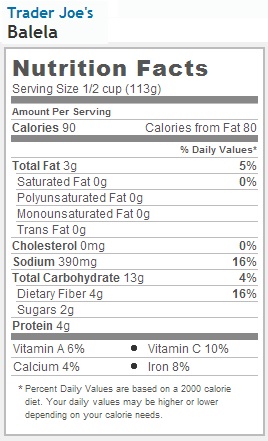
Trader Joe’s Balela – Nutrition Facts
Trader Joe’s Gorgonzola & Walnut Salad
Posted: October 3, 2013 Filed under: Cabbage, Cheese, Nuts, Salad, Trader Joe's Brand, Vegetarian, Walnuts | Tags: gorgonzola, Walnut 2 Comments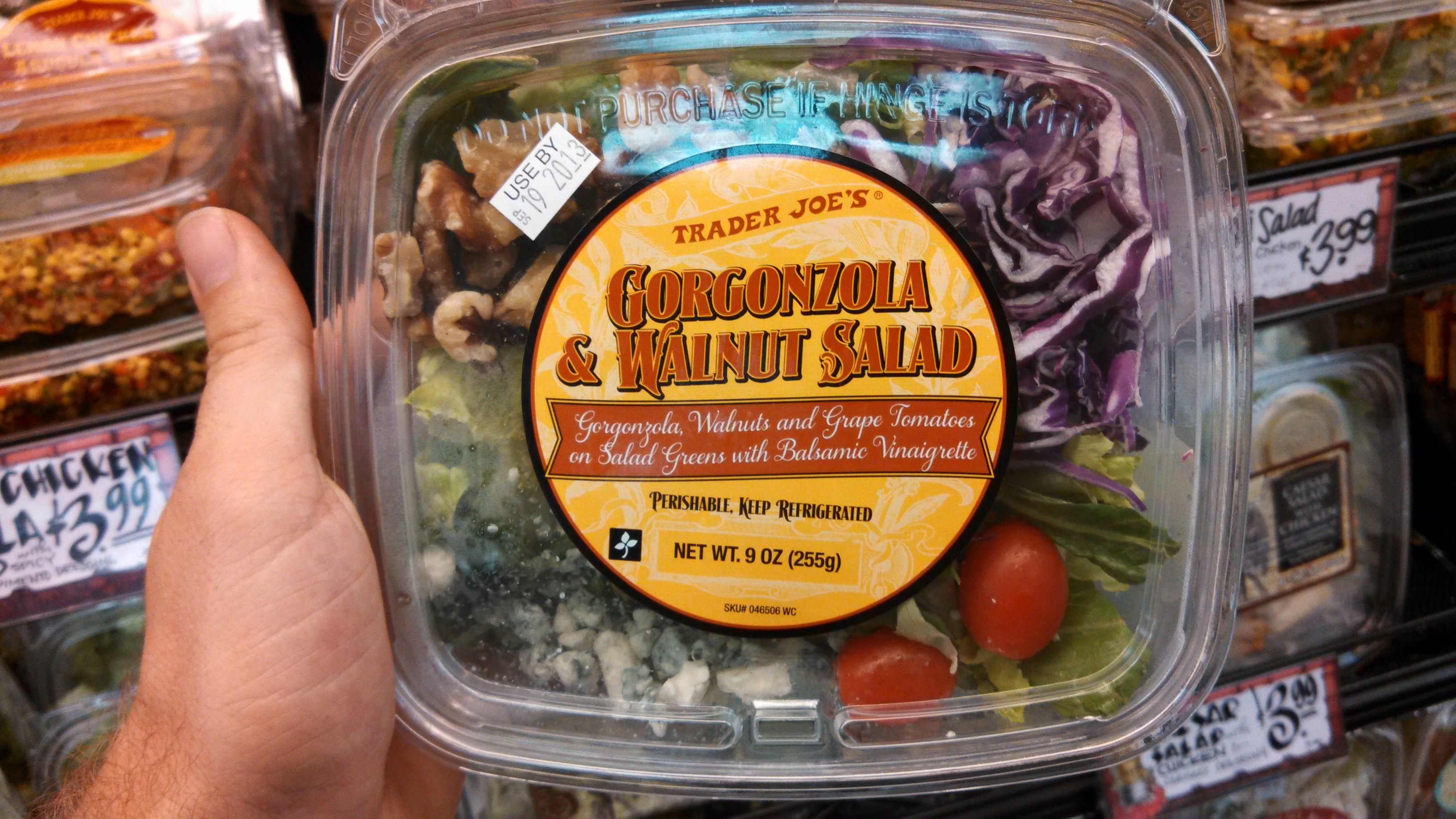
A very attractive old timey font on this salad. Not much else to brag about though.
Oh, Trader Joe’s your salads are so uneven. Sometimes your salads are so good that I do little dances in my kitchen, and sometimes they simply fall flat. Trader Joe’s Gorgonzola and Walnut salad seemed like it was going to land in the first category, but ended up squarely in the second – rather bland and generally unexceptional.
How do you go wrong with such a simple concept? This salad has the fewest ingredients I’ve seen in basically any salad ever. They are, all inclusively, lettuce, cabbage, tomatoes, gorgonzola and walnuts. Five ingredients, that’s it. Such a pure, simple recipe, such a confident delivery – it’s enough to make you think those few ingredients are actually enough to make the salad taste good. It’s enough to make you think that gorgonzola and walnuts by themselves will be enough to make you sit up and go, “Yowza, I can’t believe this salad!” This, my friends, is not the case.
Gorgonzola has been served alongside walnuts since time immemorial, for the very good reason that they pair well. You’d think these two would be a delicious meal in and of themselves, salad or not. Splash a little zingy balsamic vinaigrette on that, mix with some greens and you’d think we’d be talking about a definite winner. The fact that this salad actually tastes so plain and uninteresting is rather perplexing.
The problem here lays in the cheese. When you think of a nice gorgonzola, you’re probably picturing something like a rich, aromatic wedge of veined bleu cheese. This istandard gorgonzola, the most popular kind, is known as gorgonzola piccante or gorgonzola naturale. It is this type of firm, crumbly, strong tasting gorgonzola that isn’t packaged in this salad. Instead, we are dealing with lumps of gorgonzola dolce, or “sweet” gorgonzola. This is your option B among gorgonzolas – a softer and much, much milder cheese.
I’m quite boggled as to why TJ’s went for this mild variety. The stronger gorgonzola naturale would have melded deliciously with the nutty bitterness of the walnuts and the acidic pop of the balsamic dressing. Instead, the mild gorgonzola dolce fades into the unimpressive wallpaper of the lettuce and cabbage. The overall effect is that you’re left with a salad that never really seems to get started.
The Breakdown
Would I Recommend It: Not this one, no.
Would I Buy It Again: There are too many delicious salads at TJ’s to waste time on this one.
Final Synopsis: A perplexing cheese failure wrecks what could have been a great salad.

Trader Joe’s Walnut and Gorgonzola Salad – Nutrtition Facts
ACE Hard Pumpkin Cider
Posted: September 19, 2013 Filed under: Alcoholic, Apple, Drinks, Pumpkin, Trader Joe's Brand | Tags: apple cider, Cider, hard cider Leave a comment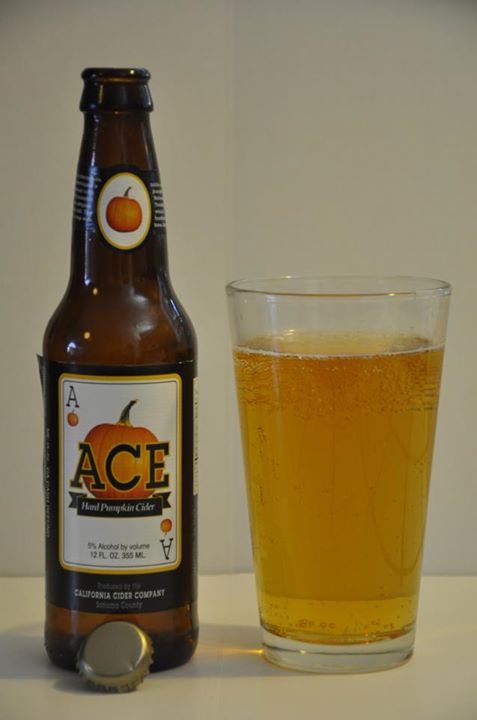
Looks like cider, tastes like pumpkin and a playing card on the label. Ace is sort of mixing its metaphors here.
Every now and then I feel compelled to review a product at Trader Joe’s that isn’t on the actual Trader Joe’s brand. I’ve done it once or twice before, and only if I’m sufficiently intrigued by the weird nature of the product. When I saw ACE Hard Pumpkin Cider in the store the the other day, I simply couldn’t contain my curiosity. I’ve heard of apple ciders before, obviously, and even pear ciders. But pumpkin? That’s just crazy enough to get you on this blog.
A good hard cider isn’t an easy thing to come by in the states. They have a rather more robust history in the old UK and across the continent, but never took off in a big way in America – this despite a strong start in the nation’s infancy. In fact, for a non-trivial portion of America’s history hard cider was drunk like water, literally. In the colonial era, the notion of practical sanitation was a far off dream. As a result of water-borne illnesses, the populous quickly started looking for alternatives to keep them healthy, hydrated and maybe get them a little drunk to boot. The common solution was hard apple cider, which became the most common beverage to drink with meals.
As time went on, of course, public sanitation came into vogue. Water lost its stigma of being unhealthy, and beer rose to the position of most patriotic beverage. Nevertheless, the way was paved for pumpkin cider which, despite my high hopes, is not actually squeezed out of pumpkins in a giant pumpkin press, but made by adding natural flavorings to ordinary hard cider.
How does it taste? Well, a bit like pumpkin, really. The apple juice that makes up the base of this cider is still the primary and unmistakable component of the drink, but ACE doesn’t skimp on the natural pumpkin flavoring either. Crack open the bottle and you’ll get not only a bouquet of pumpkin up your nose right off the bat, but a rich blend of spices that embodies all of late fall. I’ll admit that one of the reasons I bought this drink was because, standing there on the supermarket floor, I couldn’t really conceptualize what pumpkin smelled like and I hungered for the experience. (The other reason, of course, was to give me an excuse to get drunk). The pumpkin you find in this bottle is similar to the pumpkin you find in a good pumpkin pie, not overly sweet but a more basic, essential pumpkin mixed with allspice, cinnamon and cloves. If you can drink this and not be transported back to a childhood memory of crunching leaves underfoot then you are probably dead inside (or grew up in a tropical -to-semi-tropical climate, one of the two).
Speaking of deadening yourself, the cider packs a reasonably strong punch – 5% alcohol by volume. That puts it toe to toe with most beers on the market. The over-sized 22 oz bottle, on the other hand, ensure that once you open this thing up you won’t be going out for the evening.
I’m going to stay out of the cider vs. beer controversy on the grounds that it is stupid. Cider and beer can and should exist happily side by side, although if we’re keeping score ACE’s pumpkin cider is gluten-free and has lower calorie than beers with the same alcohol content.
I haven’t had a hard cider that I’ve ever really liked before, everything I’ve ever tried has seemed too sweet or too cheap, but I liked this cider and I’d go back to it again. That said, pumpkin cider is ultimately a seasonal drink and a novelty. It’s never going to replace beer, or even a hypothetical, good, hard apple cider, but it could absolutely find a place on the counter next to the egg nog.
Breakdown:
Would I Recommend It: If you’re into novel seasonal drinks, absolutely.
Would I Buy It Again: Sure, next fall.
Final Synopsis: A quality cider, with or without the pumpkin gimmick.
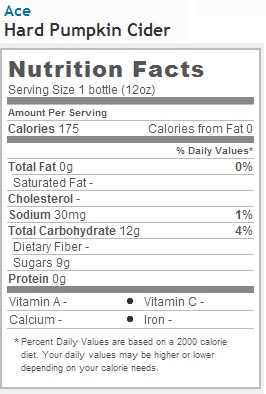
ACE Hard Pumpkin Cider – Nutrition Facts
Trader Joe’s Onion Dip Mix
Posted: September 17, 2013 Filed under: Dip, Onion, Trader Joe's Brand | Tags: dip mix, onion dip 6 Comments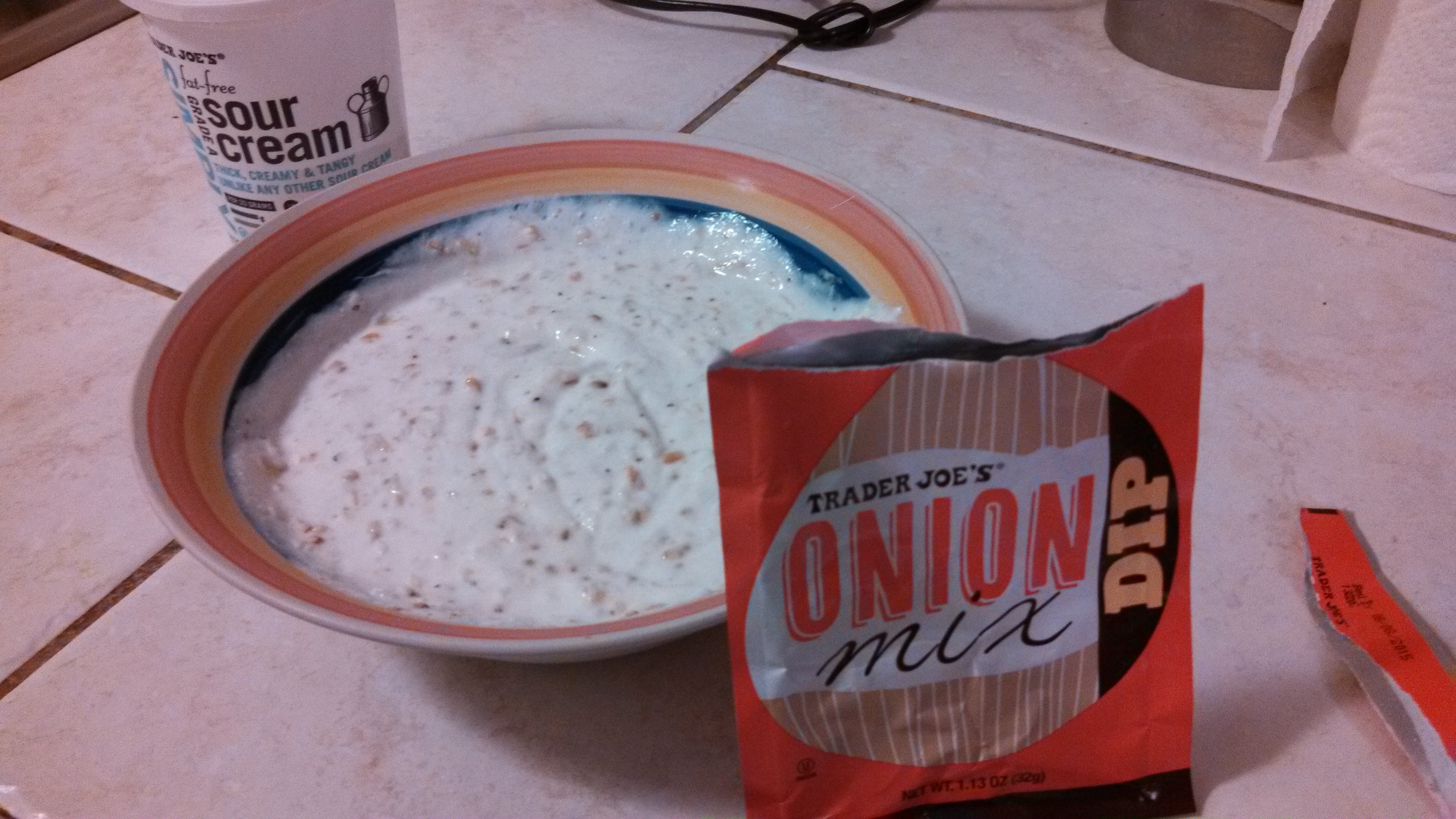
Onion dip!
Onion dip, one of mankind’s most favorite dips. With the exciting arrival of Trader Joe’s Onion Dip Mix, they have now fulfilled the requirement that all supermarkets sell some type of powdered onion dip mix. I picked this up because it was new, and that’s always cool, and because onion dip is one of the most ordinary things you’re ever going to encounter in your life. Powdered onion dip mixes seldom, if ever, vary – presumably it’s all made in the same enormous mixing plant in New Jersey somewhere and then packaged with different labels. Trader Joe’s treads so far from the beaten path, is so devoted to bringing us strange and mysterious things, that it seemed weirdly incongruous that they’d be offering something as mundane and prosaic as onion dip. Surely they’ve got something sneaky planned with their onion dip, some uniquely Trader Joe’s twist hidden in this little orange packet.
Sadly, this is not the case. Trader Joe’s Onion Dip is practically indistinguishable from any other powered onion dip you might have ever had. It’s not a bad onion dip, it’s just a very ordinary onion dip. The sort of onion dip that makes you go, “Yup, here’s some onion dip.” So, in summary – if you are looking for a cheap ($0.99) onion dip mix on par with Knorr or Lipton, here you go.
The deeper, and to me more interesting, question is why do we eat onion dip at all. It’s tasty and I’m glad we do, but who was the first enterprising soul who thought “Know what this sour cream needs? A really strong onion flavor.” That’s really weird, wouldn’t you say? These are not two ingredients that naturally occur near each other in the wild Of course, I’m not Northern European either. Various recipes involving sour cream and onions were floating around the Old Country long before we adapted it into a party appetizer in the states. That transformation took place in the mid-
As it happens, the first onion dip didn’t come about until 1954, and owes its thanks entirely to the wondrous Modern Age. The era of convenience that exploded in America after WWII showed itself nowhere more clearly than through changes in the kitchen. Take the sudden rise of powdered soup, for instance. The idea of dehydrating soup for ease of use is a surprisingly old one. Lewis and Clark packed a great quantity of a commercially produced “pocket soup” with them on their expedition. The very first mentions of such a product can be traced back to as far as England, in the year 1681. These first powdered soups however, were more akin to bouillon cubes, hard lumps to be dissolved over time. These were eventually refined into powdered mixes that could easily be added to water by the busy housewives of the 1940’s and 50’s. It was one of these women, now as forgotten to time as the honorable Governor Ding, who first grabbed a packet of Lipton’s Onion Soup Mix and added it to a bowl of sour cream. The result was a hit, and quickly co-opted by the Lipton company who as early as 1958 started printing it on every packet of onion soup mix they sold.
That, pretty much, is everything you need to know about the history of onion dip. What will the future hold for onion dip? We must wait and see. In the meantime, the next time you need to cater a party on the cheap, or prep a snack for the football game, you can give this dip a whirl
The Breakdown
Would I Recommend It: Eh. It’s as good as any other brand.
Would I Buy It Again: Sure, if I’m having people over or something.
Final Synopsis: A competent onion dip mix with no surprises.
Trader Joe’s Quinoa Teriyaki Mushroom Rolls
Posted: September 10, 2013 Filed under: Mushrooms, Quinoa, Trader Joe's Brand, Vegan, Vegetarian | Tags: quinoa, rolls, sushi, teriyaki 3 Comments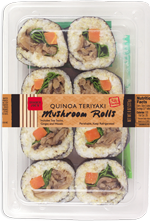
Yes, there is quinoa in sushi now. No one shall escape quinoa!
Holy crap – I mean, guys, words fail me. We’ve seen some pretty bold and unpredictable moves from Trader Joe’s before, but I’ve never seen anyone, anywhere, seen anything like Trade Joe’s Quinoa Teriyaki Mushroom Rolls. Swapping the rice out of sushi for quinoa? That is some mad scientist level tinkering there, mad science that has resulted in an abomination not fit to dwell on God’s green earth.
Look, I like Trader Joe’s, you like Trader Joe’s, but let’s be honest here – no supermarket has ever made reasonable sushi. Supermarkets on the coast of Japan don’t even do sushi well. If you want sushi, you go to a sushi restaurant. If you want cold patties of clammy rice and old fish, you go to supermarket. I can only imagine that it’s only due to the abysmal standards of supermarket sushi that Trader Joe’s thought they could get away with such an outlandish concoction. Replace the seafood with marinated mushrooms? Why not? Infuse the rice with quinoa? Who’s to stop you?
It’s not that I can’t see their thought process here – a healthy, vegetarian option for sushi lovers is a noble goal – but the execution here is unconscionable. The marinated mushrooms themselves are alright – a bit slimy, but tasty and nicely saturated with teriyaki flavor. If the product was mushrooms alone, I’d have little to complain about. The real culprit in making these rolls inedible is the unpleasant quinoa/rice wrapping – served soggy, tremendously dense and mealy. Those are characteristics shared by most supermarket sushi rolls, granted, but these were without a doubt the worst I’ve had of that dubious ilk. Was it adding quinoa that pushed it to the bottom, or would these have been just as bad with rice alone? It’s hard to say.
What would you expect the primary ingredient to be in a quinoa roll? Quinoa, perhaps? You would be mistaken, I’m afraid. I like quinoa, I’ve discussed it before, but it’s inclusion here is tragic. If the roll was entirely made of quinoa, that’d be one thing – I expect I’d even like a roll made entirely of quinoa. But that’s not what we have here. What you’re really getting is rice, sprinkled with a bit of quinoa.
Consult, if you would, the picture above. Notice the little yellow dots? That’s the quinoa. Everything else? That’s rice. It hardly seems honest, really, to bill these as quinoa rolls. If TJ’s really wanted a healthier sushi roll, they should have gone with a brown rice. You can’t just mix up an 80-20 rice to quinoa mix and call them quinoa rolls – that’s farcical, Joe. Knock it off.
If you’re a vegetarian and you love sushi, I feel for you I really do. For the time being, however, I’d suggest sticking to your cucumber and daikon rolls. I hope that Trader Joe’s will do something else with the teriyaki mushroom bits. Until then, I must award these quinoa rolls with the ignoble “Worst Thing I Have Ever Eaten from Trader Joe’s” award. Congratulations.
The Breakdown
Would I Recommend Them: No. Really, really no.
Would I Buy Them Again: Not until opposite day, the day when you buy the things you hate and throw away the things you love.
Final Synopsis: Why would Trader Joe’s do this to sushi?
Nutritional Info, per 3-pc serving
Calories: 120
Total Fat: 3g
Saturated Fat: 0g
Cholesterol: 0mg (duh, since it’s vegan)
Sodium: 430mg (before the soy sauce of course)
Potassium: 0mg
Total Carbs: 21g
Dietary Fiber: 1g
Sugars: 4g
Protein: 2g
Vitamin A: 25%
Vitamin C: 4%
Calcium: 2%
Iron: 4%
Trader Joe’s Bacon and Spinach Salad
Posted: July 25, 2013 Filed under: Bacon, Salad, Spinach, Trader Joe's Brand 3 Comments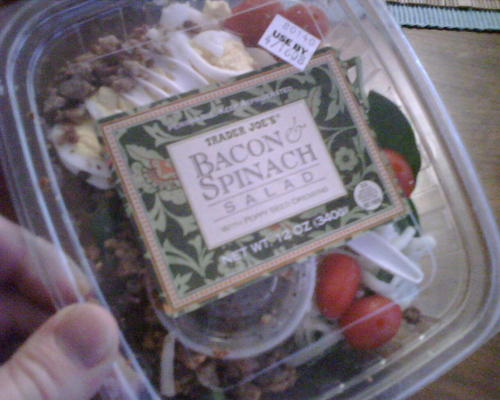
12 ounces of heart-clogging goodness.
When is a salad not a salad? No, that’s not the set up for a hilarious joke – it’s a dead on serious philosophical musing. Undoubtedly there are as many different answers as there are salad lovers on this planet. Some might quibble over the presences of leafy greens, others might argue the necessity of a dressing. For me, it comes down to nutrition.
When a salad is delivering 108% of your daily fat intake in a single serving, that’s a poorly constructed hamburger not a salad. When someone can say to you, “Whoa, buddy, instead of that salad, why don’t you try something healthier. Here, shove these two Big Macs into your mouth at the same time.” That for me is where a salad crosses the threshold into junk food. What I’m saying is, brace yourself for Trader Joe’s Bacon and Spinach Salad.
I bought this salad the other night because I was hungry and had managed to convince myself that, you know, in light of the paleolithic diet, Atkins, etc TJ’s Bacon and Spinach Salad wasn’t actually that bad for me. If you haven’t looked yet, I’m going to direct your eyes to the bottom of this article. Yup, that’s right. Not just 108% of your daily recommended fat, but 105% of your cholesterol, 68% of your sodium, and even some trans fats in there for good measure, all delivered directly to your arteries on a healthy bed of fresh spinach.
Who in their right mind can call this a salad? If they’d stopped at the bacon, that’d be one thing but this salad by no means stops at the bacon. What else is in there?
Well, we’ve got some cherry tomatoes, nice plump and juicy, that’s fine, a whole hard-boiled egg, that’s not too bad, then we have the mozzarella cheese and the poppy seed dressing. I’m not sure which of those chokes me with surprise more. I mean, the mozzarella just seems egregious. We’ve already slathered the spinach with a hefty helping of cured pork belly, bacon that is literally sagging with fat, who was out there was thinking, “This salad just isn’t rich enough. Throw on a bunch of fatty, white cheese!” And, with that in mind, can I just say – poppy seed dressing? Really, Trader Joe’s? On top of everything else, poppy seed? One of the richest, liquid-fat infused dressings on the books? And not even a poppy seed dressing that makes overtures at healthiness, but an oily poppy seed dressing? Honest to god, this poppy seed dressing has a thick layer of oil floating on the surface when you crack it open. I’ve had poppy seed dressings many times before, but never one that comes with its own oil slick.
It’s astounding, readers. This salad is practically a novella about the rage simmering beneath the exterior of one crazed salad designer at Trader Joe’s, a man who has been forced, day after day, to design fresh, light new takes on lemon chicken while his soul within slavers for sticks of butter and pork flesh, a man who, one day, snapped when presented with a bag of broccoli slaw, the levees of his mind giving way to the flood of carnal need, and leapt about ransacking the shelves, tongue hanging out of his mouth, loading up a bed of spinach with his every secret, depraved desire.
Okay, so if you eat this salad everyday your body fat will eventually smother your heart and you will die, on that we can all agree. On the other hand, it’s very tasty. And of course it’s tasty, it’s a pile of fat and salt – it’s incredibly delicious. Pour on the poppy seed dressing, mix up the bacon and cheese and dig in – you’re taste buds will be taken on a wild ride of salty, fatty, meaty tastes. In fact, the most incredible thing about this salad is that it’s actually edible. As anyone who’s had a Big Mac can testify, it’s hard to eat so much fat and salt in one sitting and not leave feeling at least a little ill. For this we can thank the spinach and cherry tomatoes, which provide a clean, light taste counterbalance to the more dominant heavy tastes. In a way, it’s a brilliant solution to the problem of how to eat a bunch of fatty bacon and cheese all at once. If that’s not a problem your trying to solve, then this may not be the salad for you.
The Breakdown
Would I Recommend It: No to salad fans, yes to bacon fans.
Would I Buy It Again: I’m not sure my blood pressure can take it.
Final Synopsis: A novel way to eat a bunch of sloppy bacon.
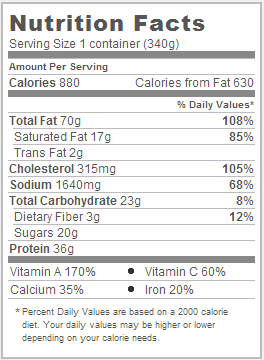
Trader Joe’s Bacon and Spinach Salad – Nutritional Facts
Trader Joe’s Eggplant Garlic Spread
Posted: July 18, 2013 Filed under: Eggplant, Garlic, Spreads, Trader Joe's Brand | Tags: bulgarian, ljutenica 7 Comments
A Bulgarian spread? I’ll allow it, but I think I know some Serbs and Macedonians who will take issue with that.
Continuing my foray into the popular world of Serbian/Bulgarian/Macedonian food stuffs comes Trader Joe’s Eggplant and Garlic Spread. Unlike its very close cousin and shelf neighbor, TJ’s Red Pepper Spread with Eggplant and Garlic, this condiment is hands-down delicious – like a thick, savory pasta sauce made with eggplant rather than tomato.
I got into this already with the craptacular ajvar, and I don’t want to kill it all over agian here, but TJ’s is really wrecking their own house with these name games. These two products, Trader Joe’s Eggplant and Garlic Spread (with peppers) and Trader Joe’s Red Pepper Spread with Eggplant and Garlic, could not be positioned to confuse the casual shopper more. One delicious, one awful, both Bulgarian, of similar packaging and nearly identical names. It’s like having an evil twin and a good twin and naming one George T. Riley and the other George D. Riley. What’s that? Did you say T. Riley? You did? Well too late, because now I’m dead and/or my chicken tastes awful.
Let’s rectify the situation right here – this product, like it’s compatriot, is proudly Bulgarian, and is known in that country as ljutenica. The name might roll off the tongue, but it’s hard to say what exactly a proper ljutenica is supposed to taste like. As with many folk foods (kimchi, etc) it’s taste, consistency and composition varies widely between households. Some are much spicier than cousin ajvar, some sweeter, and so on. This ljutenica is actually milder and more savory. Whatever it was that Trader Joe’s did to its red pepper spread to make it so they avoided it here – nothing harsh or mealy comes through from the garlic or eggplant. Instead, both blend together with the fefferoni pepper to make an intriguing new taste – a full-bodied, broad, tongue-pleasing taste. It is somewhat salty, but not overly so, and very slightly piquant. It worked excellently for me as a condiment for chicken dishes, vegetables and meatballs.
How this ljutenica stacks up against the real Bulgarian stuff I couldn’t venture to say – and if any Eastern Europeans out there want to weigh in please do so – but I personally couldn’t be happier with what I’ve got. If ajvar threatened to turn me against Bulgarian condiments, this spread has rectified all wounds.
The Breakdown
Would I Recommend It: Yes – try it with your chicken or pasta, or slathered on bread and topped with goat cheese.
Would I Buy It Again: I already killed my first jar, so it’s pretty likely I will.
Final Synopsis: A ljutenica that will do you well from Sofia to the Black Sea.
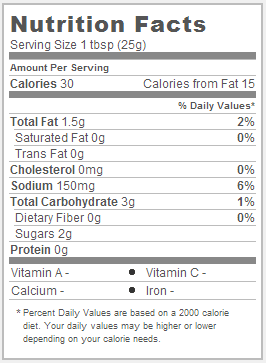
Trader Joe’s Eggplant Garlic Spread – Nutrition Facts
Trader Joe’s Artichoke and Hearts of Palm Salad
Posted: July 16, 2013 Filed under: Artichoke, Heart of Palm, Salad, Trader Joe's Brand Leave a comment
You had me at artichoke.
A heart-based salad? How intriguing, Trader Joe’s. Was this done on a bet? Did some Hawaiian-shirt wearing executive in TJ HQ start shooting off at the mouth about how nobody, but nobody, could make a delicious salad centered on two different types of plant hearts? And then did a little guy (also in a Hawaiian shirt) step forward and go, “I created a salad out of goddamn marinated beets – just watch me.” If this is not what happened, please don’t correct me.
At any rate, Trader Joe’s Heart of Palm and Artichoke Salad feels absolutely decadent. God knows – God almighty in his blue heaven knows – that there’s nothing so good as a nice artichoke heart. To make a salad of them feels almost hubristic. They don’t look like so much – little, uninteresting, drab cubes sitting mundanely on a bed of arugula instead of, as I would have imagined, gleaming with magic sparkles and heavenly rays. A single bite, however, and I was immediately hooked. I didn’t doubt that this would be the case. I mean, it’s goddamn artichoke heart. I’m definitely on the record as a fan of mango, but my mango addiction doesn’t even compare to the pleasure I derive from a properly prepared artichoke.
I think we can all agree that the artichoke is an amazing food. It’s crazy looking as hell, fun to eat, strangely delicious and hides, in its secret, armored center, what might as well be a heart of gold – the absolute intersection of crunchy and succulent. It’s goddamn madness, the kind of food that, if it didn’t exist, Philip K. Dick would have had to drop acid to envision.
Not satisfied with only one heart, Trader Joe’s reaved a second from the palm tree. Heart of palm is less of a palette pleaser than artichoke heart, but has an intriguing taste and decadent history all its own. Also known by the evocative name “Millionaire’s Salad”, the heart of palm was historically harvested from the core of a young coconut palm – killing it outright after the long labor to raise it, and throwing away of the great worth of a mature palm tree. This, being more or less the culinary equivalent to lighting a cigar with a hundred dollar bill, earned the salad it’s name. Nowadays, heart of palm is less extravagantly wasteful – the heart is cut from a different type of palm that creates off shoots, allowing the core to be harvested without killing the whole tree.
The fanciness of the salad is beyond reproach – but does it taste any good? My love of artichoke heart aside I found this salad quite tasty. There are really three big flavors going on – the the succulent crunchiness of the artichoke heart, the marinated zing of the heart of palm and a touch of bitterness from the otherwise mild baby greens. These tastes meld into an enjoyable symphony of tastes, taking your tongue one way one moment and another way the next, but ultimately playing well together. At 7.5 oz, it’s a bit smaller than the average TJ salad, but packs big, novel flavors into it’s small size.
My one big mark against it is the salad dressing – a raspberry vinaigrette that hardly lives up to the name, a thick, opaque pink dressing with the appearance and consistency of Pepto Bismol. This purported vinaigrette packs a fair amount of fat as well, so I substituted Trader Joe’s Light Champagne Vinagarette instead. For a salad already so decadent, I thought a little champagne only a fitting touch.
The Breakdown
Would I Recommend It: Yes. This is a tasty, if unusual, salad.
Would I Buy It Again: It’s got artichoke heart, man. I’ll be back.
Final Synopsis: A salad that manages to stand on it’s novelty.
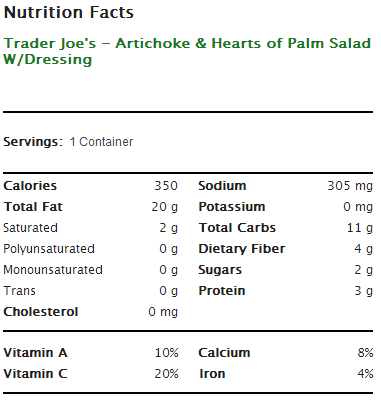
Trader Joe’s Artichoke and Hearts of Palm Salad – Nutrition Facts
Trader Joe’s Indian Fare – Punjab Eggplant
Posted: July 11, 2013 Filed under: Eggplant, Trader Joe's Brand, Vegetables | Tags: Indian 10 Comments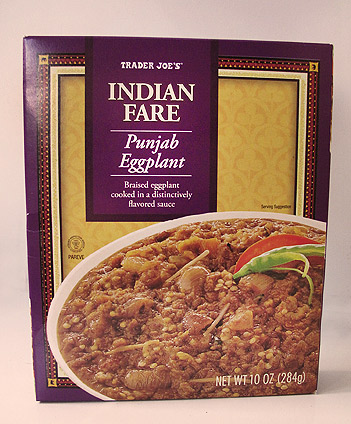
Nothing says Indian food like barbecued eggplant.
Okay, now this confuses me. I’ve made the observation before – but I must again express how perplexed I am by their naming conventions.
Trader Joe’s Cacciatore being placed next to Trader Giotto’s Balsamic Glaze is one thing. But Trader Joe’s Indian Fare Punjab Eggplant? Why delve into such twisted wording when there’s so much existing precedent? Just call it Trader Juhi’s Punjab Eggplant leave it at that – we’ll figure it out.
Sigh. Sorry, but proper applied nomenclature is one of my buttons. Look, let’s just talk about this delicious, savory dish and forget all about it.
Though my haughtier, Indian-cuisine loving friends will probably roast me in a tandoor for saying so, I really liked this dish. Simple, cheap and bursting with flavor – what’s not to like?
This is roasted eggplant done right. Pay attention, you crappy ajvar, you might learn something! I mean let’s take a look at the (typically) awesome ingredient list: four veggies (eggplant, tomatoes, onions and pumpkin), a host of wonderfully Indian spices (coriander, cumin, turmeric, ginger, all that), and not a preservative or artificial color in sight. Of course, there’s the sunflower oil as well, which they go more than a little heavy on. It does nothing to harm the taste – but when 60% of your calories are from fat, it’s time to ease up.
The taste is typically Indian, thanks to the medely of spices listed above, and the eggplant simply lays back and lets them go to work. There isn’t much recognizable left of the eggplant, but that’s okay by me. It might have ended up as a sort of beige mush, but that’s beside the point. The eggplant is there more as a medium for the intriguing aroma and complex taste of the cooking, both of which are entirely enjoyable.
Okay, so maybe it’s lacking a little something in the class department. Food that gets served to you in ready-to-heat Mylar pouches can’t help but make you feel like you’re standing barefoot in your college kitchen again. It’s better then even a TV dinner for dissipating all the day’s successes and making you realize that, oh yeah, you’re just a fat, lonely man.
The other gripe is that, yes, it looks like a big pile of wet cat food when you pour it onto your dish. That would probably be more depressing if it didn’t smell so damn good, redolent of everything you expect Indiant food to be.
Everything else aside, Trader Joe’s Punjab Eggplant wins one award from me – Most Creative Serving Suggestions. Check it out: “Serve with fluffy rice, hot Indian bread, pita – or as a burrito stuffing.”
Burrito stuffing!? Whoever came up with that one, I want to high five you. I live in LA, spiritual heartland of “Let’s mush stuff together and call it fusion” cuisine, and I have not yet seen such a thing. Indian-mexican food? What could be more natural?
Finally, I’m let to wonder, once again, why we can’t figure out how to make delicious (and cheap) meat-free food in the West when the Indians knock it the hell out of the park again and again. Let’s get on the game here vegetarians! Food without meat in it should taste great and cost less. America can do this!
The Breakdown:
Would I Recommend It: Yes, especially to inept cooks like myself.
Would I Buy It Again: That seems pretty likely.
Final Synopsis: Tasty, exotic bachelor food.
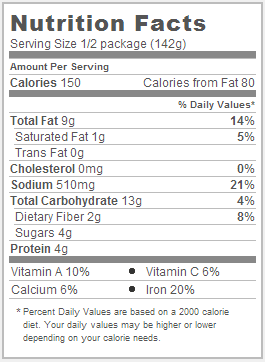
Trader Joe’s Indian Fare – Pujab Eggplant – Nutrition Facts
Trader Joe’s Red Pepper Spread with Eggplant and Garlic
Posted: July 9, 2013 Filed under: Eggplant, Red Pepper, Spreads, Trader Joe's Brand, Vegetables | Tags: ajvar, serbian 7 Comments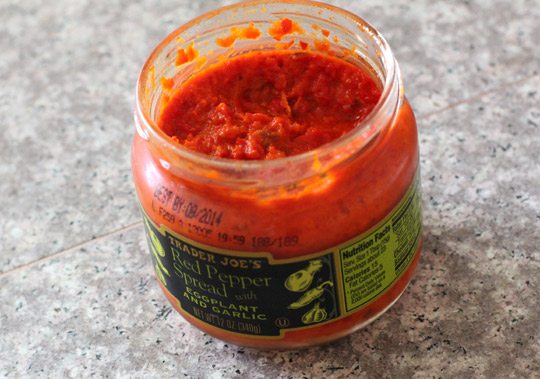
A little Serbian Salad for ya.
It seems like there must be something wrong with Trader Joe’s Red Pepper Spread with Eggplant and Garlic. For one, that is a ponderous descriptor for something which has an actual name. Two, and more importantly, it’s bitter – so unpleasantly bitter!
“Add to pasta sauces, spread on chicken,” the jar enthusiastically suggests, “Top a burger with it!” Why, jar? I like all those things. Why would I want to smear a bitter condiment from the former Soviet bloc all over them?
That is being, perhaps, a bit unfair to the good people of Bulgaria, from whence this spread hails, and who I’m sure are only trying to do the best they can. The problem may lay in me, after all. Red Pepper Spread – or ajvar as it’s known as in its Serbian homeland – is not something I’m very familiar with. I’m more than willing to grant that the the subtleties of the spread are being lost on me.
Let’s take a quick look at the history of this unusual spread before we get into what exactly it’s trying to do to your taste buds.
Ajvar, also known under the more easily remembered but more frightening sounding name “Serbian Salad”, is basically a type of relish – made primarily from roasted red bell pepper and garlic, containing various quantities of eggplant, red pepper etc. Historically, the dish is known as a winter food throughout the Balkans, canned in early Autumn and subsisted on until spring brings fresh veggies.
I’m not quite sure why Trader Joe’s embraces some of the cultural names for its dishes, like dukkah, but not others, like this poor spread, unless perhaps they feared the outrage of countless babushkas, their dudgeon raised high by a sub-standard product peddled under the name ajvar.
All else set aside, I must praise Trader Joe’s for fetching interesting foods from interesting places. Always a culinary adventure at TJ’s! Of course, every adventure must have its times of misfortune, and that is where our red pepper spread comes in. In its homeland, this spread can be many things – piquant, red hot, even sweet – what it is not supposed to be, and what most foods try and avoid being, is unpleasantly bitter.
As the spread hits the tongue it is nearly sweet, thanks to the sugar added by TJ’s to offset the harshness of the taste. Even with the sugar, however, the bitterness comes through, clean and strong, right from the beginning. During the chew the bitterness rises in power, finally lording over your tongue for the length of the aftertaste. I can’t really figure out what it is they put in the spread that makes it so bitter – the list of ingredients is pure and simple, veggies, some oil and vinegar, no preservatives or artificial colors. It’s possible the fault lay in the preparation process itself. Ajvar is rumored to be best when roasted – not simply cooked on an industrial scale. Perhaps what the spread is missing is the tender loving of a roasting flame?
What isn’t bitter in the spread is certainly worth praising. The robust, earthy tastes of the eggplant and red pepper very nicely compliment simple meat and vegetable dishes, but the bitterness is simply too strong for me to actually enjoy any given mouthful of the stuff. It’s a nice idea for a spread, I only hope Trader Joe’s can reformulate this and bring it back under a prouder banner.
The Breakdown:
Would Recommend It: I’m afraid not, not even for novelties sake.
Would I Buy It Again: This spread has no place in my cabinet.
Final Synopsis: A hearty, tasty spread ruined by a strong bitter flavor.
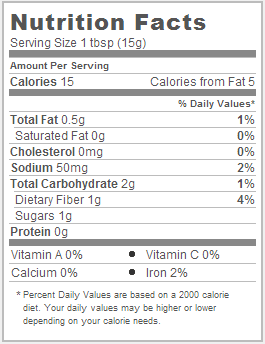
Trader Joe’s Red Pepper Spread with Eggplant and Garlic – Nutrition Facts
 Eating At Joes
Recent Comments