
Trader Joe’s Chicken Gyoza Pot Stickers
Posted: July 24, 2014 Filed under: Chicken, Frozen Food, Meat, Trader Joe's Brand | Tags: 4 stars, chicken dumplings, chinese food, dumplings, gyoza, japanese food, potstickers 6 Comments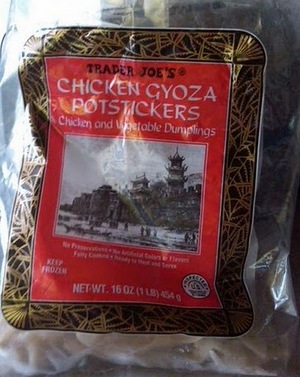
Frozen, chicken filled happiness.
We continue our look at Trader Joe’s frozen Chinese-insipired food with Trader Joe’s Chicken Gyoza Pot Stickers. Unlike the Chicken Chow Mein from the other day, I like these gyoza just fine. In fact, I have a nearly bottomless stomach for a good gyoza, and Trader Joe’s certainly manages to deliver. I crammed hundreds of these savory dumplings into my face in Japan, and I’ll cram hundreds more if given the chance. Where the chow mein clearly lacked any sort of passion in it’s execution, these gyoza were made by a true believer. Despite coming to you frozen, these little dumplings are nearly as good as the real thing and, even better, seem to cook up perfectly every time.
There’s something wonderful that happens to mince meat and vegetables when they’re put inside the thin, crimped skin of a gyoza dumpling. Trader Joe’s combination of rich and flavorful chicken with minced vegetables combines brilliantly with the smooth, almost creamy texture of the tender skin. Whether pan fried or steamed, the gyoza seal in the flavors, keeping the insides moist and tender.
The name gyoza is directly taken from the Japanese, but that name is as meaningless to them as it is to us. The Japanese took both the name and idea from Northern China where gyoza go by the name giaozi or jioazi. Their true origin is obscured by the hazy reaches of history, but seems to owe their creation to Zhang Zhongjing – a legendary figure in Chinese history and the most prominent physician of the year 200 AD – as some sort of medical treatment.
The name Mr. Zhang bestowed upon his creation, jiaozi, translates literally “tender ears”. This is not, as you might expect, because of the lumpy, oblong shape of gyoza makes them look a somewhat ear-like. Instead, historic record suggests they were used to treat frostbitten ears. Whether this means that they were supposed to be fed to a person with frostbitten ears as a sort of medicine, or strapped directly to the head in order to warm the damaged extremities is unknown, as Zhang’s original texts were lost during the ravages of the Three Kingdoms period.
Medical use aside, the other big gyoza question is – what’s the difference between these things and Trader Joe’s equally delicious wantons?
While outwardly similar, the wanton is usually rounder than the gyoza, with a somewhat thinner skin and more heavily seasoned filling. When steamed, the differences between gyoza and wantons are more academic than anything – it’s when you pan-fry your gyoza that the differences really show up. A good pan-fried gyoza turns toasty brown on one-side while steaming up on the other. The result is a spectrum of textures, from crispy to soft, to add another dimension to the meaty filling.
Of course, no good potsticker would be complete without a killer dipping sauce. A simple mixture of soy sauce and vinegar (I like a 1:2 ration) elevates this humble dumpling to surprisingly levels of flavor and melt in your mouth pleasure. Ideally, you should use a mild rice vinegar, but any vinegar will work.
It’s a winning combination in my book, and a flawless execution of a delicious and versatile food that can be eaten as a side dish or main course. Trader Joe’s should be proud – they’ve done the gyoza proud.
The Breakdown
Would I Recommend It: Yes – they’re perfect for entrees or sides.
Would I Buy It Again: I’m hooked.
Final Synopsis: Authentic tasting gyoza that cook up fantastically.
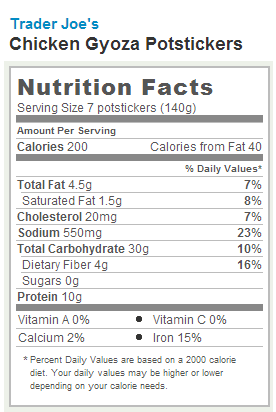
Trader Joe’s Chicken Gyoza Potstickers – Nutrition Facts
Trader Joe’s Four Uttapam with Coconut Chutney
Posted: June 23, 2014 Filed under: Bread, Onion, Trader Joe's Brand | Tags: 4 stars, indian food, indian pizza, pancakes, tamil cuisine, uttapam 2 Comments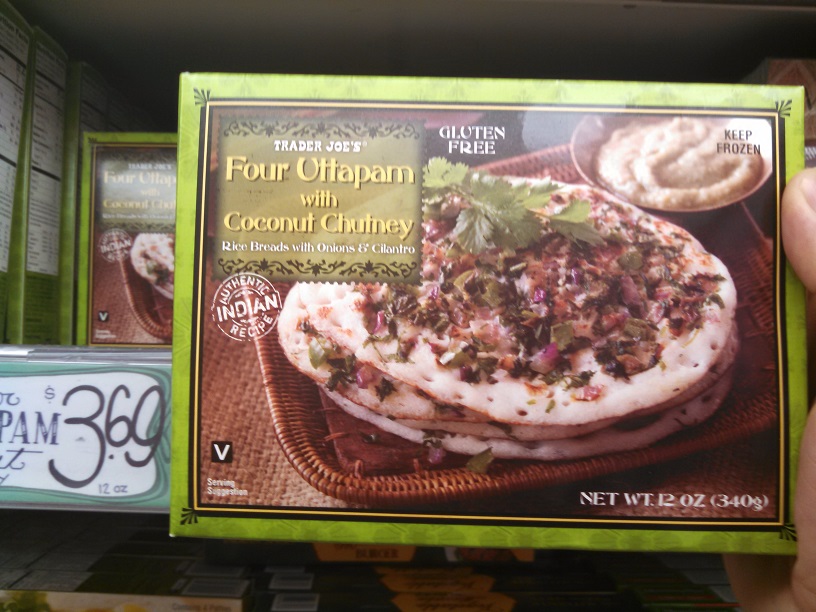
Uttapam! What will those Tamils think of next?
I liked my last taste of East Asian non-traditional savory snack pancakes so much, that I went out this week and tried another one. This time we’re talking about Trader Joe’s Four Uttapam with Coconut Chutney – a South Indian flat bread that’s not only vegan and gluten free, but also down right tasty.
I’ll admit right out that I picked up Trader Joe’s uttapam because reading the package made the language part of my brain have a little spasm. As we’ve seen time and time again, if you put a crazy enough word on your package I basically can’t stop myself from buying your product.
In this case, it turns out that uttapam (U-thap-pam, apparently) are smallish, plain pancake/pizza-like flatbreads from the south of India. Each uttapam is about the size of a bagel (a bit smaller than the Pa Jeon) and topped with a healthy scattering of diced onion, green bell pepper and some subtle cilantro. The taste is a mild, but rich with both the flavor of the vegetables and a dusting of traditional Indian spices.
These veggies are all resting on the uttapam itself, a very specifically Indian sort of bread – both doughy, spongy, and slightly sour. I put bread in “quotes” here because the dough is made from a specific mixture of mashed, fermented rice and black lentils called urad dal, which are not things you typically imagine bread as being made out of. In fact, I’m fairly certain urad dal is one of the locations Frodo and Sam had to pass through on the way to Mordor.
You might think that a bread made from rice and beans would taste wildly different from a standard wheat-based flatbread, but shockingly that isn’t the case. The spongy, soft bread base tastes just as good, as any wheat based flat bread – only due to it’s rice and lentil origin it’s miraculously gluten free.
The bread poofs up nice and soft when cooked, like a soft pillow for the minced vegetables to rest on. You can eat them like this
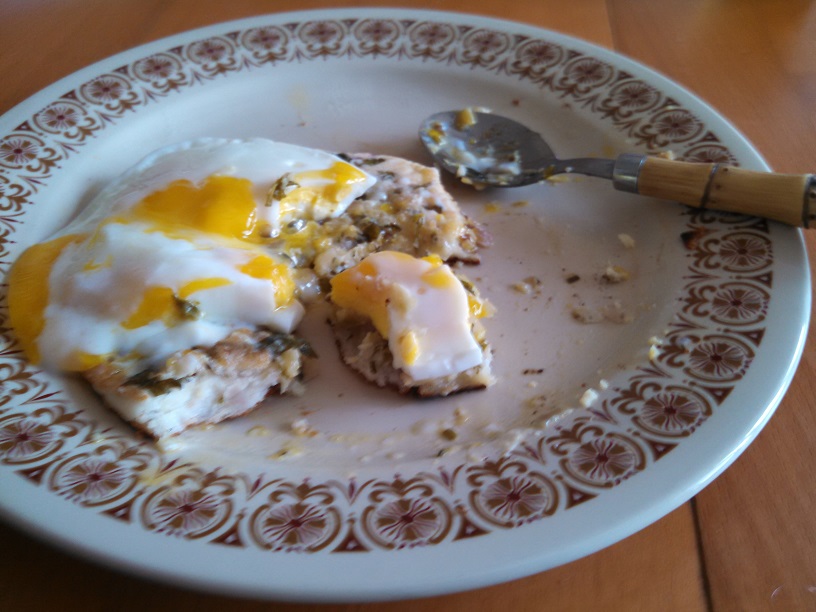
Yeah, Britain – the Indians saw your English Muffins and they weren’t impressed.
directly, or get fancy with some toppings. Trader Joe’s includes a couple little packets of coconut chutney to throw on top, but I’d recommend throwing them out instead. The included chutney is rather weak and lackluster, and doesn’t do much for the subtle flavors already present in the bread. Instead, I’d recommend applying your imagination and topping them with whatever seems good – be that a better chutney you have laying around or some other food entirely. I threw some fried eggs on mine one morning and discovered that uttapam beat the hell out of English Muffins. At $3.69 for a pack of four, you can afford to get a little crazy with them.
Your box of four uttapam comes frozen, and Trader Joe’s offers two suggestions for cooking them – either microwave or stove top. This is no idle consideration, because each method yields a very different final result. Microwaved uttapam (net time required: < 1 min) stay soft and pliable and more pancake-y. Stove top, on the other hand, takes about 4 or 5 minutes per uttapam, but comes off the griddle toasty crisp. Having tried both, I’d recommend the stove top without hesitation – not just because the creators of the uttapam, the Tamils, have a culture of enjoying elaborate and leisurely cooking – but also because the time on the stove really brings out the redolent smells and flavors of the dish.
Really, I have to consider myself a lucky guy – just two weeks ago I couldn’t name you a single tasty, simple, vegetarian/vegan, super-snackable, savory mini-pancake, and now I know two. I’d recommend picking up the uttapam and pa jeon at the same time, and having yourself an Asian Pancake Frolic to go along with the waffle frolics you are enjoying already. At the very least, they could serve as a decent stand in for those still feeling the pain of loss of Arabian Joe’s Spicy Spinach Pizzas.
The Breakdown:
Would I Recommend It: Yup – it’s as tasty as it is worldly.
Would I Buy It Again: I most certainly would.
Final Synopsis: Tasty south Indian flatbread perfect for gluten-eaters and gluten-free alike.
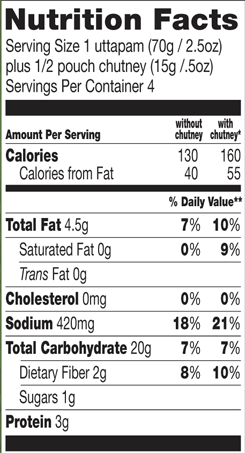
Trader Joe’s Four Uttapam with Coconut Chutney – Nutritional Facts
Trader Joe’s Scallion Pancakes (Pa jeon)
Posted: June 17, 2014 Filed under: Mushrooms, Onion, Trader Joe's Brand, Vegetables | Tags: 4 stars, korean food, pa jeon, pancakes, scallions, trader joe's korean food 4 Comments
Who would have thought scallions and batter would taste so good together?
What? Korea has a sort of dinner pancakes made from more veggies than batter? And Trader Joe’s has brought it to us under the simple, if intriguing, name of Scallion Pancakes? This sort of esoteric awesomeness is exactly what I made this blog for.
What are you, scallion pancakes? What are, as the South Koreans say, pa jeon? I wondered these things as I stood stupid in the frozen food aisle. I tried smelling the bag. No luck there – the strange mystery of scallion pancakes was securely locked inside the cheerful green sack. Was it really just pancakes made with wild green onions? Could that possibly be any good? If pa jeon was a product of, say, Swinton England, I would guess no – but this is a tradition Korean food and I’ve done pretty well by those so far, despite the occasionally debacle, so I was willing to give it the old college try. Was this going to be another Spicy Seaweed Salad or just another dehydrated kimchi? Fortunately, it’s my pleasure to report that Trader Joe’s Scallion Pancakes are totally awesome.
Jeon in Korean (pronounced “jun”) means something like “battered stuff”, while pa means scallions (aka green onions). Pa is by no means the only Jeon out there – the Koreans really went to town on the whole notion. Where Americans were content to put some bananas in their flapjacks then rest on their laurels, the South Koreans diced up basically anything they could get their hands on. While the scallions and batter are usually there, it can come loaded up with any sort of seafood or meat imaginable. Trader Joe’s gives us the most basic version here – plain green onions with a smattering of other vegetables, including leeks and onions plus some carrots and oyster mushrooms.
If pretty much anything can go into a scallion pancake, you might wonder why the Koreans insist on keeping the scallions in there at all. The answer is one, because they are super delicious, and two, because of history. As well as I could dig up, pa jeon owes its existence to a bunch of Koreans that started throwing green onions at retreating Japanese soldiers during one of the numerous Japanese-Korean battles of the the late 16th century. Obviously, that led immediately to people cooking them into pancakes for some reason. There’s no figuring out history folks, it’s just a bunch of crazy stuff like that.
At any rate, scallion pancakes are exactly what they sound like – each bag contains four danish sized “pancakes” made with a wheat and egg batter mixed with, you guessed it, scallions. I put pancake is quotes because the word doesn’t quite do justice to what you’re getting. The shape is approximately that of a nice sized buttermilk flapjack, flat, smooth, rounded and about a ¼ inch thick, but that’s where the resemblance ends. The pa jeon batter is very different from pancake batter. Trader Joe’s uses a mix of wheat flour, corn powder, baking powder, and a touch of egg in their mix, and the result is something more like bread dough than pancake batter – a difference that comes to the fore when you fry them up. Instead of staying light and fluffy, like they are when they come out the bag, the pa jeon become golden and crispy on the stove top. This crispy crunchiness is delightfully toothsome, with a somewhat flaky and pastry-like crunch to the bite.
Once you do throw your scallion pancakes on the stove, get ready for a room filling aroma of mouthwatering proportions. The mixture of onions, leeks, mushrooms and other veggies smells warm, rich and hearty – expect people to be popping their heads in to see what smells so good.
A single glance at these scallion pancakes makes it obvious that they are packed with all sorts of vegetables. What’s more surprising is how much oil is in there as well. Whether you cook these up in a frying pan or in the oven, you’ll notice the pool of oil that forms around each cake. With 7 grams of fat in each pancake and 21 grams of carbs, these are more savory appetizer than health food. On the other hand, with only 160 calories in each pancake, and so much vegetable filler, you can fret the guilt off pretty quickly.
A final note – although Trader Joe’s doesn’t mention it on the bag, you’ll want to eat the scallion pancakes with a traditional dipping sauce of some kind. The most basic type (which worked well for me) is just to mix up a little bit of soy sauce and white (or rice) vinegar. If you’re looking for a fancier sauce recipe, you can try this rather complex one http://www.trifood.com/pajeon.asp.
The Breakdown
Would I Recommend Them: If you’ve never tried a savory pancake before, you should try these.
Would I Buy Them Again: Yes indeed – these make great snacks/appetizers/sides.
Final synopsis: Crispy, scallion filled pancakes that prove the Koreans know what they’re doing in the kitchen.
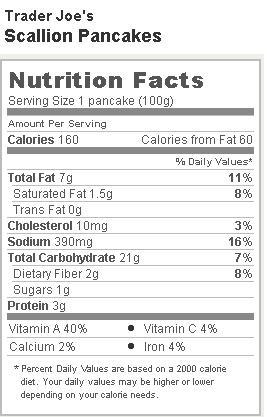
Trader Joe’s Scallion Pancakes – Nutrition Facts
Trader Joe’s BBQ Rub and Seasoning with Coffee and Garlic
Posted: June 12, 2014 Filed under: Coffee, Garlic, Spices, Trader Joe's Brand | Tags: 4 stars, bbq rub, coffee, coffee rub, garlic, seasoning, Trader Joe's 9 Comments
I love your titles TJ, but when you have to start rotating words like puzzle pieces to fit them on your packaging, things have gotten out of hand.
I’m sorry, what? Can you repeat that please? Did you say, Trader Joe’s BBQ Rub and Seasoning with Cofffee and Garlic? Does that make any sense at all? This one is truly mind boggling. I knew Trader Joe’s didn’t give a flying fig about convention, I knew that the second I saw them stocking Toasted Pumpkin Seed Oil on their shelves, I knew that when I picked up their Avagadro’s Number themed guacamole, but even I didn’t dream they were this dangerously unhinged.
I’d like to put myself in the mindset of the Trader Joe’s food scientist who dreamed up this insane blend of seasonings, but I’m afraid to do so would be to permanently wrench my psyche from it’s bearings. Coffee grounds and garlic – blended together, for the sake of rubbing on your meat. It’s got to be a stunt, right? Maybe there isn’t that much coffee in it, or maybe it’s, like, a type of coffee that isn’t really coffee. Let’s just check out the ingredient label.
Ingredient #1: Coffee. Period.
Okay, we’ll, there’s a bunch of other stuff in here too. Look – brown sugar, salt, garlic, um… paprika… and, uh, clemengold rind,? Which is apparently the skin of the Nandorcott mandarin orange? Okay, that’s a new one. At any rate, it must, like, all blend together in a way that sort of hides the strong coffee taste amid many flavors. Let’s just open it up and take a whiff. Wow – nope, that’s coffee. That is straight up coffee. I can’t imagine this is going to be any good.
And this, folks, is where it gets even crazier. After all that, when you really get down to it, this seasoning is spicy, flavorful, intriguing, nuanced, and totally worth your $1.99.
Crazy though it may sound to me, coffee rubs are not a wholesale invention of Trader Joe’s. Many in the hardcore slow-cooked meat world have experimented with the intriguing addition of robust coffee grounds to otherwise ordinary rubs. Despite the intense coffee smell of the rub, the taste is actually much more diverse and interesting. Coffee, being coffee, has a smell that tends to overshadow everything around it. On the tongue, however, that bold, bitter coffee taste is joined by a medley of other equally strong flavors that stand out on their own. The coffee gives way, in turn, to sparks of sweetness, sudden notes of saltiness, and the simmering, low key spiciness of the garlic and paprika.
These flavors do not blend, but tussle for position on your taste buds, and that’s what makes this rub work. It’s not a single flavor, or polite union of similar flavors, it’s a raucous dust up of competing tastes. It’s a tour of the whole tongue, with fun flavors for every taste bud. I’d be interested to see how this stuff would taste without all the coffee in it, to be honest, but having the coffee is what makes it really stand out. While other rubs commonly play up to saltiness, Trader Joe’s Coffee and Garlic Rub plays up the boldness, and it’s this strong base note that gives the riot of other flavors the grounds to go wild.
Trader Joe’s also suggests that you can use this rub as a seasoning on veggies, fish, etc. I’m not sure I’d recommend that myself. While it isn’t bad, per se, the rub is so intense that it can only really be used in tiny amounts, and even then you probably want to mix in another, more traditional seasoning to round out the taste.
One final caveat – make sure you leave yourself plenty of time for the flavors of the rub to permeate your ribs, steaks etc. Trader Joe’s recommends at least an hour – but the longer you wait the richer the flavor in the end. Give this rub as much time as possible on your meat, and apply it generously, for the full effect. Just don’t wait until too late at night to eat. This is real coffee in the rub and, as I discovered, a late dinner might leave up for hours.
The Breakdown:
Would I Recommend It: Absolutely. This will shake up your life a little.
Would I Buy It Again: I think I’ll stock up on a little more.
Final Synopsis: A bold, mix of bitter, salty and sweet flavors that you should try at least once.
Trader Joe’s Coffeehaus European Style Low Fat Yogurt – Mocha and Chocolate flavors
Posted: May 15, 2014 Filed under: Chocolate, Coffee, Trader Joe's Brand, Yogurt | Tags: 4 stars, active cultures, Chocolate, european style yogurt, live cultures, mocha, yogurt 28 Comments
Possibly the most unwieldy name Trader Joe’s has unveiled to date. I’m not even sure I’ve got it right.
Tangy coffee – do you like it? If you can answer that one question for yourself, there will be no need to read the rest of this post about Trader Joe’s Coffeehaus “European style” low fat yogurts. I will repeat it once again – do you like the taste of tangy coffee?
Very probably you have never had tangy coffee before, you might be confused by these words – angered by them even. No problem, friend. Just relax, sit back, close your eyes… and imagine. Imagine sipping a cup of coffee, imagine that unmistakable coffee aftertaste, that bold, full-roast dark coffee flavor that sits on the tongue like burnt toast. Now imagine it’s also real tangy. Tangy like a glass of Tropicana orange drink. Tangy, tangy coffee, sitting on your tongue, and also it’s cold. Do you like that idea?
If you’ve said yes, hold on tight because we are going to get into this. If, and I’m guessing this is more likely, you said no then you can feel free to navigate away from this browser tab right now. You sir, will not like Trader Joe’s Coffeehaus yogurts because if there’s one thing they have, it’s a serious tanginess.
Let’s unspool this for a moment. There’s about five different things going on in the name of this product alone, and it could do with a little unpacking before we start laying into if I, personally, enjoyed this thing or not.
To begin, let’s start with what a “European style” yogurt might be, and why Trader Joe’s feels they need to single that notion out for some reason – not just by name, but by packaging, iconography and font as well. How, in fact, is European yogurt different from the Greek yogurts, French yogurts and Swiss yogurts which can all also be found in Trader Joe’s yougurt aisle? The straight forward, if basically uncorrect, answer is that “European style” yogurt is called as such because it isn’t going to sit well with the average American. More specifically, it’s much less firm than standard grocery store yogurt, and much more tangy due to the presence of the many live, active bacteria cultures fermenting it full of lactic acid.
Now, every yogurt in the world is a product of bacteria cultures – that’s just the basic nature of its existence, but it’s not a fact that the big commercial yogurt companies like to play up on TV here in the States. The “now full of more live bacteria colonies than ever before” pitch is just not one that appeals to the standard demographic. As such, the bacterial nature of yogurt has been downplayed to the point where it’s almost totally overlooked. For the same reason, your usual grocery store yogurt varies between “slightly tangy” and “not tangy at all”.
Much more common in the US are the standard, “custard” style yogurts where fruit and thickening agents have been blended into a firm, sugary, low-bacteria yogurt. Confusingly, custard style yogurt can also be called French or Swiss style yogurt, despite the fact that they are much more American than European in sensibility. In fact, real Swiss yogurt (yogurt made by the Swiss in Switzerland) must, by Swiss law, contain a certain minimum number of bacterial colonies to even be considered yogurt.
So, to summarize, by saying “European Style” Trader Joe’s is singling that this is going to be some bacteria-filled, tangy yogurt, and you’d better be ready for that. They are as good as their word as well – each type of their coffeehaus yogurt comes packed with four different live and active cultures: S. thermophillus, L. Bulgaricus, L. Aciodphilus, and Bifidus. I don’t know quite enough about biology to expound on what all the important differences are between these, but I can tell you that you can sure as hell taste them in every tangy, zingy bite.
The other unusual aspect of these European style yogurts are their rather continental flavors. Dannon and Yoplait may have turned every type of cream pie and sherbet into a yogurt flavor, but even they haven’t yet done a straight up mocha or dark chocolate yet. While that might not go over very well in a custard style yogurt, it makes for a very nuanced bite here. The subtle bitterness of the dark chocolate and the mocha both play against the sourness of the yogurt, the tang of the lactic acid and the gentle sweetness of the added sugar. The result is a yogurt that challenges the tongue to a unique flavor experience, not merely a confection of high sugar content sweetness that passes the gums unnoticed.
So do I like tangy coffee? In this case, yes. I’ve had sweet yogurt, and I’ve had unsweetened yogurt, but I’ve never had yogurt that takes a path separate from sweetness all together. Tangy, bitter yogurt is an intriguing development, and one that I could easily see myself enjoying on my classier mornings.
The Breakdown
Would I Recommend It: Yes – if you’re willing to give a whole new yogurt experience a chance.
Would I Buy It Again: I’d like to think that I’m just cultured enough to do so.
Final Synopsis: A very tangy, somewhat bitter, somewhat sweet, sophisticated yogurt.

Trader Joe’s Coffeehaus European Style Lowfat Yogurt – Mocha

Trader Joe’s Coffeehaus European Style Lowfat Yogurt – Chocolate
Trader Joe’s French Market Sparkling French Berry Lemonade
Posted: April 22, 2014 Filed under: Drinks, Juice, Trader Joe's Brand | Tags: 4 stars, french berry, french lemonade, lemonade, limonade, sparkling lemonade, strawberry lemonade 8 Comments
Look at that guy appreciate the hell out of that glass of lemonade. Go man, go!
I really had no choice but to pick up Trader Joe’s French Market Sparkling French Berry Lemonade. Who could resist such a coy little bottle? Everything about this drink is designed to attract – from the sweeping curves of the bottle, to the cheery, blush colored drink, to the fanciful, inset labeling.
Once it’s caught your eye, once you’ve seen that this is not just lemonade, not just sparkling lemonade, but “French Berry” sparkling lemonade, well sir, you’re probably more than just a little bit intrigued. And that’s where the god damn geniuses over there at the Trader Joe’s Marketing department get you. Contrary to every other TJ product on the shelves, there’s not one word of explanation on the whole bottle. Nothing more than a nutrition label, a very elegant “refrigerate after opening”, and a tiny “product of France” notice, tucked away in one corner. Even the Trader Joe’s hand lotion has about a paragraph justifying its folksy existence to the world. All of that, and you’re not going to offer one word of explanation about what the hell a “french berry” is? My curiosity was piqued.
What you’ll find in this bottle is a truly delightful taste of bottled summertime pleasure. Sparkling fruit juices are by no means rare in this world. Martinelli’s, the unstoppable juggernaut of seasonal apple juice, is the most visible player, but they aren’t alone (as we saw with Ace Pumpkin Cider). What is rare, however, is a really well done carbonated fruit juice. Most, and Martinelli’s really comes to mind here, just decide to make the thing cloyingly sweet and call it a day. It takes a little bit of moxie and character to say to yourself, “Why can’t a sparkling fruit juice aspire to nuance and complexity?”
Let’s begin with the basics. When you get a bottle of Trader Joe’s French Market lemonade, you shouldn’t expect lemonade like Minute Maid likes to make. Outside of America, lemonade takes on strange and different meaning. In France, it happens to mean carbonated, lemon-flavored, clear sodas – including drinks like Sprite and 7-up – and by no mean’s including anything actually made from squeezed lemons, unless you’ve canned or bottled and carbonated it. That’s what Trader Joe’s have given us here in the form of a delightfully fizzy, tickle-your-nose style bottled drink. This French lemonade is also much less citrus-y than you might expect if you were raised on the pucker-your lips, homemade stuff. This sparkling lemonade has citrus notes that emerge from between the bubbles, tingling and buzzing the tongue lightly, but never approaching anything like sour.
Lemonade get even crazier the farther you get from central Europe. In Ireland, for example, they have three types of “lemonade”: clear, green and red. And if that hasn’t already terrified you into never leaving the country again, you might enjoy one of the fine salted lemonades of South East Asia.
Where Trader Joe’s Sparkling Lemonade really stands on it’s own, however, is in the light and fruity berry notes that infuse it. Subtle, mellow notes of strawberry lay over the light lemon flavor. With all the other flavors going on, plus the bubbles, the strawberry hardly tastes like strawberry at all, but simply a more general mixed berry taste. Nevertheless, it’s tasty, light and refereshing – not heavy and artificial like a lot of strawberry lemonades out there.
Wait a minute, strawberry? Where’s our eponymous “French Berry”, if that is in fact such a thing? Is it even used in this drink?
No, and yes, are your answers respectively. The french berry is indeed a real berry, but no french berry comes close to having a part in this “French Berry Lemonade”. The french berry is known by several names, among them “persian berry” and “avignon berry”, and is shockingly hard to uncover information about online. Despite it’s alluring appellations, the french berry is nothing more than the inedible fruit of an unexceptional buckthorn bush. It’s sole claim to fame, so far as I was able to uncover, is that medieval scribes used it to make a variety of dyes out of. What does that have to do with sparkling lemonade? Nothing. I expect that it was simply stuck on here because it sounds so much fancier than “strawberry”.
Weird naming conventions aside, this is still a fabulous summertime libation, pleasing to all the senses. What are the wages of enjoying such levity? About 130 calories a cup, and a 31 grams of sugar. That’s not all that bad for a full calorie soft drink, just be sure to enjoy your lovely tipples in moderation.
The Breakdown
Would I Recommend It: Sure, this is a great alternative to normal soda and perfect picnic accompaniment.
Would I Buy It Again: Yes, I’m looking forward to it.
Final Synopsis: A not too sweet, and very tasty, sparkling strawberry lemonade.

Trader Joe’s Sparkling French Berry Lemonade – Nutrition Facts
Trader Joe’s Dried Fruit – Soft and Juicy Mandarins
Posted: April 15, 2014 Filed under: Fruit, Oranges | Tags: 4 stars, dehydrated fruit, dehydrated oranges, mandarins, oranges 11 Comments
Finally, someone has done dehydrated oranges right.
It’s been awhile since I’ve reviewed any dehydrated fruit. On the one hand, this is surprising because Trader Joe’s has more dried fruit than a mountain man’s cabin. Seriously, whenever I walk into the fruit and nut section of my local TJ’s I feel like I could be standing in a rustic general store in some picturesque moutain town that probably only exists in the movies. On the other hand, this is not surprising, because all dehydrated fruit more or less tastes the same. Trader Joe’s apricots taste basically just like the dried apricots you’re going to get anywhere else. Thus I tend to limit my dried fruit selections to truly unusual offerings – like vacuum fried banana chips – or precious, precious mango. For that very reason, I’ve long avoided the winking gaze of Trader Joe’s Soft and Juicy Manadrin Slices. Pretty much I felt I was capable of guessing what these were going to taste like, and if that’s the case, why the hell would I need to bother with reviewing it. Finally, after about of year of seeing these sitting lamely in the “New!” section, I bit.
Boy howdy, I’m glad I did.
If you’ve had dehydrated oranges before, they probably rank among your least favorite dehydrated fruits. Usually a slice of dehydrated orange becomes something like a desicate flap of leathery skin, and tends to adhere itself to your teeth the moment you take a bite. Not so here.
These slice are every bit as soft and juicy as they are set up to be. Not only are they piable, chewy and soft, but they’re amazing flavor and sweet to boot. Now make no mistake, there is added sugar here, but it’s the natural brilliant orange flavor of these mandarin slices that really shines through. I know that doesn’t sound like anything too special, but believe me when I say the first one of these you try is going to make you sit up in your chair. It’s hard to believe that they did it, but Trader Joe’s has really managed to capture that juicy, citric zing and sweet, warm flavor of perfectly ripe oranges.
The thing that really impresses me about these sugared, sulfured orange slice though, is just how damn healthy they are. The serving size is a generous 14 slices, for a total of 140 calories. That’s right – only 10 calories per plump slice of sweet, natural orange flavor. I’m well aware that the most cliched thing I could say right now is these orange slices are nature’s candy, but dammit these orange slices are nature’s candy. In fact, they’re better than candy. If you sat a bag of these delicious little orange slice in front of me, and a bag of stupid Skittles or something, I’d go for the dehydrated orange slices every time – they’re really that good.
Just how does Trader Joe’s manage to deliver such plump and juicy dehydrated fruit slices? Isn’t dehydration supposed to result in the exact opposite of that? Ggodo question – the answer is sulfur dioxide, that handy preservative that locks in the flavor and color of dried fruit. This is the very same sulfur that is being referenced when a dried fruit product boasts of being “unsulfured” – generally also identifiably by the dead brown color that tends to be the result of the sulfuring process. Without a doubt, if these mandarin slices were unsulfured they wouldn’t taste half so tangy and sweet. If sulfur dioxide is so helpful, why don’t we just sulfur all our fruit, you may well be asking. The answer, of course, is that people have a tendency to dislike preservatives in their food, especially in something so primal as dried fruit – hence the variety.
Generally, I go for unsulfured fruit myself, but when the results are as delicous as these mandarins, I have no qualms about sulfuring the hell out of them. I recommend you give them a taste and see if you agree with me.
The Breakdown
Would I Recommend Them: I already have.
Would I Buy Them Again: Yes, I’ll go for these next time my sweet tooth demands a sacrifice.
Final Synopsis: Dehydrated mandarin slices are nature’s candy.
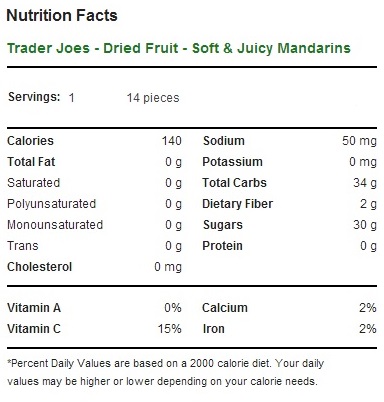
Trader Joe’s Dehydrated Fruit Soft and Juicy Mandarin – Nutrition Facts
Trader Joe’s Wasabi Mayonnaise
Posted: April 8, 2014 Filed under: Condiments, Spreads | Tags: 4 stars, horseradish, horseradish mayo, mayo, Trader Joe's Brand, Wasabi, wasabi mayo 2 Comments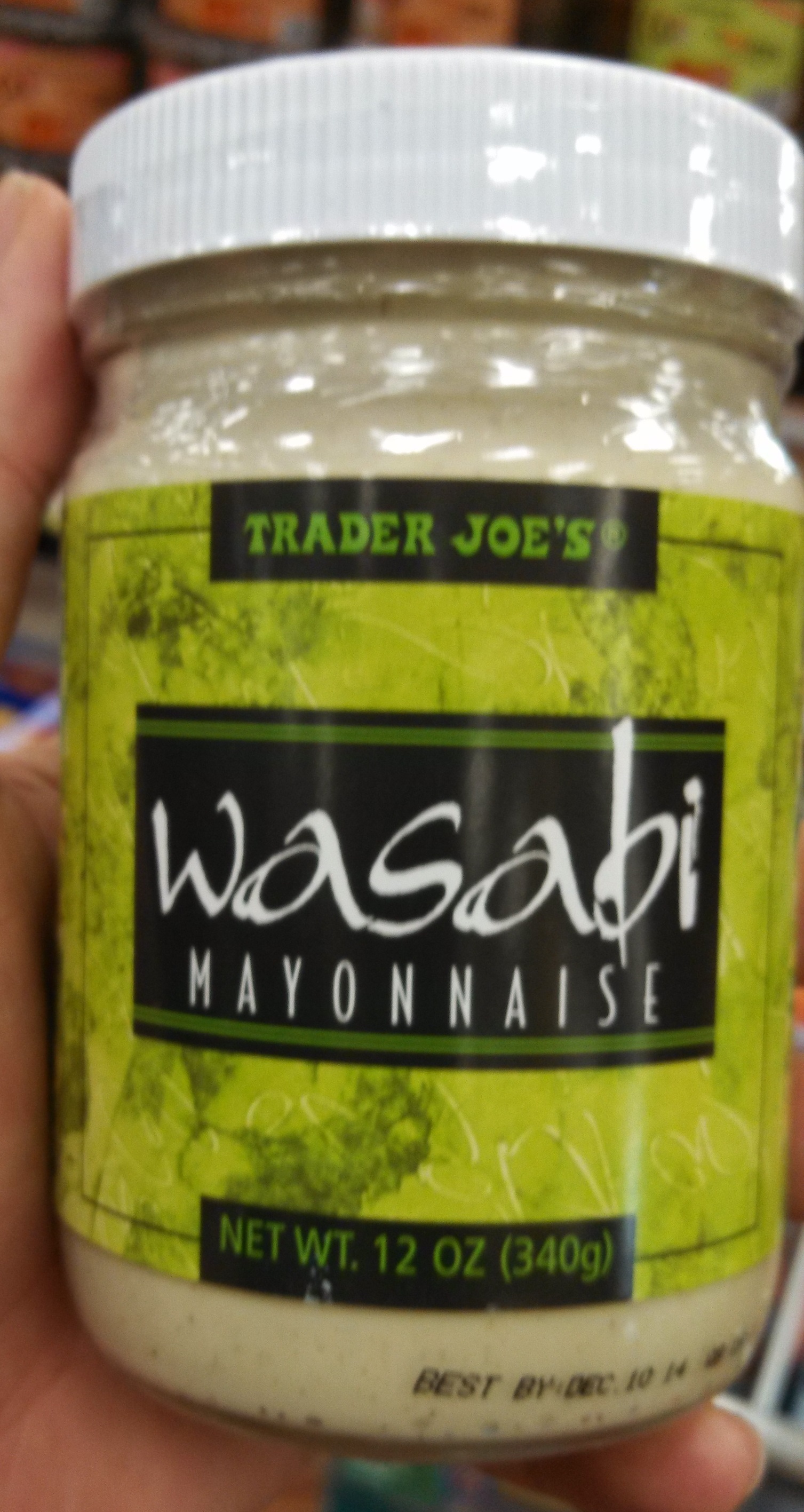
The lying little jar itself.
I was truly surprised when I saw Trader Joe’s Wasabi Mayonnaise. I suppose it’s quite provincial of me to be surprised by flavor tweaks to traditionally mundane condiments, it is, after all,the year two thousand and fourteen, miracles abound. I have, for instance, in my cupboard this very minute a bottle of balsamic vinegar infused ketchup from Heinz, of all people, and a plastic canister of PB2. In the face of that mixing a bit of powdered horseradish in with a ubiquitous and world famous emollient in desperate need of reinventing itself is practically child’s play.
Nevertheless, I was surprised. Wasabi mayonnaise is a very clever update on everyone’s favorite egg-based salad dressing and sandwich spread. I’ll cut right to the chase here, because we have plenty to get to today. Trader Joe’s Wasabi Mayonnaise is an excellent tool to have in your condiment tool box. It does everything that regular mayonnaise does just as well, plus it adds an extra dimension of bold spice to the mix. The mayo is thick, smooth and creamy – perfect for adding a savory skim of fat to food that are otherwise too healthy for their own good. Only a single quibble, and that’s that it’s a rather oily mayonnaise. That’s certainly not a deal breaker, just be prepared for it.
That leads us to the wasabi side of the mayo. The spiciness here is well balanced, it provides a mild kick in small amounts and a bigger one if you really lay it on, but make no mistake, this is a mayonnaise not a horseradish spread. You’re never in danger of burning your sinuses out of your head, though they might get a little wake up call.
Of course, there’s the small problem that our wasabi mayonnaise doesn’t actually have any wasabi in it. Or, more accurately, it has very very little wasabi in it, way down at the very end of the ingredient list below the spinach powder food coloring. When you have less wasabi in your wasabi mayo then you have artificial coloring, you might want to consider a different name, TJ.
Actually, as much as I’d like to condemn Trader Joe’s for barely putting any wasabi in their wasabi mayo, that’s simply the way it goes. Choose any wasabi product from your supermarket shelf and check out the ingredient list. 99 times out of 100, you won’t find any actual wasabi in the product. Real wasabi is difficult to grow – it can take up to two years to grow a mature wasabi root, and once mature it can only be harvested once. As a result, real wasabi is quite expensive – much more expensive than the simple combination of common horseradish, mustard and food coloring that almost everyone, Trader Joe’s included, uses in it’s place. It’s actually to TJ’s credit that they throw a token amount of real wasabi in here. Many less scrupulous wasabi providers (including, in all likelihood, your favorite sushi restaurant) settle for the cheap, horseradish-based variety that lacks any real Japanese wasabi what’s so ever.
Outraged? Maybe you should be – although you better check to see if you can afford real wasabi prices, currently about $20 for 2 oz. A better question might be, what’s the difference between real wasabi and this substitute? The answer seems to be not a lot. Those who know report that real wasabi is hotter with a sweeter finish. The sort of thing a real gormund might insist on, but which is probably wasted if it’s just being mixed in with a bunch of mayo anyways.
If you an get over the subterfuge and misdirection, Trader Joe’s Wasabi Mayonnaise is still a quality mayo with a lot of flavor, and one that you won’t regret buying at the much more reasonable price of $6.99 for a 12 oz. a jar.
The Breakdown
Would I Recommend It: Yes, this is a tasty twist on mayo.
Would I Buy It Again: I don’t use a lot of mayo, but if I was going to buy some I’d probably buy this.
Final Synopsis: A flavorful mayo balanced perfectly between spiciness and creaminess.
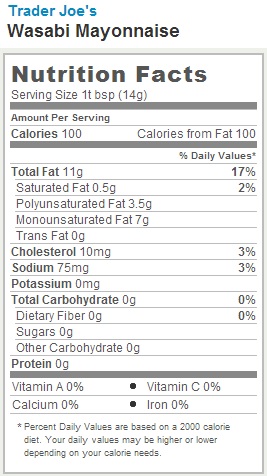
Trader Joe’s Wasabi Mayonnaise – Nutrition Facts
Trader Joe’s Vacuum Fried Banana Chips
Posted: August 31, 2011 Filed under: Uncategorized | Tags: 4 stars, banana, banana chips, Trader Joe's, vacuum-fried banana chips 11 Comments
The package. Simple, pretty and shiny – like an angel.
I’m not going to play coy on this one – these freakin’ banana chips rock. Let’s get it out up front – who doesn’t love banana chips? No one, obviously, and I think we should all tip our metaphorical hats to the man, men, woman, women or mixture thereof who pioneered the frying of this fleshy fruit in the first place.
As much as we love them though, what’s the ever-present downside of banana chips? Too much grease, and not enough rockin’ banana flavor.
Well, man, brace yourself. Trader Joe’s has solved both problems by, once again, applying the science of vacuum frying. As I mentioned in my last post, vacuum-frying is just deep frying but done inside a vacuum chamber. This is commonly used for fruit chips (like bananas!) because the absence of an atmosphere lets things fry at a lower temperature – thus preserving flavor and color while (slightly) reducing oil. In this case, however, we are talking a 50% reduction in fat – and the best damn banana chips you’re likely to find.
Crisp and very sweet, but not overwhelming, I was pleasantly surprised to see the complete list of ingredients read “Bananas, Palm Oil”. I was like, “Seriously? And this much flavor?!” Listen guys, I’m telling you they are totally serious.
There’s only one downside here, and that’s that you’re paying more than for your standard chip, but forget your standard chip already. It’s 2011 man, and it’s time to vacuum fry bananas.
Would I recommend them? Totally already did.
Would I buy them again? Over regular banana chips? Every time.
Final Synopsis: The best banana chip that I, personally, have eaten.
 Eating At Joes
Recent Comments