
Trader Joe’s True Thai Vegetable Pad Thai
Posted: September 11, 2014 Filed under: Frozen Food, Trader Joe's Brand | Tags: 3 stars, frozen food, pad thai, thai cuisine, Trader Joe's, Vegan 14 Comments
Yeah – vegan pad thai!
I certainly do love Thai food – or, more accurately, I love pad thai, and the rest of Thai cuisine is pretty good as well. Odds are that you love pad thai as well – this is double true if you happen to be a Thai national, as pad thai is the national dish in your country. However, even for the 99.98% of my audience that isn’t Thai, it’s still pretty likely that you love pad thai. In fact, pad thai is so highly regarded world wide that it was voted 5th most delicious food in the world by CNN in 2011. And while that may just the result of a fluff-piece poll in a desperate bid to get clicks, it also seems like it’s about right.
It is intriguing, then to come across Trader Joe’s vegetable “true Thai” pad thai in the frozen food aisle. With a promise of being 100% vegan, and a five minute microwaveable meal, Trader Joe’s was setting itself some pretty considerable hurdles TJ’s already proved that they could deliver on Thai street food with their green curry and GABA rice, but could they pull it off again? Fortunately, the answer is a firm yes.
If you enjoy this pad thai, don’t forget to give a quick thanks to Mr. Plaek Phibunsongkhram, one of the most important figures in Thai history, owner of an amazing name, and the person solely responsible for the modern day popularity of the dish. Prime minister of Thailand and de factor dictator during the the WWII years, Phibunsongkhram is a complex character, but the most important thing he did (within the context of this post) is give pad thai the name “pad thai”. Why focus his rather weighty attention on this one dish? The answer, of course, is geo-politics! With World War II raging around them, Phibun wanted to promote Thai nationalism and centralization while reducing domestic demand for rice. He managed to do all this by raising pad thai, and it’s noodles, to a prominent place in Thai culture. The result was an explosion in popularity across Thailand, and from there across the rest of the world.
Trader Joe’s Vegetable Pad Thai delivers not just as a delicious vegan meal, and as a delicious microwaveable meal, but as a delicious meal period. There’s a lot going on in a pad thai – from the bean sprouts, to the rice noodles, to the tofu and veggies, to the sauces. On each front TJ keeps things simple and natural. There isn’t an artificial ingredient to be found in the whole pot – just a vareity of vegetables mixed with water.
That natural simplicity plays out in the dish as a refreshing, wholesome taste – even when its just been been defrosted frosted from frozen. The bean sprouts, which make up the bulk of the dish, still retain some of their juicy crispness, even after being steamed in the microwave, and the rice noodles are suitably chewy and rich with the flavor of the creamy, mildly piquant pad thai sauce (a mix of chili sauce, tamarind sauce, and tomato paste).
The sauce isn’t quite as strong here as it is on other pad thai that you’ve probably had. Part of the reason for that is the absence of fish sauce in the dish. Although not a mandatory ingredient for authentic pad thai, the pungent, musky body of fish sauce gives pad thai a savory second kick underneath the noodles and chili paste. Although it’s missing here in order to keep the dish vegan, it doesn’t degrade the quality of the dish below satisfaction. There’s still enough harmony between the spicy, sweet and salty elements that it carries the rest of the dish along. This is particularly important when it comes to the tofu, which usually needs as much help as it can get. The tofu does manage to make it through alright, again thanks to the sauce, but it isn’t the best processed soybean mash you’ve ever had. The cubes are small, which is to its advantage, because they freezing process was not kind to them – rendering each tofu cube into a tough, chewy customers. While not exactly toothsome, without any meat or fish in the dish, they firmness of the tofu does lend the dish some much needed body.
Over all it works. It’s not going to be the most delicious pad thai you’ve ever had in your life, but for frozen, all-vegan pad thai it’s suitably impressive. The only strange touch is the crushed cashew nuts used in place of crushed peanuts. Whatever the rationale was behind that decision is hidden from my faculties, but it’s a moot point anyway since the nuts are undetectable except as points of crunchy texture,
This dish can be enjoyed as a tasty, vegan option, or just in its own right as a quick and easy dinner. Once caveat, however – bring your own limes. Evidently not even Trader Joe’s could figure out a good way to fit freeze-dried lime juice into the dish, and its the one flavor that the dish is noticeably missing. Get yourself a wedge to squeeze over the dish, and you won’t have any complaints.
The Breakdown
Would I Recommend It: Yes – the vegans and non-vegans alike.
Would I Buy It Again: I would, this is perfect for filling in last minute dinner ideas.
Final Synopsis: Delicious, microwaveable pad thai – as long as you have a lime wedge on hand.
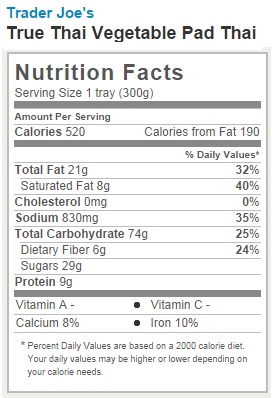
Trader Joe’s Vegetable Pad Thai – Nutrition Facts
Trader Giotto’s (Joe’s) Girasoli Ricotta & Lemon Zest
Posted: September 9, 2014 Filed under: Cheese, Pasta, Trader Joe's Brand | Tags: 3 stars, Italian cuisine, lemon, pasta, ravioli, ricotta, Trader Joe's Brand 8 Comments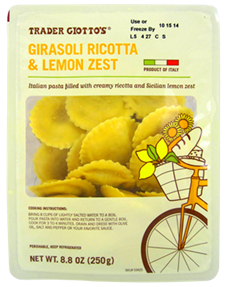
Fooled again by Trader Joe’s brazenly ambiguous syntax!
Although we haven’t spent much time looking at them yet, Trader Joe’s fields a pretty tasty line of ready to rock pasta dishes. Of course, the reason I haven’t really bothered to review them yet is that nothing has lept out at me as particularly crazy. The goal of this blog isn’t to review every average, Joe-schmo thing at Trader Joe’s, but to taste test the truly weird and daring – for better or worse. That means I haven’t felt a need to pick up any TJ pasta until now – with Trader Joe’s Girasoli Ricotta & Lemon Zest ravioli. There are a lot of delicious things to pack into ravioli, but never before this day did I dream that lemon would be one of them.
Let’s start with the name, which I was somewhat disappointed by. Girasoli, as all you literate latinate lovers out there already know, is Italian for sunflower. This immediatley led me to assume that these raviolis contained both lemon and, like, sunflower petals or something. A foolhardy assumption at most grocery stores, maybe, but this is Trader Joe’s were talking about – they already tried taking the sticks out of popsickles, I wouldn’t put anything past them.
Disappointingly, to me at least, there isn’t a seed or stem to be found in these ravioli. The eponymous sunflower refers, predictably, to the shape of the pasta, little flowery suns, not the contents. The lemon, on the other hand, is very real and, what’s even better, tastes terrific. Why put lemon in your pasta? Well, dammit, like most things in life the real question is why not? Actually, lemon zested pasta may be uncommon on American shores, but has a long tradition in Italy.
Trader Giotto lives up to his name here by not just zesting the ravioli with lemon, but with lemons harvested from around Mount Etna in Sicily. And while this sounds terribly authentic, it’s worth noting that while ricotta and lemon stuffed ravioli are certainly Italian, they’re a traditionally Sardinian dish, not Sicillian. I really hope someone got fired for that blundered.
Regardless of the providence of the dish, it’s tremendously tasty. Where Trader Joe’s gets it entirely right is in keeping it simple. The pasta is a basic, wholesome combination of flour, semolina and egg. Into these tender little pockets they add mild, creamy ricotta cheese dressed up with just the right touch of lemon zest. It’s easy to imagine this step going wrong. Lemon is delicous, but add a little too much and suddenly you’re serving up acidic pasta. TJ’s encounter’s no such difficulties here – the ravioli are touched by just enough lemon to bring out the flavorful citrus taste without being at all harsh or astringent. In fact, more than anything, the lemon tastes mellow and creamy – no doubt thanks to the mixture of butter and bread crumbs that also make up the filling.
So what’s the best way to eat this light, summery pasta? Keep it equally simple and light, of course. No need for a heavy pasta sauce here – just let the natural, intriguing flavor of the pasta shine shine through on its own – with a little help from a touch of pesto and fresh tomatoes. It’s a simple, quick recipe, perfect for a relaxed lunch or casual dinner.
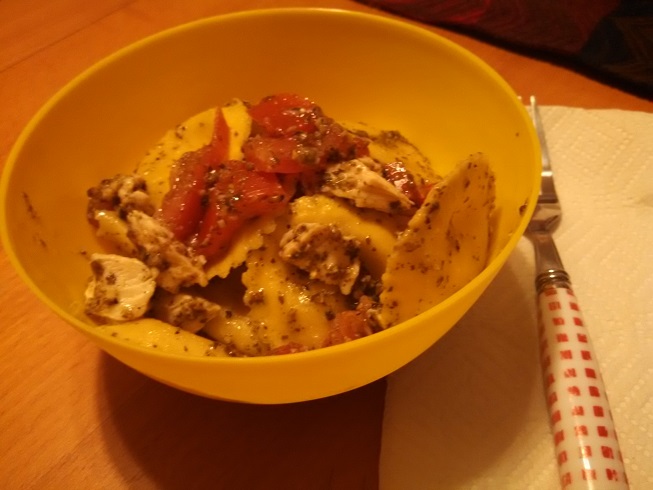
Trader Joe’s Girasoli Ricotta and Lemon Ravioli , with Pesto and Tomatoes
Trader Joe’s Lemon Ricotta Ravioli with Tomato and Pesto
Ingredients:
- 1 pkg Trader Joe’s Girasoli Ricotta & Lemon Zest Ravioli
- about 1/4 cup of Trader Joe’s Genoa Pesto
- 2 ripe, flavorful tomatoes, sliced and/or diced
Directions:
- Boil water in a medium-sized sauce pan, and add the ravioli.
- Keep on boil for 6-7 minutes, until appropriately al dente. Drain and place in a mixing bowl.
- Add sliced tomato, a nice bit of pesto and mix.
- Serve!
The Breakdown
Would I Recommend It: Yes, these ravioli are refreshing and filling.
Would I Buy Them Again: Certainly.
Final Synopsis: A traditional Sardinian ravioli that keeps things fresh with the right amount of lemon.
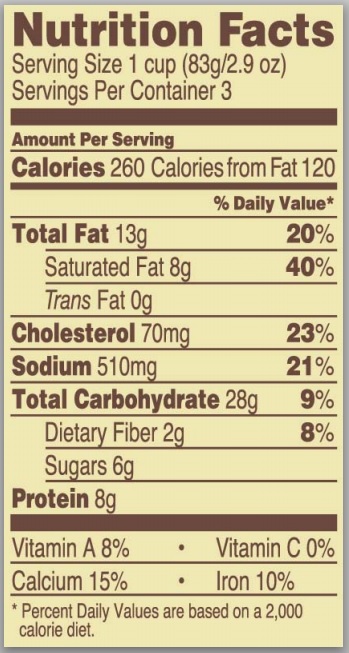
Trader Joe’s Girasoli Ricotta and Lemon Ravioli – Nutrition Facts
Trader Joe’s Potato Chips with South African Style Seasoning
Posted: September 4, 2014 Filed under: Chips, Snacks, Trader Joe's Brand, Uncategorized | Tags: 2 stars, Potato Chips, recipe, seasoning, south african smoke seasoning, Trader Joe's 4 Comments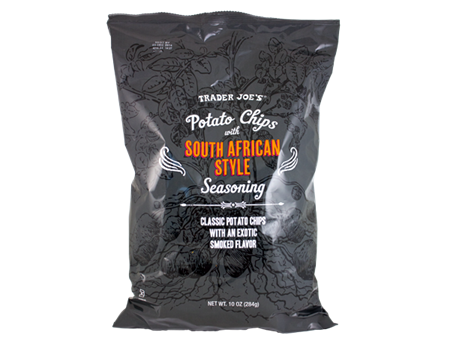
The seasoning you love, now in bag form.
Back when I reviewed Trader Joe’s South African Smoke Seasoning I was delighted to discover it was one of Trader Joe’s hidden gems. Easy to overlook on shelves full of peppercorn grinders and rock salt, this South African style seasoning is imbued with a whole different dimension of flavor – the savory, rich taste of smoked meat.
When used on hamburger, steak, chicken, or anything you might like to barbecue, it’s a killer seasoning that brings to the fore the richer, meatier flavors hidden in any meat – a little magic touch of South African umami.
Of course Trader Joe’s would be Trader Joe’s if they could just leave it there. Which has lead, apparenlty, to Trader Joe’s throwing this seasoning designed for meat onto potato chips with the new Trader Joe’s Potato Chips with South African Style Seasoning.
It’s an innovation that could go either way. On the one hand, we live in an age of out-of-control potato chip creativity. Bold, daring and, some might say, insane flavors of potato chips are not just possible to find, but aggressively marketed from supermarket shelves. 10 years ago about the most “out there” chip you could find was jalapeno. Nowadays you can dabble in the sorts of epicurean excess that would have made Nero take note. Chicken & waffle flavored potato chips, mac & cheese, wasabi ginger, balsamic vinegar & rosemary, – even cappuccino, by god, cappuccino! It’s an age of snack madness, and one that Trader Joe’s is clearly unafraid to get in on. Already they’ve weighed in on with their non-standarad Beurre Meuniere Popcorn. Throwing a meat seasoning onto potato chips is almost tame by comparison.
So we can’t doubt the boldness of Trader Joe’s resolve or vision – the question is, does this seasoning actually go well on potato chips. The answer, sadly, is no.
The same qualities that make the South African Smoke Seasoning so savory on meat work against it here – it’s simply too salty and strong tasting for the simple potato chips. Divorced of a meat base, the seasoning has nothing to work off of. The result is sort of like throwing a handful of the seasoning directly into your mouth. It’s not that the taste of the seasoning is bad, it’s simply overpowering. When used on a grilled steak or hamburger, the smoke seasoning simply blends in to the complex profile of the flavors at hand. Here, on its own, it has the very strong taste of bratwurst, or as one taste tester put it, “burnt hot dog”.
How much you’re going to like these chips, then, depends on how much you like that heavy, bratwurst taste, without getting the juicy bratwurst bite. This wouldn’t be as much of a dealer breaker if it wasn’t for the strength of the taste. Trader Joe’s isn’t mincing around here – each chip is blasted with a full on shot of seasoning that is close to overwhelming. These chips are best not eaten by the handful, but slowly, one by one, or not at all.
For me the intensity of the flavor simply didn’t work together very well. Between the serious saltiness, and the heavy seasoning these chips tended to overshadow whatever I was eating them with. When your potato chips taste more like hot dogs than the hot dogs themselves, it’s generally not a good thing.
The chips may not work very well as chips because of the seasoning, but what if they were the seasoning. That barely coherent thought is what lead me to cook up the recipe below – country fried steak, with crushed potato chips instead of breading.
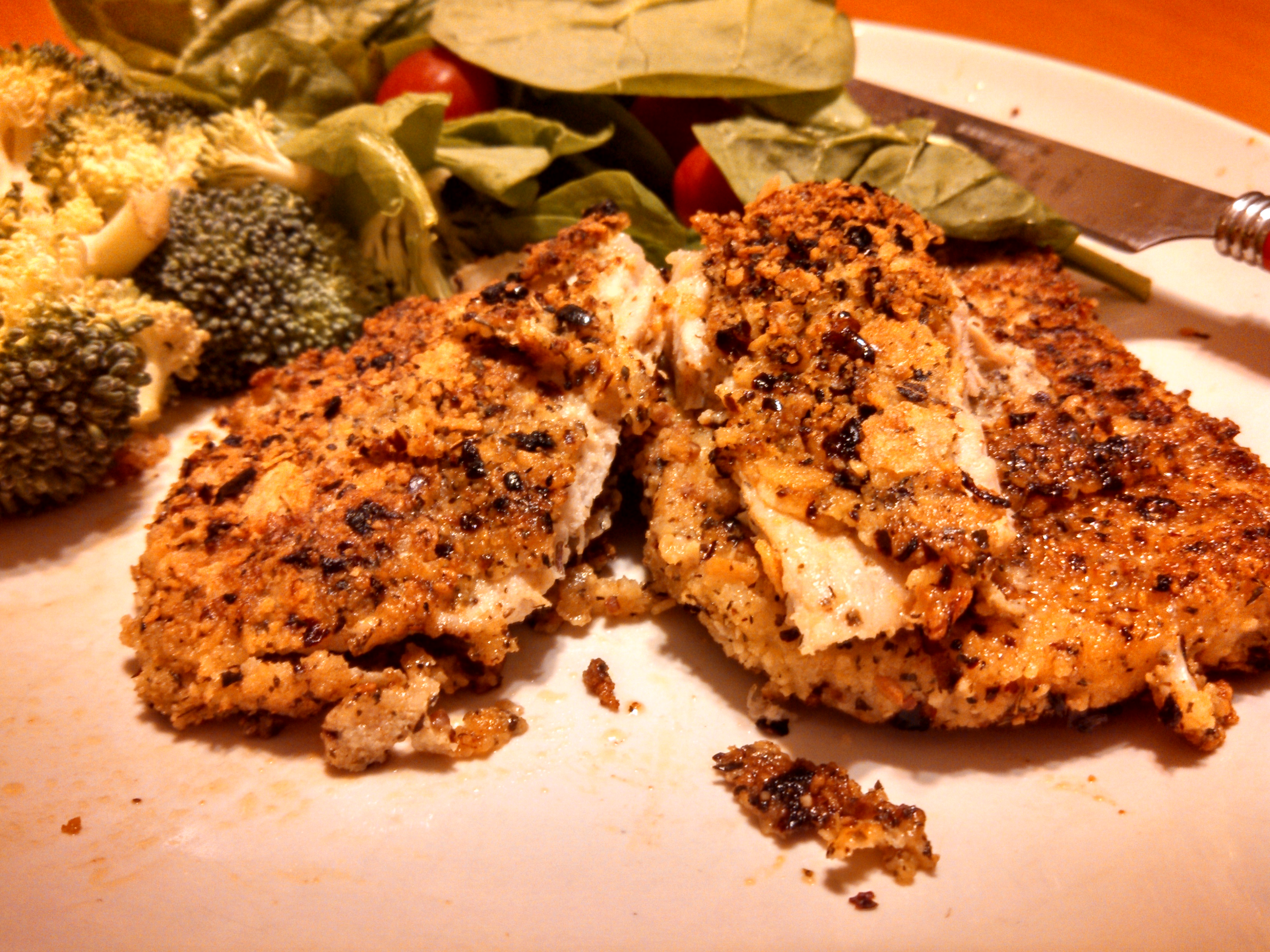
Trader Joe’s Potato Chips with South African Style Seasoning-Fried Steak
Trader Joe’s South African Style Seasoning Potato Chip-Fried Steak
Ingredients:
- 2 steaks, about 1/2″ thick
- 1 cup flour (any sort, I don’t care)
- 1 cup pulverized Trader Joe’s African Style Seasoning Potato Chips
- 2 or 3 eggs, beaten
- About a 1/4 cup vegetable oil
- Maybe a delicious gravy?
Directions:
- Pulverize the hell out of your chips. You can do this with a food processor, or by putting them in a baggy and smashing the hell out of them. (This is the most fun part of the recipe.)
- Spread the flour around in one dish, and the potato chip dust in another dish.
- Have the eggs ready in another dish or shallow bowl.
- Dredge the meat on both sides in the flour. (This is the third most fun part of the recipe)
- Dredge the meat in the potato chips dust, followed by the egg, and finally in the potato chips again. (This is the second most fun part of the recipe.)
- Repeat these steps with all the meat.
- Place enough of the vegetable oil to cover the bottom of a skillet and set over medium-high heat. Once the oil begins to shimmer, carefully add the meat.
- Cook each piece on both sides until golden brown, about 4 minutes per side.
- Serve the steaks (with some of the delicious gravy?)
Notes: This recipe delivers a crunchier steak than you might otherwise get, and the African Smoke Seasoning lends it’s helping hand, giving it a robust, BBQ sort of taste.
Turning chips into the seasoning instead of just adding the seasoning directly might be considered taking the long way around, and that’s a fair criticism, but dammit we live in the world of the Mini Waffle Stick Maker and Segway. If something’s worth doing, it’s worth doing in an unnecessarily, silly way.
A delicious gravy is bound to help these steaks out, but that’s beyond the purview of this post.
The Breakdown
Would I Recommend It: Not unless you usually feel your brautwurts aren’t brautwursty enough.
Would I Buy Them Again: I don’t think so.
Final Synopsis: Trader Joe’s excellent south african style seasoning should stick with meat instead of potatoes.
Trader Joe’s Lemon Chicken Salad
Posted: September 2, 2014 Filed under: Trader Joe's Brand | Tags: 4 stars, Chicken, Salad, Trader Joe's 1 Comment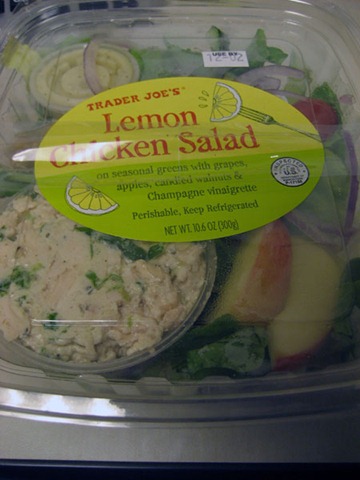
A salad in a salad? Trader Joe’s gets meta.
There are a lot of Trader Joe’s salads to like, a a lot of different reasons to like them. Some, like the Bacon and Spinach Salad, are decadent tongue-pleasers. Some, like the Country Salad are a good hearty meal. Some, like the Quinoa and Squash Salad, are simply intriguingly different. But of all the Trader Joe’s salads I’ve had, Trader Joe’s Lemon Chicken salad has been the most purely refreshing.
I’m an avowed salad lover. It’s not unheard of, for instance, for me to eat 10 salads in a week. The issue I find facing me most often, the true concern of the salad lover, is in balancing heartiness with healthiness. It’s all too common to run into salads out there which load on the cheese and bacon and heavy cream dressings, and end up being and end up at a monstrous calorie levels. On the other hand, there’s also the issue of the super light, salad – a collection of lettuce leaves, free of any protein source, that cost $13 and contain 150 calories. Somewhere in the middle, and oh so rare, are the salads that balance a good meal with nutritious content. There are a rare handful of these kingly salads, even at Trader Joe’s, and this Lemon Chicken Salad is one of them.
Most of Trader Joe’s salads are simple and straight forward – here’s your bin of greens, here’s your dressing, go at it. Trader Joe’s Lemon Chicken Salad, on the other hand, plays it a little more subtle. It isn’t a salad so much, as it is a light entree built around a sub-salad – in this case a chicken salad.
We start out with a good portion of chicken salad, packaged in a small tub inside the salad itself. This is the cornerstone of the dish, and it successfully carries the day. Lean white chicken breast is zested up with lemon and a touch of black pepper and melded together with just enough mayonnaise. There are a lot of ways to screw up a supermarket chicken salad, but Trader Joe’s version is not just edible, but flavorful and delicious.
Added to the bed of seasonal greens (romaine, chard, argula, etc) and this would make for a fine, refreshing salad by itself – but things get taken up a notch with a welcome portion of crisp grapes and apples that provide fresh, sweet bursts of juicy flavor. This fruity sweetness is itself a perfect pairing with the citric zing of the lemon chicken and not only alternates flavors, but makes you think about how you’re eating the salad as you eat it. That’s not a big deal but it’s a nice touch.
Cherry tomatoes, cucumbers, carrots and, divinely, red onion, although not referenced in the title, all make appearances as well – bulking up the body of salad as well as laying the ground for a scattering of decadently sweet, candied walnuts. All of this is topped off with a light and zingy champagne vinaigrette that buoys the salad up and brings out the flavors of each part, a refreshing touch to the end of a refreshing meal.
At 400 calories per container, 18 grams of carbs, and 22 grams of lean protein it’s a tremendously well balanced salad as well – as healthy as it is filling. The nutritional profile, along with the variety and interactions of the many flavors, makes this one of the most enjoyable salads I’ve had form TJ’s – and a prefect option to turn to when the thought of heavier salads seems oppressive.
The Breakdown
Would I Recommend It: Yes, this salad strikes just the right balance between healthy and hearty.
Would I Buy It Again: Without a doubt, this is a good ol’ salad.
Final Synopsis: A light, refreshing salad that still fills you up.
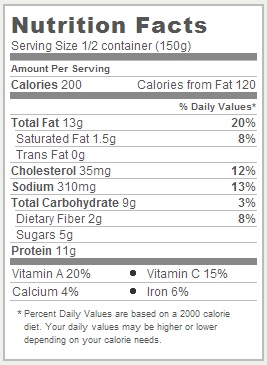
Trader Joe’s Lemon Chicken Salad – Nutrition Facts
Trader Joe’s Crispy Crunchy Jack Fruit Chips
Posted: August 28, 2014 Filed under: Fruit, Trader Joe's Brand | Tags: 3 stars, banana chips, bonda, dehydrated fruit, Fruit, jackfruit, recipe, Trader Joe's 4 Comments
More convenient than a smelly, 80 pound mega fruit
One thing that Trader Joe’s cannot be accused of lacking are options is the dried fruit department. I’m endlessly charmed by the lengths and methods TJ’s will go to in order to bring us a fourth type of dehydrated apricot, or a new way to make banana chips.
However, even I was surprised by Trader Joe’s Crispy Crunchy Jackfruit Chips. For one, it’s weird to see such a massive fruit in such a tiny bag. The first time I encountered jackfruit in real life, I was shocked and a little taken aback, that fruit could get so big. How big is it? Big enough that I was momentarily afraid I had been shrunk to the size of bug. A fully mature jackfruit can be up to 3 feet long, weigh up to 80 pounds, and grow in bunches on trees – meaning they straddle the line between fruit, and natural hazard.
Your average jackfruit could kill a horse if it happened to drop at the right moment, helped along by the fact that they are covered in spiked, armored plates – as if Nature decided to stop screwing around after this pineapple thing. It’s rare to find a fruit where two, stacked on top of each other, could beat me in a fight.
Despite its relative obscurity here in the West, jackfruit has been a staple in India and South East Asia for thousands of years thanks to its size, resiliance and versatility as an ingredient. Like papayas, jackfruit are used for much more than simply a sweet snack. It is roasted, added to soups, fried into cutlets, mashed into kati and otherwise eaten all over the placed. In fact, jackfruit is so adored that it’s the National Fruit of Bangledesh. It’s not surprising, then, that Trader Joe’s got the idea to dehydrate them into chip. After all, that’s been a popular snack throughout South East Asia for many years.
In their natural, raw state the jackfruit tastes something like a banana crossed with a very mellow mango. By drying jack fruit out, Trader Joe’s reduces this flavor profile greatly. Regardless of the exotic origin and taste of jackfruit, what we’re encounter here is basically a nice-sized banana chip. It may be a hint sweeter, and there are subtle tones of mango and pineapple hiding in the background, but these more exotic flavor are not nearly pronounced enough to over power the starchiness of the chip. It’s the size and softness of the jackfruit chips that makes them most different from banana chips – each piece is a mouthful, and they yield rather more pleasantly to the tongue than the brittle banana chip.
One other thing the jackfruit is famous for is its trade mark odor. Fortunately lost during the dehydrating process, the fruit is generally described as having an unpleasantly overripe musk often compared to smelly feet.
Overall, it’s only subtle touches that set these jackfruit chips apart. If you’re a banan chip fan, these will be interestig to pick up by comparison. If you’re looking for a fresh new taste, however, something exotic to tingle the tastebuds, Trader Joe’s Cripsy Crunch Jack Fruit chips aren’t going to blow you away.
That left me a little disappointed, but not defeated, so I went looking for a recipe that could give second life to this otherwise limited snack chip. I may or may not have found it. The recipe below is for traditional jackfruit bonda – a type of small, South Indian snack dumpling. Ideally you make these by grinding fresh jackfruit into a paste but, dammit, we just don’t live in an ideal world. Until TJ’s starts stocking their shelves with smelly, 80 pound monster fruits, I guess I’ll just have to make do with their jackfruit chips instead.
The concept behind re-purposing this recipe is to somehow reconstitute the dehydrated jackfuit chips with a bit of water (or juice) in order to create a paste. This paste is then, conceivably, used to cook with. Unfortunately, my food processor couldn’t manage the task and I was left with an unusable slurry. Next time I’ll try taking a mortar and pestle approach, and pulverize the jackfruit chips before trying to reconstitute them – so stay tuned for that!
In the meanwhile, if anyone has more luck with this recipe, please share with us in the comments!
Impossible(?) Jackfruit Bondas (using dehydrated Jackfruit chips)
Ingredients
- 1 cup of dehydrated jackfruit chips
- 1 cup brown sugar
- 1 cup farina or semolina (cream of wheat will do)
- 1/2 cup shredded coconut
- 1/2 tsp of fun exotic spices (Recommended options: a mix of dried ginger and cardamom, with a pinch of salt and black pepper, but really you can get crazy with this part)
- oil to fry with
Directions
- Somehow grind jackfruit chips into a fine paste (maybe with a mortar and pestle?)
- Combine jackfruit paste, sugar, farina, coconut and spices.
- Let sit for 15 minutes
- Roll into small balls (about 1/2 the size of an egg, or so)
- Heat up a frying pan, fill with oil, and start frying the suckers.
- Eat them bonda up!
Notes: Real bondas should be made with jaggery and rava – two Indian ingredients that I barely understand and can’t get into here. Instead, I substituted brown sugar (for the jaggery) and cream of wheat (for the rava). Both of these substitutions will probably piss off anybody who makes real bondas, so be careful.
The Breakdown
Would I Recommend Them: Not really, these weren’t much better than banana chips.
Would I Buy Them Again: I have to! I’m not resting until I figure out this bonda recipe
Final Synopsis: Like banana chips, but a little softer and a subtly more exotic tasting.
Trader Joe’s Fruit Bar with Flax and Chia Seeds
Posted: August 26, 2014 Filed under: Apple, Candy, Fruit, Snacks, Trader Joe's Brand | Tags: 3 stars, chia seeds, flax seeds, Fruit, fruit bars, Snacks, Trader Joe's 2 Comments
Flax seeds *and* chia seeds *and* stylish packaging? I’m in.
Trader Joe’s has renewed it’s fruit bar producing efforts of late. We just took a look at their new line of thick and hearty two ingredient only fruit bars. Not content to rest with a mere 14 varieties of fruit bars across three separate labels, TJ’s has released yet another one – this one simply called “Fruit Bar with Flax and Chia Seeds.” The hardest part about covering these bars are their homogeneous names, a trend that TJ’s has decided to double down on by not even telling you what kind of fruit this bar has in it. Fruit, it suggests to you coyly, with seeds! Okay TJ, that weird enough to get my attention.
The reason, it turns out, that Trader Joe’s leaves the fruit name off this one is that, for once, it’s a blend of the whole orchard. Apple puree is the primarily ingredient, followed by a mixture of pear, elderberry and strawberry touched with lemon juice.
I went in to the bar with low expectations – after reviewing every fruit bar TJ has to offer, I was pretty sure they wouldn’t have any more surprises for me. I was wrong. This bar easily bests all of the Apple & Whatever bars I reviewed last month. That maybe shouldn’t be such a surprise really – when you limit yourself to just 2 ingredients, you’re also limiting our flavor palette. Trader Joe’s Fruit Bar with Flax and Chia seeds has a much deeper, more nuanced taste, injecting each chewy, tacky bite with a density of flavor, one fruit mingling harmoniously with the next in a way that teases the tongue to probe each bite. The lemon juice, in particular, has an appreciated presence, giving the bar a zesty bite that sets it aside from its starchier, blander siblings.
In and of itself, Joe has a winner here. However, they don’t stop there, mixing in a pinch of flax and chia seeds to boost the nutritional profile. Both flax and chia seeds have been very much in the public eye of late for their “super nutrient” qualities. While their purported qualities owe as much to marketers as they do to science, these seeds are undeniable potent sources of nutrients and fats. Each bar brings a full 1000 milligrams of Omega-3 Fatty Acids, advertised right there on the front of the wrapper. That’s a fun perk if you’re trying to get more into your diet, and an interesting concession to texture for the rest of us.
As already mentioned, the bars is gooey and tacky in that “stick to the wrapper” kind of way. The added seeds give the bar a touch of crunch to each chewy bite that lends them a touch of welcome body.
The result is a surprisingly tasty, fruity, and munchable fruit bar. If you’re looking for single ingredient fruit bars (or fruit leather), you’ve got plenty of choices out there. However, if you’re just looking for a good fruit bar to snack on, this is the best TJ currently has to offer.
The Breakdown
Would I Recommend It: Sure, if you like fruit bars, or need natural alternatives Fruit Roll Ups.
Would I Buy It Again: I’m not a big fruit bar guy, but if I was this is the one I’d go for.
Final Synopsis: Trader Joe’s tastiest fruit bar.

Trader Joe’s Fruit Bar with Chia Seeds and Flax Seeds – Nutrition Facts
Trader Joe’s Cookie Butter Ice Cream
Posted: August 21, 2014 Filed under: COOKIE BUTTER!, Desserts, Frozen Food, Trader Joe's Brand | Tags: 5 stars, cookie butter, ice cream, recipie, Trader Joe's, vanilla 1 Comment
Humana humana humana- COOKIE BUTTER?!?!?
We all know about Cookie Butter. We all know that it’s a semi-divine creation that has melted hearts across the nation and, in fact, the world – lighting up the taste buds with the decanted taste of pure Christmas from here to Belgium. If, and it saddens me to even spin the hypothesis, you don’t know what cookie butter is, you had better educate yourself.
Now, it has long been my firm stance that cookie butter is like an edible form of elemental gold – pure and perfect in and of itself. We’ve seen that mixing it with anything else, even Nutella (?!), merely dilutes it’s purity and introduces imperfections.
So it was with a great deal of excitement, but also skepticism, that I picked up Trader Joe’s latest, greatest development – Cookie Butter Ice Cream. On the one hand, how could cookie butter ice cream possibly be better than cookie butter by itself. ON the other hand, it’s ice cream! Maybe “Nutella” couldn’t do the job, but if there was ever anything that could improve on CB it’s a good helping of heavy cream and sugar.
These are high stakes to be sure. Trader Joe’s Cookie Butter Ice Cream is sure to either elate me to previously imagined heights of ecstasy, or deliver a crushing blow to the solar plexus of my soul – there is no middle ground here.
It is to my elation that I can report Trader Joe’s really knocked this one out of the park – an undeniable master stroke. How did TJ manage it? The answer is as simple as it is brilliant. Starting with a nice, creamy vanilla they mixed in a plenty of crushed speculoos – permeating the medium with that cookie butter taste. On top of that, is this is what carries the day, they wove ribbons of pure cookie butter, caramel like, through the whole thing. The result is a sweet, delicious ice cream that alternates moments of low-key, pleasant cookie butter taste with bursts of intense, uncut cookie butter. I don’t see how heroine can be illegal while this isn’t, but regardless you and I get to reap the windfall.
There’s not much more to add, really – the ice cream is as good as you want it to be. If you’re still reading at my post at this point, you should obviously stop and go out to buy some cookie butter ice cream. Eat some of that, then come back and we can finish here.
The question of how to incorporate Cookie Butter Ice Cream into a recipe is may well be as futile as asking that question of cookie butter itself. It’s hard to improve on eating it straight from the bucket – sometimes even the spoon seems like a cruel impediment standing between you and sweet, sweet cookie butter. Nevertheless, I took my best shot at it with this week’s recipe for Salted Cookie Butter Ice Cream Shakes.
Is it better than the straight ice cream? I can’t look you straight in the eyes and say that. It might be better to think of the recipe as a remix of a song you really like, as another way to experience that initial rush over again.

Trader Joe’s Salted Cookie Butter Ice Cream Shake
Salted Cookie Butter Ice Cream Shake
Ingredients:
- ~ 3 cups of Cookie Butter Ice Cream
- ~1 cup milk
- A pinch of Trader Joe’s Pyramid Salt
Directions:
- Put all the ingredients in a blender and puree to your heart’s content.
I would recommend using whole milk, or even Trader Joe’s Organic Top Cream Milk, for the creamiest taste.
Also, a note on the salt. I used the pyramid shaped flake salt we’ve looked at before. The advantage is that even after blending there are small flakes of salt suspended in the shake, meaning you get little pleasant moments of saltiness to highlight the sweetness. If you don’t have flake salt on hand, consider just throwing a tiny pinch of salt on top at the end, instead of blending it in.
The Breakdown:
Would I Recommend It: Yes. If I met the President, I’d probably recommend it to him.
Would I Buy It Again: Sure, whenever they’re not sold out.
Final Synopsis: Cookie butter meets vanilla ice cream – and it’s as good as you’d hope.
Trader Joe’s Organic Cream Top Milk
Posted: August 19, 2014 Filed under: Trader Joe's Brand | Tags: cream top milk, Milk, Organic, organic milk, Trader Joe's, whole milk 9 Comments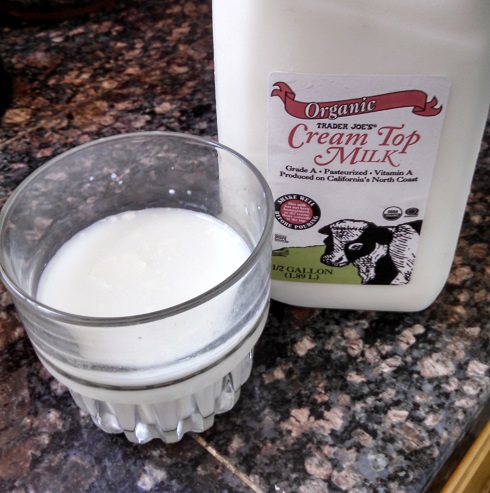
Not pictured: the plug of solid creamy fat.
Sure, I’m a city boy. Aside from a week spent working on a cattle ranch, most of my encounters with cows have been at the end of a fork. Even the cows on that ranch we’re destined for the killing floor (a misnomer actually – it’s more of a steel grating that lets loose material sluice through). Come to think about it, milk is the closest I ever get to a living cow.
And really, I thought I understood milk – it’s food number one after all. There’s literally no food product I’ve drinking for longer . You’ve got your skim milk, your whole milk, and that’s about it. So it was with considerable surprise that I encountered Trader Joe’s quart of Organic Cream Top Milk. What is this stuff? It’s neither of those types – how could there be a milk that I’d never heard of before?
Determined to find out, I cracked open the bottle, and was shocked at what I saw. I was prepared for cream top milk to taste creamy, or to have cream floating on top of it. What I wasn’t ready for was a physically solid plug of butter-like cream to be between me and the rest of the milk. Just beneath the milk cap is a stopper, and that stopper is a thick, smooth lump of pure milk fat. It doesn’t so much float on top of the milk as it is firmly crammed into the spout. Can milk be like this? Is this even normal?
Yes, as a matter of fact, it is. In fact, for much of the history of milk drinking, this is how everyone’s milk looked. The half inch thick of plug of butter fat is simply the result of skipping one eminently modern step in the milk process – homogenization.
Milk is a naturally complex liquid, with a great number of balanced interactions that occur between the various proteins, enzymes and fats that constitute it. About half a day after being gathered, the creamy fat in milk organically rises to the top and melds together.
Homogenization is the act of breaking these fats back down, pulverizing them on a molecular level, essentially, until they are so diffuse and scattered that they can no longer naturally join up. This microscopic demolition is done by rapidly shooting milk through tubes thinner than the width of a human hair until the fat can no longer reform. It’s a process first perfected by enterprising Frenchman Auguste Gaulin in 1899. The primary reason was one of longevity – with the fat dispersed throughout milk it becomes rancid less quickly, in addition to which it has a somewhat creamier taste, due to the diffusion of the fat.
So why is Trader Joe’s so determined to undo the hard work of monsieur Gaulin? The reason is similar to the drive for organic food – a return to nature. The question being asked is, is it not better to simply let milk be? Is it not, perhaps, in someway harmful to meddle so much with something fundamentally natural. There are proponents who come down on both sides of this issue, but science has not yet struck a conclusive blow for either side. In the absence of overwhelming evidence, the question is mainly a matter of personal taste. Just how natural do you like your milk?
It should also be noted that Trader Joe’s Cream Top Milk has several other features beyond the thick pat of cream. Most notably, it has a subtly richer flavor and more organic scent than your typical homogenized whole milk. There is a sort of ineffable wholeness to the smell that homogenized milk seems to lack.
Does this make it a worthwhile purchase? If you value being that much closer to the source – a touch closer to nature – then this is the milk for you. If you want milk that will last longer and taste a little blander, than you can stick to whole milk. Of course, if you usually shop skim like myself it’s all moot point. With 150 calories per cup, and more than half that from fat, it’s more of a calories expenditure than I’m willing to accept in a glass of milk.
This was an interesting purchase because it was a visceral reminder of the truly organic nature of milk, and I rather like the thought of having a little pat of semi-butter to harvest every morning for my toast or whatever. That said, it’s increasingly a fat-free world we live in. I might pick some more of this up around Christmas to see how it handles in egg nog, but until then I’ll be satisfied just knowing there’s something so primal on the dairy shelf.
The Breakdown:
Would I Recommend It: Yes to people who like their orange juice with pulp and their beef grass fed.
Would I Buy It Again: Nope – too much fat for my figure.
Final Synopsis: Whole milk with the fat floating on top instead of mixed in.
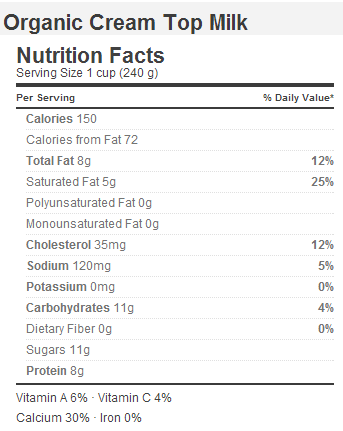
Trader Joe’s Cream Top Milk – Nutrition Facts
Trader Joe’s Champagne Grapes
Posted: August 14, 2014 Filed under: Fruit, Grapes, Trader Joe's Brand | Tags: 4 stars, black corrinth grapes, champagne grapes, currants, grapes, mini grapes, Trader Joe's 2 Comments
Ha ha – and you thought YOU were small, cherry tomatoes!
Ah – champagne grapes! That’s precisely the type of exclamation I would have made when I came across these, except that I’d never heard of champagne grapes before and had no concept of what they were. Well, that might be a bit disingenuous, I suspected they might be grapes – but why so small, why so many, and why the evocative and memorable name?
The champagne grape wins some sort of award for being the most confusingly named grape. For starters, our little champagne grapes have nothing to do with the manufacture of champagne. Champagne is, of course, made from grapes – but those grapes are either Chardonnay or Pinot Noir grapes, larger, thicker-skinned brutes. The pseudonym “champagne grape” allegedly owes its existence to one Mr. Allin Corrin – a grape producer from Reedly, Califronia. According to lore Mr. Corrin arranged to have this variety of tiny grape featured in Sunset Magazine next to a flute of champagne and the blurb “champagne grapes”. Supposedly, that single image in Sunset Magazine had a strong enough national reach to indelibly brand the grape with that name forever more. I would like to believe this story as much as I’d like to believe the story about gyoza and Chinese ears, but there seems to be little evidence to back up the claim beyond a passel of unsourced Yahoo Answer results.
Prior to being called champagne grapes, these little guys were known as Black Corrinth grapes, due to their origin in that region of Greece – still the primary produce of the grapes to this day. Of course, like all grapes, Black Corinth grapes undergo that magical change when they’re dried – a magical change that transforms their name. While most grapes become raisins, the champagne grape actually becomes a currant.
Wow, you might be thinking, so that’s where currants come from! Well, no – not really. In all likelihood the currant you’re thinking of is the blackcurrant or redcurrant, two very similar berries in taste and appearance that just happen to be totally unrelated to grapes. The full name of the dried champagne grape is the “Zante currant”, but the “Zante” part is commonly dropped, adding to the whole confusion.
Long and complicated name history aside, you may well be wondering how the Champagne grape actually tastes. The answer is, quite delicious! Each tiny grape is incredibly sweet and flavorful, not to mention seedless. The taste is like that of a larger grape, but concentrated into a smaller space, like a Jelly Belly compared to a Jelly Bean. The little grapes are sweet all the way through – never tart or harsh.
Of course, being so tiny and numerous, you might well be asking yourself what to do with them. Well, for starts there’s nothing wrong with just casually snacking on them – much as a recumbent Pharaoh may be want do. One of the perks of the diminutive size of the grapes is that the stems are nearly thread-thin and supple enough to eat. You can simply snack down on the little grape without bothering to stop and pluck out each tiny stem.
If you’re looking for something a little grander to justify your champagne grape purchase, they can easily be substituted into any recipe that call for any other sort of table grape – just be sure to account for the extra sweetness they bring. It’s easy enough to scatter a handful of these over your salad, (to be paired with a nice vinaigrette perhapss). If you’re feeling even more adventurous, you can try the grilled cheese and champagne grape receipe below:

“Crying over my champagne” Grilled Cheese Sandwich
Recipe – “Crying over my Champagne” Grilled Cheese Sandwich
Ingredients:
- A couple slices of bread
- Softened butter (enough for bread and sautéing)
- Some sliced cheese – cheddar is nice.
- Very thin slices of red onion
- About 2 tablespoons worth of champagne grapes
Directions:
- Heat a skillet to medium heat.
- Add the rest of the butter to the pan and sautee your red onions. (Cook for 5 to 7 minutes or until tender, stirring frequently).
- Butter each slice of bread on one side.
- Lay a slice of bread, butter side down, on a plate and add the cheese slices.
- Add the sautéed onion, followed by the champagne grapes. Try to spread everything evenly.
- Place the other slice of bread on top, buttered side out. (Press down slightly to keep it all together).
- Cook over medium heat for about a minute to a minute and a half on each side, until nice and melted.
- Cut the sandwich in half (diagonally!) and serve.
The red onion is such a strong taste, that it can overpower the gentle sweetness of the champagne grapes. Sauteeing them makes the onions milder, but if you like your sandwich to have bite you can skip this step.
All in all, these grapes are a perfectly nice way to fill your fruit bowl with something a little out of the ordinary. If you’re a fan of grapes, or sweet fruit in general, you’ll want to give these a shot.
The Breakdown:
Would I Recommend Them: Yes, these are very nice for snacking on.
Would I Buy Them Again: Sure, I like to have a varied fruit bowl.
Final Synopsis: As Jelly Bellys are to Jelly Beans, so are Champagne grapes to regular table grapes.
Taos Joe’s (Trader Joe’)s Southewest Chicekn Quesadillas with Seasonal Vegetables
Posted: August 12, 2014 Filed under: cheddar, Cheese, Chicken, Frozen Food, Meat, Onion, Poblano, Spinach, Trader Joe's Brand | Tags: 3 stars, cheese, mexican food, quesadilla, southwester food, taos joe's, Trader Joe's 2 Comments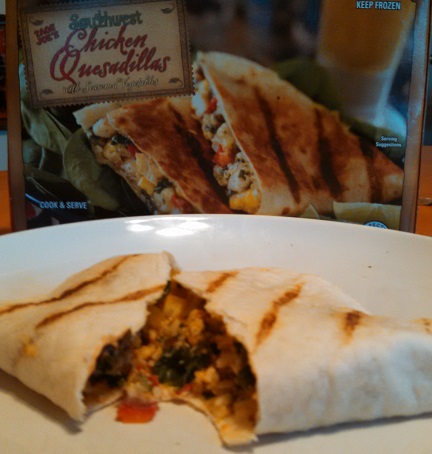
Yup, it comes pre-grill marked. All you need to do is pop it in the microwave and lie to your guests.
The only real rule I have for myself with this blog is to review only those things which are unusual enough to catch one’s attention, but are too unusual to warrant an immediate purchase. This plan has guided me down some terrible alleyways and up some delightful avenues. Why then, am I bothering to review Trader Joe’s Southwest Chicken Quesadilla – one of the safest, least intriguing foods out there? After all, isn’t the quesadilla such a staple of kid’s food menus for its tremendously simple execution and supremely inoffensive recipe, namely melted cheese in a white flour tortilla?
Yes, all that may be true, but I was drawn to this product for one very simple reason – the “Taos Joe” brand name.
One of Trader Joe’s charming quirks is their penchant for tweaking their brand name to reflect the “ethnic” nature of some foodstuff or another. There is Trader Josef and Trader Jose, Trader Giotto and Trader Jacques, just to name a few.
Things get a little nutty after this, as Trader Joe starts breaking the pattern altogether with Arabian Joe and Trader Ming. What strikes me as particularly strange, is that Trader Joe’s sort of stops there. Despite having a huge range of Thai, Indian and even African cuisine, there are no labels that reflect these cultural roots. Why, Joe?
While this is all charming and clever, it also irks me deeply because of their erratic application of nomenclature. Why, in god’s name, is this guacamole not a Trader Jose product, but this guacamole is? Perhaps only Joe himself knows.
At any rate, the sight of a Taos Joe product stopped me cold. What I like most about the name is that it’s a sign of Trader Joe’s true commitment to this gimmick. A less devoted brand might feel tempted to just stick their quesadillas under the Trader Jose name, but not so TJ. Evidently they felt that the somewhat subtle difference between Southwestern and Mexican cuisine demanded the creation of the entirely new “Taos Joe” label.
Actually, come to think about it, that’s even more irksome. Going through all the trouble of generating a brand name just for southwestern food makes the absence of, say, a Greek brand feel like more of an intended slight than a simple overlook. Is it madness or brilliance? You be the judge.
That more or less brings us to the quesadilla itself, about which there’s not a lot to say. This quesadilla is a pretty comfortable quesadilla – it’s thick, cheesy, soft and tasty in that sort of way that melted cheese usually is. If you’ve ever had a quesadilla, you pretty much know what you’re going to get from this.
That said, Trader Joe’s does manage to work in a couple nice additions that elevate it above a microwave-it-yourself affair. The best addition are the titular seasonal vegetables – a phrase which in this case means corn, red bell pepper, jalapeno pepper, and strangely, spinach. The jalapenos, along with the blend of monterrey jack and pepper jack cheese, give the quesadilla a barely detectable blip of spiciness, but not so much that it really does anything for the dish.
The vegetables and white chicken are diced to rather small chunks, and spread evenly throughout the quesadilla. This gives it a nice body and something to think about other than the cheese while chewing, but doesn’t really effect the overall cheestastic taste of the dish.
Not getting too fancy with it is actually to Trader Joe’s credit. People don’t usually turn to a quesadilla because they want challenging food, but because they want something pleasant and reliable. This quesadilla may not hit any culinary heights, but it does satisfy on a basic, comfort food level.
In the end, it’s a pretty solid dish – some chicken, some vegetables, plenty of cheese, and microwavable in about 3 minutes. Perfect for a quick and easy frozen dinner any time.
The Breakdown:
Would I Recommend It: Sure, this is a pretty good quesadilla.
Would I Buy It Again: Probably not – it’s got lots of cheese, but not a ton of excitement.
Final Synopsis: A perfectly good quesadilla, suitable for whatever.
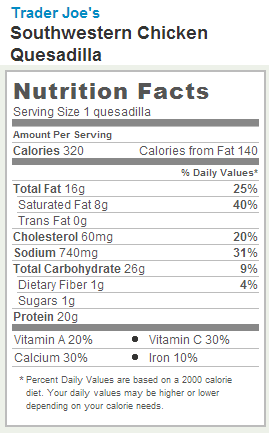
Trader Joe’s Southwester Chicken Quesadilla – Nutrition Facts
 Eating At Joes
Recent Comments