
Trader Joes’ Reduced Guilt Fat-Free Brownies
Posted: March 6, 2014 Filed under: Chocolate, Desserts, Trader Joe's Brand | Tags: brownies, fat free brownies, Trader Joe's 1 Comment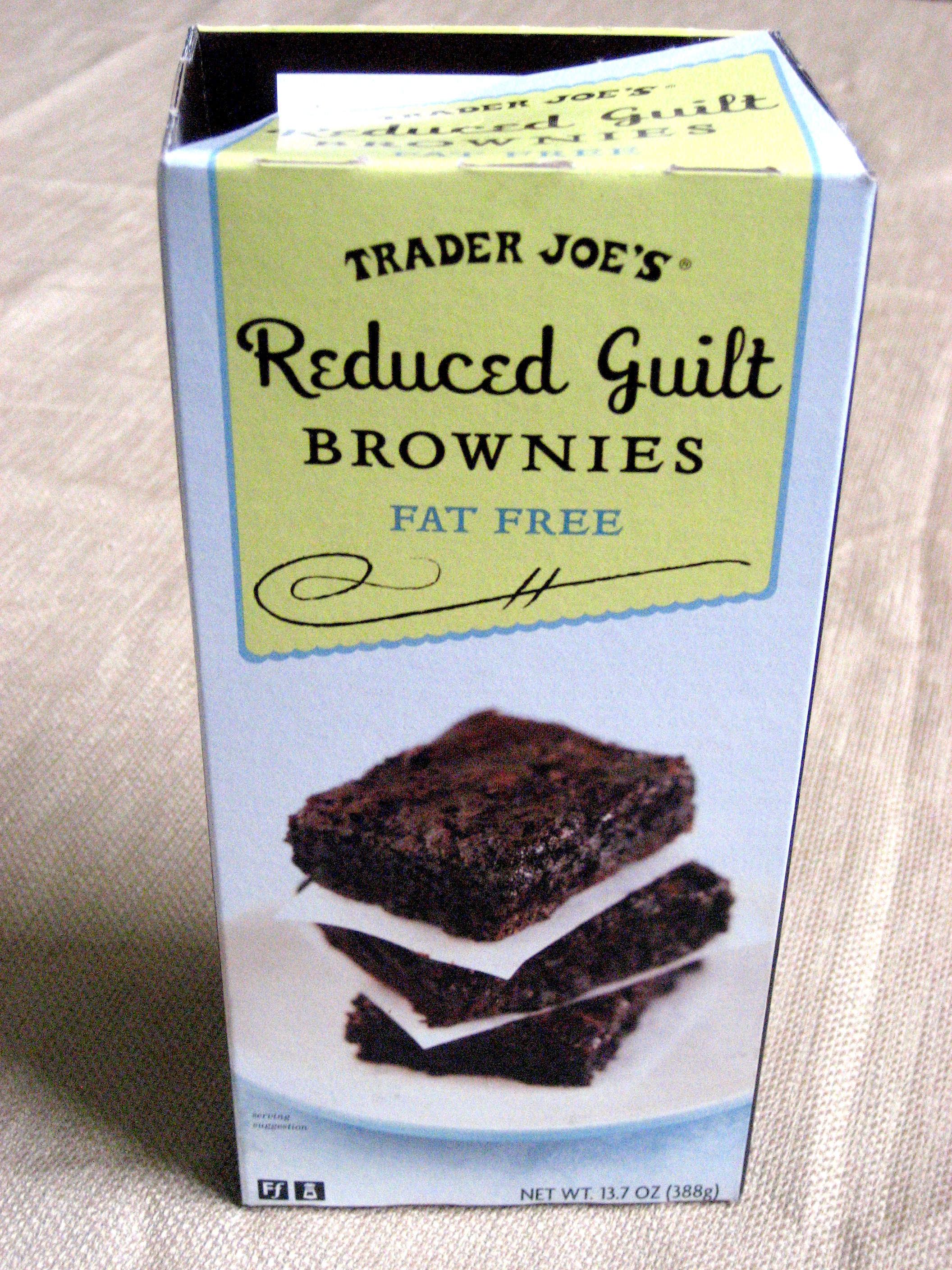
The Marketing Dept: targeting the weakest areas of your soul.
Trader Joe’s Reduced Guilt Fat-Free Brownies is one of those crazy products that wants to have it both ways. Similar to no-fat “cheese” products, low-carb bread, and methadone, reduced guilt brownies are one of those paradoxical products that attempts to negate its own existence. Everyone knows that the fat free versions of fatty foods are never as good as the real thing. It’s just one of the fundamentals rules of the universe, put in place by God as a daily reminder that no, life will never be fair. The sad question we must ask ourselves when we pondering whether to buy a box of reduced guilt anything is not “are they good”, but “are they good enough”? In this case, the answer is yes, if you’re prepared for a little weird.
Let’s talk about what’s right with these brownies first. There are several things Trader Joe’s does wonderfully right with these brownies. The most surprising quality of these brownies is that they actually deliver on the “reduced guilt” qualifier. The box prepares about a dozen normally sized brownies, each of which contains only 130 calories, zero of those calories from fat. There’s still the 26 grams of carbs to consider, but seeing as that Trader Joe’s is only promising reduced guilt, not guilt free, I’m willing to call that a success.
It’s also worth noting that the only ingredient you have to add to the box mix is fat-free vanilla yogurt. It takes a little bit of elbow grease to blend the yogurt with the dry mix, but once you’re finished all you have to do is pop the pan in the oven. It doesn’t get much easier than that.
To compare real brownies to reduced guilt brownies is a sorrowful thing, and I wouldn’t normally do it if there were any other choice. A good brownie is a delicious, wonderful little bit of chocolate heaven. A reduced guilt brownie is what you cook up when that heaven is barred from you, but you still hang around trying to stare in through the gates. The hope is always that maybe, maybe these reduced guilt, no fat brownies will be just as good as regular brownies.
Trader Joe’s Reduced Guilt Brownies are surprisingly tasty, all things considered, but there is a weirdness about them that is slightly off putting. The weirdness is two fold – taste and texture.
Taste is what you might expect, the intensity of delicious chocolate flavor that you expect from a brownie is much more muted in these. It’s still recognizable as a brownie, you just won’t be swooning over them. Texture is the bigger issue. The brownies are still dense and moist – but they’re also strangely spongy and yoken. There’s nothing egg-y about these guys, seeing as that no eggs go into it, but nevertheless the overall consistency and tooth feel of the brownies reminded me of a porous bit of omelette.
It’s certainly a long cry from the perfect brownie, but given the very reasonable nutritional profile, the flavor and texture you get is ultimately good enough to justify the purchase.
The Breakdown
Would I Recommend Them: If you have a sweet tooth and a restrictive, but not too restrictive, diet I would.
Would I Buy Them Again: I prefer to go no brownies, or real brownies all the way.
Final Synopsis: An erstaz brownie that is just healthy enough to be worth the bother.

Trader Joe’s Reduced Guilt No Fat Brownies – Nutrition Facts
Trader Joe’s Chicken Pot Pie Bites
Posted: March 4, 2014 Filed under: Chicken, Frozen Food, Meat, Trader Joe's Brand | Tags: bite sized pot pies, chicken pot pie, mini pot pies, trader joe's pot pies 1 Comment
I will guarantee you that your pot pie bites won’t be that nicely formed coming out of the oven.
“Chicken meat with vegetables in a flaky pie dough”, promises the box of Trader Joe’s Chicken Pot Pie Bites. There’s nothing fundamentally wrong with this description, but I’d suggest switching the word order around. Flaky pie dough with chicken and vegetables is considerably more accurate.
If you come to pot pies mainly for the flaky, buttery crust then this the pot pie for you. It will suffice for you to stop reading this post now and pop on down to your local TJ’s. If, on the other hand, you come to chicken pot pie for the chicken, or other intra-pie materials, then this is going to be a much tougher sell.
There’s nothing inherently wrong with Trader Joe’s Chicken Pot Pie Bites. The filling is made with yummy little bits of chicken, creamy sauce, peas, carrots, etc – all the stuff you’d expect, and all done well and tasty. As already mentioned, the crust is very good – in fact, it’s probably the best pot pie crust I’ve ever had. Crispy, buttery and flaky, never dry or tasteless, it’s a fine crust on a fine pot pie. The only problem is that there’s just so much of it. The pot pie bites are served up to as 12 individual tiny pot pies, each with their own complete pot pie crust. In theory this is the perfect pot pie upgrade for our take-it-anywhere, always-on-the-go mobile age. In practice it ends up being a whole lot of extra crust that undermines the entire nature of the pot pie.
You would imagine that in order to make a 1/12th scale pot pie, you would simply implement the culinary equivalent of a shrink ray and reduce all the pastry’s ingredients by 1/12th. In practice this doesn’t work. If you tried to make a pot pie crust that was 1/12th the thickness of an ordinary pot pie there wouldn’t be enough structural support to keep all the insides in and you’d end up with a just a little spot of burnt stew on a baking pan.
There’s a limit to how far down you can scale the crust. The problem Trader Joe’s encounters here is actual similar to the same reason giant insects don’t rule the world. Exoskeletons work really well for keeping bugs together as long as they’re relatively small. Start scaling up the size of an ant and you need a thicker and thicker carapace to keep it from falling all to pieces. The thicker the shell, however, the less room for the important stuff inside, hence the impossibility of ants the size of cars. Simply put, attempting to scale things at a 1:1 ratio breaks down pretty quickly in the real world.
In order to maintain the structural integrity of their mini pot pies, TJ’s has to use nearly the same thickness crust they’d use on a full sized pot pie. This means when you bite into a tiny pot pie, you’re getting something like 50% crust, and 50% filling on a good bite. This brings me back to our main point – if you’re a real crust fiend the talk of so much crust has probably got you pretty hot and bothered. If, on the other hand, you enjoy the traditional ratios of pot pie filling to pot pie crust these are going to be more interesting to you as a novelty than as real repast.
There’s a wonderful history of pot pies that is as long and colorful as it is dubiously apocryphal. Unfortunately, I don’t really have the time to get into it in this post. We’ll have to suffice with noting that the ancient Romans purportedly served pot pies filled with live birds at their banquets, a practice that, as the LA Times notes, “must have startled unwary guests.” Associated Press’s Tom Hoge, I would imagine that’s an understatement.
Sadly, we no longer live in a time where the diner must approach his pot pie warily lest he be overtaken by screeching, disoriented birds. Nevertheless, Trader Joe’s continues to enliven the pot pie tradition with novelty – even if in this case it’s more of a miss than a hit.
The Breakdown
Would I Recommend It: Only to inveterate pot pie crust lovers.
Would I Buy It Again: I’ll buy a regular sized pot pie next time.
Final Synopsis: Good little pot pies that are as much crust as filling.
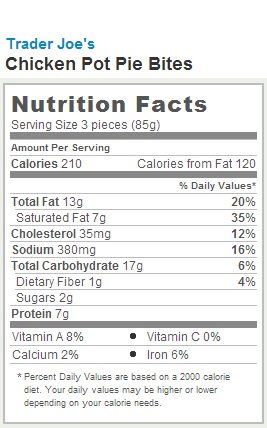
Trader Joe’s Chicken Pot Pie Bites – Nutrition Facts
Trader Joe’s 4 Kouigns Amann
Posted: February 25, 2014 Filed under: Bread, Trader Joe's Brand | Tags: breton, butter cake, queen yaman, Trader Joe's 1 Comment
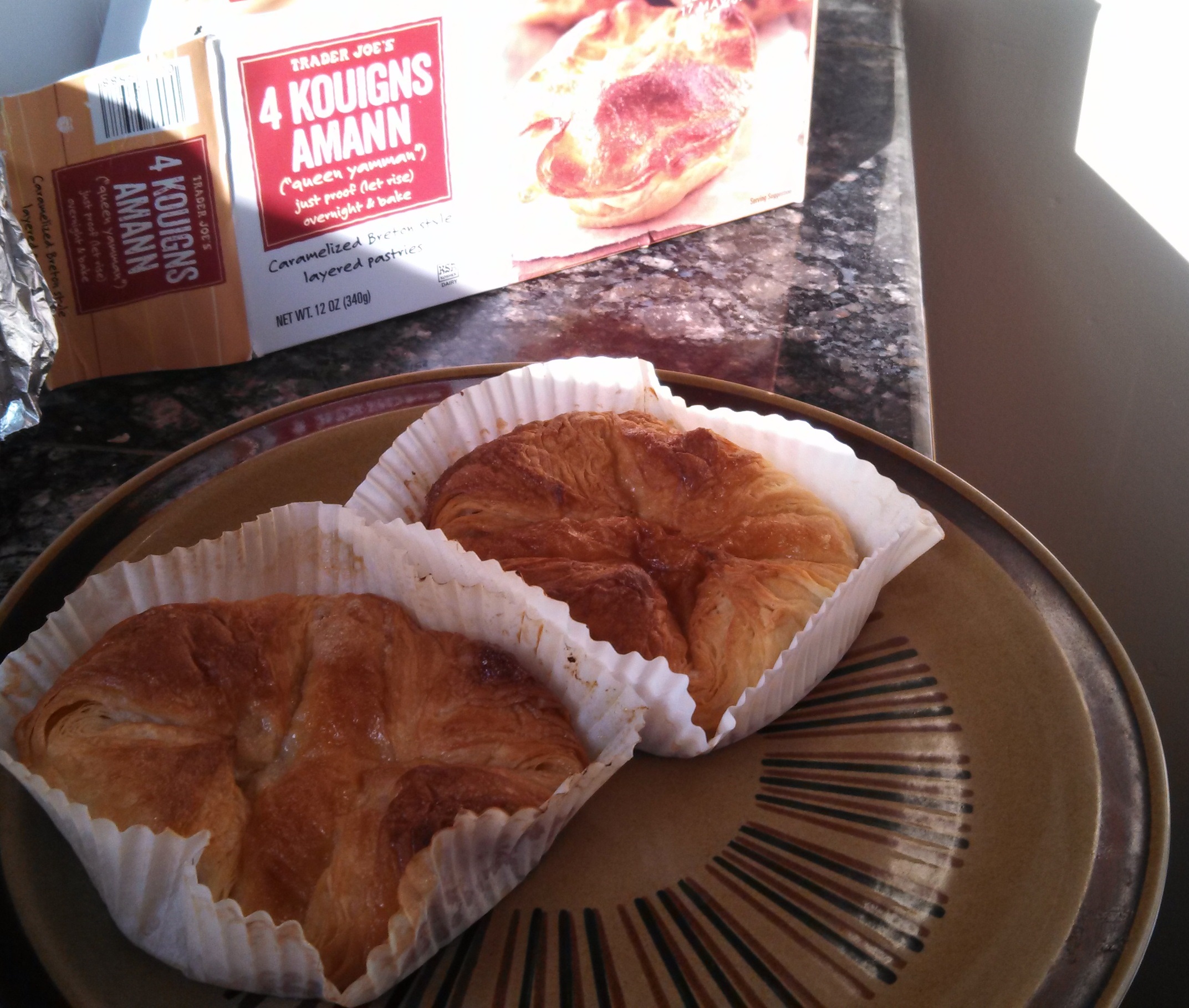
Trader Joe’s: Putting the number you get right there in the name.
Yes! Trader Joe’s! How awesome are you? I’ve never even heard of Kouign Amann before, and now I’m in love with them. As you may havenoticed, good reader, I’m a sucker for amazing sounding food names. Avacado’s Number was good, but Trader Joe’s 4 Kouigns Amann is an absolute knock out. What sounds like an ancient Mesopotamian ur-city is actually a delightful layered pastry from Brittany, which give us just so much to talk about today.
First up, what is it exactly and is it any good? What it is, is a dense, hefty square of flaky, moist and yummy pastry with no filling, but a sweet, delicious carmelized bottom. Yes, flying in the face of well-established tradition the world over, the Bretons stuck the sweet bit on the bottom. Simply outstanding work, in my opinion.
Is it any good? My god, yes. It’s good because it walks that wildly dangerous line between flaky crispiness and sweet sugariness and comes out just flaky enough and just sweet enough on the other side. It’s also terribly good because you bake them yourself, and very few things in life beat a warm, fresh-baked pastry straight out of the oven.
To my taste it most resembles a turnover without any filling. This analogy sells the kouign amann short however, because it’s not really like any other pastry I’ve ever had. Essentially, it’s bread dough with layers of butter and sugar folded in. The first difference, is that it doesn’t have as many folds as more common puff pastries, like croissants. As the kougin amann bakes, the folded in butter puffs up the pastry giving it lift and flakiness, but not airiness. At the same time, possibly due to advanced witchery, the sugar caramelizes within the pastry and across the bottom – forming a chewy caramel base.
I’ve tried a few of Trader Joe’s cook-at-home pastries, and I’ve enjoyed all of them. That said, this is my favorite to date with it’s elegant balance that is neither too sweet, or too dry. If there’s a downside, it’s the long prep time. Like other pastries, the kouigns amann need to be left to proof over night, and require a lengthy stay in the oven – at least 25 minutes for them to caramelize properly. This takes it out of the running for an every morning kind of breakfast food – but a wonderful addition to lazy weekends.
So who do we have to thank for this pastry? The French of course! Well, not really the French – but the Bretons! Every good country has a bit that doesn’t really like to be associated with the rest of the country. Canada has Quebec, America has Hawaii, Japan has Okinawa, Great Britain has all the bits that aren’t England, and France has Brittany. With a history that diverged from the rest of mainland France in pre-Roman times, and the hilarious nickname “Lesser Britain”, Brittany never really got on board with the whole “France” thing, and retains it’s own distinct culture and language. In fact, Breton (the language) is far more closely related to Welsh than it is to French – hence a French pastry with a very un-French sounding name of kouigns amann, which translates to “butter cake” in Breton.
In particular, kouign amann hails from a part of Brittany called Douarnenez, where it was first invented in the 1860’s by some unsung genius. Dournenez is also famous for being the home to the mythical Breton city of Ys, long since vanished beneath the waves but ready to rise again once, as the Bretons say, “Paris is swallowed”.
The moral? Kouigns amann are delicous, and might somehow lead to the destruction of Paris. Until that happens, I’d recommend eating up.
The Breakdown
Would I Recommend It: Yes, if you have the time to cook them.
Would I Buy Them Again: Yes – as soon as I can rationalize them back into my diet.
Final Synopsis: Tasty, dense and flaky pastries with caramelized bottoms.
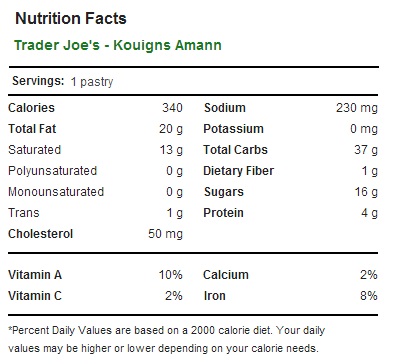
Trader Joe’s Kouign Amann – Nutrition Facts
Trader Joe’s Pane Guttiau – Sardinian Parchment Crackers
Posted: February 18, 2014 Filed under: Snacks, Trader Joe's Brand, Vegan, Vegetarian | Tags: crackers, pane guttiau, parchement crackers, Trader Joe's 15 Comments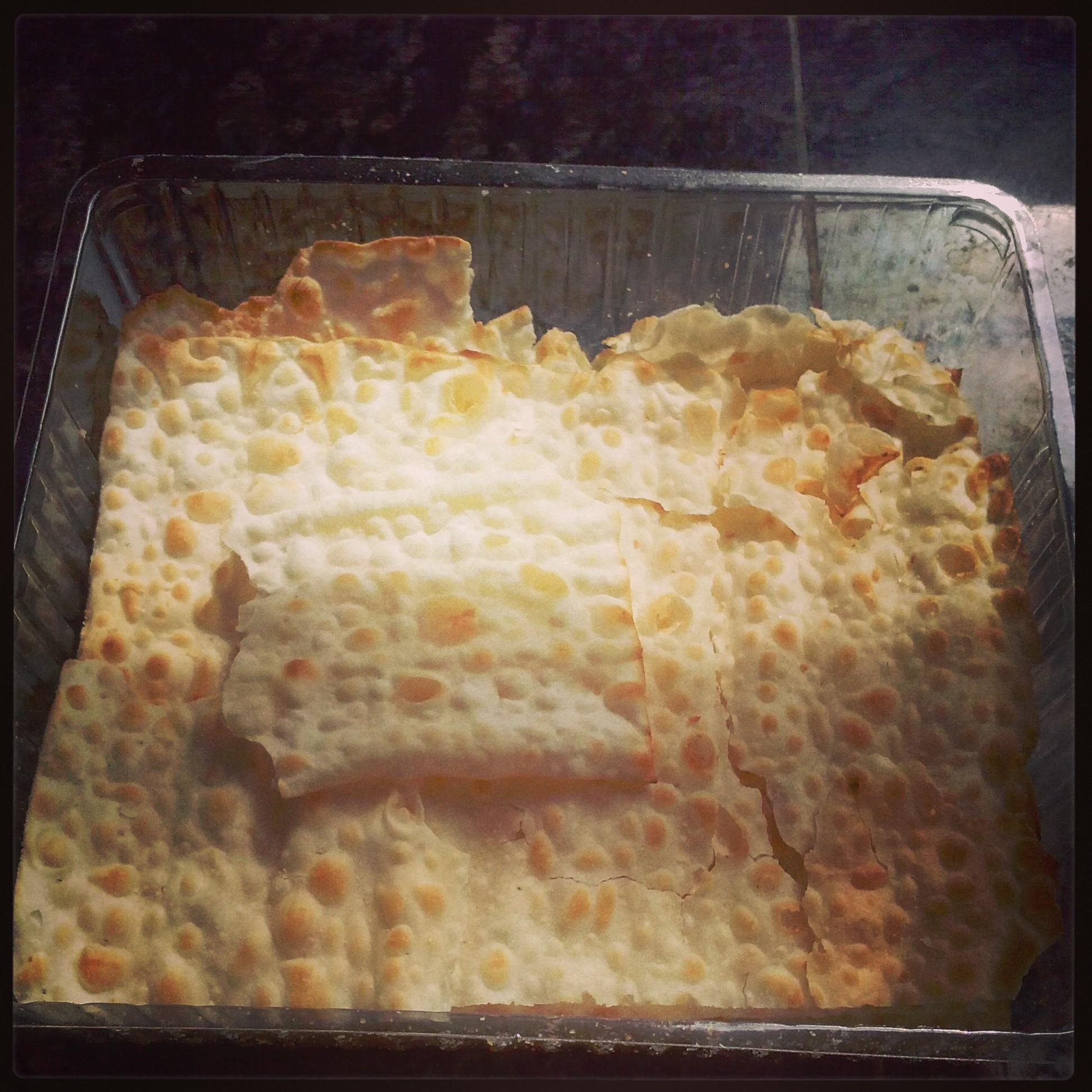
We might as well be in Sardinia right now.
Sometimes you’re just hankering for something from Sardinia. Maybe the Big Game is about to come on, or maybe the kids are driving you up the wall? Times like these, nothing hits the spot like a little something Sardinian. Not only does Trader Joe’s Sardinian Parchment Crackers bolster the relatively anemic roster of the Sardinian products available from your grocer, but it also has the added benefit of sounding like the hotly contested artifact a dashing archaeologist might be racing Nazis for.
So it’s a great name – but what is a Sardinian Parchment Cracker?Well get ready for some excitement folks, because it’s very thin, flat, unyeasted cracker bread milled from semolina. In other words, a taste explosion. This might be expected given the origin of these crackers – invented circa 1000 BC by wandering shepherds trying to make a portable lunch. No bread lasts so well as a good, dry cracker, and so this it was that this simple, broad, flat snack entered the world.
Joking aside – Trader Joe’s Pane Guttiau is a good tasting cracker with some intriguing applications. In terms of flavor, these crackers are very close to saltines, only enlivened by a touch of olive oil and served much thinner. Much, much thinner actually. The more jocular name for pane guttiau is carta di musica or “music sheet” – either because these wafer thin crackers resemble wrinkled sheets of paper, or because they’re so thin that you can actually read a sheet of music through them. This is no exaggeration – I was able to see my hand through a sheet of pane guttiau, which is not something most crackers can brag of.
There are two main reasons you’re going to want to come to these crackers – for the size and for the texture. The taste, though good, won’t blow you away – it’s the huge 4-5” size of each cracker and their light, crispiness that lets you snack on these in a whole new way. You won’t necessarily be digging into a tub of hummus with these crackers – though you can manage it if you’re careful enough. Instead, they lend themselves to being layered with thin slices of salami and cheese, or dabbed with a nice tapenade and had as an antipasta.
There’s something really enjoyable and liberating about dealing with crackers this size. Instead of being forced into dealing with a set size of cracker out of a box, these parchment crackers allow you to easily snap off any sized section you want from the larger cracker. Nibble on a broken-off corner or stack a plate with multiple layers – the versatility of the pane guttiau is tremendous.
A final note, despite the thinness of the crackers, I found that Trader Joe’s packed a good number into each box. I wound up running out of things to put on the parchment crackers before the parchment crackers themselves ran out.
If you’re going to try these – get some good cheese and meats, some nice spreads, and enjoy a little free-form snacking.
The Breakdown
Would I Recommend Them: Yes, particularly if you’re exhausted by traditionally sized crackers.
Would I Buy Them Again: Eventually, maybe when I have guests over.
Final Synopsis: These ancient, wafer-like crackers are a whole new way to snack!
Trader Joe’s Honey Glazed Miso Salmon on Salad Greens
Posted: February 11, 2014 Filed under: Fish & Seafood, Salad, Salmon, Trader Joe's Brand | Tags: asian salad, miso, miso glaze, Salad, salmon, three stars 5 Comments
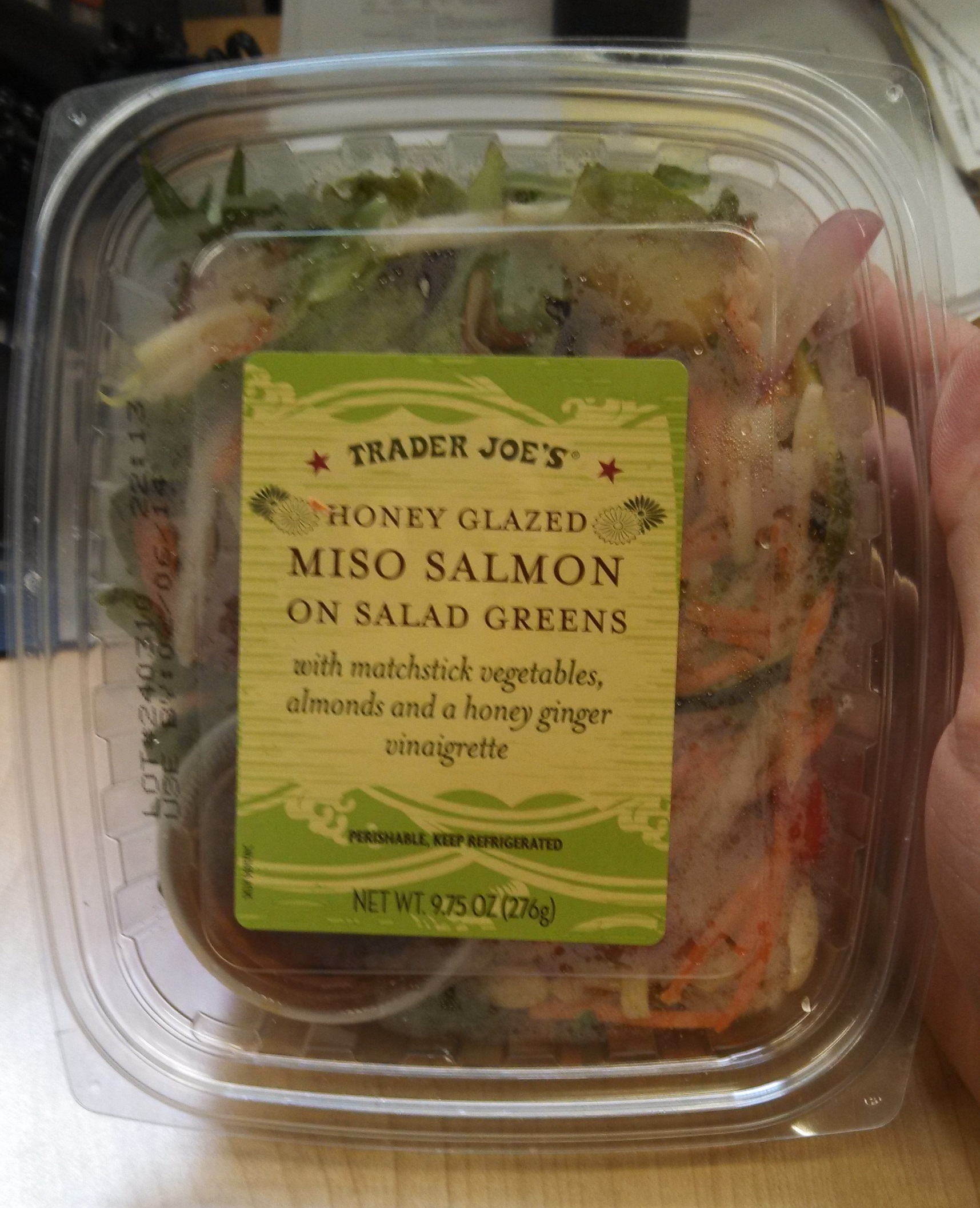
When you put salmon on a salad it’s no longer a salad – it’s merely a bed of “salad greens”.
Many a good salad have I reviewed from Trader Joe’s, but always am I on the prowl for more – ever hunting, never satisfied. So it was that, in my endless roaming, I cam across Trader Joe’s Honey Glazed Miso Salmon salad – an Asian-style salad with pretensions to greatness, but which settles merely for good.
Before we dig into this salad, it’s important to note which version of Trader Joe’s Honey Glazed Miso Salmon on Salad Greens I’m talking about. Running contrary to the feeling of friendliness and openness that Trader Joe’s cultivates is their shadowy, behind the scenes operations. The goings-on of Trader Joe’s corporate offices are famously private – cloaked from all public scrutiny due to orders straight from the owners, Germany’s ultra-private Albrecht family.
Despite the rather sinister tone all this evokes, Trader Joe’s seems to be a mostly a force for good – at least in the supermarket world. One way that it continually surprises me, however, is through the continual reformulations that TJ’s is carrying out invisibly, beneath our very noses. Last month I found myself staring rather blankly at my old friend Turkey Bacon, not sure who he was anymore. The packaging was the same, the product copy was the same, but these were undeniably different strips of meat – leaner and with a different, less tasty, flavor profile. Can I prove that this was a reformulation? No, I have no proof, nothing beyond my own vanishingly subjective experiences, and Trader Joe’s won’t comment. Is this how the hegemony convinces us that our protestations are merely symptoms of madness? By replacing our bacon? Time will tell, I’m sure.
Rather more noticeably is the face lift that the miso salmon salad in question went through. A previous product of the exact same name but of totally different formulation used to sit on Trader Joe’s shelves. This previous iteration, in addition to having different packaging, was served over lo mein noodles and had an inferior salmon. The version I’m reviewing today has no noodles and a better cut of fish – overall a change for the better.
The previous version of the salad – notice the noodles.
There’s a lot to love in this salad actually – salmon, first of all, is a wonderful salad accompaniment. Not only is it flavorful and healthy, but it flakes easily under the fork, a highly desirable quality for a fork-only food. That said, salmon can be a difficult fish to do right – doubly so when you’re packing it cold into a refrigerated salad. Trader Joe’s does a reasonable job delivering the salmon here. It’s a generous hunk of fish, and clearly some love went into the cooking process, in particular the miso-honey glaze. The miso honey glaze is nearly as good as it sounds, a sweet and tangy drizzle of flavor that gives your taste buds a pleasant zing. That said, the salmon itself is somewhat on the bland side, possibly over boiled. In any case, it’s the glaze you’ll notice, and the salmon passes by more or less as wallpaper.
The rest of the salad delivers a similarly satisfactory experience. “Matchstick” vegetables simply means that everything has been julienned into long veggies strips, strips that include such elegant additions as daikon (a mild Japanese radish) among the carrots and broccoli. The slivered almonds are also a nice touch, giving a bit of toothsome crunch to the proceedings.
The biggest problem, for me, was the salad dressing. The honey ginger vinaigrette included with the salad wasn’t bad – but I found it too oily, and tending toward bland where it should have been zingy. Not a death stroke, certainly, but a problem in that it’s hard to find a good dressing to pair with the honey-miso salmon. Apart from this one little misstep, this salad was a welcome change of pace to the chicken dominated salad fare that makes up most of Trader Joe’s other selections.
The Breakdown
Would I Recommend It: Yes, but bring your own dressing.
Would I Buy It Again: Yes, and I might try TJ’s Asian Sesame Seed Dressing with it next time.
Final Synopsis: A good, Asian salad with average salmon on it.
Trader Joe’s Quinoa Duo and Vegetable Melange
Posted: February 6, 2014 Filed under: Frozen Food, Quinoa, Trader Joe's Brand, Vegetables, Zucchini | Tags: red quinoa, Sweet Potato, Trader Joe's, white quinoa, zucchini 7 Comments
QUINOA!
Trader Joe’s Qunoa Duo with Vegetable Melange is the sort of healthy fare I turn to when the New Year rolls around and the scale starts broadcasting dire warning vis-a-vis my sexiness. I’ve touched upon the intricacies of quinoa before, but this is the first time I’ve really sat down for an all quinoa dish.
The big deal with quinoa, and the cornerstone of its popularity, is the fact that quinoa contains a balance of all nine essential amino acids, in other words it’s a “complete protein”. This is common among meats, but rare in the plant world which makes it a boon to vegetarians. While that’s not me, I was particularly excited by the notion that I would be eating both red and white quinoa at once. Two quinoas? They must be, like, wildly different right? Otherwise, why mix them together? Sadly, I was a let down to discover that red and white quinoa are practically identical. The only real difference is that red quinoa is a little more toothsome than white quinoa, and doesn’t clump as much.
Trader Joe’s Quinoa Duo combines the quinoas with cubed zucchini and sweet potato, tinged with a bit of tomato sauce. The result is about as strange as it sounds. I’ll be upfront with you, I didn’t much love this one. It’s not that I dislike quinoa – I like it just fine, sometimes I even love it, and it’s not that I dislike vegetable melanges either, I’ve had one or two from TJ’s that I’ve quite enjoyed. The problem for me came in the mixture of everything together.
Quinoa has a decidedly nutty flavor.This works well with the sweet potato, and reasonably well with the zucchini, but for some reason Trader Joe’s decided to put a french twist on the dish. This takes the form of a tomato flavoring that is mixed in with the dish – not so strong as to really stand on its own, just strong enough to sort of throw the other flavors off. It certainly makes for a complex taste, but to me it came across as more of a mess of flavors than a medley.
Really, though, how much you like this dish will come down to how much you like hot quinoa . Although the words “vegetable melange” are right there in the title, don’t come to this dish expecting much more than quinoa. The pseudograin-to-veggie tradeoff is something like 80 – 20, meaning for every big mouthful of quinoa you’ll get a couple bits of zucchini or sweet potato. That also means that, despite Trader Joe’s urgings to the contrary, this doesn’t make a very good main dish. Undoubtedly there’s room to find a good entree pairing here that will elevate the rather confused taste of the quinoa duo to a higher level, although I couldn’t tell you what that would be.
If you’re really interested in working this quinoa duo into your diet, I reckon the best approach is to disregard Trader Joe’s serving suggestions entirely. Cool down the quinoa after you cook it up, and turn it into a salad base. You can find one good recipie for just that on this blog. Mixed with the right combination of veggies and seasoning this quinoa duo can become something great – by itself, not so much.
The Breakdown
Would I Recommend It: Yes, to undernourished vegetarians and adventurous salad makers. No to most others.
Would I Buy It Again: No, I wasn’t really into it.
Final Synopsis: Lots of good qunoia with a strange tomato taste.
Trader Joe’s Poutine
Posted: February 4, 2014 Filed under: Cheese, Fries, Frozen Food, Trader Joe's Brand | Tags: canadian nachos, gravy, poutine, Trader Joe's Leave a comment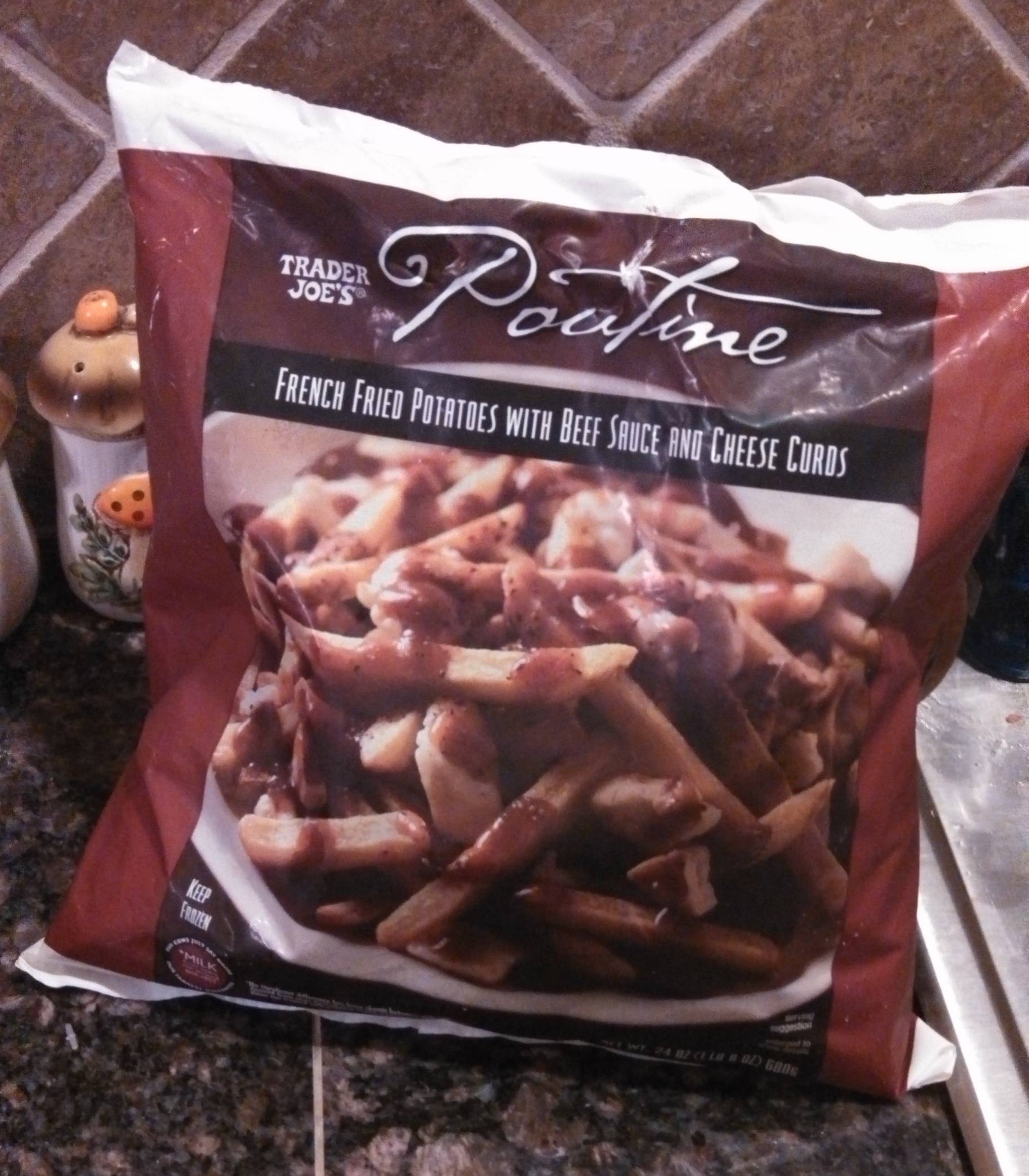
A font that fancy even makes poutine look classy.
Put on your checkered, ear-flap caps readers, because today we’re going full Canadian with Trader Joe’s Poutine.
Poutine – what is poutine? What is this strange word, this strange brown bag smiling broadly at us from the depth of the freezer section? What do french fries, cheese curds and gravy have to do with each other? To put it simply, poutine is French Canadian nachos – only instead of tortilla chips you have fries, and instead of melted cheese you have gravy, and instead of jalapenos you have melted cheese. Yes, I know that’s confusing, but there’s no avoiding that. Only a Canadian can truly understand poutine – just as only Aussies can truly understand Vegemite, only Scots can truly understand Irn-Bru and only Americans can truly understand root beer. Nevertheless, I’ll do my best to explain.
Basically, what you get with Trader Joe’s Poutine is a big bag of frozen french fries, a packet of beef gravy and a packet of cheese curds. The idea is, you cook the fries in your oven, while warming the gravy and curds on the stove top. Once everything’s ready, you top the fries with the curds, drizzle the gravy over the whole lot, then eat it with a fork/your fingers. It’s a sloppy heap of messy, salty savory junk food perfect for anytime you feel like abandoning your goals and dreams in favor of immediate mouth-stuffing gratification – again, not unlike nachos.
I’d never had poutine before, which presented me with a unique challenge. How could I fairly review Trader Joe’s Poutine, and thus avoid incurring Cannuck ire, without anything to compare it against? Where was my control group? A Google search revealed the depth of my problem. Although poutine is wildly popular in the barren polar regions of North America, it doesn’t have much of a presence anywhere so far south in America as Los Angeles, CA.
I was able to find a number of upscale restaurants offering their own nouveau fusion versions of poutine designed to downplay the more uniquely Canadian side of poutine (read: giant salty cheese curds) in favor of a more marketable, bastardized dish, but little in the way of real, authentic poutine. For a moment I thought I’d found a lucky break in the form of the Gravy Train Poutinerie – a poutine slinging mobile food truck promising real, home-style poutine – but an examination of their Twitter account revealed that they moved operations to the greener pastures of Salt Lake City, UT in October 2013. Things were getting depressing.
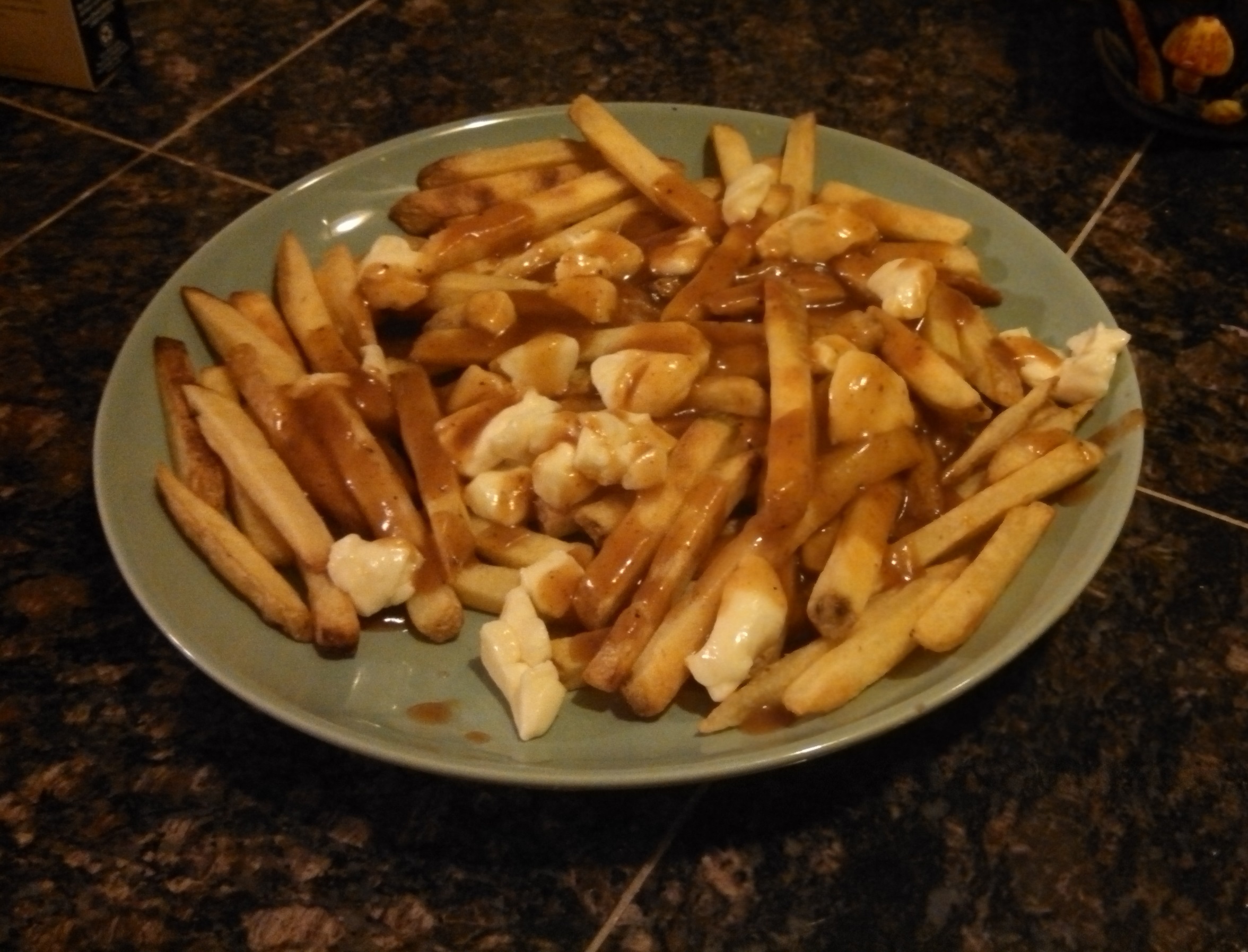
If nachos are the nachos of Mexico, and poutine is the nachos of Canada, what are the nachos of the US? Still nachos?I’m not sure, but leave your best guess in the comments.
Finally, I found success at Little Fork, Hollywood – a cool little box of a restaurant dedicated to serving Canadian food up right. Over a couple cheap Molsens I enjoyed my first real poutine – smoked meat gravy, gooey cheese curds and all. Folks, it was a delicious heap of a hot mess.
So it was with considerable anticipation that I cooked up Trader Joe’s Poutine on my stove. After following the direction and digging in – I’m sorry to report that I didn’t like it very much at all.
The gravy is fine, and the cheese curds, though saltier than I like, are as thick and squeaky as you could ask for. The problem, unfortunately and unavoidably, is in the fries. It’s next to impossible to cook fries in an oven and have them be anywhere as near as good as fries out of a deep fryer. Countless brands have tried to do it, but none, not ever Trader Joe’s, has succeeded. Without the deep fryer, fries aren’t fries – they’re just dull potato planks.
There are some other minor difficulties with Trader Joe’s Poutine – I found it hard to heat up the cheese curds without them melting together into a big blob, even by heating them in a water bath, but these are only petty concerns. The heart of a good poutine is in the good fries – take those away and your might as well just have your cheese and gravy on a baked potato. Honestly, you’d be much better off buying some good fries from a takeout joint and adding the curds and gravy to them than you would be buying this frozen bag of flat potato slices. Thank you, Trader Joe’s, for bringing us the delicacy of rural Quebec, but these fries simply won’t do.
The Breakdown
Would I Recommend It: Not with these fries I wouldn’t.
Would I Buy It Again: No – I’ll just wait for the Poutinere to wheel it’s way back here.
Final Synopsis: The great Quebecoise cuisine brought low by inadequate fries.
Trader Jose’s (Trader Joe’s) Avocado’s Number Guacamole
Posted: January 30, 2014 Filed under: Avocado, Condiments, Dip, Trader Joe's Brand, Vegetables | Tags: avacado's number, avagadro's number, guacamole, Trader Joe's, trader jose 3 Comments
Let’s party indeed.
I’ve heaped some pretty high praise on the names of a few Trader Joe’s products before – but as of this moment those items are dead to me. There’s only room in my heart for one truly amazingly named product and the throne now belongs to Trader Jose’s Avocado’s Number Guacamole. Truly, I can’t imagine it will ever be deposed.
Avacado’s Number Guacamole is awesome for many reasons.
- One, it’s guacamole and guacamole is amazing.
- Two, the name is a play on the esoteric mathematical measurement “Avagadro’s Number”, better known to most as the number of atoms in one gram-molecule of hydrogen and commonly jotted down by housewives, accountants, etc as 6.0221413e+23 .
- Three, this guacamole has five avocados in it. That’s a lot of avocados!
- Fourth and finally (and best) there is a picture of good ol’ bug-eyed, limp-haired, shyster-looking Amedeo Avagadro himself making the dry proclamation: “Let’s party. ‘Arriba.’ ”
Simply, wow.
Before we get to the guacamole itself, which is quite tasty, we’ve got to spend a few minutes just looking at what the hell is going on here. First, lets just try and wrap our brains around the international gumbo we’re knee deep in here. The guacamole is a Trader Jose’s product, being a traditionally Mexican food of course, featuring the picture of, and named after, an Italian who doesn’t actually have anything to do with Avagadro’s number other than the fact that a Frenchman decided to name his discovery after him in 1909. So that’s one thing.
Yes, despite the slick looks of Mr. Avagadro, he’s only loosely connected with Avagadro’s number. The number in question, the above mentioned 60221413e+23, is one of the cornerstones of modern chemistry and physics – the number of atoms in a conventional unit of measurement called the mole.
The mole, and by extension the number, is essentially a way for us to talk about infinitesimally small and rather fidgety atoms on a reasonable and realistic scale. In 1909 a future noble prize winner and current Frenchman named Jean Baptiste Perrin coined the term to describe his work, naming it in honor of the Italian Amedeo Avagadro. Our man Avagadro lived and died back in the 19th century and amused himself by calculating the volume of gasses, thereby laying the groundwork that lead up to Perrin’s discovery, but had nothing to do with the number that bears his name per se.
Two things bother me about his gucamole. First, it only has five avocados in it which, while pretty good for guacamole, is certainly less than the 602,214,130,000,000,000,000,000 avocados (AKA six hundred and two sextillion, two hundred and fourteen quintillion, one hundred and thirty quadrillion) that the name suggests will be in it. I’m willing to let this slide in this case, seeing as that making the name more truthful would require each man, woman and child on Earth to pick a few trillion avocados first, and that’s just too long to wait for guac.
Really, this guacamole is pretty good. It comes in two separate 8 oz tubs, each one individual sealed. In order to cram in as many avocados as they did, Trader Joe’s has left in the occasional big, uncut chunk. When I say big, I mean big – think potato-chip sized. This really isn’t that bad of a thing – I found that it gives you something to break up the monotony of the otherwise featureless smooth greenness, something to really shake you up and make you confront the reality of your dip.
On the other hand, I did find Trader Joe’s Avacado’s Number Guacamole a bit on the salty side. This wouldn’t present a problem if you were eating it with unsalted chips, but when combined with salted tortilla chips its just a little too salty to really enjoy.
The other thing that bothers me about this guacamole is that Trader Joe’s was willing to go out there for the whole “Avocado’s Number” thing, but just left “mole” and “guacamole” sitting on the table. This is your once chance to ever make a “mole” related guacamole pun, and you missed it TJ! All you had to do was put a hyphen in “guaca-mole” up in the title and say something like
“Don’t ask us how many avocados are in this guaca-mole, ask our friend Amedeo.” Really, really disappointing work there Joe, but otherwise fine.
The Breakdown
Would I Recommend It: Yes, especially to physicists who like word play.
Would I Buy It Again: Yes, but I’d use unsalted chips next time.
Final Synopsis: A good guac with an excellent name.
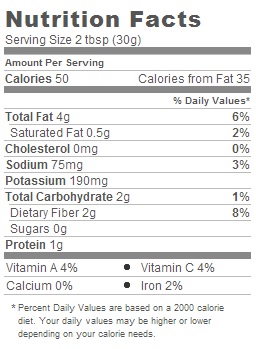
Trader Joe’s (Trader Jose’s) Avacado’s Number Guacamole – Nutrition Facts
Trader Joe’s Cobb Salad
Posted: January 28, 2014 Filed under: Bacon, Meat, Salad, Trader Joe's Brand | Tags: cobb salad, Trader Joe's 2 Comments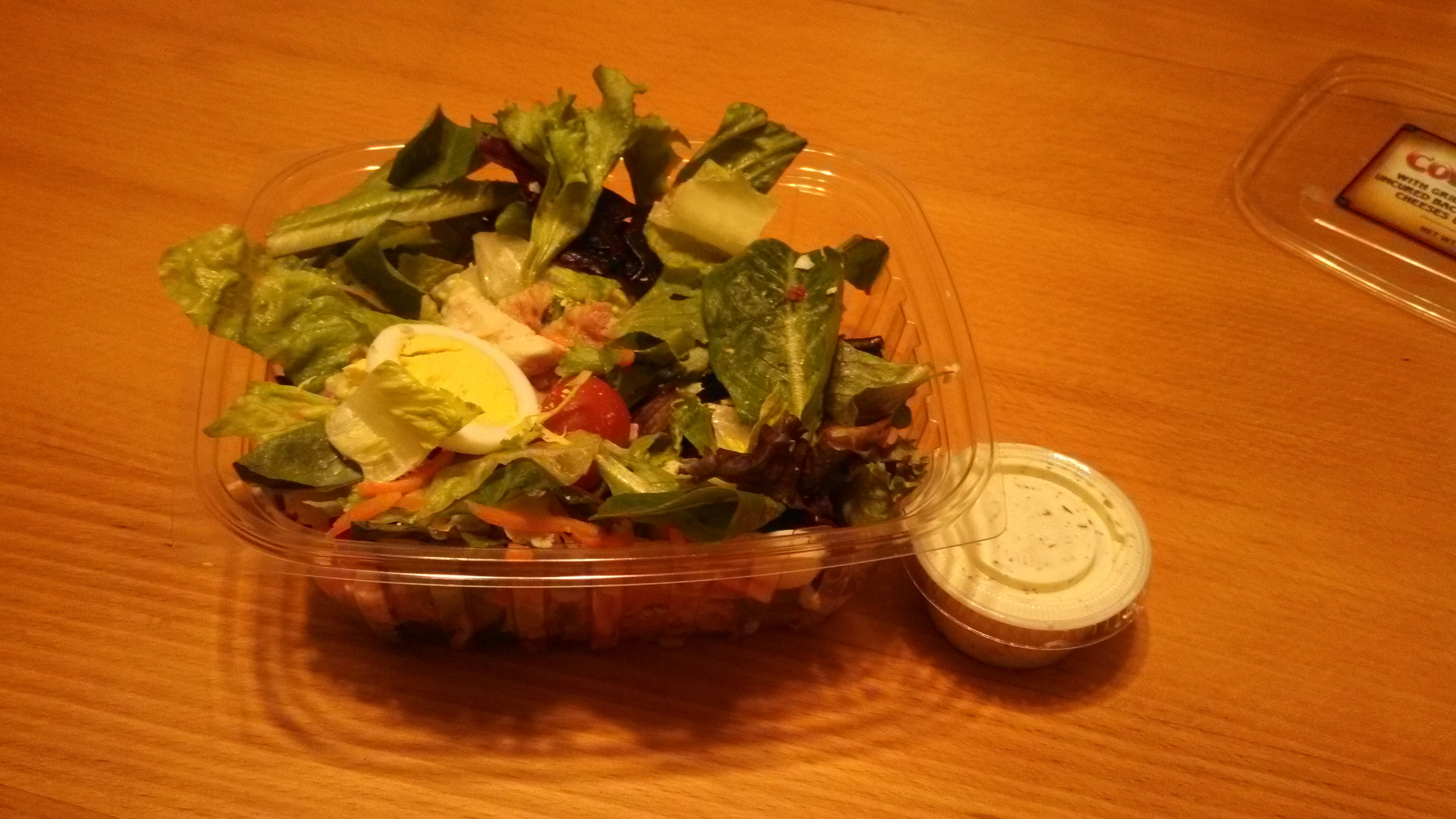
A salad named for some guy named Cobb.
I love salad, but so often it mystifies me. For instance, why do salads always cost more than the surf ‘n turf at restaurants, and why has no fast food chain been able to create a salad that tastes better than a pile of anemic grass clipping with woody chicken strips on top? But of all the salad imponderables, I’m most perplexed by the salads that manage to pack in more fat and carbs than the grossest monstrosities ever to shamble out of Wendy’s R&D department.
Now, Trader Joe’s Cobb Salad isn’t the worst offender on the block (that honor belongs to the 800 calorie candied pecan and blue cheese salad) but it’s still a serious fat delivery system.
Now, yes, before we get going, I am fully aware this is a cobb salad we’re talking about – never high on anyone’s list of healthy noshes. Nevertheless, this is one deceptively hefty salad we’re talking about.
Trader Joe’s bring you by-the-book cobb salad with no real surprises here. Grilled chicken breast, bacon crumbles, ripe blue cheese, some tomatoes, and of course, a sliced hard boiled egg, served with a side of hearty ranch dressing.
What, no olives and anchovies? No sir, I’m afraid not. Perhaps Joe was afraid of turning off the 98% of the population that can’t stand the two of those things together. The salad attempts to compensate for this by bringing in a second cheese in the form of some musky gorgonzola. At any rate, with a run down like that you’re going to expect a certain amount of fat, etc. And, in fact, in some ways this salad isn’t that bad. Only 380 calories, with dressing, and a quite satisfactory 10 grams of carbs.
Just below the surface, however, lurks some shocking stats – 250 calories out of 380 are from fat – that’s 28 grams AKA 43% your daily recommended amount. Combine that with the 47% of your daily cholesterol limits, and you might start to think twice.
Normally, salads that suffer from such unhealthy nutritional profiles are under the sway of a fatty dressing. That’s true here – to some extent. The ranch kicks in 12 grams of fat, but even without it you’re still talking about 42% of your cholesterol.
None of that would be so bad, if only the dressing was better than it is. A far as ranch dressings go, this is actually a really nice version. This clearly isn’t something taken from another brand’s mass produced bottles. The ranch in this salad feels downright rustic – smooth and creamy, sure, but swimming with full-bodied herbs that season the ranch and give it some real character. It practically feels home made.
That said, it doesn’t really work in this salad. This ranch is too mild for such a robust salad as this. It’s a gentle butter milk ranch that disappears into the background of each bite, and while there’s much to be appreciated in subtlety, it leaves you wondering why you’re pouring 12 grams of fat into your arteries if you can’t even taste it.
Just like the Artichoke and Hearts of Palm salad from the other day, I’d recommend a dressing substitution. Chuck that tub of ranch (or save it for a future occasion) and drizzle on a little of Trader Joe’s Light Champagne Vinaigrette. Not only is it much, much healthier, and tastier but the creamy zing of the vinaigrette really plays well against the savory and salty flavors of the bacon, eggs, and cheese.
With the dressing switched out, this cobb salad does better – but it didn’t wow me. It’s not bad – just very average. The tomatoes taste like tomatoes, the lettuce tastes like lettuce, and everything else just sort of tastes pretty okay. Like Trader Joe’s Cowboy Bark, I feel if you’re going to sit down and eat 28 grams of fat, you should enjoy the hell out of it. Trader Joe’s has some great salads and some healthy salads – this one is neither.
The Breakdown
Would I Recommend It: It’s not bad, but I wouldn’t recommend it.
Would I Buy It Again: Not if I want to lose any weight.
Final Synopsis: A standard cobb salad without anything to recommend it by.
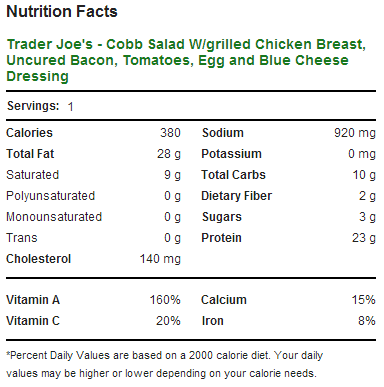
Trader Joe’s Cobb Salad -Nutrition Facts
Trader Joe’s Uncured Black Forest Bacon
Posted: January 23, 2014 Filed under: Bacon, Meat, Trader Joe's Brand | Tags: bacon 1 Comment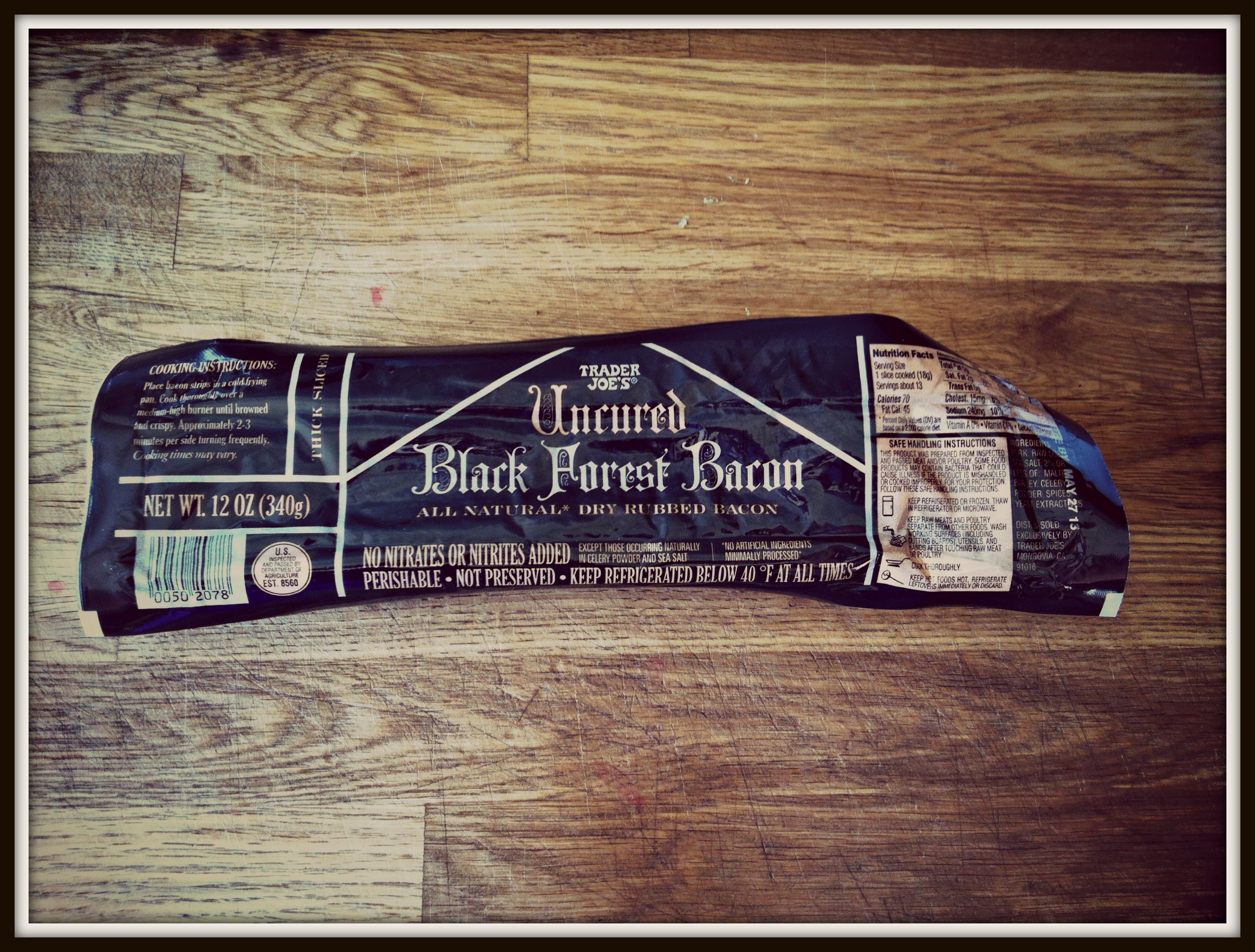
Despite repeated phone calls, TJ’s is staying quite on how the bacon is cured, what’s in the dry rub, and whether the pigs are actually from the Black Forest. That raises more questions than it answers, Joe.
Bacon week continues with Trader Joe’s Uncured Black Forest Bacon!
This has been a banner week for me. The transition from a baconless existence to a world of delicious bacon has left me unnaturally giddy and elated. Not just one, but two different kinds of suberp, praise-worthy bacon have glorified my breakfast this week. Trader Joe’s Uncured Apple Smoked Bacon we already covered, and by gum if you don’t have some of this in your pantry already then I don’t know what you’re doing with your life. Today we take a look at Trader Joe’s other delicious bacon – Black Forest Bacon.
Is the Black Forest bacon delicious? Absolutely – it’s a nice thick cut of fatty, smoky, slightly sweet bacon that is almost too good for this earth. Is it better than the Apple Smoked Bacon? That’s a trickier question. Where the applewood smoked bacon comes out the gate strong with plenty of razzle dazzle, Trader Joe’s Uncured Black Forest Bacon offers a more sophisticated and nuanced bacon choice.
Tastewise, these bacons are playing quite different games. The apple smoked bacon has set out to dominate the world of smokey, strongly seasoned bacon and it has done exactly that. In a side by side taste test, I’d have to choose the the apple smoked bacon, no question. But real life isn’t a taste test. When it comes to a bacon you’re going to turn to every morning, you don’t necessarily want the intense flavor and smokey aroma of the apple smoked bacon day after day. In the same way that you don’t always turn to the maltiest beer, or the sweetest soda, Trader Joe’s Black Forest Bacon provides a more nuanced alternative.
The taste of the black forest bacon is still as absolutely delicious as the apple smoked bacon, but plays up the “cured” side of bacon over the smoked side. You’ll notice the rind of spices on each slice forms a sort of natural crust once cooked, almost like a honey baked ham, and the raw sugar in the rub gives this bacon just a hint of sweetness. The taste is overall much broader than the apple smoked bacon, a little sugary, a little smokey, and lots of rich meaty flavor.
Two other factors enter into the comparison: nutrition and price. The Black Forest Bacon is actually the healthier choice, despite the sugar rub, with 70 calories a slice, and 45 from fat. That’s still 5 grams of fat per thick slice, but that’s better than the 7 grams of fat in each apple smoked slice. Pricewise, Trader Joe’s Black Forest Bacon is the more expensive option, $4.99 / 13 slice pack – a dollar more than the apple smoked variety.
Like the apple smoked bacon, the black forest bacon is also “uncured”, meaning no sodium nitrate or commercial curing salts were used in the process – nothing but the natural nitrates found in sea salt and celery power.
The takeaway is, on the balance these bacons are equally good. If you’re only an occasional bacon eater, the apple smoked version is probably the better choice – given it’s bigger flavor and worse nutritional profile. If, on the other hand, you’re snacking on bacon all the time, you might want to go with the more nuanced, and slightly healthier, black forest bacon.
The Breakdown
Would I Recommend It: Yes, but try Trader Joe’s Apple Smoked Bacon first.
Would I Buy It Again: I already have.
Final Synopsis: A delicious bacon for frequent bacon eaters.
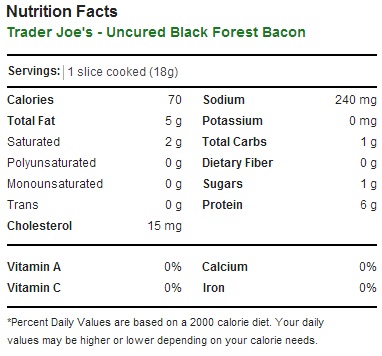
Trader Joe’s Uncured Black Forest Bacon – Nutrition Facts
 Eating At Joes
Recent Comments