
Trader Joe’s Scallion Pancakes (Pa jeon)
Posted: June 17, 2014 Filed under: Mushrooms, Onion, Trader Joe's Brand, Vegetables | Tags: 4 stars, korean food, pa jeon, pancakes, scallions, trader joe's korean food 4 Comments
Who would have thought scallions and batter would taste so good together?
What? Korea has a sort of dinner pancakes made from more veggies than batter? And Trader Joe’s has brought it to us under the simple, if intriguing, name of Scallion Pancakes? This sort of esoteric awesomeness is exactly what I made this blog for.
What are you, scallion pancakes? What are, as the South Koreans say, pa jeon? I wondered these things as I stood stupid in the frozen food aisle. I tried smelling the bag. No luck there – the strange mystery of scallion pancakes was securely locked inside the cheerful green sack. Was it really just pancakes made with wild green onions? Could that possibly be any good? If pa jeon was a product of, say, Swinton England, I would guess no – but this is a tradition Korean food and I’ve done pretty well by those so far, despite the occasionally debacle, so I was willing to give it the old college try. Was this going to be another Spicy Seaweed Salad or just another dehydrated kimchi? Fortunately, it’s my pleasure to report that Trader Joe’s Scallion Pancakes are totally awesome.
Jeon in Korean (pronounced “jun”) means something like “battered stuff”, while pa means scallions (aka green onions). Pa is by no means the only Jeon out there – the Koreans really went to town on the whole notion. Where Americans were content to put some bananas in their flapjacks then rest on their laurels, the South Koreans diced up basically anything they could get their hands on. While the scallions and batter are usually there, it can come loaded up with any sort of seafood or meat imaginable. Trader Joe’s gives us the most basic version here – plain green onions with a smattering of other vegetables, including leeks and onions plus some carrots and oyster mushrooms.
If pretty much anything can go into a scallion pancake, you might wonder why the Koreans insist on keeping the scallions in there at all. The answer is one, because they are super delicious, and two, because of history. As well as I could dig up, pa jeon owes its existence to a bunch of Koreans that started throwing green onions at retreating Japanese soldiers during one of the numerous Japanese-Korean battles of the the late 16th century. Obviously, that led immediately to people cooking them into pancakes for some reason. There’s no figuring out history folks, it’s just a bunch of crazy stuff like that.
At any rate, scallion pancakes are exactly what they sound like – each bag contains four danish sized “pancakes” made with a wheat and egg batter mixed with, you guessed it, scallions. I put pancake is quotes because the word doesn’t quite do justice to what you’re getting. The shape is approximately that of a nice sized buttermilk flapjack, flat, smooth, rounded and about a ¼ inch thick, but that’s where the resemblance ends. The pa jeon batter is very different from pancake batter. Trader Joe’s uses a mix of wheat flour, corn powder, baking powder, and a touch of egg in their mix, and the result is something more like bread dough than pancake batter – a difference that comes to the fore when you fry them up. Instead of staying light and fluffy, like they are when they come out the bag, the pa jeon become golden and crispy on the stove top. This crispy crunchiness is delightfully toothsome, with a somewhat flaky and pastry-like crunch to the bite.
Once you do throw your scallion pancakes on the stove, get ready for a room filling aroma of mouthwatering proportions. The mixture of onions, leeks, mushrooms and other veggies smells warm, rich and hearty – expect people to be popping their heads in to see what smells so good.
A single glance at these scallion pancakes makes it obvious that they are packed with all sorts of vegetables. What’s more surprising is how much oil is in there as well. Whether you cook these up in a frying pan or in the oven, you’ll notice the pool of oil that forms around each cake. With 7 grams of fat in each pancake and 21 grams of carbs, these are more savory appetizer than health food. On the other hand, with only 160 calories in each pancake, and so much vegetable filler, you can fret the guilt off pretty quickly.
A final note – although Trader Joe’s doesn’t mention it on the bag, you’ll want to eat the scallion pancakes with a traditional dipping sauce of some kind. The most basic type (which worked well for me) is just to mix up a little bit of soy sauce and white (or rice) vinegar. If you’re looking for a fancier sauce recipe, you can try this rather complex one http://www.trifood.com/pajeon.asp.
The Breakdown
Would I Recommend Them: If you’ve never tried a savory pancake before, you should try these.
Would I Buy Them Again: Yes indeed – these make great snacks/appetizers/sides.
Final synopsis: Crispy, scallion filled pancakes that prove the Koreans know what they’re doing in the kitchen.
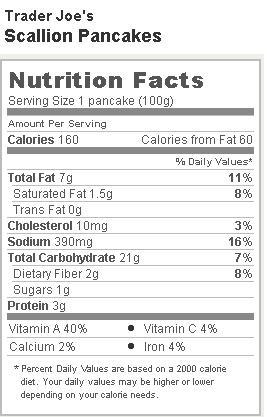
Trader Joe’s Scallion Pancakes – Nutrition Facts
Trader Joe’s BBQ Rub and Seasoning with Coffee and Garlic
Posted: June 12, 2014 Filed under: Coffee, Garlic, Spices, Trader Joe's Brand | Tags: 4 stars, bbq rub, coffee, coffee rub, garlic, seasoning, Trader Joe's 9 Comments
I love your titles TJ, but when you have to start rotating words like puzzle pieces to fit them on your packaging, things have gotten out of hand.
I’m sorry, what? Can you repeat that please? Did you say, Trader Joe’s BBQ Rub and Seasoning with Cofffee and Garlic? Does that make any sense at all? This one is truly mind boggling. I knew Trader Joe’s didn’t give a flying fig about convention, I knew that the second I saw them stocking Toasted Pumpkin Seed Oil on their shelves, I knew that when I picked up their Avagadro’s Number themed guacamole, but even I didn’t dream they were this dangerously unhinged.
I’d like to put myself in the mindset of the Trader Joe’s food scientist who dreamed up this insane blend of seasonings, but I’m afraid to do so would be to permanently wrench my psyche from it’s bearings. Coffee grounds and garlic – blended together, for the sake of rubbing on your meat. It’s got to be a stunt, right? Maybe there isn’t that much coffee in it, or maybe it’s, like, a type of coffee that isn’t really coffee. Let’s just check out the ingredient label.
Ingredient #1: Coffee. Period.
Okay, we’ll, there’s a bunch of other stuff in here too. Look – brown sugar, salt, garlic, um… paprika… and, uh, clemengold rind,? Which is apparently the skin of the Nandorcott mandarin orange? Okay, that’s a new one. At any rate, it must, like, all blend together in a way that sort of hides the strong coffee taste amid many flavors. Let’s just open it up and take a whiff. Wow – nope, that’s coffee. That is straight up coffee. I can’t imagine this is going to be any good.
And this, folks, is where it gets even crazier. After all that, when you really get down to it, this seasoning is spicy, flavorful, intriguing, nuanced, and totally worth your $1.99.
Crazy though it may sound to me, coffee rubs are not a wholesale invention of Trader Joe’s. Many in the hardcore slow-cooked meat world have experimented with the intriguing addition of robust coffee grounds to otherwise ordinary rubs. Despite the intense coffee smell of the rub, the taste is actually much more diverse and interesting. Coffee, being coffee, has a smell that tends to overshadow everything around it. On the tongue, however, that bold, bitter coffee taste is joined by a medley of other equally strong flavors that stand out on their own. The coffee gives way, in turn, to sparks of sweetness, sudden notes of saltiness, and the simmering, low key spiciness of the garlic and paprika.
These flavors do not blend, but tussle for position on your taste buds, and that’s what makes this rub work. It’s not a single flavor, or polite union of similar flavors, it’s a raucous dust up of competing tastes. It’s a tour of the whole tongue, with fun flavors for every taste bud. I’d be interested to see how this stuff would taste without all the coffee in it, to be honest, but having the coffee is what makes it really stand out. While other rubs commonly play up to saltiness, Trader Joe’s Coffee and Garlic Rub plays up the boldness, and it’s this strong base note that gives the riot of other flavors the grounds to go wild.
Trader Joe’s also suggests that you can use this rub as a seasoning on veggies, fish, etc. I’m not sure I’d recommend that myself. While it isn’t bad, per se, the rub is so intense that it can only really be used in tiny amounts, and even then you probably want to mix in another, more traditional seasoning to round out the taste.
One final caveat – make sure you leave yourself plenty of time for the flavors of the rub to permeate your ribs, steaks etc. Trader Joe’s recommends at least an hour – but the longer you wait the richer the flavor in the end. Give this rub as much time as possible on your meat, and apply it generously, for the full effect. Just don’t wait until too late at night to eat. This is real coffee in the rub and, as I discovered, a late dinner might leave up for hours.
The Breakdown:
Would I Recommend It: Absolutely. This will shake up your life a little.
Would I Buy It Again: I think I’ll stock up on a little more.
Final Synopsis: A bold, mix of bitter, salty and sweet flavors that you should try at least once.
Trader Joe’s Soy Yogurt – Strawberry and Peach Flavors
Posted: June 10, 2014 Filed under: Peach, Strawberry, Trader Joe's Brand, Yogurt | Tags: 3 stars, Gluten-Free, Organic, peach, soy yogurt, strawberry, trader joe's yogurt, Vegan 8 Comments
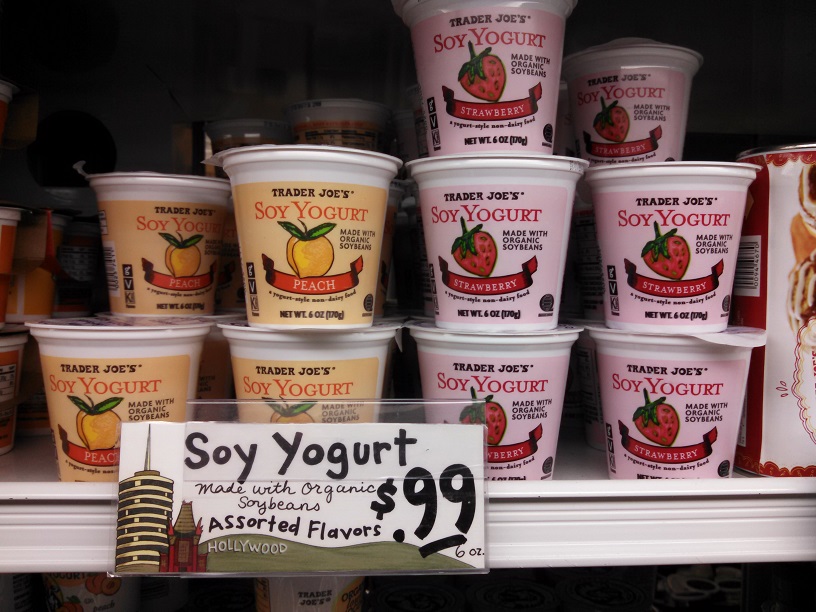
It’s amazing that you can get so much sugar in something for such a low price.
The cavalcade of gluten free, vegan food continues! My stars, but aren’t we having fun? Trader Joe’s Soy Yogurt is yet another entry in their huge wall of yogurt variations. This one leaped out at me in particular for it’s soy nature. After having such a good time with the non-ice cream, Soy Creamy, it seemed like a natural follow up. The results were similar – tasty, if you’re willing to accept a certain level of soy bean aftertaste.
You may have noticed that I review a fair number of yogurts. The rather mundane reason is that I habitually have one for breakfast, Monday through Friday, and have done since before I can remember.
In fact, my yogurt habit is rather more than habitual. A not insignificant part of my life is run off of what I like to call the “yogurt clock”. As the most modular food in my diet, I use the yogurt clock as a fail safe to remind my stupid bachelor self that I have to go buy more food on a regular basis. Every time I go to Trader Joe’s, I buy six yogurts. I eat one yogurt a day, Mon – Fri, and when I run out I go shopping again. The extra, sixth yogurt is my emergency back up yogurt so if a friend asks if they can have a yogurt, I don’t have to say, “No, those yogurts are a precision instrument, and only I can eat them.” This situation has never actually occurred, but I’m ready for it.
Planning out a good shopping trip, given the crazy state of life that is modern city living, is more than a trivial consideration, requiring numerous harrowing encounters with all sorts of biological and mechanical foes. As such, the steady, daily ticking of my yogurt clock is probably the third or fourth most important consideration in my daily life – below the internet and my girlfriend, but above the car.
That brings me back, more or less, to Trader Joe’s Soy Yogurt. A yogurt that, like so much vegan food, is not legally a yogurt. Trader Joe’s is forced to concede this point several times on the packaging with the subtitle, “a yougurt-style non-dairy food”.
The last yogurt I reviewed from TJ’s, the European-style chocolate-infused yogurts, we’re strikingly off-putting in their zesty taste. There’s no such non-American trickery at play here. Despite the fact that no milk has ever gone into this soy yogurt, it tastes very very similar to your ordinary Dannon or Yoplait.
The yogurt is smooth and thick, with a heavy “whipped” style texture and nice bits of chopped up fruit in it. It’s a remarkably close approximation to ordinary, dairy based yogurt, and at first bite you’d never suspect it’s vegan. Both types of the yogurt are also very sweet – too sweet for me in fact. The peach yogurt has 18 grams of sugar per serving, while the strawberry version has a considerable 21 grams of sugar in it – the equivalent of 6-7 packets of sugar in each yogurt. Considering that you can polish off a yogurt in about 6-7 spoonfuls, that’s a serious sugar load for first thing in the morning. While this amount of sugar is certainly not unusual in the super sweet world of grocery store yogurt, it’s more than I like to eat over breakfast.
The other consideration, as I hinted at above, is the soy bean-y aftertaste you can expect. Trader Joe’s does their best to keep this under control, but once you’ve finished one of one of these pots you won’t have any doubts that you’ve just had some soy beans. The soy aftertaste is still mild, a gentle graininess of beans on the tongue, but slightly stronger than the Soy Creamy aftertaste. It certainly wasn’t enough to ruin the overall tastiness of the yogurt, but as a guy used to dairy it did give me pause from time to time.
Even if I was dedicated to the vegan lifestyle, I probably wouldn’t replace my yogurt clock with Trader Joe’s Soy Yogurt. Though tasty, there’s just too much sugar in guys to eat on a daily basis. I’d much rather swap in fruit or something else a little better for me. The yogurt is a fine and tasty treat, just not a particularly healthy one.
The Breakdown
Would I Recommend Them: Yes to vegans, but not in general.
Would I Buy Them Again: No, they’re too sweet for me.
Final Synopsis: A good yogurt, and a great vegan option, as long as you don’t mind a lot of sugar.

Trader Joe’s Soy Yogurt – Nutrition Facts
Trader Joe’s Cypriot Pyramid Salt
Posted: June 5, 2014 Filed under: Salt, Spices, Trader Joe's Brand | Tags: 3 stars, cyprus, finishing salt, pyramid salt, salt, trader joe's salt 8 Comments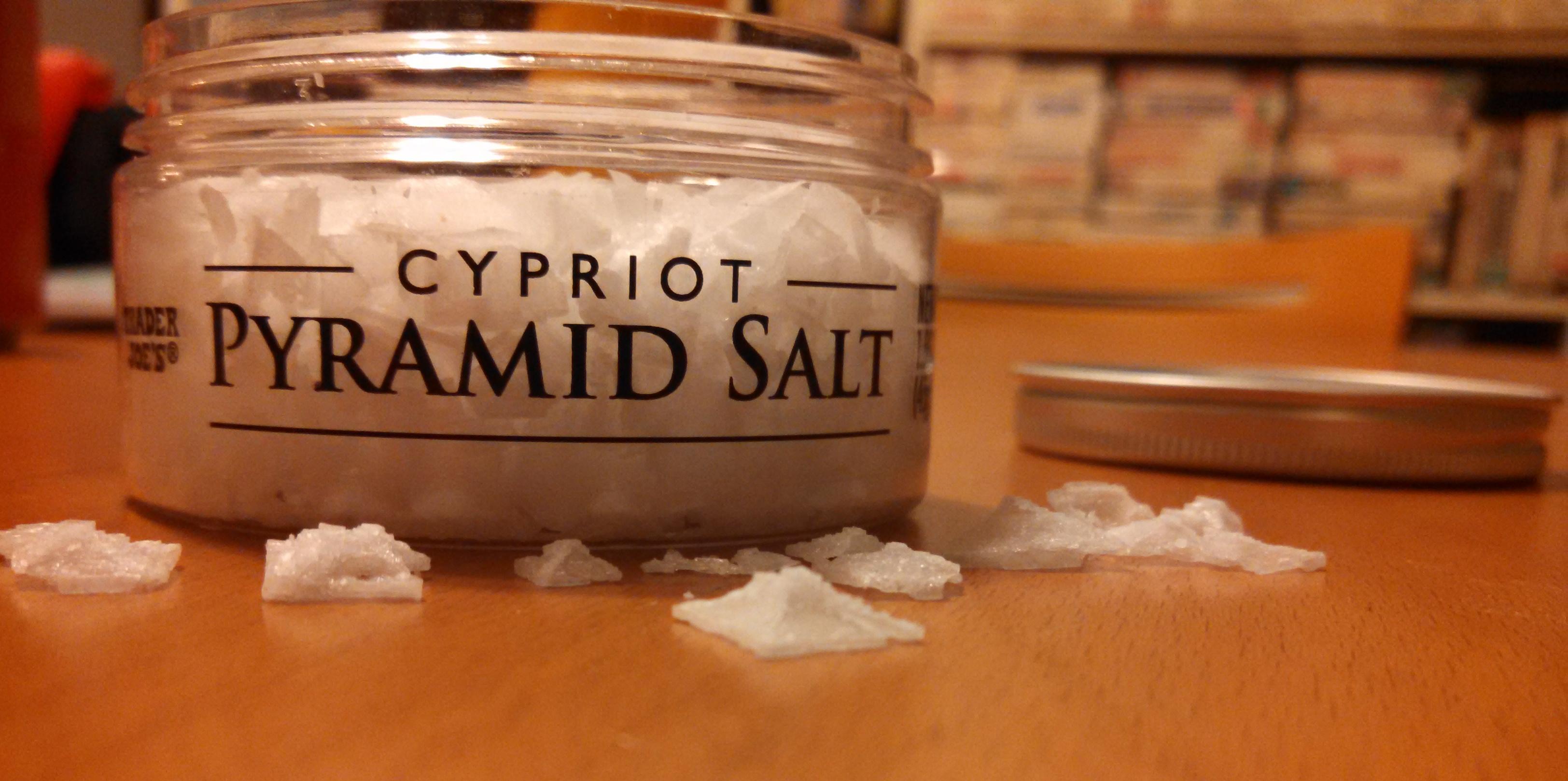
A product name that is both self evident, and maddeningly confusing.
Holy crap guys, I dare you to string three words together that make less sense than “Cypriot Pyramid Salt”. What does that mean? Is it salt from the pyramids of Cyprus? The code name of a covert military strike force? Surely it couldn’t be salt actually shaped like tiny pyramid. Surely anything but that. I’ve seen some pretty unbelievable things in the 30 or so revolutions I’ve taken on this little ball we call the Earth, but nothing in my experience has ever prepared me for salt that self-assembles into large, pyramid-shaped crystal. And yet, dear reader, that is exactly what we are talking about today.
Honestly, there’s not much more to say about Trader Joe’s Cypriot Pyramid Salt. Is it from Cyprus? Yup. Is it salt? Yup. Is it inexplicably shaped like little pyramids? Double yup. That’s basically case closed. Do you want your eggs to look more like Egypt? You’re all set. There’s nothing I can say or do to detract from the demonstrable reality that this salt looks like little pyramids. Well done, Trader Joe’s – you win again.
I mean, I guess the only real big question we need to answer here is, why is Trader Joe’s getting their Pyramid Salt from Cyprus, instead of somewhere else? There’s nothing specifically uniquely Cyprian about pyramid salt – similarly shaped salt naturally occurs around the world from Bali to England. The interesting phenomenon of “pyramid salt” falls under the broader salt category of “flake salts”, as opposed to granular salt. These flake salts are capable of taking all sorts of forms, although usually just irregular shapes or potato-chip like laminated crystals. Pyramid shaped salt crystals are just one of those remarkable quirks of life on this here planet, and a cool example of the amazing structures that nature is apt to produce when you do things like evaporate the water from a saline solution.
Unlike the Himalyan Salt with Truffles that we reviewed before, there is nothing shocking or strange about this salt’s taste. It simply tastes like salt. So why pick it up, when you already have a big box of Molson’s in the cupboard? Because of the unusual shape, of course. I may be no selmelier, but even I can appreciate the interesting texture you get from these little hollow pyramids. For one, there’s an exciting crunch to each of these crispy, hollow crystals. That same, thin form means that each salt crystal has a huge amount of surface area as well – the crystal hits the tongue all at once then melts away in a moment. As Trader Joe’s says themselves on the jar – these tiny pyramids of salt add bursts of flavor.
Okay, but what are you adding flavor to with this stuff? Well, like most flake salts – this pyramid salt is best used as finishing salt. What’s a finishing salt? Honestly, I’d really love to just dig into that question, but I’m not sure it’s possible to hold forth on the finer points of finishing salts and not feel like an asshole. Simply put a finishing salt is basically a garnish to top off your dish. Flaking some of this pyramid salt over a broiled fish, or rimming a margarita glass with these angular shards is just one more way to add an intriguing new dimension to your food.
If that extra touch of flair is worth it to you, then this is an easy accessory to pick up. If, on the other hand, your ordinary shaker gets you by alright, this is probably an embellishment you can skip.
The Breakdown
Would I Recommend It: I would if you like impressing dinner guests.
Would I Buy It Again: I doubt I’ll ever use up the container I’ve got.
Final Synopsis: Pyramid shaped salt that gives adds an interesting crunch.
Trader Joe’s Gluten Free, Raw, Vegan Fruit Bars – (Apple & Strawberry, Apple & Mango, Apple & Banana, and Apple & Coconut)
Posted: June 3, 2014 Filed under: Apple, Banana, Coconut, Fruit, MANGO!, Snacks, Trader Joe's Brand, Vegan, Vegetarian | Tags: 3 stars, Fruit Bar, raw fruit bars, trader joe's fruit bar, trader joe's vegan food, trader oe's raw food, Vegan 8 Comments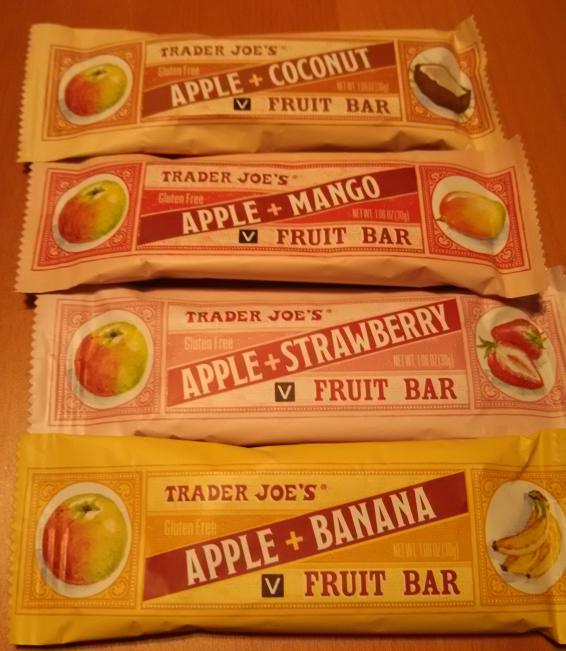
TJ’s, you’re killing me with these generic fruit bar names. C’mon get some adjectives in there!
With the addition of Trader Joe’s Apple and [blank] Fruit Bars, they have added another participant to the already crowded Trader Joe’s fruit bar arena. How, I wondered as I picked these up, could Joe possible justify the existence of a third, no nonsense, “healthy” fruit bar?
There are, in fact, many similarities between these fruit bars and Trader Joe’s other fruit bars. Like its competitors, these bars are 100% fruit, with no additives of any sort. Does that mean we’re just talking about more fruit leather? No indeed sir, it does not! While Trader Joe’s other fruit bars all hopped on the fruit leather boat, these Gluten Free Raw Vegan Fruit Bars are another thing entirely.
Open up a pack and take a look. For starters, you’ll notice that they’re not all that flat. Each bar is a good half inch or more thick, with the heft and body of a candy bar. As you pick it up, you’ll notice that they’re not all that sticky either – you can wrap your fingers around any of the varieties without fear of peeling them away to the dreaded sensation of “sticky raisin fingers”.
You’ll notice another big difference as well – unlike TJ’s other fruit bars, these guys look minimally processed. Instead of a uniform fruit paste, each of these bars is visibly full of shredded fruit – be it bits of strawberry, chunks of banana, lumps of mango, or slivers of coconut. That same quality means that each type of bar actually feels very different in the hand. The Apple & Banana is probably most dense and firm, while the Apple & Coconut has a tendency to crumble as you handle it.
Which brings us to the taste. Apple goes into basically every fruit bar ever made because its pulp is simply excellent and binding things together. What that means is that you can expect all of these bars to taste at least a little bit like apple. The question is, how much does it taste like anything else?
Actually, before we even get into that, I’d better mention that these bars are surprisingly unsweet. To be sure, they are definitely sweet as compared to – for instance, dirt. But compared to any of the other TJ fruit bars I’ve reviewed these bars are much more muted. There is none of the light-up-your-tongue zazz you normally expect from these sorts of snacks. In fact, these fruit bars are less sweet even than the fruits they’re made from.
The reason for this, in part, is because of the unsulfured nature of the raw fruit that has gone into the bars. We’ve talked about the sulfuring process
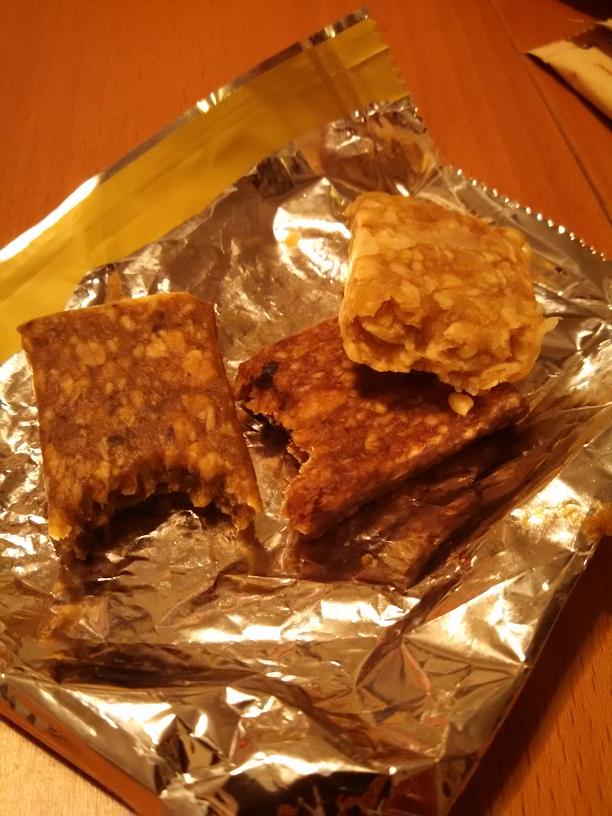
Now those are some meaty fruit bars!
before – and how it preserves the color and taste of fruit once it’s been dried. Without preservatives, and without the chemical changes that occur with exposure to high heat, these bars are essentially just shredded, dried fruit – and as such lose a good deal of their fruit’s original intensity.
Why aren’t the bars exposed to high heat? Because they’re “raw”, of course. The notion of raw food, and the ethos of rawism, is simply too big a topic to tackle in this post. One of the more interesting puzzles of only consuming raw food, however, is deciding at what temperature a raw food should no longer be considered raw. It’s generally agreed that the cut off for vegetables and fruits is between 104 – 120 degrees Fahrenheit (40-49 degrees Celsius). Presumably, these bars abide by that guideline, although there is no official “seal of rawness” yet, so really it’s anyone’s guess.
Which brings us back to the taste – just how good are these raw fruit bars? I’m happy to say that even though they are somewhat unsweet, they’re still quite flavorful. The guest fruit in each bar (banana, coconut, mango or strawberry) really come to the fore in each bite. The sugariness may be gone, but the appealing underlying taste of the fruit is still there, mingling pleasantly with the subtle, mellow apple taste. Essentially, you are getting the taste of the fruit without the sweetness. The Apple and Banana Bar, for example, tastes like a cooked plantain more than a ripened banana. The same applies to the coconut, strawberry and even the mango. You can recognize and appreciate the flavors with the candied sugariness common to many dried fruits.
Are these bars worth your money then? There’s certainly a lot to like about them. They give you a convenient way to keep your blood sugar up, a way to stay committed to your raw food diet, and can act as a substitute candy bar for dieters in need of a cheat. Then again, a regular piece of fruit does all of that just as well – and the fruit tastes better.
Really, it comes down to if you like everything about fruit except the sweetness, or if you’ve been questing for a fruit bar that won’t make your fingers sticky. If either of those qualities defines you, then you’ll want to pick up these bars. For everyone else, I’d suggest giving one a try, if for no other reason than the novel experience.
The Breakdown
Would I Recommend Them: Sure, if you need a healthier alternative to a Snickers.
Would I Buy Them Again: I’d buy these before any of the other Trader Joe’s Fruit bars, just because they’re less sticky.
Final Synopsis: A hefty fruit bar that isn’t all that sweet.
Trader Joe’s Toasted Pumpkin Seed Oil
Posted: May 29, 2014 Filed under: Condiments, Dip, Pumpkin, Trader Joe's Brand, Vegetables | Tags: 2 stars, pumpkin seed oil, toasted pumpkin seed oil, vegetable oil 10 Comments
Foreground: Toasted pumpkin seed oil; Midground: Toasted pumpkin seed oil can w. bread; Background: My table
Trader Joe’s Toasted Pumpkin Seed Oil sounds interesting, looks off-putting and costs $9.99 a can. Maybe you’re intrigued by it – but can you really justify such a purchase? If you write a blog where that’s your only function you can!
Let me save you some time, and ten bucks, right now. This oil is not worth your hard earned cash, but before I start maligning it, let’s talk about what Toasted Pumpkin Seed Oil is in the first place.
Toasted pumpkin seed oil owes its entire, modern day existence to the region Styria in south east Austria. Styria is probably most famous for being the home of 2004’s Nobel Prize in Literature winner Elfriede Jelinek. If for some reason you’re unfamiliar with Jelinek’s musical use of voices and counter voices in such important works as The Piano Teacher, then I should probably mention that Sytria is also the birthplace of Arnold Schwarzenegger.
At any rate, toasted pumpkin seed oil is, as Trader Joe’s puts it, “a distinct culinary specialty in Styria”. The fact of that matter is, that’s a gross understatement. The pumpkin as we know it is a New World crop – with no existence in Europe until Chrisopher Columbus brought some back with him from his exotic expeditions. The famous orange gourd spread to Austria where, in the 1600’s, someone got the bright idea to roast the pumpkin seeds then, instead of eating them like a barbaric ape, run them through a press and collect the intensely dark green/brown oil that dribbled out. It was an instant hit.
Such a hit, in fact, that the Empress of Austria felt compelled to ban the stuff in 1773 out of fear that people were guzzling it all up. The edict stated: “This healthy oil is unique and much too precious for using it in tasty meals and therefore should rather be used as a medicine. So it shall not be used as a culinary delicacy anymore but shall be collected and distributed only by the apothecaries.”
The medicinal qualities of the oil being somewhat dubious, it eventually returned to general use in Austria where it is generally consumed in one of three common ways: as a simple salad dressing, as a dip for bread or, strangely, as a condiment for vanilla ice cream. What it absolutely cannot be used for is cooking. Trader Joe’s even warns you against this right on the can, and I quote: “Don’t use it for cooking as it burns easily.”
Given all that, plus the high price tag, plus the strange and enigmatic can, you’re bound to assume this is some dynamite stuff, right?
Unfortunately, as much as I wanted to love this obscure oil, I was totally nonplussed by it. The big selling point of the pumpkin seed oil is its “intense nutty flavor”. And it certainly is true that the oil has a strong nutty taste – but it also tastes an awful lot like slightly burnt pumpkin seeds. Stronger, and longer lingering, than the nutty taste is this slightly charred taste, and of course the very pumpkin-y flavor of the pepitas.
On paper that still sounds like it should be reasonably good, but in reality it was very flat, and somewhat bland. Feeling certain that I must be wrong, I conducted an informal tasting panel with the oil and some of Trader Joe’s fine artisanal bread. All four voices found the same as myself – the oil is okay, but there’s nothing particularly winning about it. As one taste tester put it – it’s fine, I’d eat it if I had it in front of me, but I’d never request it. When you’re trying to sell 250ml of oil for ten bucks, that’s quite the damning review.
I’ll wrap this up on two final thoughts. The first, and most perplexing, is why Trader Joe’s didn’t wait until their annual Pumpkin Madness in October to trot out this product. It really doesn’t seem to have enough value to stand on it’s own, but it would have looked wonderful next to the pumpkin cider and pumpkin trees.
Second, my favorite thing about the oil was it’s color. The TJ’s product copy calls it “eerily dark green”, and while that’s about right it’d actually be more accurate to say it’s “eerily dichromatic”. When you pour this oil onto a white plate, it’s a thick blackish red, almost like a balsamic vinegar. When spread out thin, however, it becomes an intense spring green. That may not be enough to win me over, but it is pretty cool.
Really, the main issue here is that Trader Joe’s Toasted Pumpkin Seed Oil doesn’t exist in a vacuum. As far as bread dips and salad dressings go, it’s alright but I’d go for some nice olive oil of this stuff every time. At least I can cook with the olive oil. If it wanted a little extra nuttiness I’d pick up some dukkah as well.
Like the Himalyan Salt with Truffles before it, Trader Joe’s Toasted Pumpkin Seed Oil might make a good gift for your gourmand buddy, but that’s about it. It’s not that the oil is without value, it’s just not worth the price of admission.
The Breakdown
Would I Recommend It: Not unless they drop the price.
Would I Buy It Again: No, I already have more than I need.
Final Synopsis: A nutty specialty oil that costs more than it’s worth.
Trader Joe’s Harvest Salad with Grilled Chicken
Posted: May 27, 2014 Filed under: Chicken, Meat, Salad, Trader Joe's Brand | Tags: 3 stars, garden salad, harvest salad, Salad, trader joe's salad 4 Comments
See, there’s some chicken right there in the far back corner.
All salads are chock full of vegetables by definition – but Trader Joe’s Harvest Salad really hammers that notion home in a robust new way with this aggressively vegetable laden cud fest. And I mean that in the nicest way possible.
I love a salad that takes the salad formula in strange new directions, like the Artichoke and Hearts of Palm Salad, but I also have a great deal of respect for the classic salad formula pulled off right. Trader Joe’s Harvest Salad with Grilled Chicken is one variation of that classic salad formula, huge hearty salad where the sheer robust presence of veggies completely eclipses the meat. It’s the perfect palette cleansing salad – a return to the roots of what a salad is meant to be: huge mouthfuls of hearty, filling veggies served on a thick bed of lettuce. Which isn’t to say the salad is so straight laced that it doesn’t dabble in absurdity. Case in point, the huge, uncut green beans laid out front and center on top of the whole shebang. “Are we really supposed to eat these?” and “Why did Trader Joe’s do this?” are a couple of the reasonable questions you’ll immediate ask yourself. It’s not like Trader Joe’s doesn’t have sliced green beans. We know you have those, Joe. No, these green beans are here on purpose, to convey a message – and that message is that you’re going to need a knife just to eat the vegetables in this salad. It’s boldness and simplicity intertwined – a masterful representation of Trader Joe’s high salad artistry.
The “eat your veggies” message is further hammered home by the choice of a creamy dijon dressing. Dijon? Certainly. Creamy? Not so much. It’s a fairly loose dressing actually, more like a vinaigrette than a heavy sauce and, more importantly, the acerbic dijon works like a vinaigrette, accenting and highlighting the chewy greenery instead of obscuring their flavor under thick, overpowering emollients.
To be sure, there are non-vegetable elements in this salad, the titular chicken, along with some cubes of white cheddar cheese and half a boiled egg, and it’s these touches that make the salad work. Vegetables for vegetables sake can quickly become boring – but the charbroiled taste of the chicken meat and thick cubes of cheese break up the homogeneity with sudden bursts of fatty flavor.
In all in all, it’s very well done – but that’s not to say it’s a must buy. Trader Joe’s put this salad together with one point in mind, to remind you about vegetables. If you’ve forgotten about vegetables, you’re sure as hell going to remember them as you sit idly chewing on a big mouthful of corn kernels and green beans, really tasting those flavors at their most basic. And while that’s an important message, it has its time and place. If you remember vegetables quite well already and enjoy them frequently in your day to day life, you might appreciate one of Trader Joe’s more subtle or unusual salad over this bruiser. If, on the other hand, you need a palette cleanser, a vegetable side dish, or simply want to wipe the slate clean after a long sojourn among fast food, you couldn’t do better. As daily meal in itself, however, you might find that this salad tends to side a little too closely with the roughage.
The Breakdown
Would I Recommend It: Yes, this is a fundamentally good salad.
Would I Buy It Again: Yes, the next time a need a simple, serviceable side salad.
Final Synopsis: A hearty garden salad that highlights the vegetables.
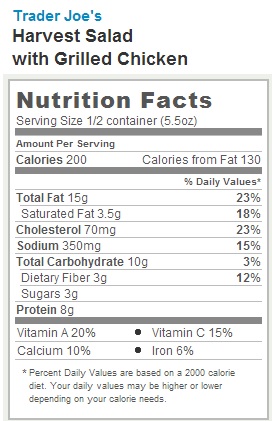
Trader Joe’s Harvest Salad with Grilled Chicken – Nutrition Facts
Trader Joe’s Chickenless Crispy Tenders
Posted: May 22, 2014 Filed under: Chicken, Frozen Food, Gluten Free, Meat, Trader Joe's Brand, Vegan, Vegetarian | Tags: 3 stars, chicken fingers, chicken tenders, frozen food, soybeans, vegan food, vegetarian food 3 Comments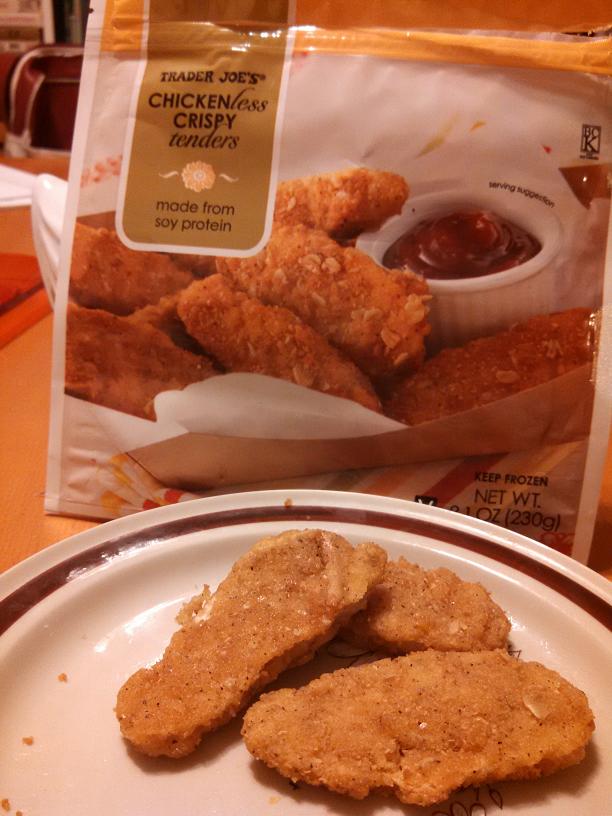
I wanted to include more of the tenders in this pic, but I accidentally ate a bunch of them.
I’ve got to hand it to Trader Joe’s Chickenless Crispy Tenders – they’re some of the best fake meat I’ve had to date. I’ve commented before on the common pitfalls of vegetarian cuisine attempting to ape meat instead of just doing its own thing. Usually this ends in a painfully tortured product name that attempts to acknowledge that it’s totally vegetarian but tastes just like meat, wink wink. (cf. Tofurkey). Generally this is an outrageous lie, or, more generously, extremely wishful thinking by a meat-starved demographic.
I’ve already expounded on my metaphysical sympathy for vegetarians. I can support the cause – I advocate the idea of abstaining from meat, and would do so myself if only my intensely bon vivant lifestyle would allow for it. Nevertheless, like the soy creamy ice cream substitute before it, I bought some crispy chickenless teneder because I needed a non-meat alternative for my (one) vegan friend. As fate would have it, I accidentally forgot to cook them in time for the meal, she ended up having nothing, and I was left with these chickenless tenders until tonight, when continued poor planning left me with nothing else in the house to eat.
Fortunately, Trader Joe’s Chickenless Tenders are not just edible, but downright tasty. They actually taste more or less like chicken tenders. How close? Close enough you could probably fool an unwary guest if you served them up without fanfare. There is still that tell-tale aftertaste of “soy-ness” that hangs around, but it’s pretty mild and is more or less totally cloaked by whatever dipping sauces or dressings you’re going to be ingesting the chicken tenders with. The only strange part is that the strips have been “breaded” in a variety of oats and flours that result in a crumbly, quasi breading that’s generally inferior to ordinary breading. The reason for this substitution, I cannot quite fathom.
TJ’s has managed to capture not just the taste, but also the texture of breaded chicken strips. The tenders are precisely that, coming out of the oven tender, moist, and just toothsome enough to give you a nice balance between chewy and yielding. They even pull apart more or less like real chicken, which is a difficult feat to accomplish when your medium is soy protein isolate.
How did TJ’s manage such a thing? I have no idea, but apparently it involves a large number of strange sounding, if allegedly natural, ingredients.
Water, soy protein isolate, and canola oil make up the first three ingredients, naturally enough. It might seem unusual that oil is ingredient #3, but remember that these are oven-baked “chicken” fingers we’re talking about. Like fish and or shrimp nuggets, when you take them out of the oven you’re going to be picking them up out of a little pool of their own oil.
After these three ingredients things get a little crazy. Pea protein pops up in a prominent position. Are peas known for their protein? Is it possible to tell someone, out loud, that your food has a lot of pea protein in it and not make it sound like an unspeakable form of bio-waste recycling? Not as far as I’m concerned.
After that we get into the ancient grain flours – including quinoa (natch), millet, and everyone’s favorite, amaranth. Rounding all that out is a good helping of Kamut®. “What the hell is Kamut®, and why is it trademarked?” is the very reasonable question you might be asking yourself right now. We’ll have to save that can of worms for another day, but the short answer is it’s a proprietary form of ancient wheat known as Khorasan wheat, originally from round about Afghanistan and nowadays lorded over by two Montana farmers. Also there’s beet root fiber in the tenders.
Somehow, in the end, all of this comes together to make strangely delicious vegan chicken tenders, with only thrice the fat of regular chicken tenders. For me it’s less important how it all works out, then the fact that it does. They might not replace regular, flesh and blood chicken in my life, but it’s good to know there’s a good back up option should it ever come to it.
The Breakdown
Would I Recommend It: I would, if you’re a vegan/vegetarian.
Would I Buy It Again: This seems like a good fit for Meatless Monday.
Final Synopsis: Eerily good vegan chicken tenders.
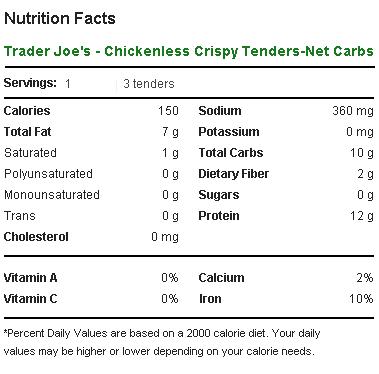
Trader Joe’s Chickenless Crispy Tenders – Nutrtion Facts
Trader Joe’s Freeze Dried Fuji Apple Slices – Unsweetned & Unsulfured
Posted: May 20, 2014 Filed under: Apple, Fruit, Trader Joe's Brand | Tags: 3 stars, dried apples, Dried Fruit, freeze dried fruit, fuji apples Leave a comment
Even better than the look on the package.
It’s time again to turn our attention to Trader Joe’s freeze dried produce section – with Trader Joe’s Freeze Dried Fuji Apples. We’ve seen considerable range in Trader Joe’s dessicated produce, from freeze dried grapes to dehydrated kimchi to vacuum fried banana chips. It would appear that Trader Joe’s has never met a piece of produce they didn’t want to turn into a dry, crunchy snack.
These apple slices appealed to me immediately because they entomb, for perpituity, my favorite apple, the glorious Fuji. So much better than mundane Red Delicious or unexceptional Gala, the Fuji is invariably dense, sweet and crisp – a thoroughly delicious apple that satisfies to the final bite. I can still remember my first bewitching bite of a Fuji apple to this day, as sweet as an illicit kiss on a rainy summer afternoon.
Fuji apples are, as you might imagine, quintessentially Japanese – originating in the far northern province of Aomori back in the 1960’s and taking the world by storm. The secret the Fuji hides, however, is that it is actually the result of cross-breeding two American apples – the ubiquitous Red Delicious and the lesser known Virginia Ralls Genet. These two strains were first genetically collided at an agricultural research center in the town of Fujisaki in the 1930’s. The apple subsequently took the name of the town as its own and never looked back. Whether out of a sense of national pride or, more probably, simple good taste, the Japanese have embraced the Fuji apple on a massive scale. 900,000 tons of the apples tumble out of northern Japan into grocery stores across the country every year, utterly eclipsing the sales of all other apple cultivars. Here in the states, the Fuji has yet to catch on so dramatically. It ranks fourth in popularity, behind the Red Delicious, Golden Delicious and, shockingly, the Gala. Wake up America – there are better apples out there!
The same qualities that the Japanese and myself admire in the Fuji apple – the sweetness and crispness – are the same qualities that make it such a good candidate for freeze drying. Like most fruits, the apple is nearly all water. The act of sucking the water out (or in this case, flash sublimating) is tremendously violent the apple itself, and hard to do without turning your apple slices into something squat and unrecognizable. The firm, crisp quality of the Fuji apple helps retain the shape of the slices, and it’s sweetness means that the apple’s whole, crisp and sweet taste is better preserved than it might be in lesser fruits. This is all the more impressive considering that these apple slices are unsweetened and unsulfured. These steps are usually taken to keep the dehydrated fruit looking and tasting something more or less like they do on the branch. The Fujis are simply so good that neither additive is necessary in the first place.
Trader Joe’s Freeze Dried Fuji Apples are entirely delicious. Each slice is perfectly preserved in miniature, and bursts with sweet apple flavor as soon as you snap into its dry, airy form. While the taste is there, I’m left wondering how exactly one is meant best to enjoy them. They can be casually snacked on, like chips, but the 1.2 ounces of apple in the bag doesn’t last very long, even if the $2.99 price tag does justify the purchase. Trader Joe’s suggests tossing them on a salad or putting them in a trail mix, both of which seem reasonable within limits. The apples very sweet and might easily replace dried cranberries, although at a much higher price per ounce. Trail mix certainly couldn’t be a more natural fit – and I’ll consider including adding it in the next three or four times this decade that I have a reason to make trail mix.
Trader Joe’s final suggestion, to throw them on your cereal or oatmeal seems like the best idea, and probably the easiest way to incorporate these tasty little guys into you life. If for no other reason, pick a bag of these up to experience the Fuji apple in a whole new way.
The Breakdown
Would I Recommend It: Sure, if you can think of a way to eat them.
Would I Buy Them Again: I don’t buy a lot of dried fruit, but I’d probably get these guys again anyway.
Final Synopsis: A fresh new way to eat delicious Fuji apples.

Trader Joe’s Freeze Dried Fuji Apple Slices – Nutrition Facts
Trader Joe’s Coffeehaus European Style Low Fat Yogurt – Mocha and Chocolate flavors
Posted: May 15, 2014 Filed under: Chocolate, Coffee, Trader Joe's Brand, Yogurt | Tags: 4 stars, active cultures, Chocolate, european style yogurt, live cultures, mocha, yogurt 28 Comments
Possibly the most unwieldy name Trader Joe’s has unveiled to date. I’m not even sure I’ve got it right.
Tangy coffee – do you like it? If you can answer that one question for yourself, there will be no need to read the rest of this post about Trader Joe’s Coffeehaus “European style” low fat yogurts. I will repeat it once again – do you like the taste of tangy coffee?
Very probably you have never had tangy coffee before, you might be confused by these words – angered by them even. No problem, friend. Just relax, sit back, close your eyes… and imagine. Imagine sipping a cup of coffee, imagine that unmistakable coffee aftertaste, that bold, full-roast dark coffee flavor that sits on the tongue like burnt toast. Now imagine it’s also real tangy. Tangy like a glass of Tropicana orange drink. Tangy, tangy coffee, sitting on your tongue, and also it’s cold. Do you like that idea?
If you’ve said yes, hold on tight because we are going to get into this. If, and I’m guessing this is more likely, you said no then you can feel free to navigate away from this browser tab right now. You sir, will not like Trader Joe’s Coffeehaus yogurts because if there’s one thing they have, it’s a serious tanginess.
Let’s unspool this for a moment. There’s about five different things going on in the name of this product alone, and it could do with a little unpacking before we start laying into if I, personally, enjoyed this thing or not.
To begin, let’s start with what a “European style” yogurt might be, and why Trader Joe’s feels they need to single that notion out for some reason – not just by name, but by packaging, iconography and font as well. How, in fact, is European yogurt different from the Greek yogurts, French yogurts and Swiss yogurts which can all also be found in Trader Joe’s yougurt aisle? The straight forward, if basically uncorrect, answer is that “European style” yogurt is called as such because it isn’t going to sit well with the average American. More specifically, it’s much less firm than standard grocery store yogurt, and much more tangy due to the presence of the many live, active bacteria cultures fermenting it full of lactic acid.
Now, every yogurt in the world is a product of bacteria cultures – that’s just the basic nature of its existence, but it’s not a fact that the big commercial yogurt companies like to play up on TV here in the States. The “now full of more live bacteria colonies than ever before” pitch is just not one that appeals to the standard demographic. As such, the bacterial nature of yogurt has been downplayed to the point where it’s almost totally overlooked. For the same reason, your usual grocery store yogurt varies between “slightly tangy” and “not tangy at all”.
Much more common in the US are the standard, “custard” style yogurts where fruit and thickening agents have been blended into a firm, sugary, low-bacteria yogurt. Confusingly, custard style yogurt can also be called French or Swiss style yogurt, despite the fact that they are much more American than European in sensibility. In fact, real Swiss yogurt (yogurt made by the Swiss in Switzerland) must, by Swiss law, contain a certain minimum number of bacterial colonies to even be considered yogurt.
So, to summarize, by saying “European Style” Trader Joe’s is singling that this is going to be some bacteria-filled, tangy yogurt, and you’d better be ready for that. They are as good as their word as well – each type of their coffeehaus yogurt comes packed with four different live and active cultures: S. thermophillus, L. Bulgaricus, L. Aciodphilus, and Bifidus. I don’t know quite enough about biology to expound on what all the important differences are between these, but I can tell you that you can sure as hell taste them in every tangy, zingy bite.
The other unusual aspect of these European style yogurts are their rather continental flavors. Dannon and Yoplait may have turned every type of cream pie and sherbet into a yogurt flavor, but even they haven’t yet done a straight up mocha or dark chocolate yet. While that might not go over very well in a custard style yogurt, it makes for a very nuanced bite here. The subtle bitterness of the dark chocolate and the mocha both play against the sourness of the yogurt, the tang of the lactic acid and the gentle sweetness of the added sugar. The result is a yogurt that challenges the tongue to a unique flavor experience, not merely a confection of high sugar content sweetness that passes the gums unnoticed.
So do I like tangy coffee? In this case, yes. I’ve had sweet yogurt, and I’ve had unsweetened yogurt, but I’ve never had yogurt that takes a path separate from sweetness all together. Tangy, bitter yogurt is an intriguing development, and one that I could easily see myself enjoying on my classier mornings.
The Breakdown
Would I Recommend It: Yes – if you’re willing to give a whole new yogurt experience a chance.
Would I Buy It Again: I’d like to think that I’m just cultured enough to do so.
Final Synopsis: A very tangy, somewhat bitter, somewhat sweet, sophisticated yogurt.

Trader Joe’s Coffeehaus European Style Lowfat Yogurt – Mocha

Trader Joe’s Coffeehaus European Style Lowfat Yogurt – Chocolate
 Eating At Joes
Recent Comments