
Trader Joe’s Crispy Crunchy Jack Fruit Chips
Posted: August 28, 2014 Filed under: Fruit, Trader Joe's Brand | Tags: 3 stars, banana chips, bonda, dehydrated fruit, Fruit, jackfruit, recipe, Trader Joe's 4 Comments
More convenient than a smelly, 80 pound mega fruit
One thing that Trader Joe’s cannot be accused of lacking are options is the dried fruit department. I’m endlessly charmed by the lengths and methods TJ’s will go to in order to bring us a fourth type of dehydrated apricot, or a new way to make banana chips.
However, even I was surprised by Trader Joe’s Crispy Crunchy Jackfruit Chips. For one, it’s weird to see such a massive fruit in such a tiny bag. The first time I encountered jackfruit in real life, I was shocked and a little taken aback, that fruit could get so big. How big is it? Big enough that I was momentarily afraid I had been shrunk to the size of bug. A fully mature jackfruit can be up to 3 feet long, weigh up to 80 pounds, and grow in bunches on trees – meaning they straddle the line between fruit, and natural hazard.
Your average jackfruit could kill a horse if it happened to drop at the right moment, helped along by the fact that they are covered in spiked, armored plates – as if Nature decided to stop screwing around after this pineapple thing. It’s rare to find a fruit where two, stacked on top of each other, could beat me in a fight.
Despite its relative obscurity here in the West, jackfruit has been a staple in India and South East Asia for thousands of years thanks to its size, resiliance and versatility as an ingredient. Like papayas, jackfruit are used for much more than simply a sweet snack. It is roasted, added to soups, fried into cutlets, mashed into kati and otherwise eaten all over the placed. In fact, jackfruit is so adored that it’s the National Fruit of Bangledesh. It’s not surprising, then, that Trader Joe’s got the idea to dehydrate them into chip. After all, that’s been a popular snack throughout South East Asia for many years.
In their natural, raw state the jackfruit tastes something like a banana crossed with a very mellow mango. By drying jack fruit out, Trader Joe’s reduces this flavor profile greatly. Regardless of the exotic origin and taste of jackfruit, what we’re encounter here is basically a nice-sized banana chip. It may be a hint sweeter, and there are subtle tones of mango and pineapple hiding in the background, but these more exotic flavor are not nearly pronounced enough to over power the starchiness of the chip. It’s the size and softness of the jackfruit chips that makes them most different from banana chips – each piece is a mouthful, and they yield rather more pleasantly to the tongue than the brittle banana chip.
One other thing the jackfruit is famous for is its trade mark odor. Fortunately lost during the dehydrating process, the fruit is generally described as having an unpleasantly overripe musk often compared to smelly feet.
Overall, it’s only subtle touches that set these jackfruit chips apart. If you’re a banan chip fan, these will be interestig to pick up by comparison. If you’re looking for a fresh new taste, however, something exotic to tingle the tastebuds, Trader Joe’s Cripsy Crunch Jack Fruit chips aren’t going to blow you away.
That left me a little disappointed, but not defeated, so I went looking for a recipe that could give second life to this otherwise limited snack chip. I may or may not have found it. The recipe below is for traditional jackfruit bonda – a type of small, South Indian snack dumpling. Ideally you make these by grinding fresh jackfruit into a paste but, dammit, we just don’t live in an ideal world. Until TJ’s starts stocking their shelves with smelly, 80 pound monster fruits, I guess I’ll just have to make do with their jackfruit chips instead.
The concept behind re-purposing this recipe is to somehow reconstitute the dehydrated jackfuit chips with a bit of water (or juice) in order to create a paste. This paste is then, conceivably, used to cook with. Unfortunately, my food processor couldn’t manage the task and I was left with an unusable slurry. Next time I’ll try taking a mortar and pestle approach, and pulverize the jackfruit chips before trying to reconstitute them – so stay tuned for that!
In the meanwhile, if anyone has more luck with this recipe, please share with us in the comments!
Impossible(?) Jackfruit Bondas (using dehydrated Jackfruit chips)
Ingredients
- 1 cup of dehydrated jackfruit chips
- 1 cup brown sugar
- 1 cup farina or semolina (cream of wheat will do)
- 1/2 cup shredded coconut
- 1/2 tsp of fun exotic spices (Recommended options: a mix of dried ginger and cardamom, with a pinch of salt and black pepper, but really you can get crazy with this part)
- oil to fry with
Directions
- Somehow grind jackfruit chips into a fine paste (maybe with a mortar and pestle?)
- Combine jackfruit paste, sugar, farina, coconut and spices.
- Let sit for 15 minutes
- Roll into small balls (about 1/2 the size of an egg, or so)
- Heat up a frying pan, fill with oil, and start frying the suckers.
- Eat them bonda up!
Notes: Real bondas should be made with jaggery and rava – two Indian ingredients that I barely understand and can’t get into here. Instead, I substituted brown sugar (for the jaggery) and cream of wheat (for the rava). Both of these substitutions will probably piss off anybody who makes real bondas, so be careful.
The Breakdown
Would I Recommend Them: Not really, these weren’t much better than banana chips.
Would I Buy Them Again: I have to! I’m not resting until I figure out this bonda recipe
Final Synopsis: Like banana chips, but a little softer and a subtly more exotic tasting.
Trader Joe’s Fruit Bar with Flax and Chia Seeds
Posted: August 26, 2014 Filed under: Apple, Candy, Fruit, Snacks, Trader Joe's Brand | Tags: 3 stars, chia seeds, flax seeds, Fruit, fruit bars, Snacks, Trader Joe's 2 Comments
Flax seeds *and* chia seeds *and* stylish packaging? I’m in.
Trader Joe’s has renewed it’s fruit bar producing efforts of late. We just took a look at their new line of thick and hearty two ingredient only fruit bars. Not content to rest with a mere 14 varieties of fruit bars across three separate labels, TJ’s has released yet another one – this one simply called “Fruit Bar with Flax and Chia Seeds.” The hardest part about covering these bars are their homogeneous names, a trend that TJ’s has decided to double down on by not even telling you what kind of fruit this bar has in it. Fruit, it suggests to you coyly, with seeds! Okay TJ, that weird enough to get my attention.
The reason, it turns out, that Trader Joe’s leaves the fruit name off this one is that, for once, it’s a blend of the whole orchard. Apple puree is the primarily ingredient, followed by a mixture of pear, elderberry and strawberry touched with lemon juice.
I went in to the bar with low expectations – after reviewing every fruit bar TJ has to offer, I was pretty sure they wouldn’t have any more surprises for me. I was wrong. This bar easily bests all of the Apple & Whatever bars I reviewed last month. That maybe shouldn’t be such a surprise really – when you limit yourself to just 2 ingredients, you’re also limiting our flavor palette. Trader Joe’s Fruit Bar with Flax and Chia seeds has a much deeper, more nuanced taste, injecting each chewy, tacky bite with a density of flavor, one fruit mingling harmoniously with the next in a way that teases the tongue to probe each bite. The lemon juice, in particular, has an appreciated presence, giving the bar a zesty bite that sets it aside from its starchier, blander siblings.
In and of itself, Joe has a winner here. However, they don’t stop there, mixing in a pinch of flax and chia seeds to boost the nutritional profile. Both flax and chia seeds have been very much in the public eye of late for their “super nutrient” qualities. While their purported qualities owe as much to marketers as they do to science, these seeds are undeniable potent sources of nutrients and fats. Each bar brings a full 1000 milligrams of Omega-3 Fatty Acids, advertised right there on the front of the wrapper. That’s a fun perk if you’re trying to get more into your diet, and an interesting concession to texture for the rest of us.
As already mentioned, the bars is gooey and tacky in that “stick to the wrapper” kind of way. The added seeds give the bar a touch of crunch to each chewy bite that lends them a touch of welcome body.
The result is a surprisingly tasty, fruity, and munchable fruit bar. If you’re looking for single ingredient fruit bars (or fruit leather), you’ve got plenty of choices out there. However, if you’re just looking for a good fruit bar to snack on, this is the best TJ currently has to offer.
The Breakdown
Would I Recommend It: Sure, if you like fruit bars, or need natural alternatives Fruit Roll Ups.
Would I Buy It Again: I’m not a big fruit bar guy, but if I was this is the one I’d go for.
Final Synopsis: Trader Joe’s tastiest fruit bar.

Trader Joe’s Fruit Bar with Chia Seeds and Flax Seeds – Nutrition Facts
Taos Joe’s (Trader Joe’)s Southewest Chicekn Quesadillas with Seasonal Vegetables
Posted: August 12, 2014 Filed under: cheddar, Cheese, Chicken, Frozen Food, Meat, Onion, Poblano, Spinach, Trader Joe's Brand | Tags: 3 stars, cheese, mexican food, quesadilla, southwester food, taos joe's, Trader Joe's 2 Comments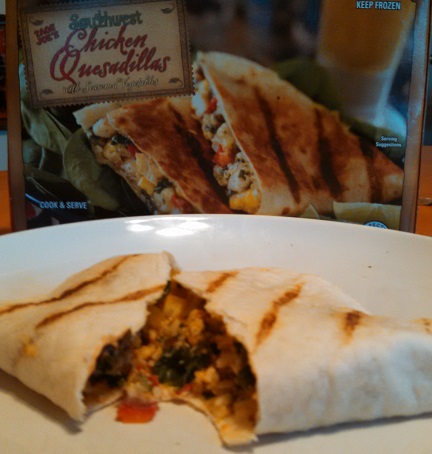
Yup, it comes pre-grill marked. All you need to do is pop it in the microwave and lie to your guests.
The only real rule I have for myself with this blog is to review only those things which are unusual enough to catch one’s attention, but are too unusual to warrant an immediate purchase. This plan has guided me down some terrible alleyways and up some delightful avenues. Why then, am I bothering to review Trader Joe’s Southwest Chicken Quesadilla – one of the safest, least intriguing foods out there? After all, isn’t the quesadilla such a staple of kid’s food menus for its tremendously simple execution and supremely inoffensive recipe, namely melted cheese in a white flour tortilla?
Yes, all that may be true, but I was drawn to this product for one very simple reason – the “Taos Joe” brand name.
One of Trader Joe’s charming quirks is their penchant for tweaking their brand name to reflect the “ethnic” nature of some foodstuff or another. There is Trader Josef and Trader Jose, Trader Giotto and Trader Jacques, just to name a few.
Things get a little nutty after this, as Trader Joe starts breaking the pattern altogether with Arabian Joe and Trader Ming. What strikes me as particularly strange, is that Trader Joe’s sort of stops there. Despite having a huge range of Thai, Indian and even African cuisine, there are no labels that reflect these cultural roots. Why, Joe?
While this is all charming and clever, it also irks me deeply because of their erratic application of nomenclature. Why, in god’s name, is this guacamole not a Trader Jose product, but this guacamole is? Perhaps only Joe himself knows.
At any rate, the sight of a Taos Joe product stopped me cold. What I like most about the name is that it’s a sign of Trader Joe’s true commitment to this gimmick. A less devoted brand might feel tempted to just stick their quesadillas under the Trader Jose name, but not so TJ. Evidently they felt that the somewhat subtle difference between Southwestern and Mexican cuisine demanded the creation of the entirely new “Taos Joe” label.
Actually, come to think about it, that’s even more irksome. Going through all the trouble of generating a brand name just for southwestern food makes the absence of, say, a Greek brand feel like more of an intended slight than a simple overlook. Is it madness or brilliance? You be the judge.
That more or less brings us to the quesadilla itself, about which there’s not a lot to say. This quesadilla is a pretty comfortable quesadilla – it’s thick, cheesy, soft and tasty in that sort of way that melted cheese usually is. If you’ve ever had a quesadilla, you pretty much know what you’re going to get from this.
That said, Trader Joe’s does manage to work in a couple nice additions that elevate it above a microwave-it-yourself affair. The best addition are the titular seasonal vegetables – a phrase which in this case means corn, red bell pepper, jalapeno pepper, and strangely, spinach. The jalapenos, along with the blend of monterrey jack and pepper jack cheese, give the quesadilla a barely detectable blip of spiciness, but not so much that it really does anything for the dish.
The vegetables and white chicken are diced to rather small chunks, and spread evenly throughout the quesadilla. This gives it a nice body and something to think about other than the cheese while chewing, but doesn’t really effect the overall cheestastic taste of the dish.
Not getting too fancy with it is actually to Trader Joe’s credit. People don’t usually turn to a quesadilla because they want challenging food, but because they want something pleasant and reliable. This quesadilla may not hit any culinary heights, but it does satisfy on a basic, comfort food level.
In the end, it’s a pretty solid dish – some chicken, some vegetables, plenty of cheese, and microwavable in about 3 minutes. Perfect for a quick and easy frozen dinner any time.
The Breakdown:
Would I Recommend It: Sure, this is a pretty good quesadilla.
Would I Buy It Again: Probably not – it’s got lots of cheese, but not a ton of excitement.
Final Synopsis: A perfectly good quesadilla, suitable for whatever.
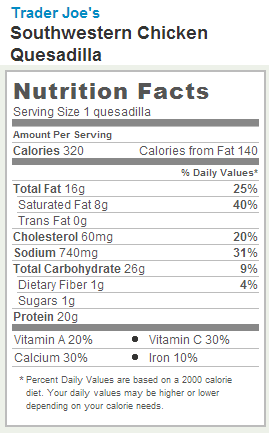
Trader Joe’s Southwester Chicken Quesadilla – Nutrition Facts
Trader Joe’s Thai Shrimp Gyoza
Posted: August 7, 2014 Filed under: Fish & Seafood, Frozen Food, Shrimp, Trader Joe's Brand | Tags: 3 stars, dumblings, gyoza, pot stickers, shrimp, shrimp gyoza, Trader Joe's 2 Comments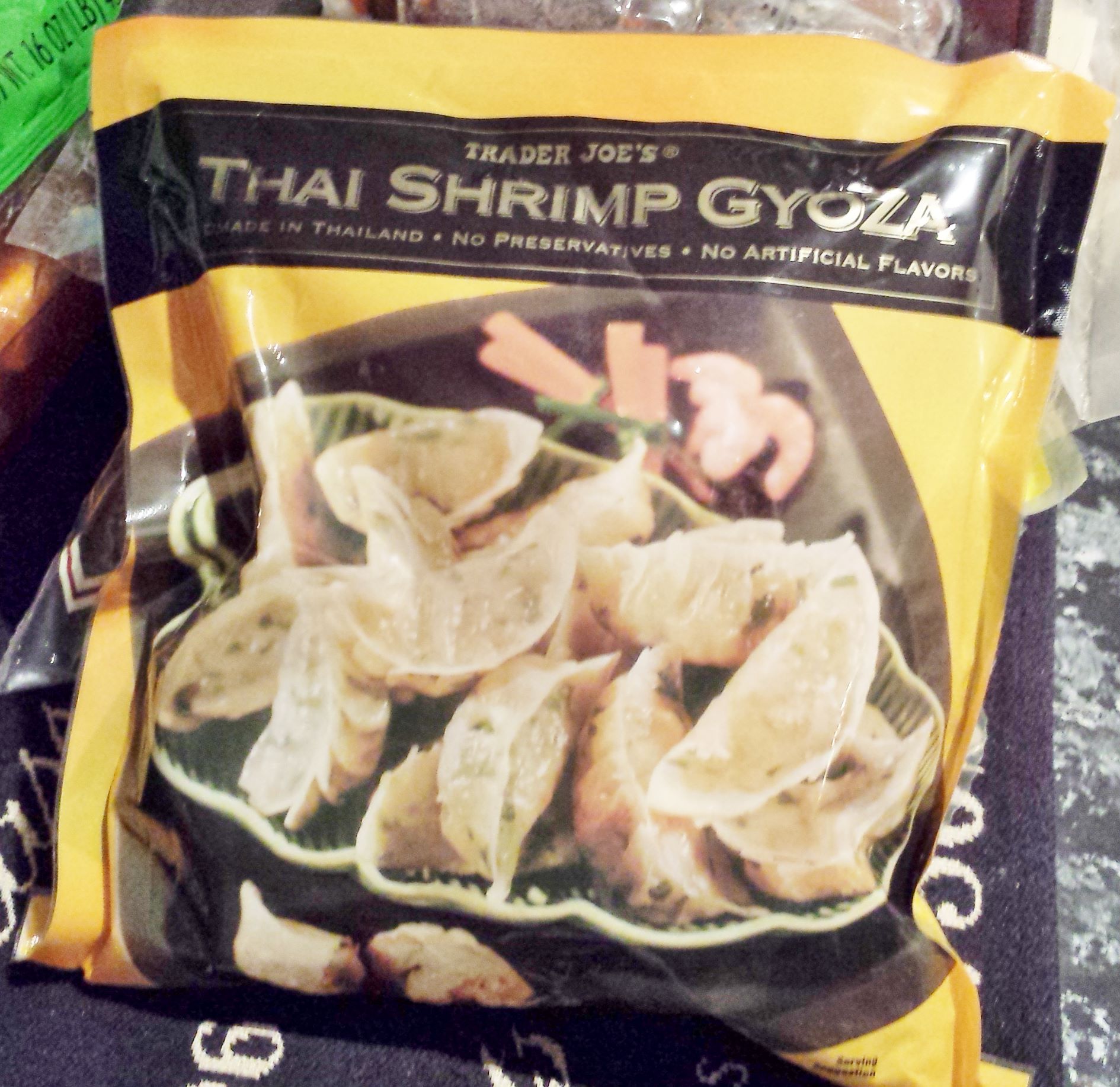
Never before has shrimp tasted so much like chicken.
Did you know Trader Joe’s sells Thai Shrimp Gyoza? I sure didn’t, and stood staring at these flat-footed for several moments when I stumbled on them the other day. Everyone knows I think TJ’s gyoza are excellent – and here was an even cooler looking bag with an even more exotic sounding gyoza in it!
Guys, you know I had to take a look. Even if someone had been, like, “Don’t do it, man! I’m you from the future – those gyoza are bad news!” I would have been all like, “Psssh – keep your drama to yourself, I’m rocking these gyoza all the way home.” And you know what? I would now be sure that that hypothetical future version of myself was a fraud – because these gyoza are awesome!
We talked about what makes a gyoza a gyoza last time, and these Thai shrimp gyoza deliver exactly the same, high-quality, pan-fryable gyoza goodness. The difference, of course, is in the filling. A generous mixture of shrimp, white cabbage, chives and green onion, plus spices, stuffs these tender dumplings of goodness. The result is a gyoza with a little more chewiness to it than the chicken or pork gyoza, but a very similar mildly savory, meaty taste. Shockingly similar in fact. Despite the top-billing of the shrimp, there is almost no discernible shrimp taste to these at gyoza at all. In a blind taste test, I would be hard pressed to tell the difference between the chicken gyoza and these shrimp gyoza.
That’s a bit surprising, because while the shrimp has been rather finely chopped it’s still easy to notice the shrimpy texture. This is not the unpleasant lumpiness of the 14 Shrimp Nuggets I gave a shot a while back, but just a sort of pleasant “Oh, that’s a bit of shrimp” experience.
If you’re worried these dumplings would be too “shrimpy” for you, that means you don’t have to worry. On the other hand, if you’re looking for a strongly executed bit of shrimp to enhance your seafood dinner, these aren’t going to do the job. That’s a little strange, but doesn’t detract from the overall goodness of the dish.
Even weirder than this, is why these gyoza are being made in Thailand in the first place. Unlike, say, Trader Joe’s Thai Lime Shrimp Skewers, these shrimp actually are from Thailand. At least, the gyoza are hand made there at any rate, and the shrimp come from off either the Chinese or Thai coast. This is actually a pretty safe thing to say about almost any shrimp you eat, as 75% of the world’s shrimp farming happens between those two countries.
That’s all well and good, but it still leaves the window open on why Trader Joe’s calls these gyoza Thai Shrimp Gyoza in the first place. As we talked about before, the cuisine of gyoza is bound up in the histories of China and Japan – Thailand is sort of a non-player in the whole scene. If you’re getting your shrimp from Thailand, I suppose you’re welcome to throw the word in the title, but if you’re just going to make the whole thing taste just like your chicken gyoza I don’t see how that’s really worth the bother.
I suppose this, as so many other answers, lays with Trader Joe’s inscrutable marketing department. Presumably there’s a chart someone has on their desk that shows seafood sales increase by 7% when the word “Thai” is in the title. At any rate, all the mind games and marketing ultimately give way to how it actually tastes, and in this case the taste is there.
If you’re vegetarian but not pescatarian, or if you’re looking for another totally easy, totally tasty potsticker to stick in your pot there’s no reason not to give these a shot.
The Breakdown
Would I Recommend It: Sure, these are pretty good gyoza – particularly if you’re staying away from meat.
Would I Buy It Again: These gyoza don’t taste all that different from the slightly cheaper chicken and pork gyoza, so probably not.
Final Synopsis: A shrimp filled gyoza that tastes just as good as, and just like, Trader Joe’s other gyoza.
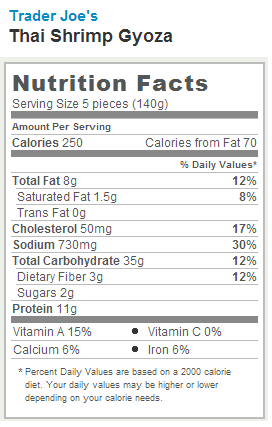
Trader Joe’s Thai Shrimp Gyoza – Nutritional Facts
Trader Joe’s Organic Whole Green Figs
Posted: August 5, 2014 Filed under: Fig, Frozen Food, Fruit, Trader Joe's Brand | Tags: 3 stars, figs, frozen food, green figs, Organic, Trader Joe's 11 Comments
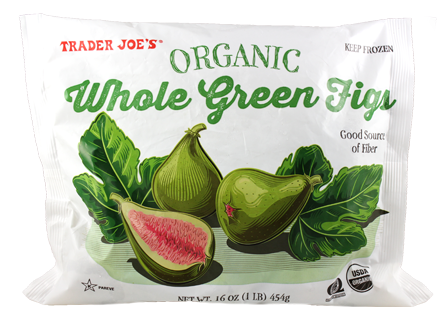
Everything you want from a fig – except the texture.
Do you sometimes crave a whole green fig, but all the ones you find are either not organic, or not frozen rock solid? Well I have good news! Trader Joe’s is solving both of your problems at once with their frozen Organic Whole Green Figs!
The last time we looked at any of Trader Joe’s figs it was their Black Mission Figs, which I found pleasantly sweet and tasty, if you can get over the somewhat unnerving fleshiness of them. Well fleshiness isn’t a problem this time around, because they’re coming to you in the form of rock hard iceballs!
The first thing you’ll notice when you pick these figs up is that Trader Joe’s didn’t go looking for the small ones. Each fig in the bag is a hefty little monster, considerably larger than the fresh Black Mission Figs you might be able to find in the produce aisle. Apart from the size, these green figs (also called kadota figs) are somewhat less sweet than the black figs from before. That said, they’re still figs – which means they’re still quite sweet indeed, and have the same mushy-soft / crispy-seedy center that gives them such a unique bite.
We spent plenty of time reviewing the history of these meaty drupes last time, so I won’t bore you all again with a lecture on prehistoric agriculture. This time let’s take a look at the religious perspective.
As you might expect from a fruit man has had such a long history with (11,000 years+), religion has a good deal to say about figs – in particular considering that they’ve been cultivated widely through the that fertile belt of religion that begins around the Mediterranean and stretches all the way to South East Asia. As such, all the big time religions feature figs in their holy books to a considerable degree.
Adam and Eve, for instance, sought to cover up their shame from God with the trusty old fig leaf – maybe not the best choice considering that figs are a notable skin allergens, and that the natural latex that the fig tree produces is a serious eye irritant. Nevertheless, thanks to A&E, fig leaves entered the art world for a pretty good stretch of centuries as the de facto tasteful genital cover in paintings and sculptures.
Meanwhile, in the religion of Islam, the fig is considered one of the two sacred trees, along with that other old favorite the olive. Going further we find that the historical Buddha went out and achieved enlightenment under the bodhi tree – otherwise known as the sacred fig tree – and that the fig is even considered to be the “world tree” from which all springs in Hinduism. Even Jesus got in on the fig tree, when he chose to kill one in Mark 11:12 by cursing it to death for not bearing fruit. Harsh Jesus!
That’s a pretty good pedigree, the fig! But all that said, what reason do I really have to buy these things frozen?
Obviously, getting them fresh is always going to be your best option, but due to their high sugar content, figs ripen and spoil very quickly. A ripe fig will even split under the strain of it’s own sweet innards if left too long, so transporting the fresh produce is a considerably trickier prospect than, say, an apple.
If you’re feeling a hankering for figs, know that the frozen solution is not a perfect one. For starters, the figs seem to freeze inconsistently. In my bag, I found that three or four were somewhat mushy, even when the others were frozen solid – and that’s after a few days in the back of my freezer! These mushier figs didn’t seem to be bad necessarily, just soft. That said, you might want to feel around for a couple different bags to find one that’s perfectly hard and frozen.
If you want to enjoy your green figs right away, you can throw them in a blender and try out this tasty and quick smoothie recipe.
If you’d rather enjoy your figs thawed, you’ll need to slowly defrost them in your fridge for a few hours. However, at this point be prepared for a shock. These defrosted figs are incredibly slimy and incredibly mushy. That’s simply an unavoidable aspect of the freezing process – and the price you’ll pay if you want figs you can defrost any time.
It’s somewhat off putting, and nowhere near as nice as handling actual fresh figs, but while the texture is somewhat compromised the taste is still the same.
If you can stand the wait to thaw these, and the softness, there are lots of great recipes that call for the refined sweetness of green figs.
Here’s one that I like, a rather laid back recipe for laid back times.

Fig, Arugula and Goat Cheese Flat Bread – straight out of the oven.
Fig, Arugula and Goat Cheese Flat Bread
Ingredients
- 1 flat bread
- 1 or 2 tsp olive oil
- Some arugula
- Some awesome goat cheese
- Trader Joe’s Organic Green Figs (quartered)
Directions
- Pre-heat your oven to 350 degrees.
- Paint the flat bread with olive oil, until it has a nice sheen.
- Lay down a bed of arugula. On top of this add your (thawed) quartered, green figs and as much goat cheese as you feel comfortable with.
- Pop you prepared flat bread in the oven and heat until toasty. About 5-10 minutes
- Enjoy the hell out of it with a few friends while discussing philosophy, the sunset, or Game of Thrones.
Note to you, the reader If you like this recipe, or want to see more, let me know! And feel free to share your notes on it in the comments.
The Breakdown:
Would I Recommend Them: I’d look for fresh figs first – but these are a good stand in.
Would I Buy Them Again: Sure, I really like that flat bread!
Final Synopsis: Not as good as getting your figs fresh, but more convenient.
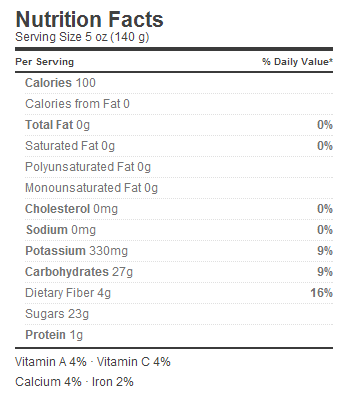
Trader Joe’s Organic Whole Green Figs – Nutrition Facts
Trader Joe’s Dark Chocolate Edamame
Posted: July 29, 2014 Filed under: Candy, Chocolate, edamame, Snacks, Vegetables | Tags: 3 stars, dark chocolate, Edamame, semi-sweet chocolate, soybeans 2 Comments
You’re calling this dark chocolate? C’mon now, be honest.
People are willing to put dark chocolate on just about anything. While I applaud the adventerous spirit, the problem is that dark chocolate is not so universal as people hope. Just because the word “chocolate” is in there doesn’t mean it’s a confection. The strong, bitter, almost astringent taste, of a high purity dark chocolate is an acquired taste and should be introduced into a dish only with forethought. Thus it was with trepidation that I picked up Trader Joe’s Dark Chocolate Covered Edamame.
I like dark chocolate, or at least I want to like dark chocolate. I certainly like it enough on its own. The trouble is, it’s hard to find it done right. One place I seem to continually encounter it is on roasted coffee beans, which has always truck me as very strange. Obviously coffee is a good thing. Coffee keeps America running. I, for one, recently fell in love with Trader Joe’s Cold Brewed Coffee Concentrate. However coffee beans are not coffee. They are the cast off husk that we extract that essential nectar from – the thing that gets in the way between us and the coffee. Why then does it seems to anyone likea good idea to cover the whole beans and eat them? It’s not like we eat them in any other way – nobody is throwing a handful of roasted coffee beans on their salad, or mixing them into their pasta. We grind them up and make coffee out of them or, in extreme cases, add it to steak rubs. We don’t just munch them down whole.
I bring this up because Trader Joe’s Dark Chocolate Edamame are essentially an improved form of the chocolate covered coffee bean. There’s a shell of dark chocolate around a crunchy, munchable core of dry roasted edamame. What’s surprising to me is that really these things are pretty good.
“Now wait a minute”, you’re probably thinking.”Aren’t edamame just soybeans?” Yes, that’s true – but don’t let the rather long history of soybean bashing turn you against me right from the start. It’s true that soy beans are mostly used to make salty and savory dishes – for example, as soy sauce, miso soup, and tofu. However, anyone who’s ever had a bowl of salted, fresh soybeans at a bar or as finger food, served still in the their little green pods, knows that they also have a very mild taste with an addicting crunchiness.
The truth is, you’ll barely taste the edamame beans in Trader Joe’s Dark Chocolate Edamame at all. They could have just as well called these Trader Joe’s Dark Chocolate Crunchers. The flavor of the heavy, dark chocolate coating is so strong that you don’t get any taste from the dry roasted soybeans at all. All you get is texture – the crunchy body and satisfying grist of the light, sere bean. The added benefit is that this snack actually has a pretty good protein content. A 1/4 cup serving contains 7 grams of protein – 49 grams in the whole container.
The other thing that Trader Joe’s did right with their dark chocolate edamame is not actually using dark chocola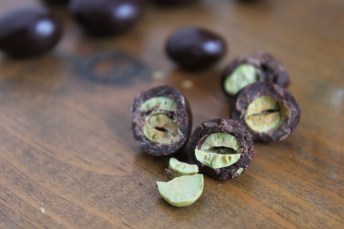 te at all. Seriously. A
quick inspection of the ingredients reveals only a mention of “semi-sweet” chocolate. Semi-sweet is a far cry from dark chocolate, sometimes containing as little as 35% cocoa. Trader Joe’s doesn’t state the percent of cocoa in these beans, but a safe bet might be around 50%.
Normally I decry this sort of misleading wordplay, but in this case I’m actually not that upset. For one, semi-sweet chocolate is still “technically” considered dark chocolate, even if it wouldn’t necessarily be considered as such in the vernacular. Secondly, and more importantly, it’s actually a good move. Dark chocolate tends to be unpalatable quickly as the purity increases. By going with a semi-sweet dark chocolate, Trader Joe’s has succeeded in making a eminently snackable chocolate treat perfect for setting out at bridge groups, high caliber sporting events, and other informal social gatherings. A chocolate treat that isn’t too sweet, or too bitter.
The Breakdown
Would I Recommend It: Yes, this is a fine use of dark chocolate.
Would I Buy It Again: Sure, I could see putting this out for guests.
Final Synopsis: Semi-sweet chocolate beans with a pleasantly crunchy center.
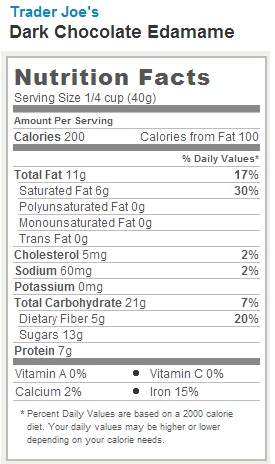
Trader Joe’s Dark Chocolate Edamame – Nutrition Facts
Trader Joe’s Uncured Bacon Ends and Pieces
Posted: July 15, 2014 Filed under: Bacon, Meat, Trader Joe's Brand | Tags: 3 stars, applewood smoked, bacon 11 Comments
All that bacon goodness packed up in a tiny little bag
You’ve probably heard about the oncoming Breakfast Armageddon. Your traditional, western-style breakfast table of bacon and eggs – the hearty, workman-like breakfast of middle-class, middle America – is on an out of control roller coaster ride straight into the mouth of Hell. What I mean, of course, is that the cornerstones of breakfast – bacon and eggs – have seen unprecedented price spikes over the last 12 months (Source: Bureau of Labor Statistics). Due to a conflux of calamities, including global drought and widespread swine pestilence, the price for a pound of bacon has jumped nearly 19% between May 2013 and May 2014.
Certainly I don’t want to be accused of fear mongering, but according to the computer simulators here at EatingAtJoes.net, if this trend continues a pound of bacon will cost $572.38 by 2029, at which point it will be cheaper to just start eating human. At the risk of appearing hyperbolic, I absolutely urge you to smash down the doors of your nearest supermarket and steal as much bacon as you can carry this very second. That, or switch over to Trader Joe’s Bacon Ends and Pieces!
I picked up this oblong little pack of scrunched up pork while weighing my grocery bill against the climbing price tag of Trader Joe’s truly, truly delicious Applewood Smoked Bacon. I’m on the record as saying that the bacon fad long ago become tiresome, and am the foremost proponent calling for a period of bacon tumescence, say a decade or so, at which point we can all start eating it again and sticking it in vodka and whatever. That said, TJ’s applewood smoked bacon makes me go weak in the knees when I smell it sizzling up in it’s own, rich fat on the skillet.
It was this battle of my animal id against my budgetary superego that Trader Joe’s so deftly diffused by producing their bacon ends and pieces.
As you can gather from the name, Trader Joe’s Bacon Ends and Pieces are the assorted left over bits of bacon that they didn’t see fit to package in their regular packs of Applewood Smoked Bacon. To a certain mindset, that means you’re eating Trader Joe’s trash, but don’t think about that. Instead, focus on the deal! In exchange for choosing the bacon rejects, and forgoing the niceties of traditional packaging, you get 12 oz of delicious, nitrate-free, applewood smoked bacon for only two bucks and change, less than half the regular price.
What I was expecting from that price, and the smaller package, was a bunch of irregular chunks of varying thickness. I was surprised to find that this wasn’t the case. On opening the pack, I discovered that the strips had been folded, but were otherwise the same size and shape as regular bacon. The big difference is in the fat/meat ration. While TJ’s regular Applewood Smoked Bacon is more or less uniformly fatty, these bacon ends varied between 50% – 80% fat. Obviously, this isn’t ideal. After all, I’m the yutz who usually buys turkey bacon. That said, a little carefully slicing with my kitchen knife before putting them in the pan left me with bacon that was as lean or leaner than what I normally get.
It’s important to note, by the way, that your results may vary. The bacon ends and pieces are a grab bag by nature. The fattiness of the pieces, and their size, is likely to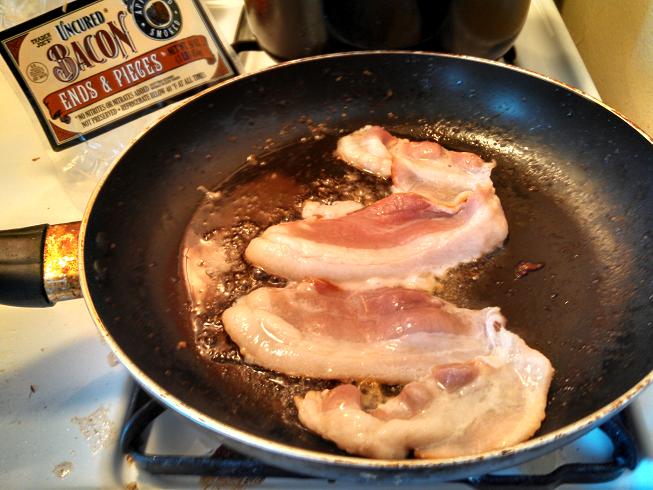 vary from package to package.
I’m sure there are those of you out there who fear picking these up lest they be branded by the stigma of poverty. After all, isn’t this just poor people’s bacon? Well – yes, maybe. But don’t forget that what you’re buying here is not just a breakfast substitute, but a raw ingredient with a long culinary tradition. There are things you can do with bacon ends and pieces that you can’t do, or wouldn’t want to do, with the neatly packaged kind. As the internet has exhaustively noted, the applications of bacon are limited only by your creativity, but in particular the higher fat content of the end pieces makes them perfect for dicing up and cooking in stews and soups, adding to green beans and baked beans, or any dish that you want to infuse with a rich, smokey hint of savory bacon.
For my part, I poured off the excess bacon fat, then cooked my eggs straight on the still glistening skillet – giving them that extra touch of delectable goodness. If you’re happy with your bacon as is, by all means continue buying as usual. If, however, you’re looking for relief from the rising cost of breakfast, or are looking for some fatty goodness to throw in the stock pot, this bacon gets the job done.
The Breakdown:
Would I Recommend Them: Yes, if you’re not concerned about your fat intake.
Would I Buy Them Again: Yes for cooking projects, but they were too caloric for my everyday bacon.
Final Synopsis: Extremely delicious bacon, with more fat for less money.
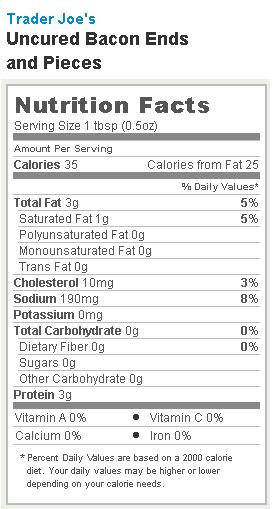
Trader Joe’s Bacon Ends and Pieces – Nutrition Facts
Trader Joe’s Gazpacho
Posted: July 8, 2014 Filed under: Cucumber, Pepper, Red Pepper, Soup, Tomato, Trader Joe's Brand, Vegetables, Vegetarian | Tags: 3 stars, gazpacho, raw food, spanish food, tomato soup, vegan food, vegetable soup 3 Comments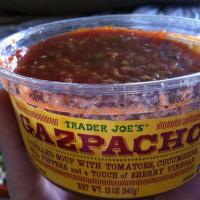
IT’S GAZPACHO TIME!
Beautiful July is on us again, and with it so too has come the promise of an infinite string of perfect barbecues at sunset, – the golden moments of life. And of course, I can never think about big, blow out BBQs without thinking about GAZPACHO!
No, I have never had gazpacho before, and certainly never at a barbecue, but the two are inextricably linked in my mind because of, like so much in my life, The Simpsons.
As I know, and I’m sure you now know, gazpacho is tomato soup – served ice cold. Despite what you may have heard from the shouting of beligerent drunks, Gazpacho is actually a Spanish dish tracing its origin back to the Andalusia region of southern Spain. Nowadays it’s eaten throughout Spain and Portugal as a go to cool-down dish during hot summer months.
If your pop culture tastes run a little higher brow than mine, you might also remember a good gazpacho scene from the movie “Violets Are Blue” (1986). In it gazpacho is described as “salad in a blender”, and that’s probably as good of a definition as any. In addition to the aforementioned cold tomatoes, Trader Joe’s Gazpacho contains cucumbers, green and yellow bell peppers, and onion – all finely diced into a robust concoction of chunky vegetables. The important thing to remember about gazpacho, and the thing that makes it different from any other vegetable soup out there, isn’t just that you serve it cold, but that it’s actually made cold. This is a raw soup – uncooked from start to finish, and as a result it’s bursting with full-bodied, vegetable flavor. Not just vegetables, actually, but fruit as well.
Many gazpacho traditions coexist, including varieties that include strawberries or muskmelon. Trader Joe’s doesn’t go so far as to throw in any fruit chunks, but they do dress up their soup with a good dose of orange juice – as the second ingredient behind tomatoes. That’s still just enough to add a subtle citrus tang to the soup, and to add the faintest touch of sweetness to the soup. Other seasonings going into Trader Joe’s Gazpacho are garlic, jalapeno pepper, and a touch of sherry vinegar, all of which work to give the soup bit of a spicy, acidic edge.
This soup isn’t hiding any surprises. Having never had gazpacho before, I found that it tasted exactly like I expected a cold soup, tomato based soup to taste. This is a soup of overwhelming vegetable flavor, and it doesn’t pull any punches. There’s no saltiness, no real sweetness, just that zing of sherry vinegar layered on top of many vegetables.
If you like strong tomato soups, you’ll like this. There’s certainly a little more than just tomato going on in the background, but overall it begins with tomato and it ends with tomato. Personally, I wasn’t exactly blown away by it. The gazpacho wasn’t flawed in anyway, but the simplicity of this cold, straightforward soup didn’t manage to catch my heart. While I didn’t mind eating it, I did keep thinking about how it might taste better if I heated it up and maybe dressed it up a little. I could have done, but at that point I might as well have just picked up one of Trader Joe’s other great soups, their minestrone for instance.
I’m willing to admit that that’s a personal failure, however. If you crave a dish of heart vegetables, or want to beat the heat with a flame-free meal, this gazpacho is certainly worth a shot.
The Breakdown
Would I Recommend It: Sure – it may not blow you away, but this is a hearty, healthy soup.
Would I Buy It Again: I don’t think so, there are too many other soups to try.
Final Synposis: A cold tomato soup, with a little zing thrown in.
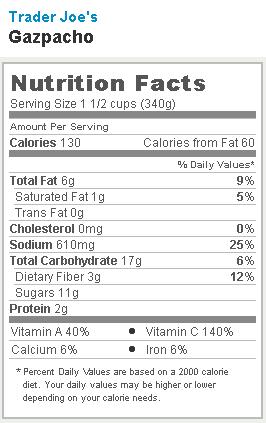
Trader Joe’s Gazpacho – Nutrition Facts
Trader Joe’s Tzatziki
Posted: July 3, 2014 Filed under: Condiments, Cucumber, Dip, Garlic, mint, Spices, Trader Joe's Brand, Yogurt | Tags: 3 stars, dip, greek food, Trader Joe's, tzatziki 1 Comment
Spackle?
Is it just me, or is the packaging for Trader Joe’s Tzatziki Creamy Garlic Cucumber Dip really weird? The big red “LOW FAT!” flag, the serving suggestions awkwardly crammed over to one side, the semi-unreadable font on the gray background of the low-grade Photoshop job. It reminds me of their weird chocolate-covered banana packaging. It’s the sort of packaging that leaves you wondering what you’re looking at “What’s in there?” you ponder, “Modeling clay? Deck varnish?” Nope, it’s food.
Most of the time, TJ’s does a good job repackaging the third party products that they source. In this case however, even the “Trader Joe’s” brand name looks shoehorned in. Nevertheless, this is a classic case of judging a book by its cover, as the tzatziki sauce within is quite nice.
Let us spend a moment on the truly awesome word that is “tzatziki”. It’s one of those dynamite cuisine words that not only sounds cool, and is spelled cool, but also makes you feel really cool to drop casually into conversation. Like “shwarma”. Throw some tzatziki on that shwarma. Sounds nice doesn’t it? Yo – buddy! Throw some tzatziki on that shwarma! The word itself is popularly attributed to Turkish, but like many foods of shared Greek/Middle Eastern/Balkan origin there’s a considerable amount of bickering over who developed it first/best.
At any rate, as we all know, tzatziki is a somewhat zesty dip/sauce made from plain yogurt and flavored with a variety of seasonings – in this case, salt, garlic, dill, mint, white pepper and, of course, lemon juice. The result is a smooth, cool mixture that comes on mild, then surprises you a moment later with a complex burst of citrus and herbs. Tzatziki exists through out the Mediterranean and Middle East in a variety of forms – extending even as far out as India where the classic yogurt side dish raita can be considered a close relative. The type Trader Joe’s is serving us up here is the familiar Greek variety, prepared with thinly sliced cucumber mixed directly into the herbed yogurt.
In fact, Trader Joe’s tzatziki is one of the better varieties I’ve had. The dip is quite loose, but it doesn’t lack in flavor. 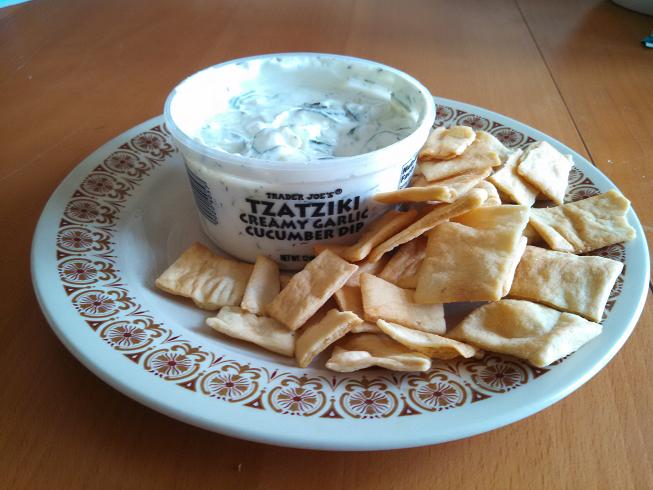 The lemon juice comes through clearly alongside the mellow, long tones of the creamy yogurt. The dill and mint come through clearly in the after notes , but the dish isn’t overloaded by their flavors, and they leave room for the tail note of languid, cool cucumber and mild garlic to linger on the tongue.
As appealing as that is, it’s made better by the extremely reasonable nutritional profile. Each 30 gram (two teaspoon) serving has only 30 calories, and two grams of fat. Even the sodium content isn’t that bad, at 65 mg per serving. For such a healthy dip you’re getting a surprising, and satisfying, amount of flavor.
The go-to applications for tzatziki sauce are gyros and pitas, but it goes awesome with pita chips as well. Even if you’re not whipping up Mediterranean food very often, it still makes an awesome side dish for any meal that could do with a little spread on top, or cooling down on the side. In other words – throw some tzatziki on that shwarma!
The Breakdown
Would I Recommend It: Yes, so long as you don’t mind cucumbers in your food.
Would I Buy It Again: Definitely – I’m always in the market for good dips.
Final Synopsis: A solid version of tzatziki with plenty of pep.
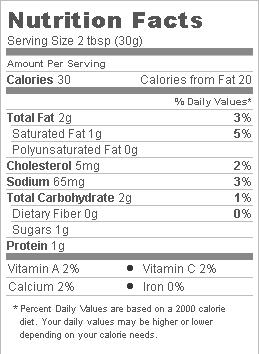
Trader Joe’s Tzatziki Dip – Nutrition Facts
Trader Giotto’s (Trader Joe’s) Chicken Piccata
Posted: July 1, 2014 Filed under: Chicken, Meat, Trader Joe's Brand | Tags: 3 stars, Chicken, italian, piccata 8 Comments Trader Joe’s Chicken Piccata is an excellent, no-frills Italian-style chicken dish perfect for your last-minute dinner. As TJ explains right on the box, chicken piccata is “seasoned breaded boneless chicken breasts, baked in a lemon, caper and white wine sauce. Even this simple descriptions belies the simplicity of the dish.
When you open package, you’ll only find only two things within, breaded chicken cutlets, and a large pouch of yellowish sauce. That’s it – and that’s all you really need. This is a meal at its most spare. Simply open the sauce packet, apply to the chicken, throw it in the microwave for two and half minutes and your piccata is ready. This minimalist meal is pared down from the more bulked up version that Trader Joe’s offered back in 2013 that included a side of broccoli and pasta.
That minimalism actually suits the chicken picatta well. Piccata, after all, has always been the very figure of quick and easy cuisine. Even traditional, hand-made chicken piccata (or veal piccata, if you going really old school) can be cooked up in a few minutes flat. The dish couldn’t be more streamlined if it had been designed in some sort of food wind tunnel (maybe it uses gravy instead of wind?). For example, the first step to a good piccata is smashing the hell out of piece of meat until it’s thin enough to see through. The chicken breast gets sandwiched between two sheets of wax paper and pounded remorselessly until the chicken is either a quarter inch flat or the cook has worked out all of his simmering rage.
The flattened meat is then dredged through a mixture of flour and seasoning until properly breaded up. This has got to be the best part of the cooking process, because every resource I consulted on piccata uses the exact same terminology. “Dredge the chicken through the flour.” Dredge it. Dredge the chicken.
Dredge is an amazing word, but most of the time you have to tack it onto downer sentences about muck and sunken corpses and such, so I’m glad it gets a chance to jazz
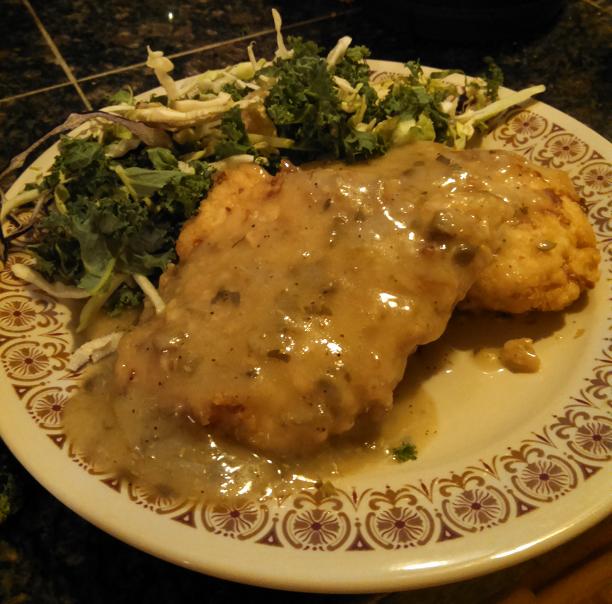
Chicken piccata – fully pounded and dredged
up a more light-hearted sentence once it a while. Unless you decided to go with the veal, I suppose. “Dredge the veal” isn’t a sentence that’s likely to win many people over.
At any rate, your smashed up, dredged meat is going to cook up on a hot frying pan almost instantly, at which point it’s removed from and the pan and the pan drippings are mixed up with some wine, lemon juice, etc into a sauce. And there you have it – piccata. Just that easy, bro.
So while it’s understandable that there isn’t more to this piccata, it’s also a shame because what it has to offer is so good. The breaded chicken breast is pre-cooked, but retains its tenderness and moisture even after reheating. This is thanks, in some part, to the breading that encloses each breast in a thick, chewy layer that crisps up after cooking. The breaded cutlet is pretty dang good by itself, but it’s the sauce that really makes this piccata a piccata.
The lemon and white wine in the sauce are no mere threats – despite the heavy nature of the sauce (and its fat content) it tastes light and packs a zippy zing. It dangerously good, the strong, dry citrus taste pairing very well with the chicken, while the melted butter satisfies to the corners of the mouth.
If it wasn’t for the considerable fat content (44 grams total), I would pick this up all the time. In fact, I’m such a fan I might skip Trader Joe’s entirely next time and just make it myself! (But probably not.)
The Breakdown
Would I Recommend It: Yes, this is as good as it is simple.
Would I Buy It Again: I want to say yes – if only it wasn’t so fatty.
Final Synopsis: A quick and easy Italian-American classic.
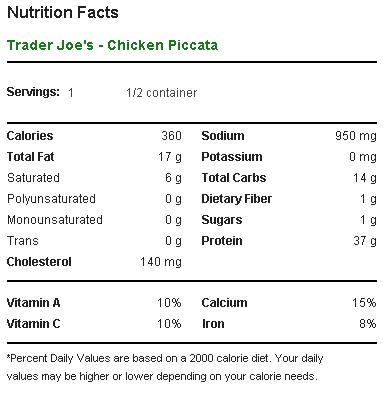
Trader Joe’s Chicken Piccata Nutrition Facts
 Eating At Joes
Recent Comments