
Trader Joe’s Gazpacho
Posted: July 8, 2014 Filed under: Cucumber, Pepper, Red Pepper, Soup, Tomato, Trader Joe's Brand, Vegetables, Vegetarian | Tags: 3 stars, gazpacho, raw food, spanish food, tomato soup, vegan food, vegetable soup 3 Comments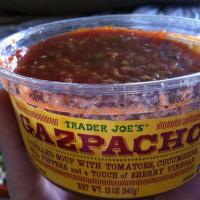
IT’S GAZPACHO TIME!
Beautiful July is on us again, and with it so too has come the promise of an infinite string of perfect barbecues at sunset, – the golden moments of life. And of course, I can never think about big, blow out BBQs without thinking about GAZPACHO!
No, I have never had gazpacho before, and certainly never at a barbecue, but the two are inextricably linked in my mind because of, like so much in my life, The Simpsons.
As I know, and I’m sure you now know, gazpacho is tomato soup – served ice cold. Despite what you may have heard from the shouting of beligerent drunks, Gazpacho is actually a Spanish dish tracing its origin back to the Andalusia region of southern Spain. Nowadays it’s eaten throughout Spain and Portugal as a go to cool-down dish during hot summer months.
If your pop culture tastes run a little higher brow than mine, you might also remember a good gazpacho scene from the movie “Violets Are Blue” (1986). In it gazpacho is described as “salad in a blender”, and that’s probably as good of a definition as any. In addition to the aforementioned cold tomatoes, Trader Joe’s Gazpacho contains cucumbers, green and yellow bell peppers, and onion – all finely diced into a robust concoction of chunky vegetables. The important thing to remember about gazpacho, and the thing that makes it different from any other vegetable soup out there, isn’t just that you serve it cold, but that it’s actually made cold. This is a raw soup – uncooked from start to finish, and as a result it’s bursting with full-bodied, vegetable flavor. Not just vegetables, actually, but fruit as well.
Many gazpacho traditions coexist, including varieties that include strawberries or muskmelon. Trader Joe’s doesn’t go so far as to throw in any fruit chunks, but they do dress up their soup with a good dose of orange juice – as the second ingredient behind tomatoes. That’s still just enough to add a subtle citrus tang to the soup, and to add the faintest touch of sweetness to the soup. Other seasonings going into Trader Joe’s Gazpacho are garlic, jalapeno pepper, and a touch of sherry vinegar, all of which work to give the soup bit of a spicy, acidic edge.
This soup isn’t hiding any surprises. Having never had gazpacho before, I found that it tasted exactly like I expected a cold soup, tomato based soup to taste. This is a soup of overwhelming vegetable flavor, and it doesn’t pull any punches. There’s no saltiness, no real sweetness, just that zing of sherry vinegar layered on top of many vegetables.
If you like strong tomato soups, you’ll like this. There’s certainly a little more than just tomato going on in the background, but overall it begins with tomato and it ends with tomato. Personally, I wasn’t exactly blown away by it. The gazpacho wasn’t flawed in anyway, but the simplicity of this cold, straightforward soup didn’t manage to catch my heart. While I didn’t mind eating it, I did keep thinking about how it might taste better if I heated it up and maybe dressed it up a little. I could have done, but at that point I might as well have just picked up one of Trader Joe’s other great soups, their minestrone for instance.
I’m willing to admit that that’s a personal failure, however. If you crave a dish of heart vegetables, or want to beat the heat with a flame-free meal, this gazpacho is certainly worth a shot.
The Breakdown
Would I Recommend It: Sure – it may not blow you away, but this is a hearty, healthy soup.
Would I Buy It Again: I don’t think so, there are too many other soups to try.
Final Synposis: A cold tomato soup, with a little zing thrown in.
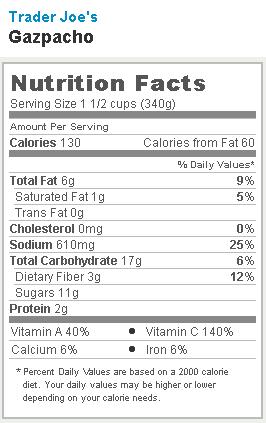
Trader Joe’s Gazpacho – Nutrition Facts
Trader Joe’s Tzatziki
Posted: July 3, 2014 Filed under: Condiments, Cucumber, Dip, Garlic, mint, Spices, Trader Joe's Brand, Yogurt | Tags: 3 stars, dip, greek food, Trader Joe's, tzatziki 1 Comment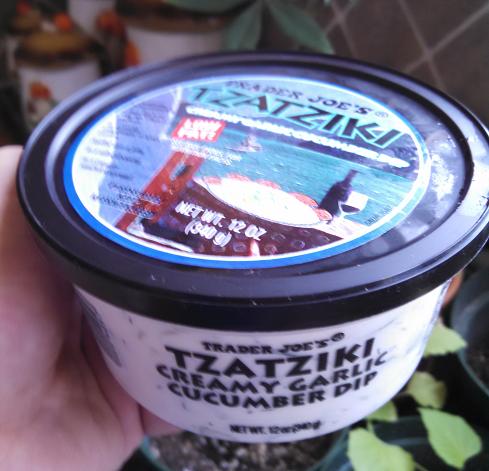
Spackle?
Is it just me, or is the packaging for Trader Joe’s Tzatziki Creamy Garlic Cucumber Dip really weird? The big red “LOW FAT!” flag, the serving suggestions awkwardly crammed over to one side, the semi-unreadable font on the gray background of the low-grade Photoshop job. It reminds me of their weird chocolate-covered banana packaging. It’s the sort of packaging that leaves you wondering what you’re looking at “What’s in there?” you ponder, “Modeling clay? Deck varnish?” Nope, it’s food.
Most of the time, TJ’s does a good job repackaging the third party products that they source. In this case however, even the “Trader Joe’s” brand name looks shoehorned in. Nevertheless, this is a classic case of judging a book by its cover, as the tzatziki sauce within is quite nice.
Let us spend a moment on the truly awesome word that is “tzatziki”. It’s one of those dynamite cuisine words that not only sounds cool, and is spelled cool, but also makes you feel really cool to drop casually into conversation. Like “shwarma”. Throw some tzatziki on that shwarma. Sounds nice doesn’t it? Yo – buddy! Throw some tzatziki on that shwarma! The word itself is popularly attributed to Turkish, but like many foods of shared Greek/Middle Eastern/Balkan origin there’s a considerable amount of bickering over who developed it first/best.
At any rate, as we all know, tzatziki is a somewhat zesty dip/sauce made from plain yogurt and flavored with a variety of seasonings – in this case, salt, garlic, dill, mint, white pepper and, of course, lemon juice. The result is a smooth, cool mixture that comes on mild, then surprises you a moment later with a complex burst of citrus and herbs. Tzatziki exists through out the Mediterranean and Middle East in a variety of forms – extending even as far out as India where the classic yogurt side dish raita can be considered a close relative. The type Trader Joe’s is serving us up here is the familiar Greek variety, prepared with thinly sliced cucumber mixed directly into the herbed yogurt.
In fact, Trader Joe’s tzatziki is one of the better varieties I’ve had. The dip is quite loose, but it doesn’t lack in flavor. 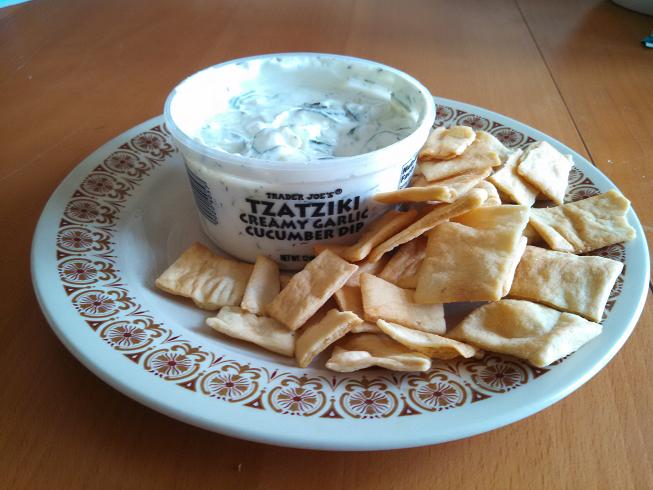 The lemon juice comes through clearly alongside the mellow, long tones of the creamy yogurt. The dill and mint come through clearly in the after notes , but the dish isn’t overloaded by their flavors, and they leave room for the tail note of languid, cool cucumber and mild garlic to linger on the tongue.
As appealing as that is, it’s made better by the extremely reasonable nutritional profile. Each 30 gram (two teaspoon) serving has only 30 calories, and two grams of fat. Even the sodium content isn’t that bad, at 65 mg per serving. For such a healthy dip you’re getting a surprising, and satisfying, amount of flavor.
The go-to applications for tzatziki sauce are gyros and pitas, but it goes awesome with pita chips as well. Even if you’re not whipping up Mediterranean food very often, it still makes an awesome side dish for any meal that could do with a little spread on top, or cooling down on the side. In other words – throw some tzatziki on that shwarma!
The Breakdown
Would I Recommend It: Yes, so long as you don’t mind cucumbers in your food.
Would I Buy It Again: Definitely – I’m always in the market for good dips.
Final Synopsis: A solid version of tzatziki with plenty of pep.
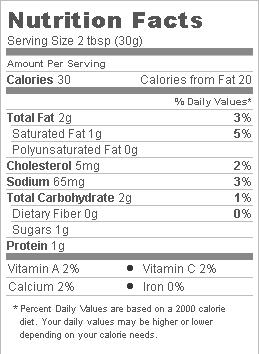
Trader Joe’s Tzatziki Dip – Nutrition Facts
Trader Joe’s Four Uttapam with Coconut Chutney
Posted: June 23, 2014 Filed under: Bread, Onion, Trader Joe's Brand | Tags: 4 stars, indian food, indian pizza, pancakes, tamil cuisine, uttapam 2 Comments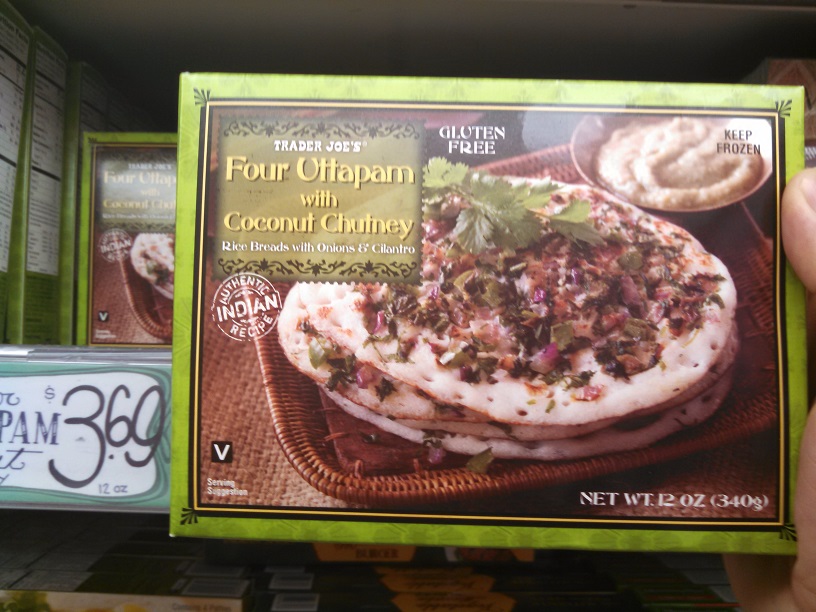
Uttapam! What will those Tamils think of next?
I liked my last taste of East Asian non-traditional savory snack pancakes so much, that I went out this week and tried another one. This time we’re talking about Trader Joe’s Four Uttapam with Coconut Chutney – a South Indian flat bread that’s not only vegan and gluten free, but also down right tasty.
I’ll admit right out that I picked up Trader Joe’s uttapam because reading the package made the language part of my brain have a little spasm. As we’ve seen time and time again, if you put a crazy enough word on your package I basically can’t stop myself from buying your product.
In this case, it turns out that uttapam (U-thap-pam, apparently) are smallish, plain pancake/pizza-like flatbreads from the south of India. Each uttapam is about the size of a bagel (a bit smaller than the Pa Jeon) and topped with a healthy scattering of diced onion, green bell pepper and some subtle cilantro. The taste is a mild, but rich with both the flavor of the vegetables and a dusting of traditional Indian spices.
These veggies are all resting on the uttapam itself, a very specifically Indian sort of bread – both doughy, spongy, and slightly sour. I put bread in “quotes” here because the dough is made from a specific mixture of mashed, fermented rice and black lentils called urad dal, which are not things you typically imagine bread as being made out of. In fact, I’m fairly certain urad dal is one of the locations Frodo and Sam had to pass through on the way to Mordor.
You might think that a bread made from rice and beans would taste wildly different from a standard wheat-based flatbread, but shockingly that isn’t the case. The spongy, soft bread base tastes just as good, as any wheat based flat bread – only due to it’s rice and lentil origin it’s miraculously gluten free.
The bread poofs up nice and soft when cooked, like a soft pillow for the minced vegetables to rest on. You can eat them like this
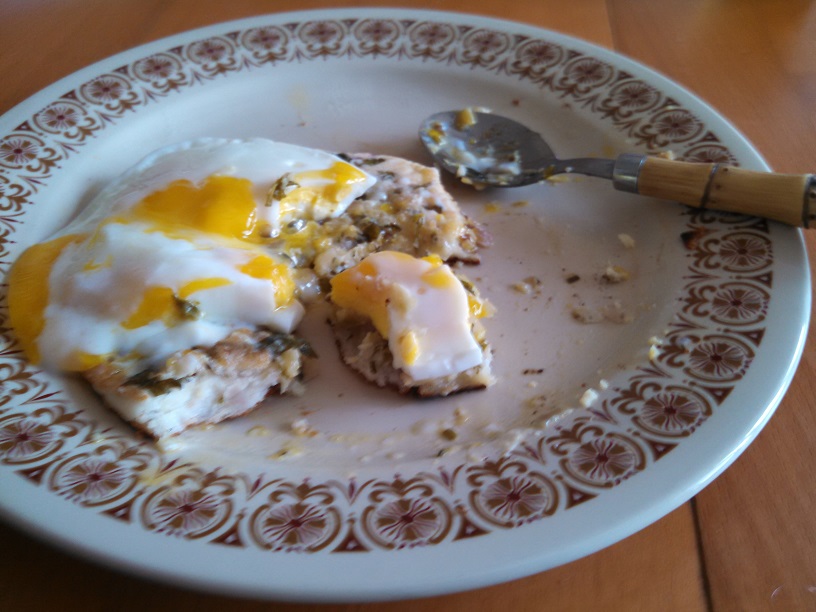
Yeah, Britain – the Indians saw your English Muffins and they weren’t impressed.
directly, or get fancy with some toppings. Trader Joe’s includes a couple little packets of coconut chutney to throw on top, but I’d recommend throwing them out instead. The included chutney is rather weak and lackluster, and doesn’t do much for the subtle flavors already present in the bread. Instead, I’d recommend applying your imagination and topping them with whatever seems good – be that a better chutney you have laying around or some other food entirely. I threw some fried eggs on mine one morning and discovered that uttapam beat the hell out of English Muffins. At $3.69 for a pack of four, you can afford to get a little crazy with them.
Your box of four uttapam comes frozen, and Trader Joe’s offers two suggestions for cooking them – either microwave or stove top. This is no idle consideration, because each method yields a very different final result. Microwaved uttapam (net time required: < 1 min) stay soft and pliable and more pancake-y. Stove top, on the other hand, takes about 4 or 5 minutes per uttapam, but comes off the griddle toasty crisp. Having tried both, I’d recommend the stove top without hesitation – not just because the creators of the uttapam, the Tamils, have a culture of enjoying elaborate and leisurely cooking – but also because the time on the stove really brings out the redolent smells and flavors of the dish.
Really, I have to consider myself a lucky guy – just two weeks ago I couldn’t name you a single tasty, simple, vegetarian/vegan, super-snackable, savory mini-pancake, and now I know two. I’d recommend picking up the uttapam and pa jeon at the same time, and having yourself an Asian Pancake Frolic to go along with the waffle frolics you are enjoying already. At the very least, they could serve as a decent stand in for those still feeling the pain of loss of Arabian Joe’s Spicy Spinach Pizzas.
The Breakdown:
Would I Recommend It: Yup – it’s as tasty as it is worldly.
Would I Buy It Again: I most certainly would.
Final Synopsis: Tasty south Indian flatbread perfect for gluten-eaters and gluten-free alike.
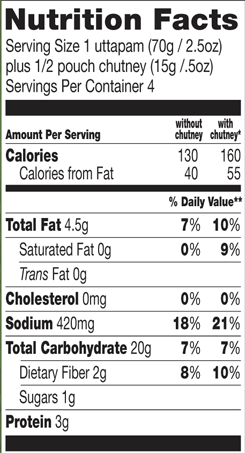
Trader Joe’s Four Uttapam with Coconut Chutney – Nutritional Facts
Trader Joe’s Sukiyaki
Posted: June 19, 2014 Filed under: Meat, Mushrooms, Trader Joe's Brand | Tags: 2 stars, beef, gobo, japanese food, mirin, sake, shitake 2 Comments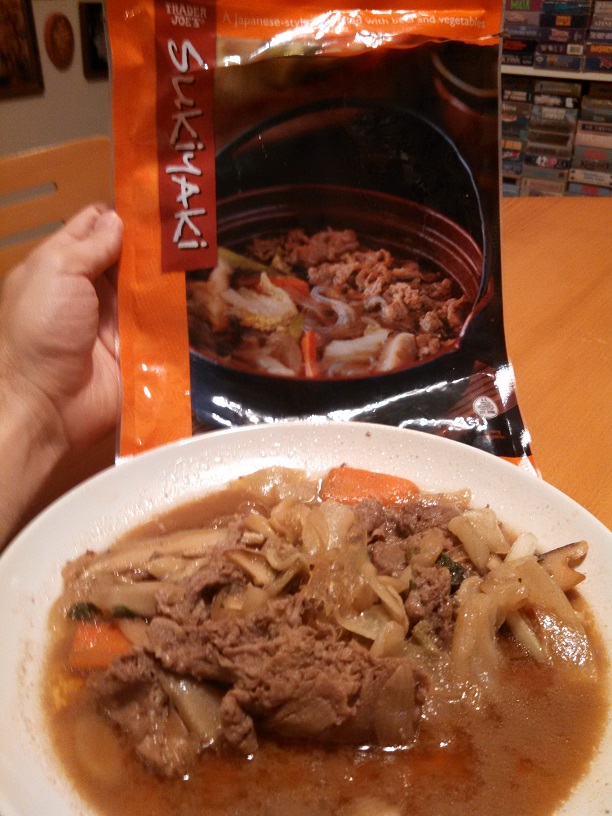
Mmm…look at all that gobo!
I really hope you’ve had sukiyaki before, but if you haven’t, here’s the breakdown. Sukiyaki is a stew like dish, made with thinly sliced beef some noodles and a selection of super Japanese vegetables including Napa cabbage, spring onion (negi), shitake mushrooms and gobo. “Gobo” translates to “burdock root” in English, but unless you’ve actually had burdock root, that probably doesn’t tell you much. Basically, gobo is a long, slender root with a taste part way between carrot and potato, generally eaten after being boiled and shredded.
These ingredients are cooked up bubbling hot in a rich soupy broth made of soy sauce, mirin, and sake. Mirin, being a much sweeter, much less alcoholic form of sake, gives the dish it’s trademark semi-sweet flavor which acts as counterpoint to the savory meatiness of the dish. In short, it’s a hard meal to get right – particularly if you’re trying to figure out a way to flash freeze it, and sell it across the nation for $6.99 a bag.
The word “sukiyaki” is Japanese for “???”. Everyone can agree that “yaki” definitely means “cooked” (as in, teriyaki, teppanyaki, yakitori, etc). It’s the “suki” part that there is no general consensus on. It’s either translated as the noun “shovel”, or as the verb “to make thin”. The verb is explained through reference to the thin slices of meat. The “shovel” claim, on the other hand, is backed up by awkwardly contorted and dubious historical scenarios, one involving a peasant who was so ashamed of his inferior kitchenware that, when a guest showed up at his hut by surprise, he decided to clean off his shovel and cook on that. I hope it’s obvious which translation I prefer to believe.
Even if you haven’t had sukiyaki before, you’ve probably heard the “Sukiyaki Song” at least once. Performed by Kyu Sakamoto, the Japanese Dean Martin, way back in the 1960’s, this happy little ditty rocketed to #1 on the billboard charts in America – a shocking fact given that there isn’t a word of English in the whole song.
Pedants and know-it-alls are quick to point out that the so-called “Sukiyaki Song” actually has nothing to do with sukiyaki at all, and is in fact a heart-rending ballad of a love lost forever saddled with a silly name by savvy American marketers. What these blowhards fail to grasp, however, is that due to the grammatical quirks of Japanese the subject of Kyu’s doleful crooning is never explicitly stated. It’s entirely possible that the love Kyu mourns is, in fact, a really good bowl of sukiyaki that he’ll never have again.
In that light, lines such as “Sadness hides in the shadow of the stars. Sadness hides in the shadow of the moon,” are all the more haunting and resonant.
So how does Trader Joe’s Sukiyaki stack up? Although TJ’s make an admirable effort, their sukiyaki just doesn’t quite cut the mustard. They make their first misstep before you even open the bag. Normally, sukiyaki is made with thick, hearty noodles like udon or chewy “jelly” noodles made of firm konyaku. Not so here – instead Trader Joe’s uses thin, flat, glass noodles made from mung beans. That may sound like a subtle difference, but the result is that the noodles are considerably downplayed in the dish, letting the veggies and meat run wild without a mild counterpart to balance out the stronger flavors.
It’s in those stronger flavors where the sukiyaki really falters. No one was more ready than I to love the hell out of this little dish, but it just doesn’t quite work. The main problem in in the sweetness. Sukiyaki should be sweet enough to intrigue the tongue, but not so sweet that your left grasping for a glass of water. Trader Joe’s Sukiyaki makes exactly this mistake, loading on the sweet mirin (and added sugar) to the point where the sweetness is the primary taste. The beef and sliced veggies certainly make an impression, they just don’t outlast the strong, sweet taste of the sauce.
That brings us to the other problem – the calorie count for this bag of sukiyaki is something to be reckoned with. Each 20 ounce bag is supposed to be broken up into 4 servings. Sadly, if you buy this dish you’ll discover that serving suggestion is a pipe dream. While the helping of meat is generous, there is hardly enough veggies and noodles for two people, let alone four. Sukiyaki is meant to be a standalone dish – or at the very least an entree. Taken at the given proportions, Trader Joe’s is delivering a side soup at best.
That’s not to say this is a bad dish – there’s a lot that Trader Joe’s does well here. The beef and veggies is good quality, and come in a separate bags for ease of defrosting and cooking. There’s a real effort to try and do the whole thing right, and if the flavor palette was reformulated a little bit this would be a killer dish. Until that happens, I’ll just have to walk along, whistling, remembering fonder sukiyakis long gone.
The Breakdown
Would I Recommend It: It’s not bad exactly, but I don’t think I would.
Would I Buy It Again: Sadly, I wouldn’t.
Final Synopsis: A good attempt at sukiyaki that ends up too scant, and too sweet.
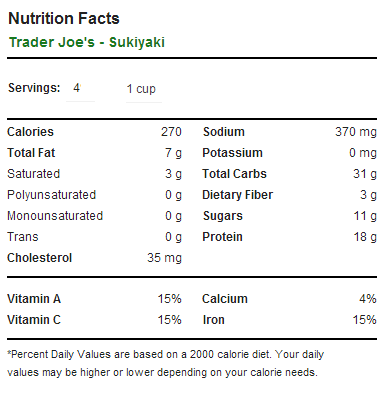
Trader Joe’s Sukiyaki – Nutrition Facts
Trader Joe’s Scallion Pancakes (Pa jeon)
Posted: June 17, 2014 Filed under: Mushrooms, Onion, Trader Joe's Brand, Vegetables | Tags: 4 stars, korean food, pa jeon, pancakes, scallions, trader joe's korean food 4 Comments
Who would have thought scallions and batter would taste so good together?
What? Korea has a sort of dinner pancakes made from more veggies than batter? And Trader Joe’s has brought it to us under the simple, if intriguing, name of Scallion Pancakes? This sort of esoteric awesomeness is exactly what I made this blog for.
What are you, scallion pancakes? What are, as the South Koreans say, pa jeon? I wondered these things as I stood stupid in the frozen food aisle. I tried smelling the bag. No luck there – the strange mystery of scallion pancakes was securely locked inside the cheerful green sack. Was it really just pancakes made with wild green onions? Could that possibly be any good? If pa jeon was a product of, say, Swinton England, I would guess no – but this is a tradition Korean food and I’ve done pretty well by those so far, despite the occasionally debacle, so I was willing to give it the old college try. Was this going to be another Spicy Seaweed Salad or just another dehydrated kimchi? Fortunately, it’s my pleasure to report that Trader Joe’s Scallion Pancakes are totally awesome.
Jeon in Korean (pronounced “jun”) means something like “battered stuff”, while pa means scallions (aka green onions). Pa is by no means the only Jeon out there – the Koreans really went to town on the whole notion. Where Americans were content to put some bananas in their flapjacks then rest on their laurels, the South Koreans diced up basically anything they could get their hands on. While the scallions and batter are usually there, it can come loaded up with any sort of seafood or meat imaginable. Trader Joe’s gives us the most basic version here – plain green onions with a smattering of other vegetables, including leeks and onions plus some carrots and oyster mushrooms.
If pretty much anything can go into a scallion pancake, you might wonder why the Koreans insist on keeping the scallions in there at all. The answer is one, because they are super delicious, and two, because of history. As well as I could dig up, pa jeon owes its existence to a bunch of Koreans that started throwing green onions at retreating Japanese soldiers during one of the numerous Japanese-Korean battles of the the late 16th century. Obviously, that led immediately to people cooking them into pancakes for some reason. There’s no figuring out history folks, it’s just a bunch of crazy stuff like that.
At any rate, scallion pancakes are exactly what they sound like – each bag contains four danish sized “pancakes” made with a wheat and egg batter mixed with, you guessed it, scallions. I put pancake is quotes because the word doesn’t quite do justice to what you’re getting. The shape is approximately that of a nice sized buttermilk flapjack, flat, smooth, rounded and about a ¼ inch thick, but that’s where the resemblance ends. The pa jeon batter is very different from pancake batter. Trader Joe’s uses a mix of wheat flour, corn powder, baking powder, and a touch of egg in their mix, and the result is something more like bread dough than pancake batter – a difference that comes to the fore when you fry them up. Instead of staying light and fluffy, like they are when they come out the bag, the pa jeon become golden and crispy on the stove top. This crispy crunchiness is delightfully toothsome, with a somewhat flaky and pastry-like crunch to the bite.
Once you do throw your scallion pancakes on the stove, get ready for a room filling aroma of mouthwatering proportions. The mixture of onions, leeks, mushrooms and other veggies smells warm, rich and hearty – expect people to be popping their heads in to see what smells so good.
A single glance at these scallion pancakes makes it obvious that they are packed with all sorts of vegetables. What’s more surprising is how much oil is in there as well. Whether you cook these up in a frying pan or in the oven, you’ll notice the pool of oil that forms around each cake. With 7 grams of fat in each pancake and 21 grams of carbs, these are more savory appetizer than health food. On the other hand, with only 160 calories in each pancake, and so much vegetable filler, you can fret the guilt off pretty quickly.
A final note – although Trader Joe’s doesn’t mention it on the bag, you’ll want to eat the scallion pancakes with a traditional dipping sauce of some kind. The most basic type (which worked well for me) is just to mix up a little bit of soy sauce and white (or rice) vinegar. If you’re looking for a fancier sauce recipe, you can try this rather complex one http://www.trifood.com/pajeon.asp.
The Breakdown
Would I Recommend Them: If you’ve never tried a savory pancake before, you should try these.
Would I Buy Them Again: Yes indeed – these make great snacks/appetizers/sides.
Final synopsis: Crispy, scallion filled pancakes that prove the Koreans know what they’re doing in the kitchen.
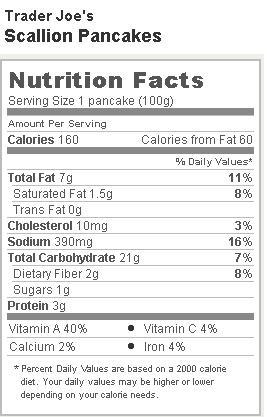
Trader Joe’s Scallion Pancakes – Nutrition Facts
Trader Joe’s Toasted Pumpkin Seed Oil
Posted: May 29, 2014 Filed under: Condiments, Dip, Pumpkin, Trader Joe's Brand, Vegetables | Tags: 2 stars, pumpkin seed oil, toasted pumpkin seed oil, vegetable oil 10 Comments
Foreground: Toasted pumpkin seed oil; Midground: Toasted pumpkin seed oil can w. bread; Background: My table
Trader Joe’s Toasted Pumpkin Seed Oil sounds interesting, looks off-putting and costs $9.99 a can. Maybe you’re intrigued by it – but can you really justify such a purchase? If you write a blog where that’s your only function you can!
Let me save you some time, and ten bucks, right now. This oil is not worth your hard earned cash, but before I start maligning it, let’s talk about what Toasted Pumpkin Seed Oil is in the first place.
Toasted pumpkin seed oil owes its entire, modern day existence to the region Styria in south east Austria. Styria is probably most famous for being the home of 2004’s Nobel Prize in Literature winner Elfriede Jelinek. If for some reason you’re unfamiliar with Jelinek’s musical use of voices and counter voices in such important works as The Piano Teacher, then I should probably mention that Sytria is also the birthplace of Arnold Schwarzenegger.
At any rate, toasted pumpkin seed oil is, as Trader Joe’s puts it, “a distinct culinary specialty in Styria”. The fact of that matter is, that’s a gross understatement. The pumpkin as we know it is a New World crop – with no existence in Europe until Chrisopher Columbus brought some back with him from his exotic expeditions. The famous orange gourd spread to Austria where, in the 1600’s, someone got the bright idea to roast the pumpkin seeds then, instead of eating them like a barbaric ape, run them through a press and collect the intensely dark green/brown oil that dribbled out. It was an instant hit.
Such a hit, in fact, that the Empress of Austria felt compelled to ban the stuff in 1773 out of fear that people were guzzling it all up. The edict stated: “This healthy oil is unique and much too precious for using it in tasty meals and therefore should rather be used as a medicine. So it shall not be used as a culinary delicacy anymore but shall be collected and distributed only by the apothecaries.”
The medicinal qualities of the oil being somewhat dubious, it eventually returned to general use in Austria where it is generally consumed in one of three common ways: as a simple salad dressing, as a dip for bread or, strangely, as a condiment for vanilla ice cream. What it absolutely cannot be used for is cooking. Trader Joe’s even warns you against this right on the can, and I quote: “Don’t use it for cooking as it burns easily.”
Given all that, plus the high price tag, plus the strange and enigmatic can, you’re bound to assume this is some dynamite stuff, right?
Unfortunately, as much as I wanted to love this obscure oil, I was totally nonplussed by it. The big selling point of the pumpkin seed oil is its “intense nutty flavor”. And it certainly is true that the oil has a strong nutty taste – but it also tastes an awful lot like slightly burnt pumpkin seeds. Stronger, and longer lingering, than the nutty taste is this slightly charred taste, and of course the very pumpkin-y flavor of the pepitas.
On paper that still sounds like it should be reasonably good, but in reality it was very flat, and somewhat bland. Feeling certain that I must be wrong, I conducted an informal tasting panel with the oil and some of Trader Joe’s fine artisanal bread. All four voices found the same as myself – the oil is okay, but there’s nothing particularly winning about it. As one taste tester put it – it’s fine, I’d eat it if I had it in front of me, but I’d never request it. When you’re trying to sell 250ml of oil for ten bucks, that’s quite the damning review.
I’ll wrap this up on two final thoughts. The first, and most perplexing, is why Trader Joe’s didn’t wait until their annual Pumpkin Madness in October to trot out this product. It really doesn’t seem to have enough value to stand on it’s own, but it would have looked wonderful next to the pumpkin cider and pumpkin trees.
Second, my favorite thing about the oil was it’s color. The TJ’s product copy calls it “eerily dark green”, and while that’s about right it’d actually be more accurate to say it’s “eerily dichromatic”. When you pour this oil onto a white plate, it’s a thick blackish red, almost like a balsamic vinegar. When spread out thin, however, it becomes an intense spring green. That may not be enough to win me over, but it is pretty cool.
Really, the main issue here is that Trader Joe’s Toasted Pumpkin Seed Oil doesn’t exist in a vacuum. As far as bread dips and salad dressings go, it’s alright but I’d go for some nice olive oil of this stuff every time. At least I can cook with the olive oil. If it wanted a little extra nuttiness I’d pick up some dukkah as well.
Like the Himalyan Salt with Truffles before it, Trader Joe’s Toasted Pumpkin Seed Oil might make a good gift for your gourmand buddy, but that’s about it. It’s not that the oil is without value, it’s just not worth the price of admission.
The Breakdown
Would I Recommend It: Not unless they drop the price.
Would I Buy It Again: No, I already have more than I need.
Final Synopsis: A nutty specialty oil that costs more than it’s worth.
Trader Joe’s Watermelon Cucumber Cooler
Posted: May 13, 2014 Filed under: Cucumber, Drinks, Juice, Watermelon | Tags: 3 stars, cucumber water, Juice, watermelon 8 Comments
Ah, luminous pink – the color of summertime refreshment!
Trader Joe’s Watermelon Cucumber Cooler is one of those surprising products that doesn’t quite seem to fit at Trader Joe’s. Do-it-yourself fusion sushi? Sure. Popcorn seasoned with brown butter and french herbs? Why not. But a watermelon cooler? A summery, watermelon drink called a “cooler”. That seems oddly plebeian on the shelves next to Trader Joe’s French Market Sparkling French Berry Lemonade, and Trader Joe’s Italian Blood Orange Soda.
As much as I like Trader Joe’s, my blue collar roots sometimes rebel at the rather fancy image Joe likes to cultivate for himself. It’s a bit of a relief to see them throw the word “cooler” around on a relaxed summer drink – much in the tradition of Cactus Cooler and HI-C’s long mourned Ecto-Cooler. That may sound like I’m trying to damning this product with faint praise, but I mean it genuinely. Whether it’s pink lemonade or cherry coke, summer is the time for unnatural sugary drinks to bring out the kid in us. It’s the time for pretensions to fall to the way side and kick back with a nickle glass of Kool-aid and a slice of watermelon.
It’s in that very spirit that Trader Joe’s has given us this Watermelon Cucumber Cooler – a jug of refreshing, sweet and tasty juice flavored beverage. There’s not much to dislike with this beverage. What you see is what you get. Pour yourself a cool cup and you’ll taste exactly what it promises on the side, a sugar-sweetened, watermelon-flavored drink with the cool aftertaste of cucumbers.
I’m actually a fan of cucumbers in water. There’s something about the long, mellow aftertaste of a chilled cucumber that seems to slake the thirst as much as the water itself. The unsweetened cucucumber presence in this drink makes for an elegant grace note to what could have easily been one more too-sugary fruit drink. The Watermelon Cucumber Cooler strikes a balance closer to the unsweetened end of the drink spectrum than the overly sweet end. That makes it a rare participant in the summer drink wars – a beverage that satisfies the sweet tooth, quenches the thirst, refreshes with cucumber, and goes easy on the sugar.
Pairing watermelon off with cucumber in the first place might seem like a random choice – but not so random as it sounds. Both watermelon and cucumber are close cousins in the plant kindgom, siblings of the Family Cucurbitaceae, known generically, along with gourds and such, as curbits. This familial association makes for a fine flavor pairing, with the strong watermelon flavor blending seamlessly into the more understated cucumber, leaving you uncertain as to where the one taste ends and the other begins. Shine on you crazy curbits!
Sure, there’s still 23 grams of sugar per glass, but at least it’s from organic sugar and watermelon juice and not high fructose corn syrup. It’s not a health drink by any stretch of the imagination, just a fresh and refreshing take on the summer drink scene. If you’re not on the bad wagon with cucumber water to begin with, there may not be much here for you. If, on the other hand, you like cucumber water or have simply never tried it, I’d recommend this drink to quench your summer thirst.
The Breakdown
Would I Recommend It: Yes – as long as you’re okay with the flavor of cucumbers.
Would I Buy It Again: I’ll pick one up the next time I head down to the beach.
Final Synopsis: A refreshing, sweet-but-not-too-sweet summertime libation.

Trader Joe’s Watermelon Cucumber Cooler – Nutrition Facts
Trader Joe’s Carrot and Cilantro Bulgur Grain Salad with Tumeric Garbanzo Beans
Posted: May 8, 2014 Filed under: Carrots, Chickpeas, Salad, Trader Joe's Brand | Tags: bulgur, garbanzo beans, grain salad, Salad, three stars, tumeric Leave a commentI may occasionally give Trader Joe’s a real tongue lashing, like I felt compelled to do the other day with their strange and terrible pseudo-salad, but only when the really deserve it, and in any case I like to try and give TJ’s the chance to settle the score. In that spirit, I went out and picked up Trader Joe’s Carrot and Cilantro Bulgur Grain Salad with Tumeric Garbanzo Beans.
As you might gather from the picture, or the long, strange name, this is another entry in Trader Joe’s new line of little grain-salads-in-a-tub, and close cousin to Trader Joe’s underwhelming Nutty Grain Salad. Surely TJ’s wouldn’t have released two, tiny, grain-based salads unless they had damn good reason to think people would actually enjoy them. They couldn’t both be as bad as the first one I tried, right?
The fact of the matter is that Trader Joe;s Carrot and Cilantro Bulgur Grain Salad is miles better than it’s counterpart in both taste and nutritional content, and I was glad I picked it up. That said, it’s every bit as twisted and insane as the Nutty Grain salad, just on a different axis.
The main thing you’ll probably notice when you pick this salad up is how it is topped with bright yellow chickpeas. Oh, great, you might think – Curry, that’s brilliant. I bet curry could taste really good on a salad like this.
Only it’s not curry, it’s just tumeric. All the other rich and exotic spices that give curry it’s magical kick – the cardamom, the cumin, the garam masala in general, aren’t present. Just musty old tumeric – wonderful for color, but dull and dusty when it comes to taste. In fact, given the overall taste of the salad the garbanzo beans are a total non-sequiter. I went into this bulgur salad expecting it to taste something like Trader Joe’s Vegetable and Country Grain Salad – one of my all-time favorite TJ’s salads, and place holder on my Best of 2013 list. Instead of the nutty and mellow tastes of that salad, or something that would work well with tumeric, we get the strong flavor of orange juice. Yes, orange juice is the primary flavoring agent in this salad and I swear to god that you can taste it in every bite. This whole salad is infused with the strong zing of not just citrus, but real oranges, real oranges and a hint tumeric.
It’s incredible. Taken back to back with the Nutty Grain salad, it feels like Trader Joe’s has started to curate a small selection of recipes broadcast to it from a parallel universe several degrees separate from our own. “Mmm-boy! Serve me another plate of cooked bulgur and a tall galss of orange juice!” demand the insect-headed denizens of that universe before scuttling off to work in their cities beneath the sea.
The other flavors you’ll experience with this salad are the slightly nutty taste of the bulgur, and the strong, lingering taste of carrots. Surprisingly, the cilantro that gets top billing in the product name is only present as a subtle background touch, emerging mid chew, then vanishing again without a trace.
All in all, this salad tastes more like an orange/carrot juice drink than anything else. In salad form, that makes for a very strange eating experience but not necessarily a bad one. Once I got used to the fact of the thing, I happily munched this salad up. There’s enough texture and chewiness to the dish that it lasts you a surprisingly long time for only eight ounces, and the orange and carrot flavor works together, if not perfectly, than well enough.
The other nice difference between this salad and the Nutty Grain salad is that it has a much more reasonable calorie count. There are only 240 calories per serving, and only a slender 10 calories from fat. There is still a considerable 54 grams load of carbs in the tub, but that’s too be expected from so much grain, and it’s ameliorated somewhat by the 9 grams of fiber in it as well.
Overall, it might be the most unusual salad I’ve ever had – even stranger than the Korean Spicy Seaweed Salad – but isn’t that what we go to Trader Joe’s for? Whether it sort of work out, like today, or misses entirely, like with the Nutty Grain salad, I have to take my hat off to Mr. Joe if for nothing more than his boldness of vision.
The Breakdown
Would I Recommend It: Not to the populous at large. This is a unique salad with an unusual taste.
Would I Buy It Again: I don’t think so. It was okay, just not good enough to justify repeat purchases.
Final Synopsis: A small, bulgur salad flavored with orange juice.
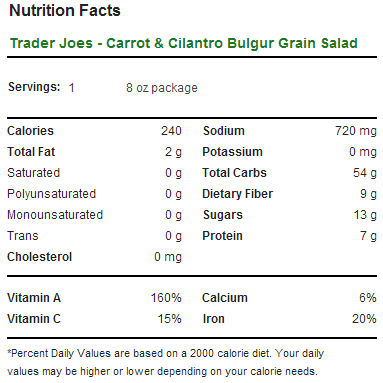
Trader Joe’s Carrot and Cilantro Bulgur Grain Salad – Nutrition Facts
Trader Joe’s Nutty Grain Salad
Posted: May 6, 2014 Filed under: Carrots, edamame, Nuts, Quinoa, Salad, Trader Joe's Brand | Tags: 1 star, Edamame, grain salads, peanuts, Pistachios, quinoa, spelt, Trader Joe's Brand 5 Comments
I don’t have anything to say about Trader Joe’s Nutty Grain Salad that isn’t short and nasty, so I suppose I’d better just get to it. Trader Joe’s should have called this Trader Joe’s Crappy Peanut Bean Thing. Instead they try and tell me it’s a salad and put it next to the good stuff.
Saying that this salad tastes as bad as it looks is not entirely accurate. Obviously, it looks terrible. I’m not sure I’ve seen a mass of soy beans, peanuts, pistachios chunked carrots, and cooked spelt that looks worse than this – and I’m including vomit in that. At least vomit has the effluvium of stomach bile to cloak it’s terrible, true nature. This stuff just sits there in the open, daring you to stare directly its clusters and lumps. Go ahead and try it – see if you can last longer than five seconds, I can’t.
So to say it’s as bad as it looks is implying that it tastes atrocious, which it doesn’t. It tastes worse than that – it tastes bland. There are foods out there that I think look and taste awful which whole cultures have passionate loves for. You’re not really a country, I reckon, unless you have at least one national dish that no one else in the world can stomach. The English have Vegemite, the Scotts have hummus, the Japanese have natto, the Americans have Kraft Singles, etc. What I’m trying to say is, taste is relative, and really intense flavors may alternately repulse and delight, depending on the eater.
Trader Joe’s Nutty Grain Salad, on the other hand, is simply bland and uninteresting. The packaging claims that it is dressed with a soy ginger sauce. This is technically true, but the dressing is present in such cowardly quantities that it contributes almost nothing to the taste, beside rendering the whole mess somewhat squishy. The primary flavor you’ll experience is “soggy nuts”. There’s some nutty tasting quinoa, some peanuts and pistachios. Next to that, the edamame, spelt and carrots don’t really show up much, and when they do it’s only to add an additional dimension of blandness to the whole affair.
I could go on and on about how upset I am at this tiny little tub, but the bulk of my ire is actually reserved for the nutrition labels. Go ahead and flip this tub over, but first set your faces to “stunned”.
Serving size, 1 package. Sure, that seems reasonable. What else. Calories: 590, Calories from fat: 290.
Trader Joe’s, ARE YOU TRIPPIN’, BRO?!?! These numbers are absurd – and the madness goes on. 45% of your daily fat value, 350mg of sodium, 68 grams of carbs.
So essentially, what we have is a tiny little tub of stuff that looks gross, tastes like a more mild version of unsalted peanuts, and contains as much fat as a Big Mac only with more calories. It’s like Trader Joe’s figured out how to remove all the fun and enjoyment from eating fast food. There are entire galaxies of more delicious, healthful and fun meal options out there – many of them right there in the Trader Joe’s salad aisle. Unless you are in desperate need of compact, high calorie food sources (sumo wrestlers, long distance bomber pilots, roving apocalypse survivors) why you would want to go for this instead of literally anything else is beyond me.
The Breakdown
Would I Recommend It: No, not unless you needed the final component for a robot powered by hate.
Would I Buy It Again: Only as a tip off to my loved ones that I’m secretly being coerced by kidnappers.
Final Synopsis: A bland, gross looking pseudo-salad that is bad for you.
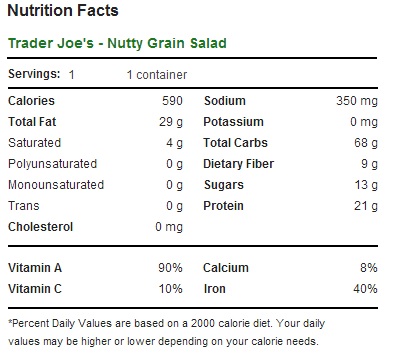
Trader Joe’s Nutty Grain Salad – Nutrition Facts
Trader Joe’s Reduced Guilt Chunky Guacamole
Posted: April 24, 2014 Filed under: Avocado, Condiments, Dip, Trader Joe's Brand, Vegetables | Tags: 2 stars, guacamole, low fat gucamole, trader joe's guacamole 3 Comments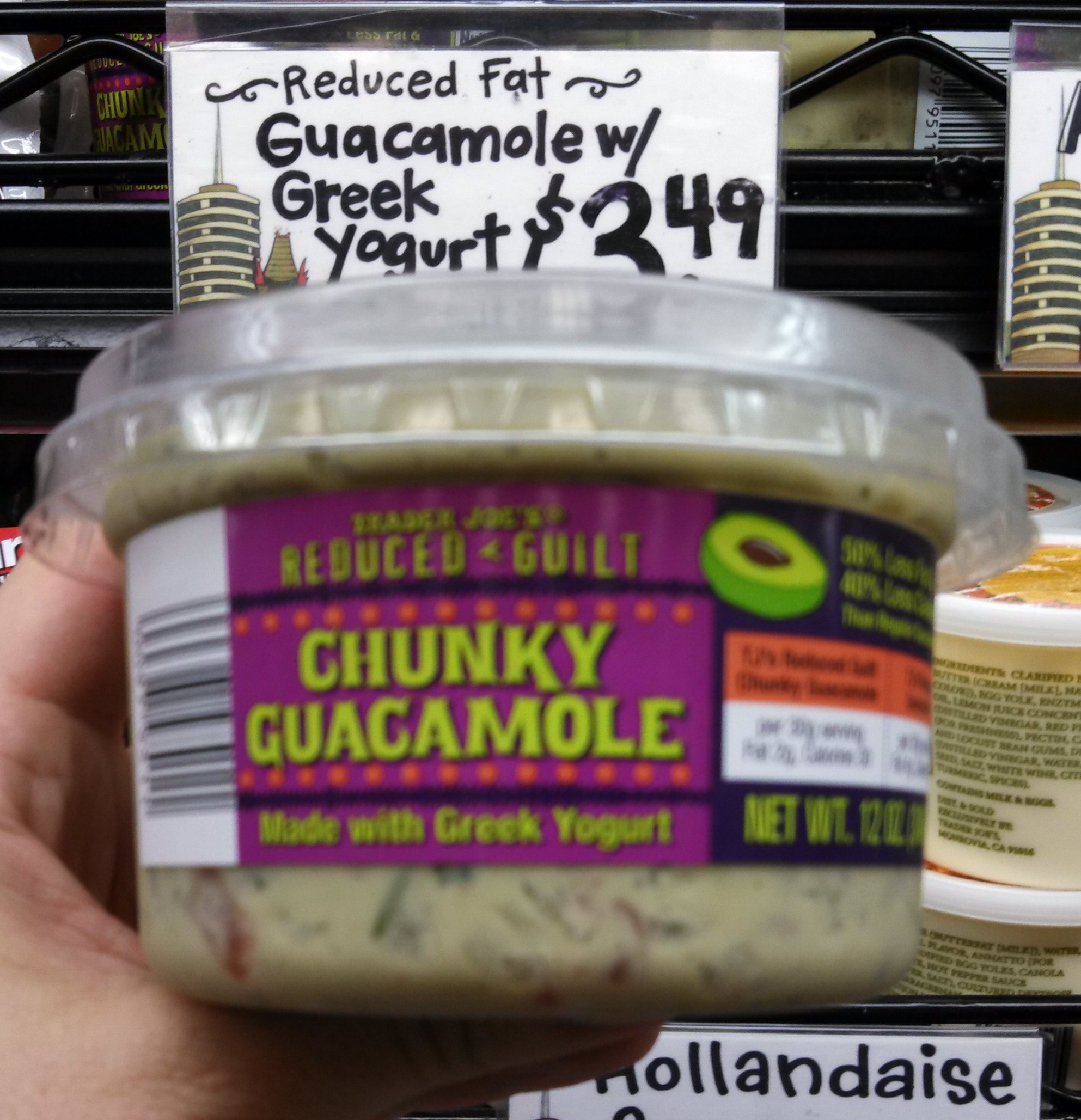
A guacamole that’s as Greek as it is Hispanic.
“Reduced Guilt”, as in Trader Joe’s Reduced Guilt Chunky Guacamole, is one of those phrases that are a little too marketing-y for me. What does that really mean, “reduced-guilt”? We all just want to enjoy ourselves in life, right? If you’re like me, that means repressing and/or ignoring the constant nagging feeling of guilt that would otherwise hound you at all moments, threatening to drag you down the muddy hill of self-loathing into the murky bogs of depression. Free-floating guilt, we all got it – do we really need Trader Joe insinuating it into our lives even here, in the vegetable aisle?
Here I was, in danger of feeling pretty good about myself for a moment, putting a bag of shredded carrots into my cart, making positive decisions and following a healthy path! Except, oh man, there’s the Reduced-Guilt Guacamole. “Reduced-guilt” because consuming calories induce guilt, and guacamole has a lot of them. Ergo, eating this guacamole means I don’t have to feel as bad about myself. Hooray!
Except, wait – doesn’t everything have calories? Even my bag of carrot shreds? And I have to eat calories to live… but eating calories induce guilt… and, oh no, I’m never going to win ever am I? Sure, I can reduce guilt – but never eliminate it. Never escape the inherent guilt of calories. Never escape the vicious cycle of consumption and loss until, at last, death claims me. And there I am again, down in the bogs of depression.
Thanks a lot Trader Joe’s.
Assuming you made it this far in this post, or have a healthier sense of self-worth than I do, you’re probably wondering a couple things about this guacamole. For one, you’re probably wondering if “reduced guilt” in this case is actually a synonym for “bad tasting”. Unfortunately, the answer is yes. That said, I feel we have to judge these sort of “healthy option” food products on a curve.
We all know that the healthy option isn’t going to taste as good as the real, full calorie, thing. The question is, does the healthy option hit that sweet spot of tasting good enough for how few calories it has? A little while ago we saw Trader Joe’s Fat Free Brownies undergo this test. Trader Joe’s Reduced Guilt Chunky Guacamole does a little better, not because it tastes all that good, but because it’s a really damn healthy option. Each 1 oz serving of this guacamole contains only 30 calories and 2 grams of fat. That’s 40% fewer calories, and 50% less fat than Trader Joe’s Avacado’s Number Guacamole.
With half the calories, does that mean it only tastes half as good? Yes, actually – that’s a pretty good description of this stuff. This low fat version of guacamole definitely lacks the full-bodied flavor and punch of a regular guac.
When you take a dip of it, it starts to taste good but then stops about half way, leaving a vague sense of dissatisfaction. On the other hand, it manages to match the creaminess of regular guac and is just as filling to snack on. That’s not bad for a diet food, where managing to come out even is practically a win.
To put it another way, for a low calorie dip this stuff is pretty good, but for guacamole it doesn’t really pass snuff. A big part of that is because you’re only getting about half as much avocado as usual in your guacamole. The rest is made up for by non-fat greek yogurt. I can only imagine that this non-traditional ingredient is the main reason this guacamole doesn’t get the traditional “Trader Jose’s” appellation.
Part of me wants to praise Trader Joe’s for going out there and making a healthy guacamole alternative. However, I can’t help but think it’s all rather pointless. After all, guacamole’s only really good with chips – and there’s nothing remotely diet friendly about a bunch of tortilla chips. Yes, I suppose you could eat this with some celery sticks or such, but in that case wouldn’t you be much better off with some low-fat ranch dressing instead? Even Trader Joe’s Veggie Chip Potato Snacks and crunchy lentil curls aren’t quite so healthy enough that the diet conscious could feel free to go out and eat a big handful.
In the end, I guess Trader Joe’s is true to their word – you get a guacamole that reduces your guilt, but doesn’t absolve it.
The Breakdown
Would I Recommend It: Not really. It’s fine for a healthy dip, but there aren’t a lot of healthy ways to enjoy it.
Would I Buy It Again: No, I think I’ll stick to the real stuff.
Final Synopsis: A low calorie guacamole with half the calories and about half the taste.
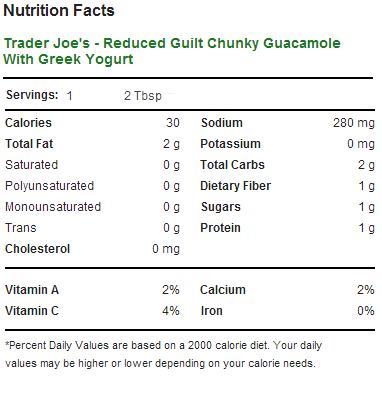
Trader Joe’s Reduced Guilt Guacamole – Nutrition Facts
 Eating At Joes
Recent Comments