
Trader Joe’s Sai Tung Green Curry and Red Gaba Rice
Posted: June 26, 2014 Filed under: Coconut, Frozen Food, Trader Joe's Brand | Tags: 3 stars, coconut curry, green curry, red rice, sprouted rice, thai curry 1 Comment
Yes, this curry really has banana flowers and morning glories in it. My god, they’re mad geniuses!
Before I get started on all the ins and outs of Trader Joe’s Sai Tung Green Curry and Red Gaba Rice, I should admit right out the gate that I’m not a huge curry fan. Somehow, I always manage to forget this. “Alright!” I commonly exclaim, “Curry! I love curry!” Then I start eating and I remember that, oh yeah, no I don’t.
The problem is, I think, that at some point my brain got all scrambled up about what curry really is. What I like is Japanese curry, and Japanese curry, like Japanese game shows, is unusual and fascinating.
If you’ve ever had Japanese curry, you know that it’s more like a thick brown gravy than a traditional South East Asian curries. Generally it comes from a rue, and nothing really goes in it except maybe some sliced up carrots and potatoes and maybe an onion. Certainly not coconut cream, one of the most common elements of Asian curries, and never anything like morning glory, young coconut shoots, or banana flowers as in Trader Joe’s Thai curry here.I love the hell out of wacky Japanese curry – the real stuff, on the other hand, I’m still getting used to.
The other thing I love about Japanese curry, as long as were on the subject, is how it’s represented in Japan as a non-Japanese food. Without a doubt, no one but the Japanese are making curry in this very particularly Japanese way, but for some reason every package of Japanese curry mix is emblazoned with images of tropical isles , swamis, or Vermont. It’s very perplexing. Presumably the Japanese imagine people in Vermont are always serving each other big plates of Japanese curry all the time – much the same way I imagine people in Vermont are always wearing sweaters and strolling through orchards.
At any rate – Trader Joe’s Sai Tung Green Curry and Red Gaba Rice is certainly not that. Instead, it’s a rather nice coconut green curry packed into a frozen TV dinner. Trader Joe’s has really gone all out on trying for authenticity here. Take a look at your green curry – what do you have in it. Looks like some bamboo shoots, spinach, and maybe some onion? Ha, no. Try young coconut shoots, banana flowers and morning glory. That’s not just an ingredient list, that’s a line of free form poetry. Obviously these three intriguing ingredients bring their own unique tastes to the meal, but you’ll have a hard time picking any of them out seeing as how they’re slathered in a typically strong tasting curry. What you will notice are the interesting textures they lend – crisp, firm and stringy, respectively. It’s an elegant touch to bring these rare produce to America’s shores, and give the whole dish a feeling of being truly exotic. The spice is there as well. While the whole curry could probably be classified as “Mild Plus”, there is no shortage of piquant and interesting spices to light up your tongue.
While “sai tung” means “take out” in Thai, a phrase commonly bantered about by food vendors on the street of Bangkok, don’t go searching your Thai dictionary for “gaba”. The “Red Gaba Rice” mentioned on the box should actually be “Red GABA Rice”, as in the amino acid chain GABA, aka “gamma-aminobutyric acid”.
The more conventional name for “Gaba rice” is germinated brown rice – unpolished brown rice grains that are allowed to germinate and sprout, in this case for up to 48 hours, before cooking. Germinating your rice is a clever way to increase the nutrients in it, in particular the above mentioned GABA, which in turn gives your rice a better protein profile. You can see that in the Nutrition Facts box – despite being a vegan dish, this curry has 10 grams of protein in it. Of course, it also has 70 grams of carbs, but that’s just the way it goes.
The other effect of letting your rice germinate is that the texture changes. You’ll notice that the rice here is considerably chewier than regular steamed rice. Partnered with a saucy curry like it is here, that’s a welcome feature as it lends more body and substance to an otherwise quite basic meal.
Having disclosed by curry bias, I feel I can admit that I wasn’t in love with this curry. Trader Joe’s has a few really really amazing quick and easy frozen dinners (like this one, and this one). This curry was a nice change of pace, but I wasn’t addicted to it. Of course, I fully expect to hear a dissenting voice from some die-hard fans in the comments on this, and I certainly hope I do.
There’s a lot to love here, especially for vegans and vegetarians seeking cuisine options, fans of authentic Thai, or anyone looking for a good dinner that only costs $2.99. Now if only TJ’s could put a picture of Delaware on it they might win me over.
The Breakdown
Would I Recommend It: Yes, this is a classy bit of Thai curry.
Would I Buy It Again: No, but I’m not a big green curry fan.
Final Synopsis: Authentic Thai curry, done cheap and quick.
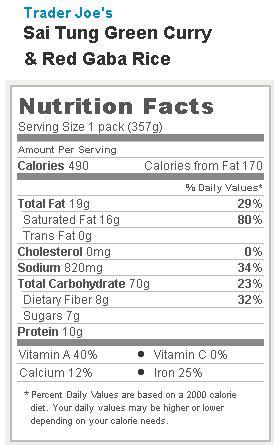
Trader Joe’s Sai Tung Green Curry and Red Gaba Rice – Nutrition Facts
Trader Joe’s Soy Yogurt – Strawberry and Peach Flavors
Posted: June 10, 2014 Filed under: Peach, Strawberry, Trader Joe's Brand, Yogurt | Tags: 3 stars, Gluten-Free, Organic, peach, soy yogurt, strawberry, trader joe's yogurt, Vegan 8 Comments
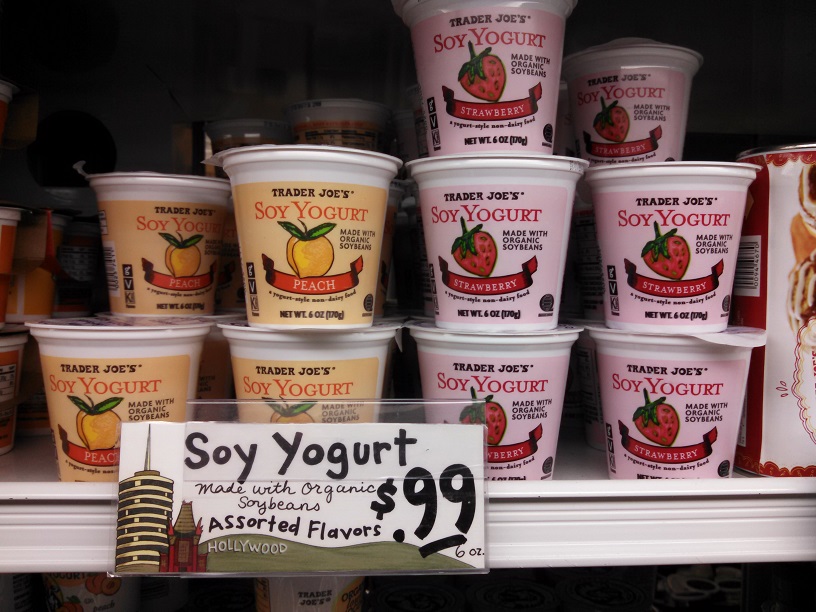
It’s amazing that you can get so much sugar in something for such a low price.
The cavalcade of gluten free, vegan food continues! My stars, but aren’t we having fun? Trader Joe’s Soy Yogurt is yet another entry in their huge wall of yogurt variations. This one leaped out at me in particular for it’s soy nature. After having such a good time with the non-ice cream, Soy Creamy, it seemed like a natural follow up. The results were similar – tasty, if you’re willing to accept a certain level of soy bean aftertaste.
You may have noticed that I review a fair number of yogurts. The rather mundane reason is that I habitually have one for breakfast, Monday through Friday, and have done since before I can remember.
In fact, my yogurt habit is rather more than habitual. A not insignificant part of my life is run off of what I like to call the “yogurt clock”. As the most modular food in my diet, I use the yogurt clock as a fail safe to remind my stupid bachelor self that I have to go buy more food on a regular basis. Every time I go to Trader Joe’s, I buy six yogurts. I eat one yogurt a day, Mon – Fri, and when I run out I go shopping again. The extra, sixth yogurt is my emergency back up yogurt so if a friend asks if they can have a yogurt, I don’t have to say, “No, those yogurts are a precision instrument, and only I can eat them.” This situation has never actually occurred, but I’m ready for it.
Planning out a good shopping trip, given the crazy state of life that is modern city living, is more than a trivial consideration, requiring numerous harrowing encounters with all sorts of biological and mechanical foes. As such, the steady, daily ticking of my yogurt clock is probably the third or fourth most important consideration in my daily life – below the internet and my girlfriend, but above the car.
That brings me back, more or less, to Trader Joe’s Soy Yogurt. A yogurt that, like so much vegan food, is not legally a yogurt. Trader Joe’s is forced to concede this point several times on the packaging with the subtitle, “a yougurt-style non-dairy food”.
The last yogurt I reviewed from TJ’s, the European-style chocolate-infused yogurts, we’re strikingly off-putting in their zesty taste. There’s no such non-American trickery at play here. Despite the fact that no milk has ever gone into this soy yogurt, it tastes very very similar to your ordinary Dannon or Yoplait.
The yogurt is smooth and thick, with a heavy “whipped” style texture and nice bits of chopped up fruit in it. It’s a remarkably close approximation to ordinary, dairy based yogurt, and at first bite you’d never suspect it’s vegan. Both types of the yogurt are also very sweet – too sweet for me in fact. The peach yogurt has 18 grams of sugar per serving, while the strawberry version has a considerable 21 grams of sugar in it – the equivalent of 6-7 packets of sugar in each yogurt. Considering that you can polish off a yogurt in about 6-7 spoonfuls, that’s a serious sugar load for first thing in the morning. While this amount of sugar is certainly not unusual in the super sweet world of grocery store yogurt, it’s more than I like to eat over breakfast.
The other consideration, as I hinted at above, is the soy bean-y aftertaste you can expect. Trader Joe’s does their best to keep this under control, but once you’ve finished one of one of these pots you won’t have any doubts that you’ve just had some soy beans. The soy aftertaste is still mild, a gentle graininess of beans on the tongue, but slightly stronger than the Soy Creamy aftertaste. It certainly wasn’t enough to ruin the overall tastiness of the yogurt, but as a guy used to dairy it did give me pause from time to time.
Even if I was dedicated to the vegan lifestyle, I probably wouldn’t replace my yogurt clock with Trader Joe’s Soy Yogurt. Though tasty, there’s just too much sugar in guys to eat on a daily basis. I’d much rather swap in fruit or something else a little better for me. The yogurt is a fine and tasty treat, just not a particularly healthy one.
The Breakdown
Would I Recommend Them: Yes to vegans, but not in general.
Would I Buy Them Again: No, they’re too sweet for me.
Final Synopsis: A good yogurt, and a great vegan option, as long as you don’t mind a lot of sugar.

Trader Joe’s Soy Yogurt – Nutrition Facts
Trader Joe’s Cypriot Pyramid Salt
Posted: June 5, 2014 Filed under: Salt, Spices, Trader Joe's Brand | Tags: 3 stars, cyprus, finishing salt, pyramid salt, salt, trader joe's salt 8 Comments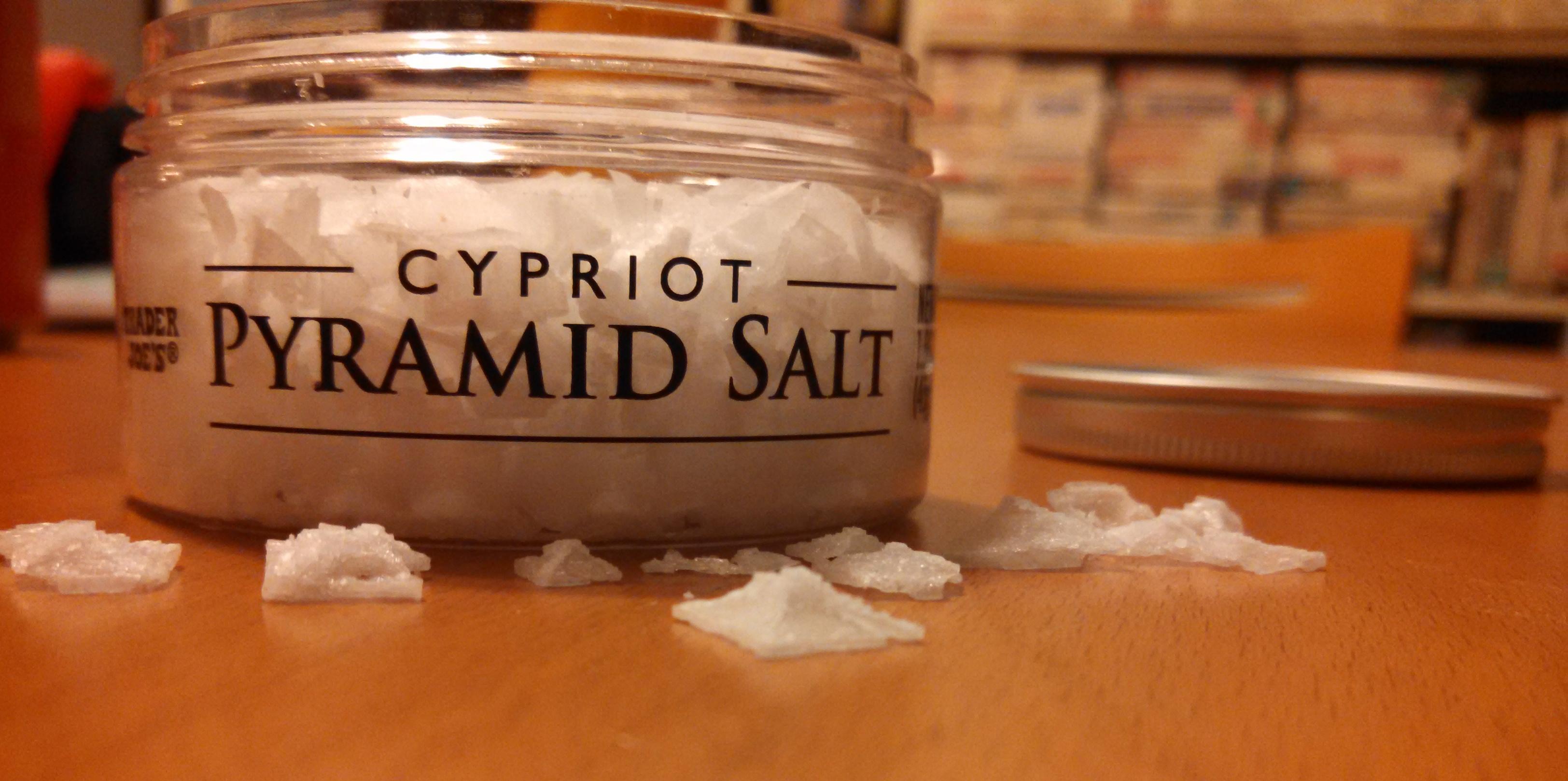
A product name that is both self evident, and maddeningly confusing.
Holy crap guys, I dare you to string three words together that make less sense than “Cypriot Pyramid Salt”. What does that mean? Is it salt from the pyramids of Cyprus? The code name of a covert military strike force? Surely it couldn’t be salt actually shaped like tiny pyramid. Surely anything but that. I’ve seen some pretty unbelievable things in the 30 or so revolutions I’ve taken on this little ball we call the Earth, but nothing in my experience has ever prepared me for salt that self-assembles into large, pyramid-shaped crystal. And yet, dear reader, that is exactly what we are talking about today.
Honestly, there’s not much more to say about Trader Joe’s Cypriot Pyramid Salt. Is it from Cyprus? Yup. Is it salt? Yup. Is it inexplicably shaped like little pyramids? Double yup. That’s basically case closed. Do you want your eggs to look more like Egypt? You’re all set. There’s nothing I can say or do to detract from the demonstrable reality that this salt looks like little pyramids. Well done, Trader Joe’s – you win again.
I mean, I guess the only real big question we need to answer here is, why is Trader Joe’s getting their Pyramid Salt from Cyprus, instead of somewhere else? There’s nothing specifically uniquely Cyprian about pyramid salt – similarly shaped salt naturally occurs around the world from Bali to England. The interesting phenomenon of “pyramid salt” falls under the broader salt category of “flake salts”, as opposed to granular salt. These flake salts are capable of taking all sorts of forms, although usually just irregular shapes or potato-chip like laminated crystals. Pyramid shaped salt crystals are just one of those remarkable quirks of life on this here planet, and a cool example of the amazing structures that nature is apt to produce when you do things like evaporate the water from a saline solution.
Unlike the Himalyan Salt with Truffles that we reviewed before, there is nothing shocking or strange about this salt’s taste. It simply tastes like salt. So why pick it up, when you already have a big box of Molson’s in the cupboard? Because of the unusual shape, of course. I may be no selmelier, but even I can appreciate the interesting texture you get from these little hollow pyramids. For one, there’s an exciting crunch to each of these crispy, hollow crystals. That same, thin form means that each salt crystal has a huge amount of surface area as well – the crystal hits the tongue all at once then melts away in a moment. As Trader Joe’s says themselves on the jar – these tiny pyramids of salt add bursts of flavor.
Okay, but what are you adding flavor to with this stuff? Well, like most flake salts – this pyramid salt is best used as finishing salt. What’s a finishing salt? Honestly, I’d really love to just dig into that question, but I’m not sure it’s possible to hold forth on the finer points of finishing salts and not feel like an asshole. Simply put a finishing salt is basically a garnish to top off your dish. Flaking some of this pyramid salt over a broiled fish, or rimming a margarita glass with these angular shards is just one more way to add an intriguing new dimension to your food.
If that extra touch of flair is worth it to you, then this is an easy accessory to pick up. If, on the other hand, your ordinary shaker gets you by alright, this is probably an embellishment you can skip.
The Breakdown
Would I Recommend It: I would if you like impressing dinner guests.
Would I Buy It Again: I doubt I’ll ever use up the container I’ve got.
Final Synopsis: Pyramid shaped salt that gives adds an interesting crunch.
Trader Joe’s Gluten Free, Raw, Vegan Fruit Bars – (Apple & Strawberry, Apple & Mango, Apple & Banana, and Apple & Coconut)
Posted: June 3, 2014 Filed under: Apple, Banana, Coconut, Fruit, MANGO!, Snacks, Trader Joe's Brand, Vegan, Vegetarian | Tags: 3 stars, Fruit Bar, raw fruit bars, trader joe's fruit bar, trader joe's vegan food, trader oe's raw food, Vegan 8 Comments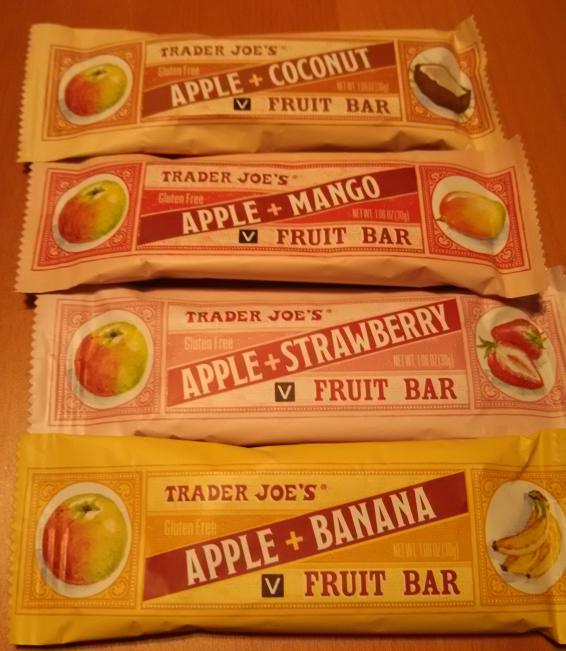
TJ’s, you’re killing me with these generic fruit bar names. C’mon get some adjectives in there!
With the addition of Trader Joe’s Apple and [blank] Fruit Bars, they have added another participant to the already crowded Trader Joe’s fruit bar arena. How, I wondered as I picked these up, could Joe possible justify the existence of a third, no nonsense, “healthy” fruit bar?
There are, in fact, many similarities between these fruit bars and Trader Joe’s other fruit bars. Like its competitors, these bars are 100% fruit, with no additives of any sort. Does that mean we’re just talking about more fruit leather? No indeed sir, it does not! While Trader Joe’s other fruit bars all hopped on the fruit leather boat, these Gluten Free Raw Vegan Fruit Bars are another thing entirely.
Open up a pack and take a look. For starters, you’ll notice that they’re not all that flat. Each bar is a good half inch or more thick, with the heft and body of a candy bar. As you pick it up, you’ll notice that they’re not all that sticky either – you can wrap your fingers around any of the varieties without fear of peeling them away to the dreaded sensation of “sticky raisin fingers”.
You’ll notice another big difference as well – unlike TJ’s other fruit bars, these guys look minimally processed. Instead of a uniform fruit paste, each of these bars is visibly full of shredded fruit – be it bits of strawberry, chunks of banana, lumps of mango, or slivers of coconut. That same quality means that each type of bar actually feels very different in the hand. The Apple & Banana is probably most dense and firm, while the Apple & Coconut has a tendency to crumble as you handle it.
Which brings us to the taste. Apple goes into basically every fruit bar ever made because its pulp is simply excellent and binding things together. What that means is that you can expect all of these bars to taste at least a little bit like apple. The question is, how much does it taste like anything else?
Actually, before we even get into that, I’d better mention that these bars are surprisingly unsweet. To be sure, they are definitely sweet as compared to – for instance, dirt. But compared to any of the other TJ fruit bars I’ve reviewed these bars are much more muted. There is none of the light-up-your-tongue zazz you normally expect from these sorts of snacks. In fact, these fruit bars are less sweet even than the fruits they’re made from.
The reason for this, in part, is because of the unsulfured nature of the raw fruit that has gone into the bars. We’ve talked about the sulfuring process
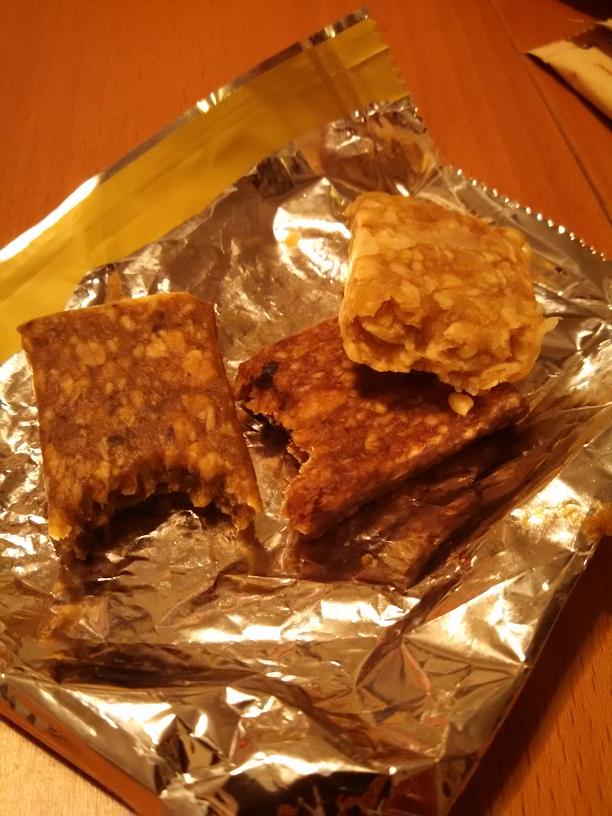
Now those are some meaty fruit bars!
before – and how it preserves the color and taste of fruit once it’s been dried. Without preservatives, and without the chemical changes that occur with exposure to high heat, these bars are essentially just shredded, dried fruit – and as such lose a good deal of their fruit’s original intensity.
Why aren’t the bars exposed to high heat? Because they’re “raw”, of course. The notion of raw food, and the ethos of rawism, is simply too big a topic to tackle in this post. One of the more interesting puzzles of only consuming raw food, however, is deciding at what temperature a raw food should no longer be considered raw. It’s generally agreed that the cut off for vegetables and fruits is between 104 – 120 degrees Fahrenheit (40-49 degrees Celsius). Presumably, these bars abide by that guideline, although there is no official “seal of rawness” yet, so really it’s anyone’s guess.
Which brings us back to the taste – just how good are these raw fruit bars? I’m happy to say that even though they are somewhat unsweet, they’re still quite flavorful. The guest fruit in each bar (banana, coconut, mango or strawberry) really come to the fore in each bite. The sugariness may be gone, but the appealing underlying taste of the fruit is still there, mingling pleasantly with the subtle, mellow apple taste. Essentially, you are getting the taste of the fruit without the sweetness. The Apple and Banana Bar, for example, tastes like a cooked plantain more than a ripened banana. The same applies to the coconut, strawberry and even the mango. You can recognize and appreciate the flavors with the candied sugariness common to many dried fruits.
Are these bars worth your money then? There’s certainly a lot to like about them. They give you a convenient way to keep your blood sugar up, a way to stay committed to your raw food diet, and can act as a substitute candy bar for dieters in need of a cheat. Then again, a regular piece of fruit does all of that just as well – and the fruit tastes better.
Really, it comes down to if you like everything about fruit except the sweetness, or if you’ve been questing for a fruit bar that won’t make your fingers sticky. If either of those qualities defines you, then you’ll want to pick up these bars. For everyone else, I’d suggest giving one a try, if for no other reason than the novel experience.
The Breakdown
Would I Recommend Them: Sure, if you need a healthier alternative to a Snickers.
Would I Buy Them Again: I’d buy these before any of the other Trader Joe’s Fruit bars, just because they’re less sticky.
Final Synopsis: A hefty fruit bar that isn’t all that sweet.
Trader Joe’s Harvest Salad with Grilled Chicken
Posted: May 27, 2014 Filed under: Chicken, Meat, Salad, Trader Joe's Brand | Tags: 3 stars, garden salad, harvest salad, Salad, trader joe's salad 4 Comments
See, there’s some chicken right there in the far back corner.
All salads are chock full of vegetables by definition – but Trader Joe’s Harvest Salad really hammers that notion home in a robust new way with this aggressively vegetable laden cud fest. And I mean that in the nicest way possible.
I love a salad that takes the salad formula in strange new directions, like the Artichoke and Hearts of Palm Salad, but I also have a great deal of respect for the classic salad formula pulled off right. Trader Joe’s Harvest Salad with Grilled Chicken is one variation of that classic salad formula, huge hearty salad where the sheer robust presence of veggies completely eclipses the meat. It’s the perfect palette cleansing salad – a return to the roots of what a salad is meant to be: huge mouthfuls of hearty, filling veggies served on a thick bed of lettuce. Which isn’t to say the salad is so straight laced that it doesn’t dabble in absurdity. Case in point, the huge, uncut green beans laid out front and center on top of the whole shebang. “Are we really supposed to eat these?” and “Why did Trader Joe’s do this?” are a couple of the reasonable questions you’ll immediate ask yourself. It’s not like Trader Joe’s doesn’t have sliced green beans. We know you have those, Joe. No, these green beans are here on purpose, to convey a message – and that message is that you’re going to need a knife just to eat the vegetables in this salad. It’s boldness and simplicity intertwined – a masterful representation of Trader Joe’s high salad artistry.
The “eat your veggies” message is further hammered home by the choice of a creamy dijon dressing. Dijon? Certainly. Creamy? Not so much. It’s a fairly loose dressing actually, more like a vinaigrette than a heavy sauce and, more importantly, the acerbic dijon works like a vinaigrette, accenting and highlighting the chewy greenery instead of obscuring their flavor under thick, overpowering emollients.
To be sure, there are non-vegetable elements in this salad, the titular chicken, along with some cubes of white cheddar cheese and half a boiled egg, and it’s these touches that make the salad work. Vegetables for vegetables sake can quickly become boring – but the charbroiled taste of the chicken meat and thick cubes of cheese break up the homogeneity with sudden bursts of fatty flavor.
In all in all, it’s very well done – but that’s not to say it’s a must buy. Trader Joe’s put this salad together with one point in mind, to remind you about vegetables. If you’ve forgotten about vegetables, you’re sure as hell going to remember them as you sit idly chewing on a big mouthful of corn kernels and green beans, really tasting those flavors at their most basic. And while that’s an important message, it has its time and place. If you remember vegetables quite well already and enjoy them frequently in your day to day life, you might appreciate one of Trader Joe’s more subtle or unusual salad over this bruiser. If, on the other hand, you need a palette cleanser, a vegetable side dish, or simply want to wipe the slate clean after a long sojourn among fast food, you couldn’t do better. As daily meal in itself, however, you might find that this salad tends to side a little too closely with the roughage.
The Breakdown
Would I Recommend It: Yes, this is a fundamentally good salad.
Would I Buy It Again: Yes, the next time a need a simple, serviceable side salad.
Final Synopsis: A hearty garden salad that highlights the vegetables.
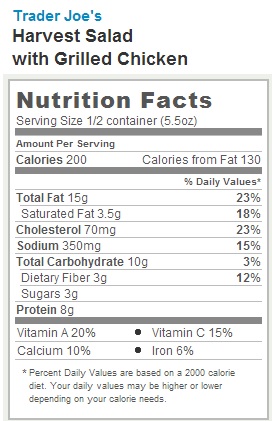
Trader Joe’s Harvest Salad with Grilled Chicken – Nutrition Facts
Trader Joe’s Chickenless Crispy Tenders
Posted: May 22, 2014 Filed under: Chicken, Frozen Food, Gluten Free, Meat, Trader Joe's Brand, Vegan, Vegetarian | Tags: 3 stars, chicken fingers, chicken tenders, frozen food, soybeans, vegan food, vegetarian food 3 Comments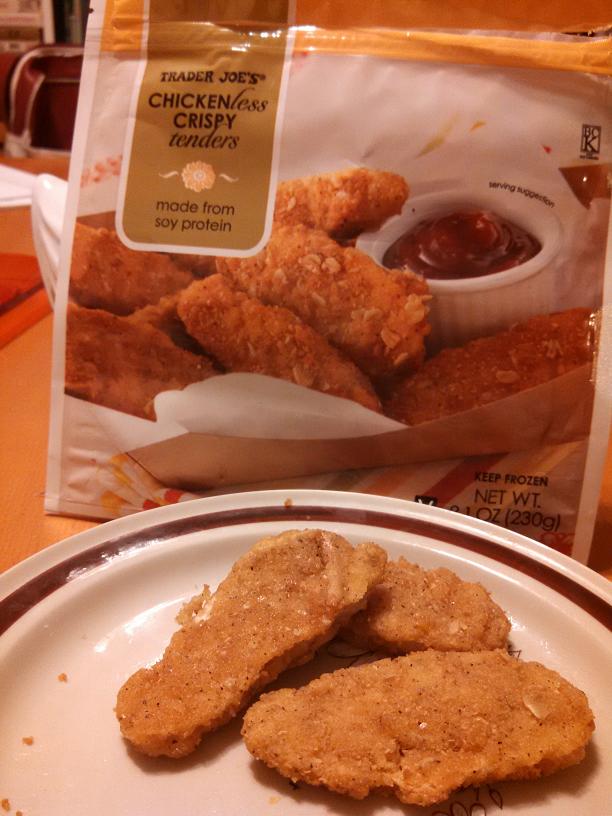
I wanted to include more of the tenders in this pic, but I accidentally ate a bunch of them.
I’ve got to hand it to Trader Joe’s Chickenless Crispy Tenders – they’re some of the best fake meat I’ve had to date. I’ve commented before on the common pitfalls of vegetarian cuisine attempting to ape meat instead of just doing its own thing. Usually this ends in a painfully tortured product name that attempts to acknowledge that it’s totally vegetarian but tastes just like meat, wink wink. (cf. Tofurkey). Generally this is an outrageous lie, or, more generously, extremely wishful thinking by a meat-starved demographic.
I’ve already expounded on my metaphysical sympathy for vegetarians. I can support the cause – I advocate the idea of abstaining from meat, and would do so myself if only my intensely bon vivant lifestyle would allow for it. Nevertheless, like the soy creamy ice cream substitute before it, I bought some crispy chickenless teneder because I needed a non-meat alternative for my (one) vegan friend. As fate would have it, I accidentally forgot to cook them in time for the meal, she ended up having nothing, and I was left with these chickenless tenders until tonight, when continued poor planning left me with nothing else in the house to eat.
Fortunately, Trader Joe’s Chickenless Tenders are not just edible, but downright tasty. They actually taste more or less like chicken tenders. How close? Close enough you could probably fool an unwary guest if you served them up without fanfare. There is still that tell-tale aftertaste of “soy-ness” that hangs around, but it’s pretty mild and is more or less totally cloaked by whatever dipping sauces or dressings you’re going to be ingesting the chicken tenders with. The only strange part is that the strips have been “breaded” in a variety of oats and flours that result in a crumbly, quasi breading that’s generally inferior to ordinary breading. The reason for this substitution, I cannot quite fathom.
TJ’s has managed to capture not just the taste, but also the texture of breaded chicken strips. The tenders are precisely that, coming out of the oven tender, moist, and just toothsome enough to give you a nice balance between chewy and yielding. They even pull apart more or less like real chicken, which is a difficult feat to accomplish when your medium is soy protein isolate.
How did TJ’s manage such a thing? I have no idea, but apparently it involves a large number of strange sounding, if allegedly natural, ingredients.
Water, soy protein isolate, and canola oil make up the first three ingredients, naturally enough. It might seem unusual that oil is ingredient #3, but remember that these are oven-baked “chicken” fingers we’re talking about. Like fish and or shrimp nuggets, when you take them out of the oven you’re going to be picking them up out of a little pool of their own oil.
After these three ingredients things get a little crazy. Pea protein pops up in a prominent position. Are peas known for their protein? Is it possible to tell someone, out loud, that your food has a lot of pea protein in it and not make it sound like an unspeakable form of bio-waste recycling? Not as far as I’m concerned.
After that we get into the ancient grain flours – including quinoa (natch), millet, and everyone’s favorite, amaranth. Rounding all that out is a good helping of Kamut®. “What the hell is Kamut®, and why is it trademarked?” is the very reasonable question you might be asking yourself right now. We’ll have to save that can of worms for another day, but the short answer is it’s a proprietary form of ancient wheat known as Khorasan wheat, originally from round about Afghanistan and nowadays lorded over by two Montana farmers. Also there’s beet root fiber in the tenders.
Somehow, in the end, all of this comes together to make strangely delicious vegan chicken tenders, with only thrice the fat of regular chicken tenders. For me it’s less important how it all works out, then the fact that it does. They might not replace regular, flesh and blood chicken in my life, but it’s good to know there’s a good back up option should it ever come to it.
The Breakdown
Would I Recommend It: I would, if you’re a vegan/vegetarian.
Would I Buy It Again: This seems like a good fit for Meatless Monday.
Final Synopsis: Eerily good vegan chicken tenders.
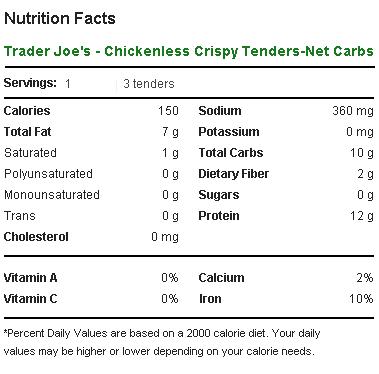
Trader Joe’s Chickenless Crispy Tenders – Nutrtion Facts
Trader Joe’s Freeze Dried Fuji Apple Slices – Unsweetned & Unsulfured
Posted: May 20, 2014 Filed under: Apple, Fruit, Trader Joe's Brand | Tags: 3 stars, dried apples, Dried Fruit, freeze dried fruit, fuji apples Leave a comment
Even better than the look on the package.
It’s time again to turn our attention to Trader Joe’s freeze dried produce section – with Trader Joe’s Freeze Dried Fuji Apples. We’ve seen considerable range in Trader Joe’s dessicated produce, from freeze dried grapes to dehydrated kimchi to vacuum fried banana chips. It would appear that Trader Joe’s has never met a piece of produce they didn’t want to turn into a dry, crunchy snack.
These apple slices appealed to me immediately because they entomb, for perpituity, my favorite apple, the glorious Fuji. So much better than mundane Red Delicious or unexceptional Gala, the Fuji is invariably dense, sweet and crisp – a thoroughly delicious apple that satisfies to the final bite. I can still remember my first bewitching bite of a Fuji apple to this day, as sweet as an illicit kiss on a rainy summer afternoon.
Fuji apples are, as you might imagine, quintessentially Japanese – originating in the far northern province of Aomori back in the 1960’s and taking the world by storm. The secret the Fuji hides, however, is that it is actually the result of cross-breeding two American apples – the ubiquitous Red Delicious and the lesser known Virginia Ralls Genet. These two strains were first genetically collided at an agricultural research center in the town of Fujisaki in the 1930’s. The apple subsequently took the name of the town as its own and never looked back. Whether out of a sense of national pride or, more probably, simple good taste, the Japanese have embraced the Fuji apple on a massive scale. 900,000 tons of the apples tumble out of northern Japan into grocery stores across the country every year, utterly eclipsing the sales of all other apple cultivars. Here in the states, the Fuji has yet to catch on so dramatically. It ranks fourth in popularity, behind the Red Delicious, Golden Delicious and, shockingly, the Gala. Wake up America – there are better apples out there!
The same qualities that the Japanese and myself admire in the Fuji apple – the sweetness and crispness – are the same qualities that make it such a good candidate for freeze drying. Like most fruits, the apple is nearly all water. The act of sucking the water out (or in this case, flash sublimating) is tremendously violent the apple itself, and hard to do without turning your apple slices into something squat and unrecognizable. The firm, crisp quality of the Fuji apple helps retain the shape of the slices, and it’s sweetness means that the apple’s whole, crisp and sweet taste is better preserved than it might be in lesser fruits. This is all the more impressive considering that these apple slices are unsweetened and unsulfured. These steps are usually taken to keep the dehydrated fruit looking and tasting something more or less like they do on the branch. The Fujis are simply so good that neither additive is necessary in the first place.
Trader Joe’s Freeze Dried Fuji Apples are entirely delicious. Each slice is perfectly preserved in miniature, and bursts with sweet apple flavor as soon as you snap into its dry, airy form. While the taste is there, I’m left wondering how exactly one is meant best to enjoy them. They can be casually snacked on, like chips, but the 1.2 ounces of apple in the bag doesn’t last very long, even if the $2.99 price tag does justify the purchase. Trader Joe’s suggests tossing them on a salad or putting them in a trail mix, both of which seem reasonable within limits. The apples very sweet and might easily replace dried cranberries, although at a much higher price per ounce. Trail mix certainly couldn’t be a more natural fit – and I’ll consider including adding it in the next three or four times this decade that I have a reason to make trail mix.
Trader Joe’s final suggestion, to throw them on your cereal or oatmeal seems like the best idea, and probably the easiest way to incorporate these tasty little guys into you life. If for no other reason, pick a bag of these up to experience the Fuji apple in a whole new way.
The Breakdown
Would I Recommend It: Sure, if you can think of a way to eat them.
Would I Buy Them Again: I don’t buy a lot of dried fruit, but I’d probably get these guys again anyway.
Final Synopsis: A fresh new way to eat delicious Fuji apples.

Trader Joe’s Freeze Dried Fuji Apple Slices – Nutrition Facts
Trader Joe’s Watermelon Cucumber Cooler
Posted: May 13, 2014 Filed under: Cucumber, Drinks, Juice, Watermelon | Tags: 3 stars, cucumber water, Juice, watermelon 8 Comments
Ah, luminous pink – the color of summertime refreshment!
Trader Joe’s Watermelon Cucumber Cooler is one of those surprising products that doesn’t quite seem to fit at Trader Joe’s. Do-it-yourself fusion sushi? Sure. Popcorn seasoned with brown butter and french herbs? Why not. But a watermelon cooler? A summery, watermelon drink called a “cooler”. That seems oddly plebeian on the shelves next to Trader Joe’s French Market Sparkling French Berry Lemonade, and Trader Joe’s Italian Blood Orange Soda.
As much as I like Trader Joe’s, my blue collar roots sometimes rebel at the rather fancy image Joe likes to cultivate for himself. It’s a bit of a relief to see them throw the word “cooler” around on a relaxed summer drink – much in the tradition of Cactus Cooler and HI-C’s long mourned Ecto-Cooler. That may sound like I’m trying to damning this product with faint praise, but I mean it genuinely. Whether it’s pink lemonade or cherry coke, summer is the time for unnatural sugary drinks to bring out the kid in us. It’s the time for pretensions to fall to the way side and kick back with a nickle glass of Kool-aid and a slice of watermelon.
It’s in that very spirit that Trader Joe’s has given us this Watermelon Cucumber Cooler – a jug of refreshing, sweet and tasty juice flavored beverage. There’s not much to dislike with this beverage. What you see is what you get. Pour yourself a cool cup and you’ll taste exactly what it promises on the side, a sugar-sweetened, watermelon-flavored drink with the cool aftertaste of cucumbers.
I’m actually a fan of cucumbers in water. There’s something about the long, mellow aftertaste of a chilled cucumber that seems to slake the thirst as much as the water itself. The unsweetened cucucumber presence in this drink makes for an elegant grace note to what could have easily been one more too-sugary fruit drink. The Watermelon Cucumber Cooler strikes a balance closer to the unsweetened end of the drink spectrum than the overly sweet end. That makes it a rare participant in the summer drink wars – a beverage that satisfies the sweet tooth, quenches the thirst, refreshes with cucumber, and goes easy on the sugar.
Pairing watermelon off with cucumber in the first place might seem like a random choice – but not so random as it sounds. Both watermelon and cucumber are close cousins in the plant kindgom, siblings of the Family Cucurbitaceae, known generically, along with gourds and such, as curbits. This familial association makes for a fine flavor pairing, with the strong watermelon flavor blending seamlessly into the more understated cucumber, leaving you uncertain as to where the one taste ends and the other begins. Shine on you crazy curbits!
Sure, there’s still 23 grams of sugar per glass, but at least it’s from organic sugar and watermelon juice and not high fructose corn syrup. It’s not a health drink by any stretch of the imagination, just a fresh and refreshing take on the summer drink scene. If you’re not on the bad wagon with cucumber water to begin with, there may not be much here for you. If, on the other hand, you like cucumber water or have simply never tried it, I’d recommend this drink to quench your summer thirst.
The Breakdown
Would I Recommend It: Yes – as long as you’re okay with the flavor of cucumbers.
Would I Buy It Again: I’ll pick one up the next time I head down to the beach.
Final Synopsis: A refreshing, sweet-but-not-too-sweet summertime libation.

Trader Joe’s Watermelon Cucumber Cooler – Nutrition Facts
Trader Joe’s Vegetable Masala Burger
Posted: April 17, 2014 Filed under: Burgers, Carrots, Frozen Food, Pepper, Potato, Trader Joe's Brand, Vegetarian | Tags: 3 stars, indian food, indian veggie burger, vegetable burger, veggie burger 8 Comments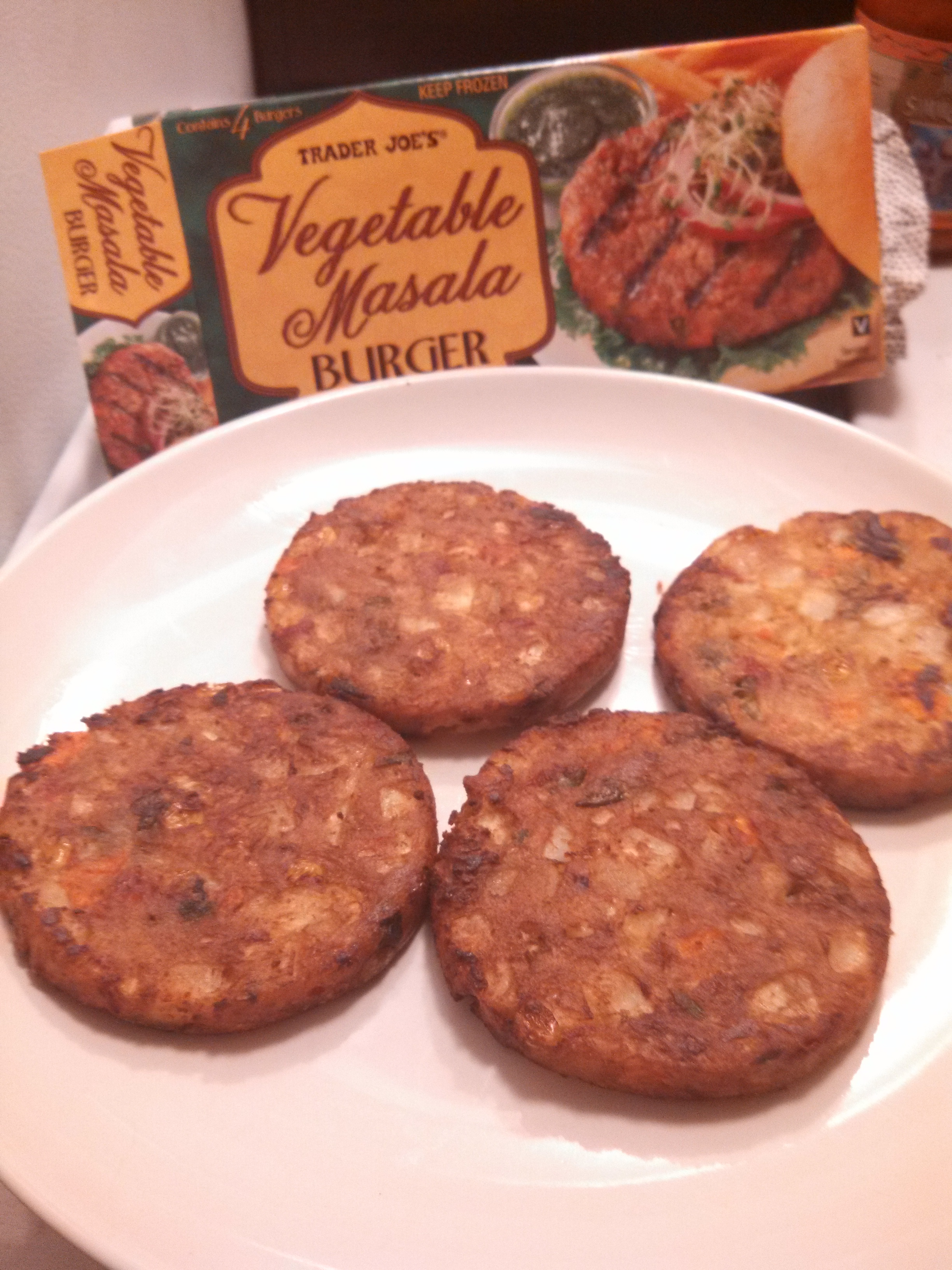
Burgers?
Making due on an overdue promise I made when reviewing TJ’s excellent Pizza Veggie Burgers, today I decided to try out Trader Joe’s Vegetable Masala Burger. What I got was a tasty bit of Indian cooking in a strange new form.
These two burgers, pizza and masala, are closely linked despite their completely different tastes. Obvisously they are both veggies burgers, but more than that they are veggies burgers that refuse to conform to the standard veggie burger model. Like Trader Joe’s Pizza Veggie Burger before it, the Vegetable Masala Burger has dared to ask the question, what if a veggie burger didn’t try to taste like a hamburger at all? It’s an ingenious solution that sidesteps the pitfall of trying to ape in greens what meat already is. You’re never going to out burger a burger with condensed tofu, the only way to win is to not play the game in the first place.
This is the highest form of vegetarianism, the food item that’s not a “meatless” version of something else, not a substitute or alternative to the mainstream, but a unique and delicious meal in its own right. You’re not giving something up to eat this burger, you’re getting something new.
Before we get into what I think was strange about the burger, I’d better give you a run down of how it tastes. Masala simply means “a mixture of spices” and the term is used throughout south east Asia. The masala Trader Joe’s uses here is mysteriously only described as “spices” on the ingredient label, but from the taste of it all the usual suspects are here. Tumeric, cardamom and cumin all mingle with the hearty mixture of veggies, which very visibly includes potatoes, carrots, green beans and bell peppers. The resultant patty is dense, and redolent of spices when lightly toasted on the stove. It both looks and tastes like a hearty vegetable soup without the soup. In particular, the veggies are all soft and toothsome, a pleasure to eat even if the patty tends to disintegrate too easily while you eat it. As for the spices, they’re strong enough that they give the burger a warm and authentic flavor, but mild enough that you might consider dressing them up with a condiment – be it ketchup or chutney. Another selling point, and relief to veterans of the veggie burger world, the masala burgers don’t include soy of any kind, relying instead on breadcrumbs to bind the veggie mix together.
What’s strange to me is that they market these as burgers at all. Where Trader Joe’s pizza burger tried to at least give you the semblance and feel of a burger, the masala burger goes complete off the beaten path. From taste to texture, there’s nothing particularly “burger-y” about these burgers beyond the fact that they’re puck shaped. It’s even stranger when you regard the huge bits of potato and other vegetables roughly shouldering each other right up there at the surface. The veggie pizza burger sort of managed to look like a burger from a distance. With such large and vulgar vegetable chunks, these masala burgers wouldn’t fool a near-sighted sloth.
It almost seems unnatural that Trader Joe’s has forced the vegetables into this shape at all. The way the whole thing comes apart as soon as you stick a fork in them makes you wonder exactly who we’re fooling by going through the trouble of corralling them into a burger shape in the first place. They might more accurately be called Trader Joe’s Cooked Indian Veggies That We Packed Into A Cylindrical Shape, although I suspect that may not have gotten past the Marketing department. Trader Joe’s may have hung onto the name, but make no mistake – these burgers defy the genre in every other way.
The Breakdown
Would I Recommend Them: Yes, to vegetarians and carnivores alike.
Would I Buy Them Again: Probably not, honestly. I’ll eat burgers for my burgers and enjoy my Indian food on a plate.
Final Synopsis: A genuinely tasty veggie burger that defies the genre.
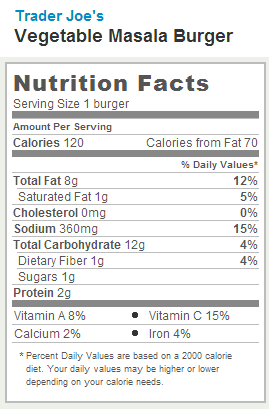
Trader Joe’s Vegetable Masala Burgers – Nutrition Facts
Trader Joe’s Apple And Carrot Fruit Crushers
Posted: September 1, 2011 Filed under: Fruit, Kids, Snacks | Tags: 3 stars, Fruit, Kids, Snack, Trader Joe's 3 Comments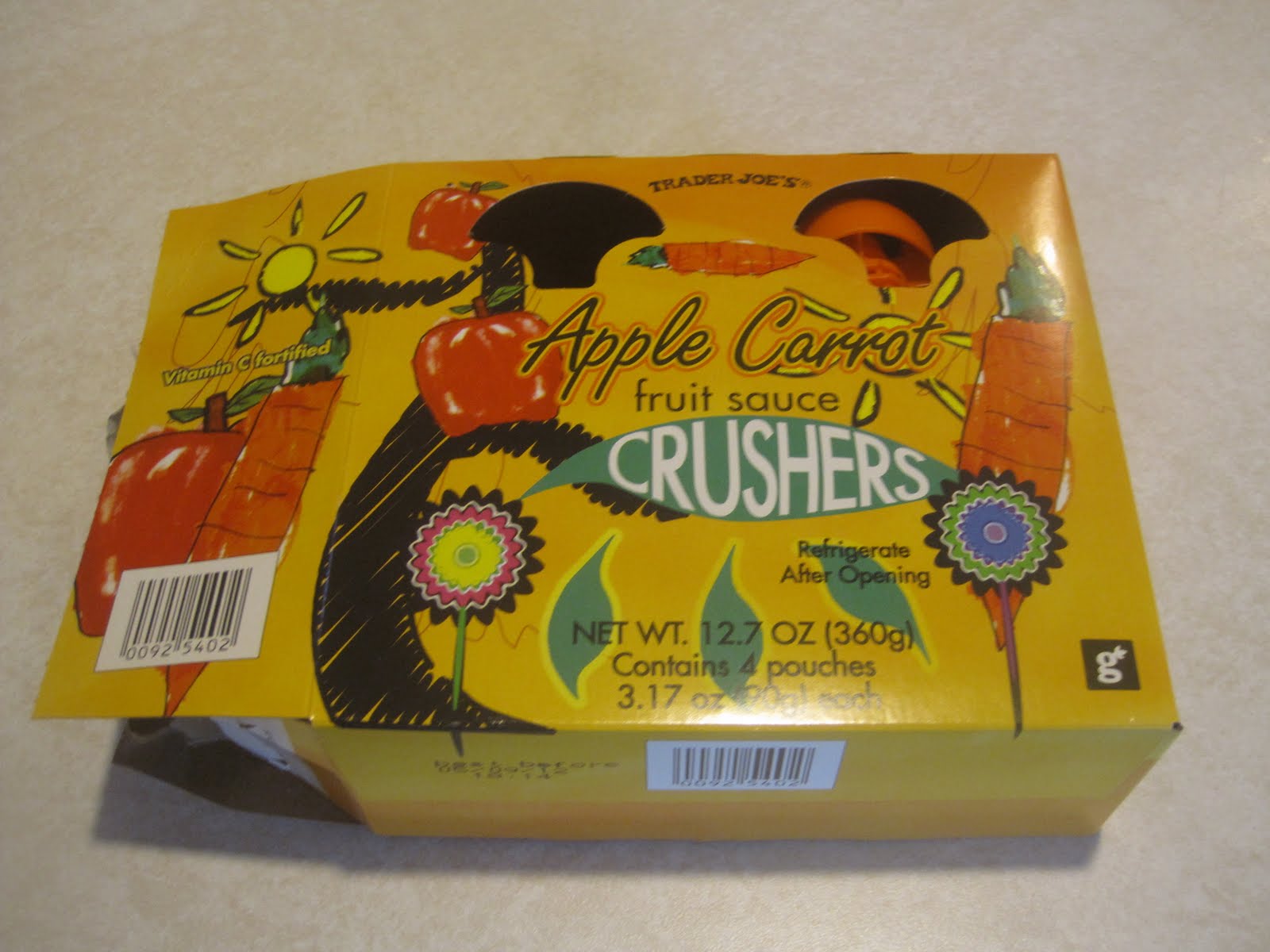
Not pictured – the crushing.
What’s behind the intriguing and slightly extreme name? (“Get yourself a CRUSHER!”, Gen-x advertising copy might read, or perhaps “CRUSH it!”). The answer is, basically just applesauce.
Trader Joe looks like he’s trying to straddle the line between kid’s snack and adult snack with this product. As such, I’ll give my review for each demographic.
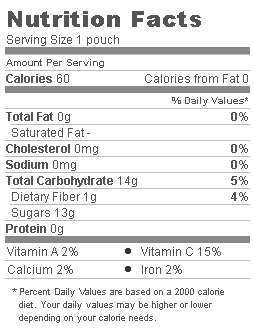
For kids: A good applesauce source. The pouches are engagingly colorful, the carrots in the apple sauce are all but undetectable, and the bags are fun to squish and play with (both in the titular crushing activity and in the fun of having a built in straw to blow and suck on). Also cool, the sleek, over-sized caps are very satisfying to twist off. The self-contained packaging also means not having to worry about where a spoon will come from, or where it will go afterwards. One small downside, the bag design is abstract in the ugly way, not the interesting way. Overall, an easy add to the sack lunch bag.
For adults: Not really happening. The pouch is just small enough that it doesn’t quite qualify as an adult-sized snack – you can basically just slurp the whole thing and not even notice it. The box of four lasted me two days and even then failed to make a lasting impression. The feeding tube combined with the bag’s soft sides means that you’ll suck the thing dry in about two seconds. With a cup of applesauce there’s the possibility of dawdling over dawdling over it during break time; with the fruit crusher there’s not much else to do but slam it and go. Unless you’ve really got your heart set on carroty applesauce, there are better choices for your snacking dollar.
Would I recommend it: If you had a small child.
Would I buy it again: If I had a small child.
Final Synopsis: Fun to play with, but leaves you hungry.
The wee pouch.
 Eating At Joes

Recent Comments